From Real Exams Exam Paper
Secondary 4 History Preliminary Examination Paper 4
Free Sec 4 History Prelim Paper 4, HY3 Exam version, with questions, answers, and O Level-style practice for Singapore students.
These static practice materials are generated from the site's syllabus and paper-generation workflow, with source and model context shown so students and parents can evaluate the material before use.
Questions
Free quiz and exam paper access
Enter your details to view this paper
Your access is remembered on this device.
Answers
TuitionGoWhere Exam Practice (AI) — History Secondary 4 (Answers)
Paper: Prelim Practice Paper (Version 4 of 5)
Total Marks: 80
Topic: Essay Explanation
Section A: Structured Explanation (20 marks)
1. Explain why the Germans hated the Treaty of Versailles. [4]
- Mark breakdown: 1 mark per valid reasoned grievance (max 4).
- Answers should include: (a) War Guilt Clause (Article 231) — Germans felt unfairly blamed; (b) Reparations — economic burden caused hardship; (c) Territorial losses (e.g. Alsace-Lorraine, Polish Corridor) — loss of land and pride; (d) Military restrictions (army 100,000, no air force) — humiliation.
- Teaching note: "Hated" is emotional; explain why each clause provoked resentment, not just what the clause was.
- Common mistake: Listing clauses without linking to German feeling.
2. Explain why the British extended control over Malaya in the 1870s–1920s. [4]
- Marks: 1 each for: (a) Tin and rubber economic interests; (b) Protection of traders from local unrest; (c) Strategic route to China (Singapore base); (d) Indirect rule via Residents to avoid cost.
- Teaching note: Link motive (profit, security) to method (Resident system).
- Common mistake: Saying "they wanted land" without economic detail.
3. Explain why the Nazi Party gained support by 1932. [4]
- Marks: (a) Great Depression — unemployment made extremism attractive; (b) Propaganda/Hitler's speeches; (c) Blame of Treaty of Versailles; (d) Fear of communism among middle class.
- Teaching note: Explain how each factor increased votes.
- Common mistake: Only stating "Hitler was popular" without context.
4. Explain why Japan became militaristic in 1920s–30s. [4]
- Marks: (a) Economic crisis / rice riots; (b) Weak civilian govt; (c) Army influence grew; (d) Need for resources (Manchuria 1931).
- Teaching note: Militarism = army control of policy.
- Common mistake: Confusing militarism with democracy.
5. Explain why League of Nations was weak in 1930s. [4]
- Marks: (a) No US; (b) No army; (c) Unanimity rule slow; (d) Failed in Manchuria/Abyssinia.
- Teaching note: Weakness = inability to enforce decisions.
- Common mistake: Saying "it was new" as only point.
Section B: Source-Based Essay Support (20 marks)
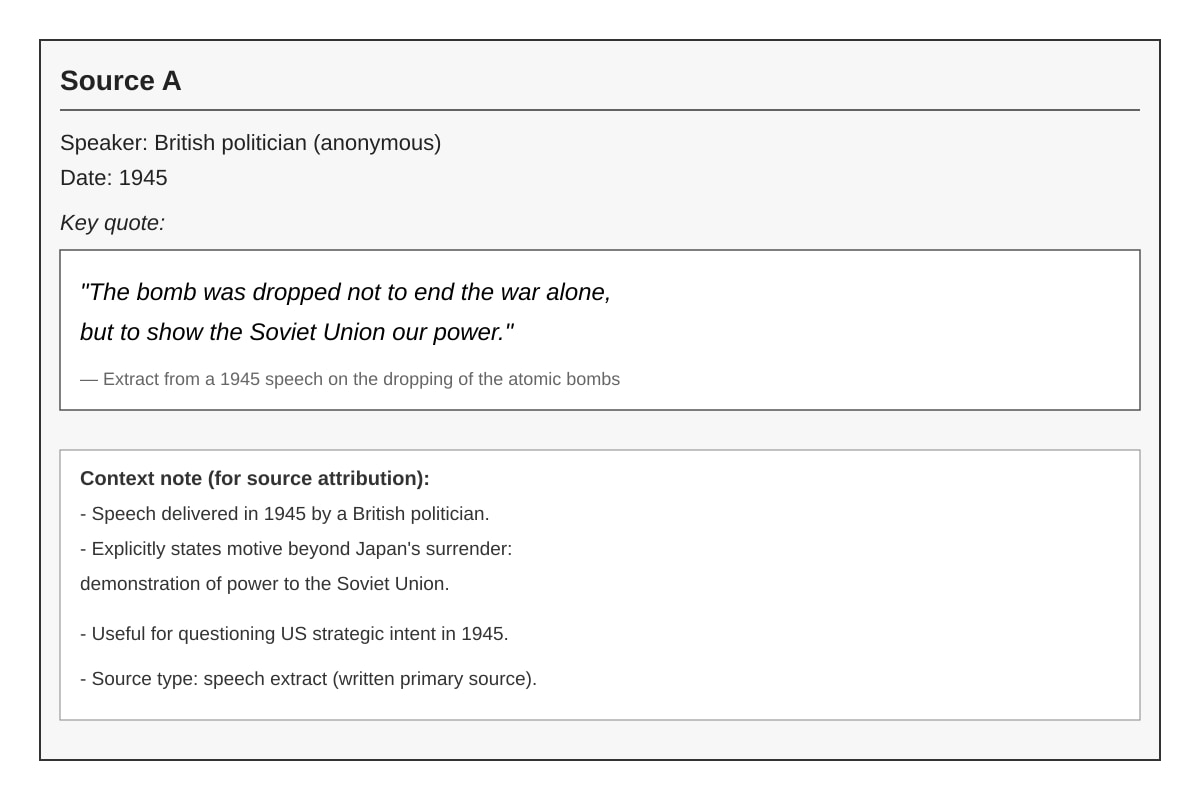
6. Source A use to support view. [4]
- 2 marks: Identifies quote shows bomb = warning to USSR.
- 2 marks: Explains this supports "mainly to warn" not just end war.
- Answer: Source A says bomb was dropped "to show the Soviet Union our power" — directly states motive beyond Japan. Student can cite this as evidence US aimed to intimidate USSR.
- Teaching note: Use source content as proof in essay.
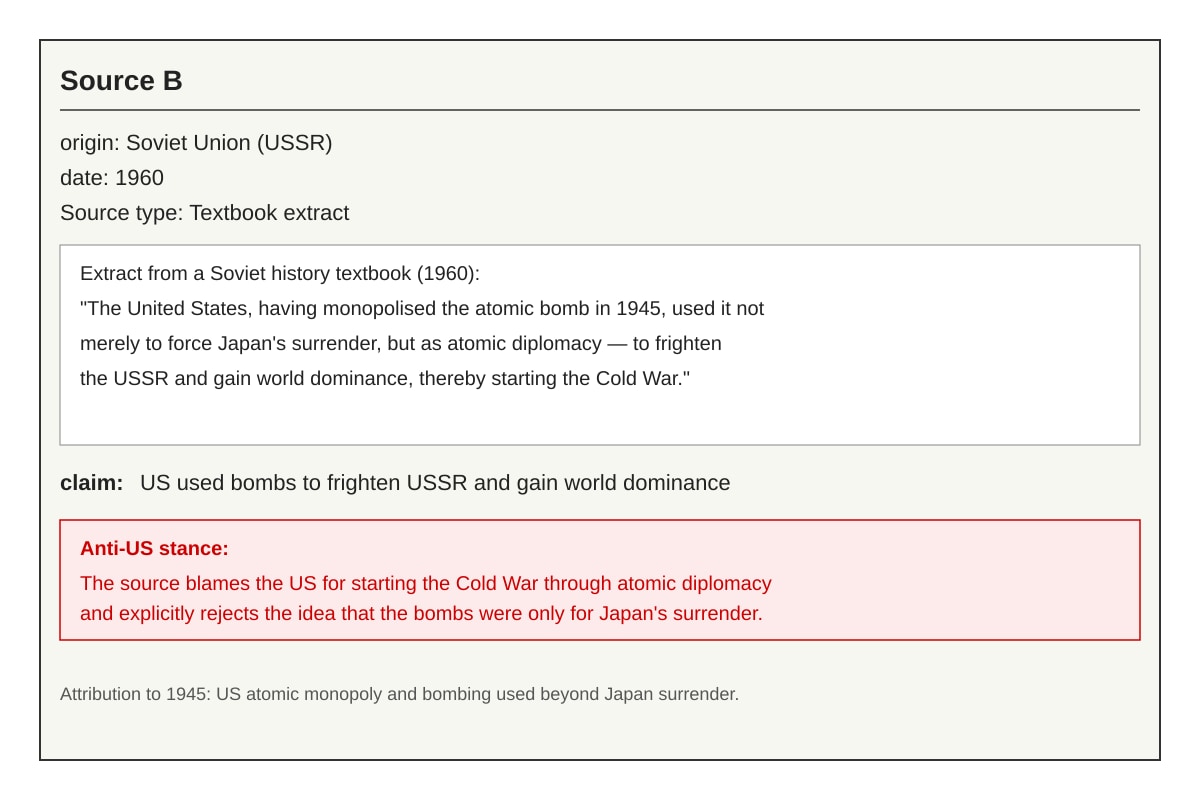
7. Source B usefulness. [4]
- 2 marks: Identifies origin (Soviet textbook 1960) and bias.
- 2 marks: Says useful for Soviet view but limited as one-sided.
- Answer: Useful to show USSR blamed US for Cold War; but propaganda so not full truth.
- Teaching note: Always check origin + purpose.
8. Sources C and D agree? [4]
- 2 marks: C says Hitler aggressive but West weak; D says Hitler forced war.
- 2 marks: Both name Hitler as cause → partial agreement.
- Answer: Both see Hitler as key cause; C adds Chamberlain's weakness.
- Teaching note: Cross-reference not just summarise.
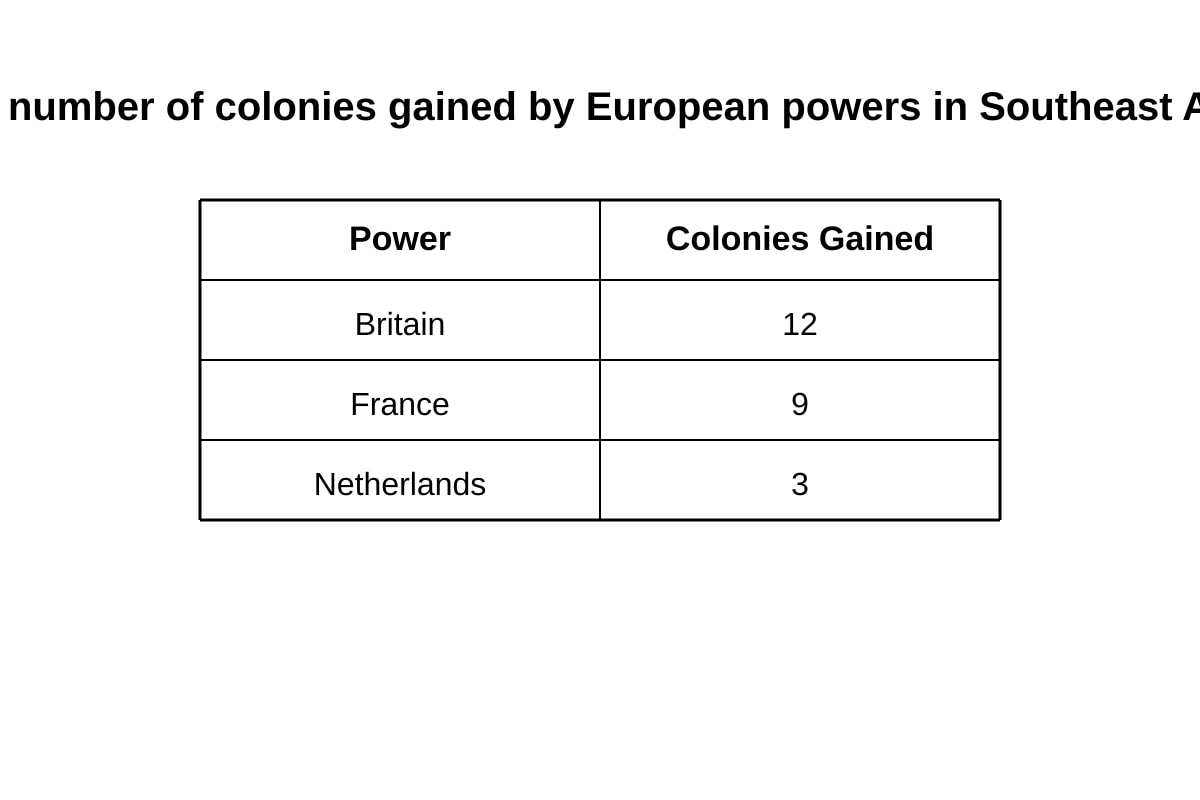
9. Table reason. [4]
- 2 marks: Names economic motive (raw materials, trade).
- 2 marks: Explains competition among powers.
- Answer: Industrial demand for tin/rubber drove expansion; table shows Britain most active.
- Teaching note: Table is evidence, not explanation alone.
10. Why not one source. [4]
- Marks: (a) Bias; (b) Incomplete; (c) Different views; (d) Need cross-check.
- Teaching note: Essays need multiple sources for balance.
Section C: Essay Planning and Argument (20 marks)
11. Two arguments for Treaty caused WWII. [4]
- Arg 1: Humiliation fed Nazi rise.
- Arg 2: Rearmament broke treaty → aggression.
- 2 marks each. Teaching note: Support with evidence.
12. Cause vs consequence. [4]
- Cause: Depression 1929 → Nazi rise.
- Consequence: Nazis = WWII.
- 2+2 marks. Teaching note: Cause = before, consequence = after.
13. Balanced essay Stalin. [4]
- Must include USSR (sphere control) + West (Truman Doctrine).
- 2+2 marks. Teaching note: Balance = both sides.
14. Essay structure Pearl Harbor. [4]
- Intro; Japanese expansion; US embargo; surprise attack; consequence.
- 1 mark per part. Teaching note: Plan = clear line.
15. Different explanations. [4]
- Bias, sources, perspective, interpretation.
- 1 each. Teaching note: History is debated.
Section D: Extended Essay Response (20 marks)
16. Nazis consolidate by 1934. [4]
- Enabling Act; Night of Long Knives; Hindenburg death; propaganda.
- 1 each. Teaching note: Link to legal + force.
17. Appeasement led to WWII. [4]
- Gave Hitler confidence; took Czechoslovakia; broke promise.
- 1 each. Teaching note: Causation chain.
18. Korean War Cold War. [4]
- US+UN vs China/USSR; ideology; no declaration.
- 1 each. Teaching note: Proxy war.
19. Plural society Malaya. [4]
- Migrants (Chinese, Indian); divisions; economic roles.
- 1 each. Teaching note: British policy shaped mix.
20. Atomic bombs debated. [4]
- Saved lives vs USSR warning; ethics; sources differ.
- 1 each. Teaching note: Historians interpret evidence differently.