AI Generated Quiz
Secondary 4 Geography Human Geography Quiz
Free Sec 4 Geography Human Geography quiz, HY3 AI version, with questions, answers, and O Level-style practice for Singapore students.
These static practice materials are generated from the site's syllabus and paper-generation workflow, with source and model context shown so students and parents can evaluate the material before use.
Questions
Free quiz and exam paper access
Enter your details to view this paper
Your access is remembered on this device.
Answers
Secondary 4 Geography Quiz - Human Geography (Answer Key)
Total Marks: 40
Topic: Human Geography
Section A: Short Structured Questions
1. [2 marks]
Push factors: lack of jobs in rural area; poor infrastructure / drought / conflict.
Teaching note: Push factors are conditions that drive people away from origin. Any two valid: unemployment, low income, natural disaster, limited services.
2. [2 marks]
A tourism system is the network connecting tourist-generating regions, destination regions, and transit routes that enables tourism to occur.
Teaching note: Must include generating region, destination, transit route as linked parts.
3. [2 marks]
Creation of employment / increase in foreign exchange earnings / income for local businesses.
Teaching note: One clear economic benefit.
4. [2 marks]
Leakage is the portion of tourism revenue that leaves the host country (e.g., to pay for imported goods or foreign-owned hotels), reducing local benefit.
Teaching note: Define as outflow of money from destination economy.
5. [2 marks]
Park for recreation / heritage site for cultural identity / scenic view for relaxation.
Teaching note: Cultural ecosystem services are non-material benefits from nature.
6. [2 marks]
Commodification of culture / loss of traditions / crowding / cultural clashes.
Teaching note: One negative social impact on locals.
7. [2 marks]
Consolidation.
Teaching note: TALC order: exploration → involvement → development → consolidation → stagnation.
8. [2 marks]
Tourists seeking novel, adventurous, off-beaten-path experiences (e.g., backpackers).
Teaching note: Venturers vs Dependables; Venturers want unique experiences.
9. [2 marks]
Good air connectivity / hub airport / stable business environment / MICE facilities.
Teaching note: Singapore's Changi and business infrastructure.
10. [2 marks]
Use public transport / build green spaces / recycling programmes / mixed land use.
Teaching note: One strategy for sustainable urban neighbourhood.
Section B: Structured Response
11. [3 marks]
(a) [2] Arrivals increased steadily from 4.2M (2016) to 6.1M (2019); rise of 1.9M over 3 years.
(b) [1] Improved transport / marketing / new attractions.
Marking: Trend described with numbers = 2; reason = 1.
12. [3 marks]
(a) [2] Sense of place = emotional bond / meaning people attach to a location based on experience.
(b) [1] Through daily activities / memories / community events.
Marking: Definition 2, example 1.
13. [4 marks]
(a) [1] Systematic / stratified / random sampling.
(b) [2] Environmental quality survey (litter count, noise), questionnaires, photos.
(c) [1] Compare peak vs off-peak impact.
Marking: Each part as shown.
14. [4 marks]
(a) [1] Budget airlines / affordable travel.
(b) [2] Attract more visitors; increase stays and spending.
(c) [1] Airport / flight route / road.
Marking: Extract-based = 1; explain = 2; transit = 1.
15. [4 marks]
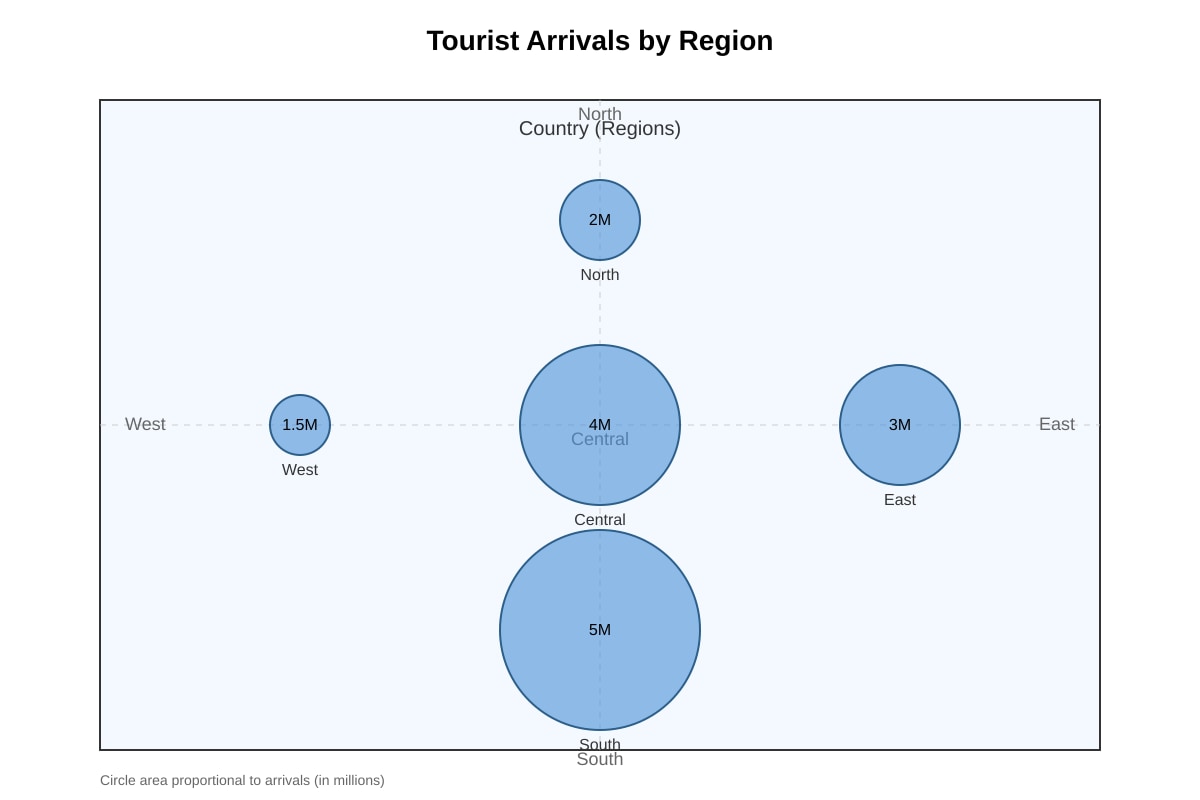
(a) [1] South.
(b) [2] South and Central highest; West lowest; uneven distribution.
(c) [1] More attractions / beaches / accessibility.
Image note: Map shows circle sizes: South largest, West smallest.
16. [4 marks]
(a) [2] Economic, social, environmental (any two).
(b) [2] Reduce heat, absorb rain, biodiversity, recreation.
Marking: Two components = 2; explanation = 2.
Section C: Extended Response
17. [4 marks]
Positive: jobs (hotels), income, infrastructure. Negative: leakage, overdependence, price rise.
Descriptors: 2 positive + 2 negative or balanced with examples = 4. Each point 1 mark.
18. [4 marks]
Exploration (few visitors, untouched) → Involvement (local facilities) → Development (foreign investment, mass) → Consolidation (growth slows, marketed) → Stagnation (capacity reached).
Descriptors: 4 stages correctly described = 4 marks (1 each).
19. [4 marks]
Economic: commercial hubs, jobs. Social: affordable housing, community spaces. Balance: mixed use, MRT access.
Descriptors: 2 economic + 2 social or integrated = 4.
20. [4 marks]
Strategy 1: cultural education for tourists (respect). Strategy 2: zoning to separate locals/tourists. Explain each = 2 marks.
Descriptors: 2 strategies with explanation = 4.