Secondary 4 Geography Quiz - Resources Sustainability
Name: ___________________________
Class: ______________
Date: ______________
Score: _______ / 40
Duration: 60 minutes
Total Marks: 40
Instructions: Answer all 20 questions. Section A and B contain structured questions. Section C contains data-based and extended response questions. Use clear geographical terms and support answers with examples where asked.
Section A: Basic Understanding (Questions 1–5) — 10 marks
1. State what is meant by the term "sustainable development". [2]
2. Give two reasons why food security is a concern for Singapore. [2]
3. Name one type of renewable energy and one type of non-renewable energy. [2]
4. Explain the term "water catchment" in the context of Singapore's water management. [2]
5. State one way in which individuals can reduce household energy consumption. [2]
Section B: Structured Response (Questions 6–15) — 20 marks
6. Study the table below showing Singapore's main food import sources in 2023.
| Source Region | % of Total Food Imports |
|---|
| Malaysia | 28% |
| Indonesia | 19% |
| China | 12% |
| Others | 41% |
With reference to the table, explain why over-reliance on a few source regions is a risk to Singapore's food security. [3]
7. Describe two strategies that Singapore uses to increase its own food production. [4]
8. The figure below shows Singapore's water management strategy known as the "Four National Taps".
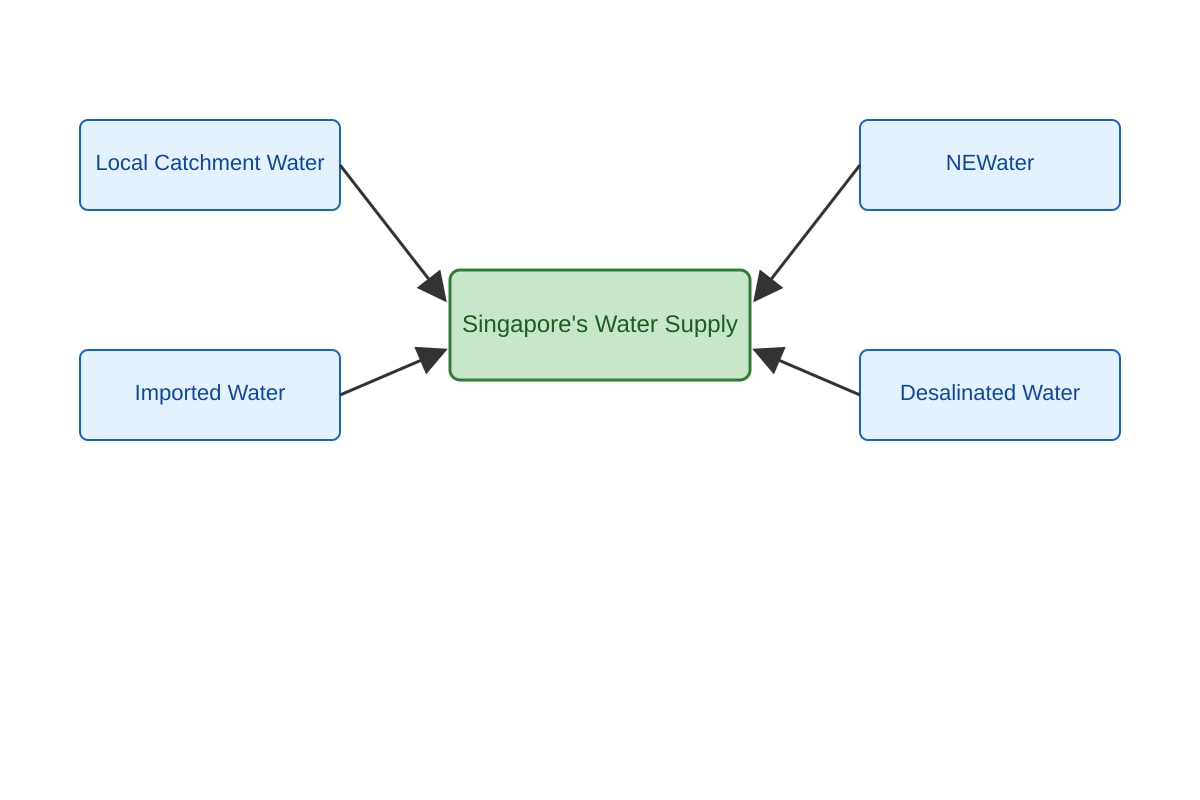
Generated diagram for Q8.
With reference to the diagram, explain how the Four National Taps improve water sustainability in Singapore. [4]
9. State two environmental problems caused by the overuse of fossil fuels. [2]
10. Explain how reducing food waste can contribute to resource sustainability. [3]
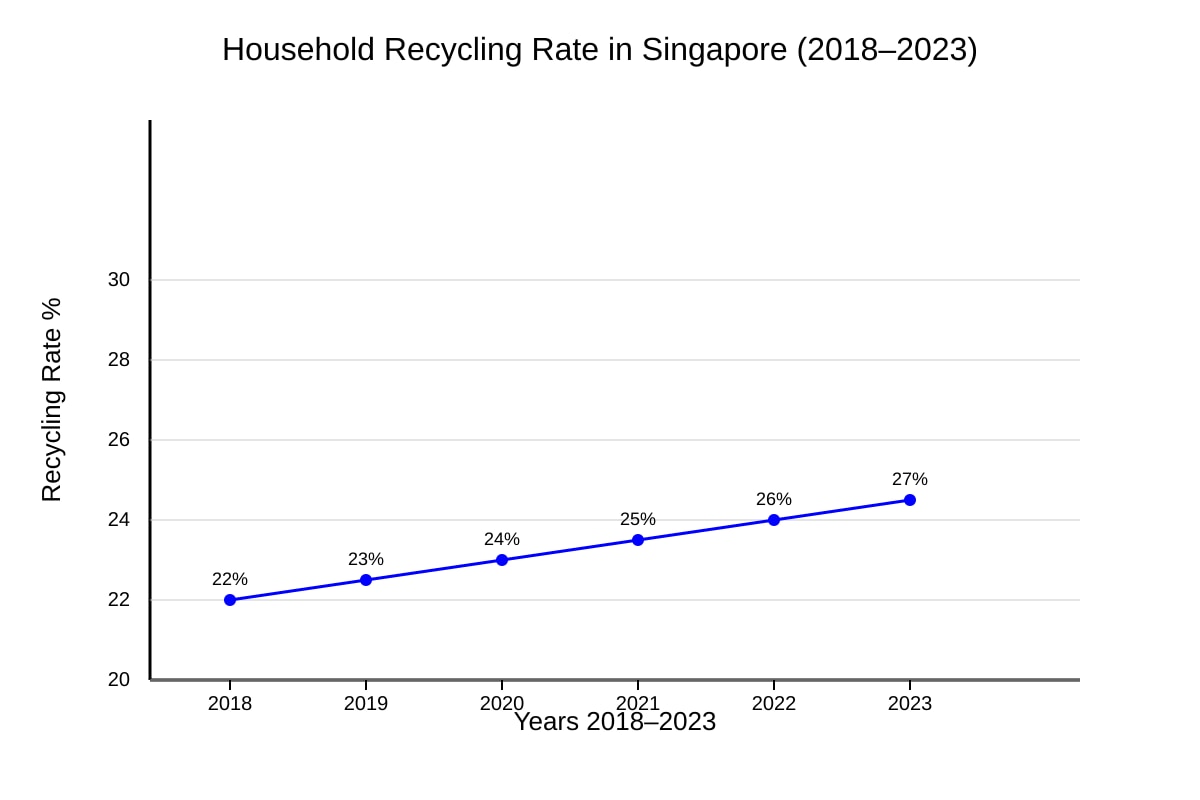
11. Study the graph below showing household recycling rates in Singapore from 2018 to 2023.
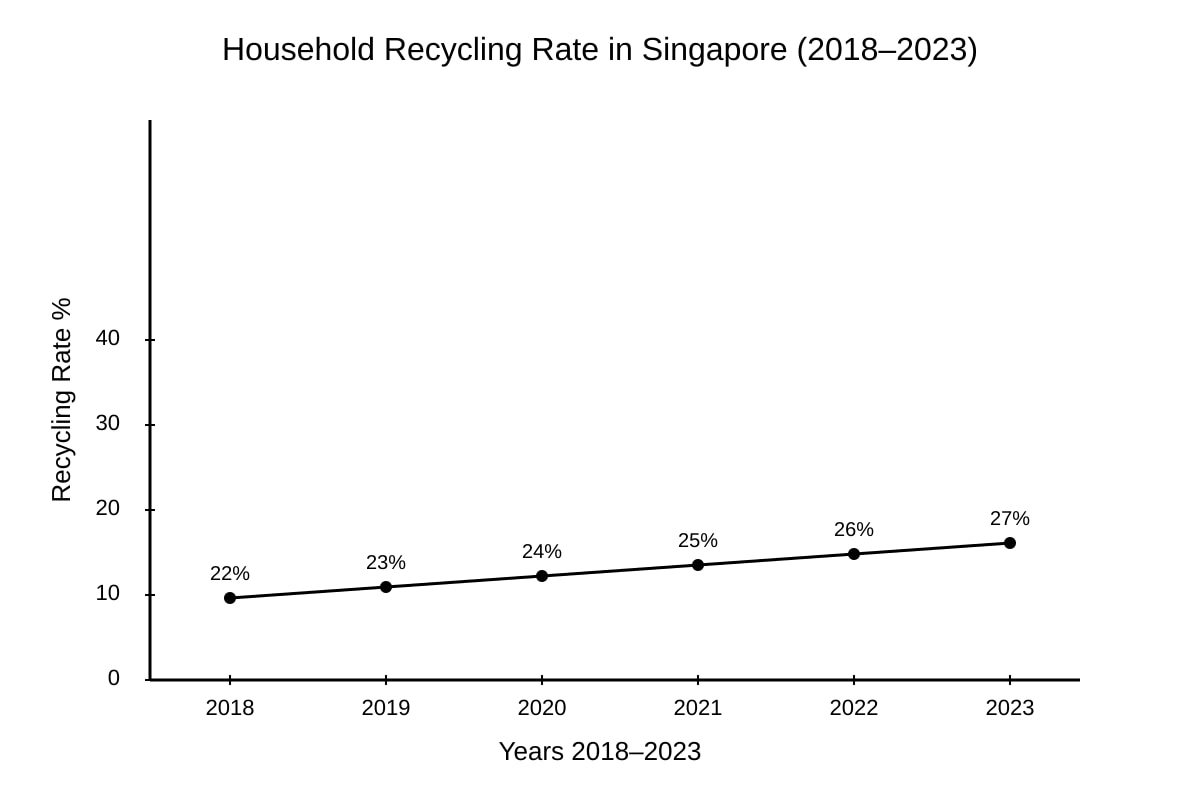
Generated graph for Q11.
Describe the trend shown in the graph. [2]
12. Suggest one reason for the trend described in Question 11. [2]
13. Explain the concept of a "circular economy" and how it supports sustainability. [3]
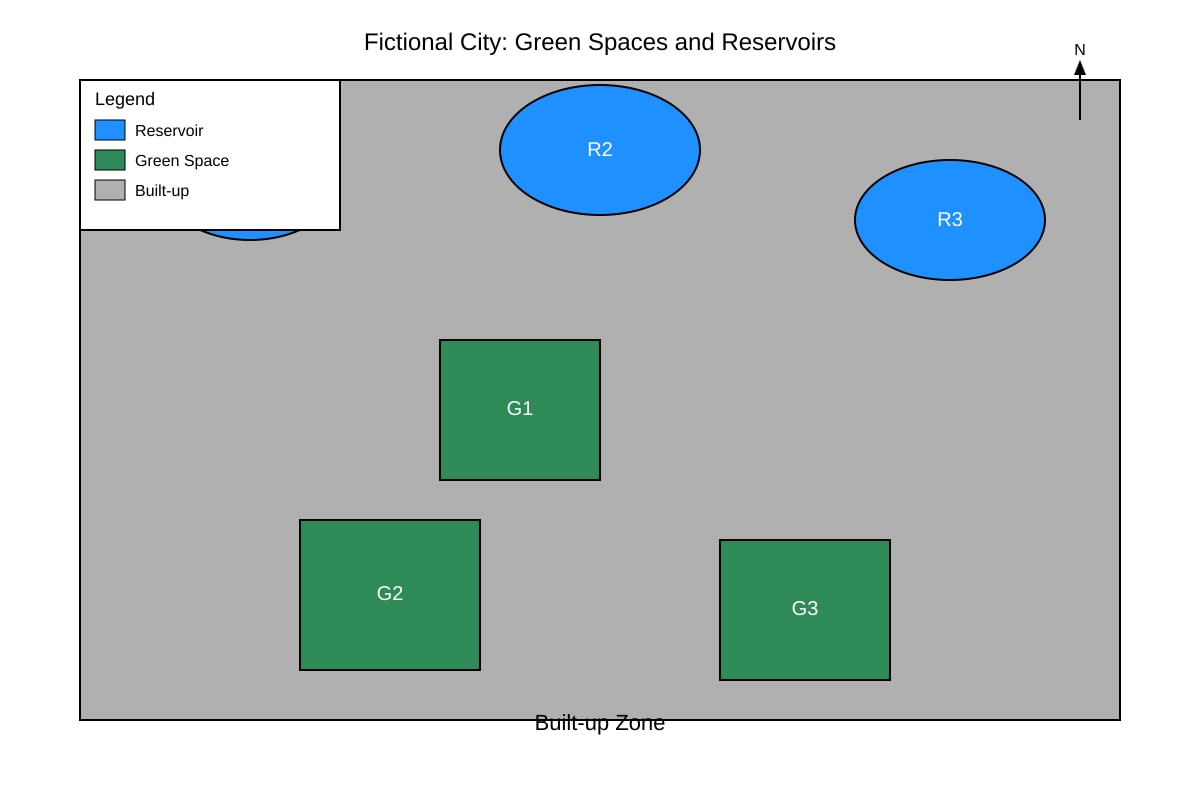
14. Study the map below showing designated green spaces and reservoirs in a fictional city.
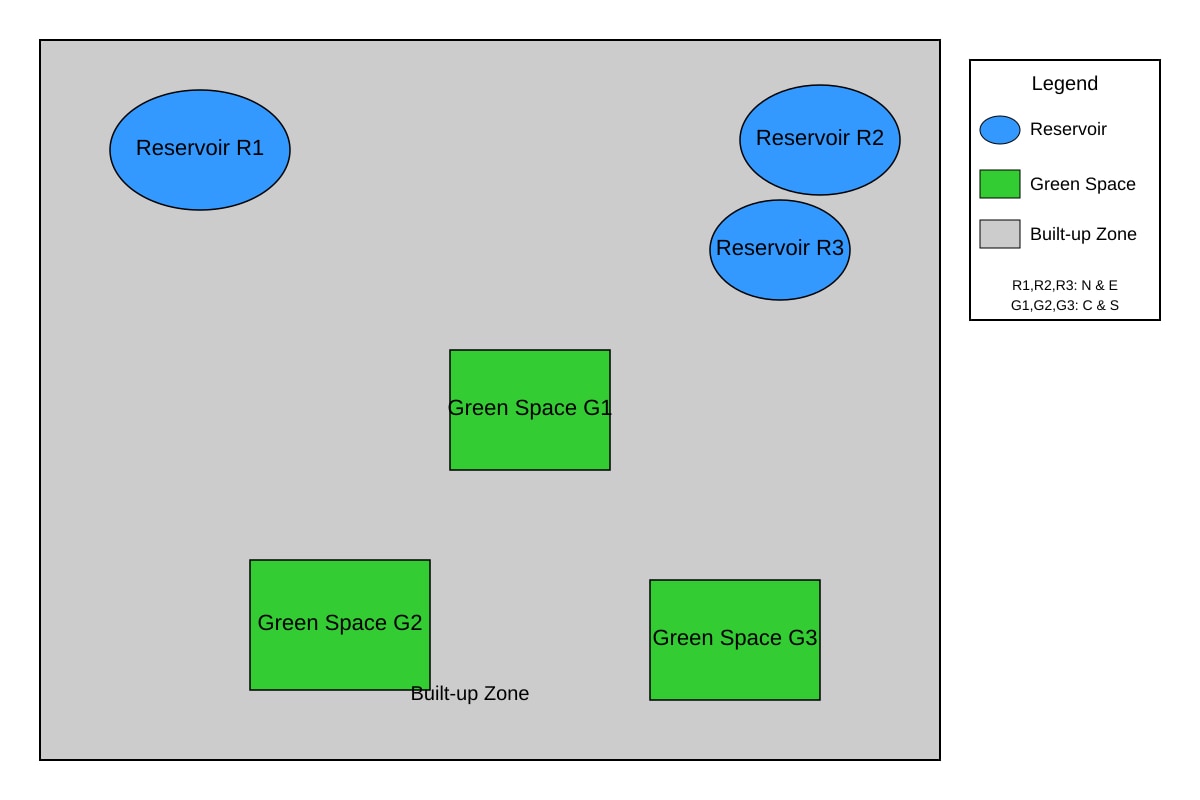
Generated map for Q14.
With reference to the map, explain how protected green spaces and reservoirs can support resource sustainability in the city. [4]
15. Give two advantages of using solar energy in Singapore. [2]
Section C: Data-Based and Extended Response (Questions 16–20) — 10 marks
16. Study the data below on land used for agriculture in Singapore (in hectares).
| Year | Agri Land (ha) |
|---|
| 2015 | 620 |
| 2018 | 720 |
| 2021 | 810 |
| 2023 | 860 |
Plot a line graph of the data on the grid provided. [3]
(Grid not shown; student to draw axes: x = Year, y = Agri Land ha, scale 0–900)
17. Using the graph from Question 16, calculate the percentage increase in agricultural land from 2015 to 2023. Show your working. [2]
18. "Singapore should rely fully on imported food because local production is too costly." Do you agree? Explain your view with reasons. [3]
19. Study the extract below.
Singapore imports over 90% of its food. To reduce dependence, the government aims for 30% of nutritional needs to be locally produced by 2030 ("30 by 30" goal).
With reference to the extract, explain why the "30 by 30" goal improves resource sustainability. [2]
20. Suggest two challenges Singapore may face in achieving the "30 by 30" goal and explain one strategy to overcome each. [3]
</stage3_quiz_answers_md>
Secondary 4 Geography Quiz - Resources Sustainability (Answer Key)
Total Marks: 40
Section A (Q1–5): 10 marks
Section B (Q6–15): 20 marks
Section C (Q16–20): 10 marks
Section A: Basic Understanding
Q1. [2 marks]
Definition: Sustainable development means meeting the needs of the present generation without compromising the ability of future generations to meet their own needs.
Marking: 1 mark for "present needs", 1 mark for "not compromising future".
Teaching note: From Brundtland Report; core geography concept. Do not just say "save the Earth" — must include both present and future.
Q2. [2 marks]
Any two: (1) Limited land area for agriculture; (2) No natural water sources so reliant on imports; (3) Small local production cannot feed population.
Marking: 1 mark each, max 2.
Common mistake: Stating "we are rich" — not a risk, must be specific vulnerability.
Q3. [2 marks]
Renewable: solar/wind/hydro; Non-renewable: coal/oil/natural gas.
Marking: 1 mark each type correct.
Q4. [2 marks]
A water catchment is an area where rain is collected and channelled to reservoirs for storage and treatment. In Singapore, catchments like MacRitchie collect rainwater for drinking.
Marking: 1 mark definition, 1 mark Singapore context.
Q5. [2 marks]
E.g., using LED lights, air-con at 25°C, switching off appliances.
Marking: 1 mark for valid action, 1 mark for household context.
Section B: Structured Response
Q6. [3 marks]
Answer: Over-reliance on Malaysia (28%) and Indonesia (19%) means if exports stop due to conflict or climate shock, supply drops. Concentration increases vulnerability.
Marking: 1 mark identify concentration risk; 1 mark explain disruption; 1 mark link to food security.
Teaching: Use data — 47% from two neighbours.
Q7. [4 marks]
(1) Vertical farming / rooftop farms to use limited land; (2) Research in aquaculture / lab-grown meat.
Marking: 2 marks each strategy with explanation.
Note: Must be Singapore-specific.
Q8. [4 marks]
With ref to diagram: Four sources diversify supply so no single source fails. NEWater and desalination reduce rain dependence. Local catchment uses rain.
Marking: 1 mark diversity; 1 mark NEWater; 1 mark desalination; 1 mark local catchment.
Visual needed: Diagram shows 4 arrows to central box.
Q9. [2 marks]
Any two: air pollution, global warming, oil spills.
Marking: 1 mark each.
Q10. [3 marks]
Less waste = less landfil, less production energy, resources used efficiently.
Marking: 1 mark each point up to 3.
Q11. [2 marks]
Trend: Recycling rate rose slowly from 22% (2018) to 27% (2023).
Marking: 1 mark state increase; 1 mark values.
Q12. [2 marks]
E.g., education campaigns, fines for littering.
Marking: 1 mark reason, 1 mark explain.
Q13. [3 marks]
Circular economy = reuse/repair/ recycle to keep materials in use. Reduces waste and new resource need.
Marking: 1 def, 1 explain, 1 link sustainability.
Q14. [4 marks]
Green spaces absorb rain, cool city, reservoirs store water. Map shows planned distribution.
Marking: 1 mark each: green spaces, reservoirs, map evidence, sustainability link.
Q15. [2 marks]
E.g., clean energy, land-efficient (on roofs).
Marking: 1 mark each.
Section C: Data-Based and Extended Response
Q16. [3 marks]
Graph: x-year, y-ha, plot 4 points, join line.
Marking: 1 axes+scale, 1 points, 1 line.
Q17. [2 marks]
Increase = (860-620)/620 ×100 = 38.7%.
Working: 860-620=240; 240/620=0.387; ×100=38.7%.
Marking: 1 correct method, 1 answer.
Q18. [3 marks]
Disagree: local gives buffer, import risk. Agree: cost. Balanced view needed.
Marking: 1 view, 2 reasons.
Q19. [2 marks]
Local production reduces import reliance, shock resilience.
Marking: 1 mark reduce import, 1 mark resilience.
Q20. [3 marks]
Challenges: land, cost. Strategy: vertical farms, tech R&D.
Marking: 1 challenge1+strategy, 1 challenge2+strategy, 1 explain.
</stage3_quiz_answers_md>
<stage3_quiz_md>
Secondary 4 Geography Quiz - Resources Sustainability
Name: ___________________________
Class: ______________
Date: ______________
Score: _______ / 40
Duration: 60 minutes
Total Marks: 40
Instructions: Answer all 20 questions. Section A and B contain structured questions. Section C contains data-based and extended response questions. Use clear geographical terms and support answers with examples where asked.
Section A: Basic Understanding (Questions 1–5) — 10 marks
1. State what is meant by the term "sustainable development". [2]
2. Give two reasons why food security is a concern for Singapore. [2]
3. Name one type of renewable energy and one type of non-renewable energy. [2]
4. Explain the term "water catchment" in the context of Singapore's water management. [2]
5. State one way in which individuals can reduce household energy consumption. [2]
Section B: Structured Response (Questions 6–15) — 20 marks
6. Study the table below showing Singapore's main food import sources in 2023.
| Source Region | % of Total Food Imports |
|---|
| Malaysia | 28% |
| Indonesia | 19% |
| China | 12% |
| Others | 41% |
With reference to the table, explain why over-reliance on a few source regions is a risk to Singapore's food security. [3]
7. Describe two strategies that Singapore uses to increase its own food production. [4]
8. The figure below shows Singapore's water management strategy known as the "Four National Taps".
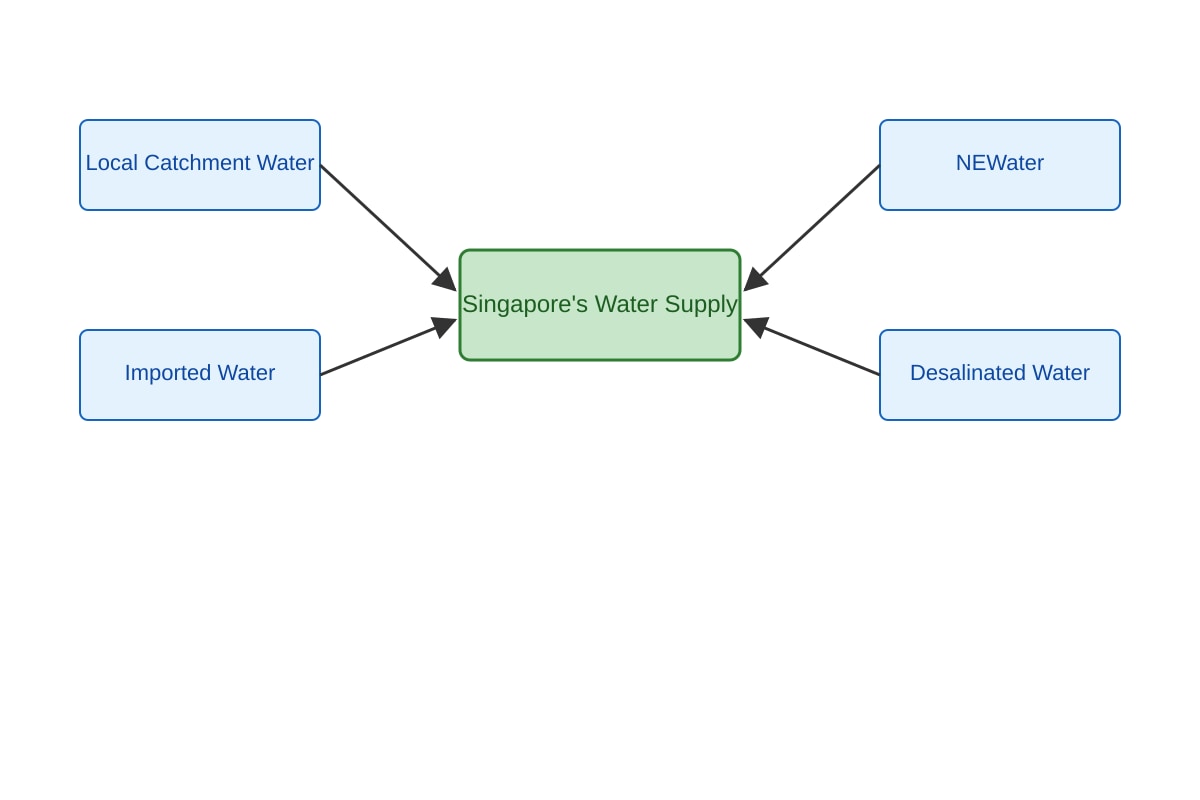
Generated diagram for Q8.
With reference to the diagram, explain how the Four National Taps improve water sustainability in Singapore. [4]
9. State two environmental problems caused by the overuse of fossil fuels. [2]
10. Explain how reducing food waste can contribute to resource sustainability. [3]
11. Study the graph below showing household recycling rates in Singapore from 2018 to 2023.
Generated graph for Q11.
Describe the trend shown in the graph. [2]
12. Suggest one reason for the trend described in Question 11. [2]
13. Explain the concept of a "circular economy" and how it supports sustainability. [3]
14. Study the map below showing designated green spaces and reservoirs in a fictional city.
Generated map for Q14.
With reference to the map, explain how protected green spaces and reservoirs can support resource sustainability in the city. [4]
15. Give two advantages of using solar energy in Singapore. [2]
Section C: Data-Based and Extended Response (Questions 16–20) — 10 marks
16. Study the data below on land used for agriculture in Singapore (in hectares).
| Year | Agri Land (ha) |
|---|
| 2015 | 620 |
| 2018 | 720 |
| 2021 | 810 |
| 2023 | 860 |
Plot a line graph of the data on the grid provided. [3]
(Grid not shown; student to draw axes: x = Year, y = Agri Land ha, scale 0–900)
17. Using the graph from Question 16, calculate the percentage increase in agricultural land from 2015 to 2023. Show your working. [2]
18. "Singapore should rely fully on imported food because local production is too costly." Do you agree? Explain your view with reasons. [3]
19. Study the extract below.
Singapore imports over 90% of its food. To reduce dependence, the government aims for 30% of nutritional needs to be locally produced by 2030 ("30 by 30" goal).
With reference to the extract, explain why the "30 by 30" goal improves resource sustainability. [2]
20. Suggest two challenges Singapore may face in achieving the "30 by 30" goal and explain one strategy to overcome each. [3]