From Real Exams Quiz
Secondary 4 Geography Map Graph Data Skills Quiz
Free Sec 4 Geography Map Graph Data Skills quiz, Exam version, with questions, answers, and O Level-style practice for Singapore students.
These static practice materials are generated from the site's syllabus and paper-generation workflow, with source and model context shown so students and parents can evaluate the material before use.
Questions
Free quiz and exam paper access
Enter your details to view this paper
Your access is remembered on this device.
Answers
Secondary 4 Geography Quiz - Map Graph Data Skills (Answer Key)
Section A: Data Interpretation [15 marks]
Question 1 [3 marks]
Working: Total visitors = 1,850 + 1,420 + 980 + 750 + 520 = 5,520 thousand
China: (1,850 ÷ 5,520) × 360° = 121° Indonesia: (1,420 ÷ 5,520) × 360° = 93° Malaysia: (980 ÷ 5,520) × 360° = 64° India: (750 ÷ 5,520) × 360° = 49° Australia: (520 ÷ 5,520) × 360° = 34°
Marking:
- Correct angle calculations (2 marks)
- Accurate pie chart with title and labels (1 mark)
Question 2 [4 marks]
Features: Mangrove trees with extensive root systems visible above water level; mudflats between trees; calm water conditions; dense vegetation canopy (2 marks for any 2 detailed features)
Erosion reduction: Root systems trap sediment and reduce wave energy; dense vegetation acts as natural barrier; organic matter from mangroves increases soil stability; roots bind sediment together preventing erosion (2 marks for any 2 mechanisms with explanation)
Question 3 [5 marks]
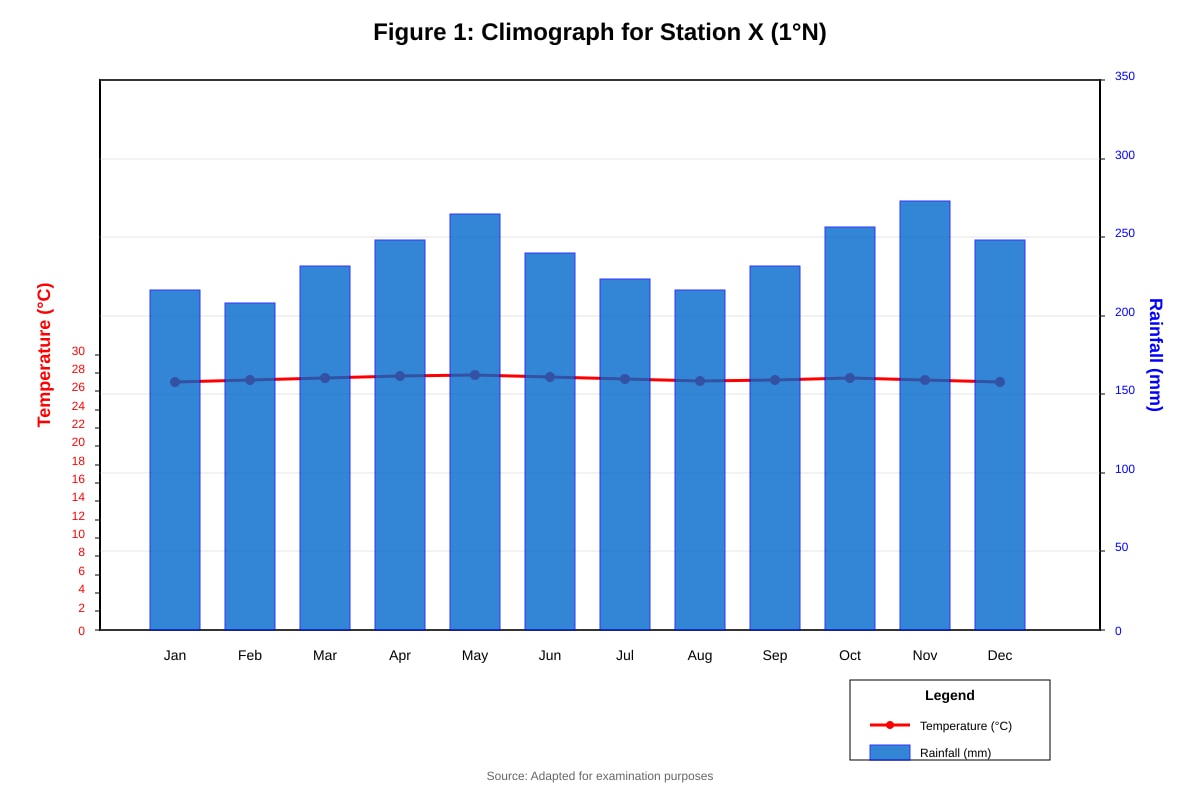
(a) Climate type: Equatorial/Tropical rainforest climate (1 mark)
(b) Account for climate:
- High temperatures due to location near equator receiving intense solar radiation year-round (1 mark)
- High rainfall caused by Intertropical Convergence Zone (ITCZ) bringing convectional rainfall (1 mark)
- Trade winds converge causing air to rise and cool, forming clouds and precipitation (1 mark)
- Consistent conditions throughout year due to minimal seasonal variation at equatorial latitude (1 mark)
Question 4 [3 marks]
Relationship explanation:
- Larger/coarser beach material (shingle) creates steeper slopes due to poor packing and high friction between particles (1 mark)
- Fine sand creates gentler slopes due to good packing and lower friction allowing particles to settle at lower angles (1 mark)
- Mixed sediment shows intermediate slope angle reflecting combination of particle sizes (1 mark)
Section B: Map Analysis [10 marks]
Question 5 [4 marks]
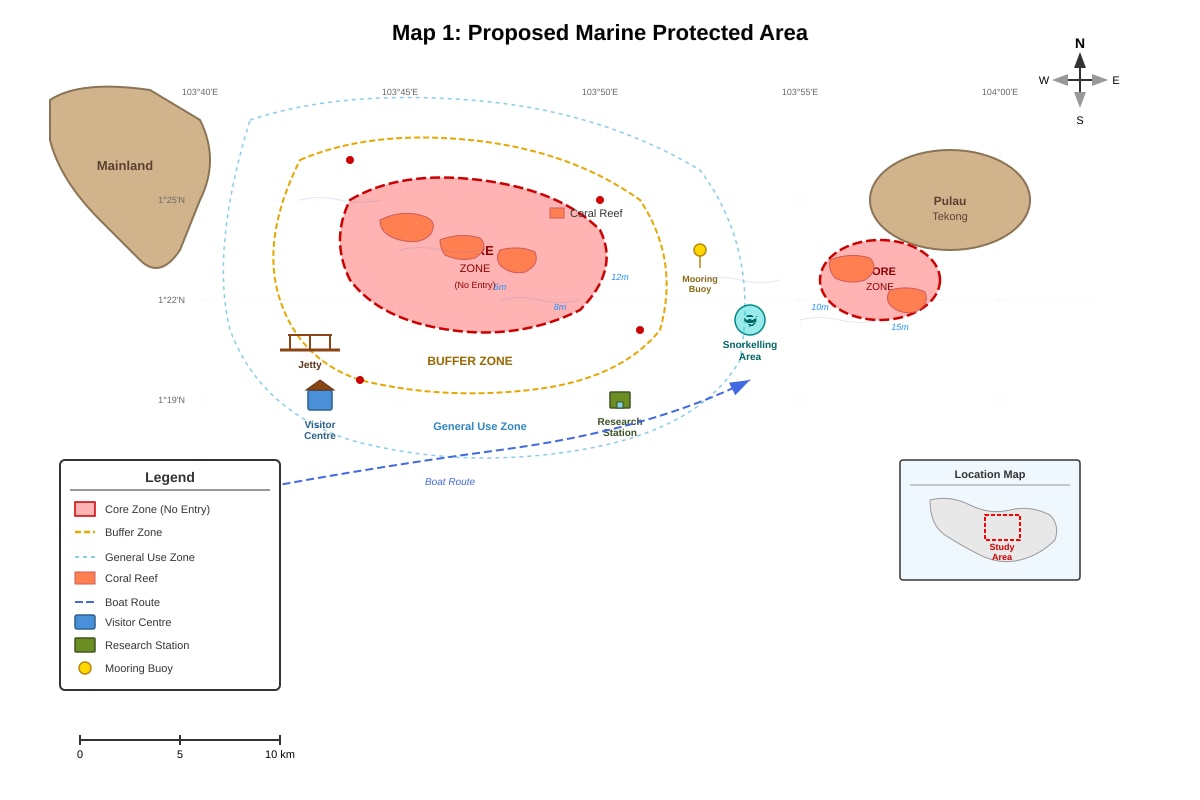
Conservation explanation:
- Core zones (no-take areas) allow fish populations to recover and coral to regenerate without human disturbance (1 mark)
- Buffer zones limit fishing activities while allowing some sustainable use, reducing pressure on core areas (1 mark)
- Visitor facilities concentrate tourism activities in designated areas, preventing damage to sensitive coral areas (1 mark)
- Zoning system allows monitoring and enforcement of regulations to prevent illegal fishing and pollution (1 mark)
Question 6 [6 marks]
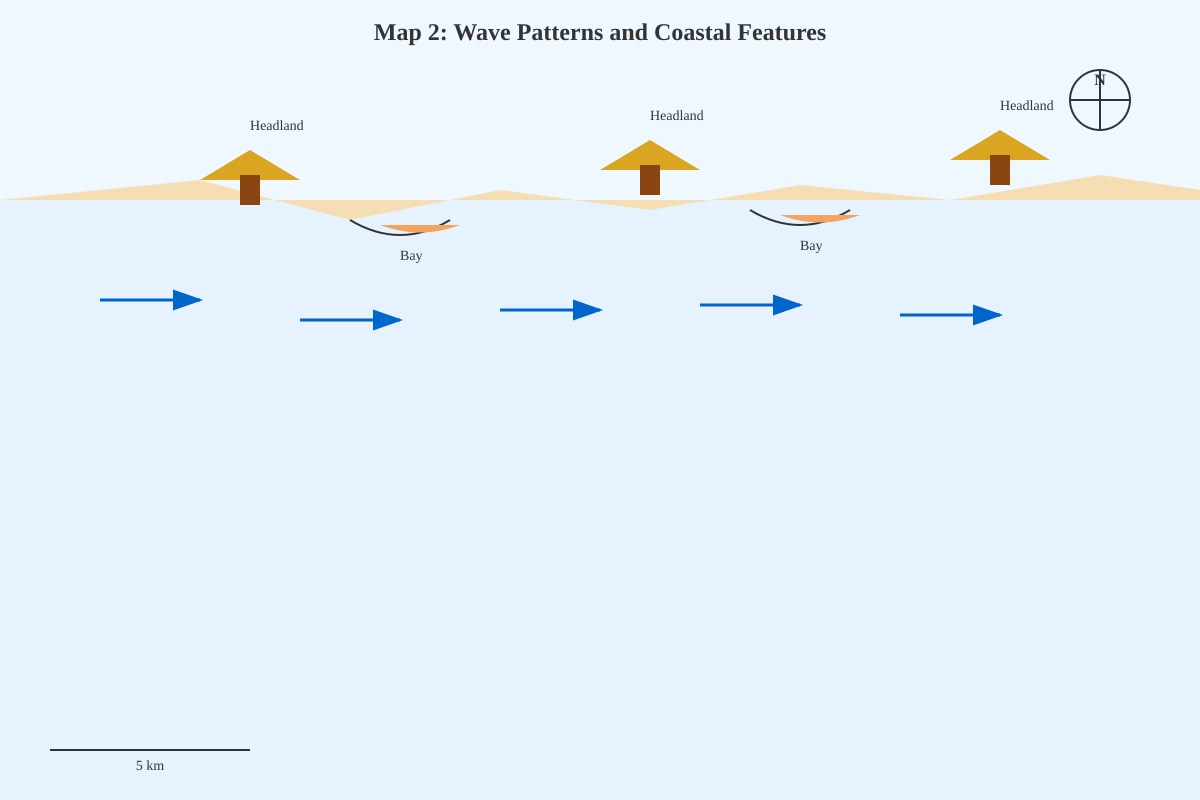
(a) Wave pattern: Waves approach coastline at an angle; wave crests bend/refract around headlands; waves concentrate energy on headlands and spread energy in bays (2 marks for accurate description)
(b) Wave refraction effects:
- Waves slow down in shallow water near headlands, causing wave crests to bend and concentrate energy (1 mark)
- Concentrated wave energy on headlands increases erosion, forming cliffs and removing material (1 mark)
- Waves spread out in bays, reducing energy and allowing deposition of sediment (1 mark)
- This creates alternating pattern of erosional (headlands) and depositional (bays) landforms (1 mark)
Section C: Data Analysis [10 marks]
Question 7 [6 marks]
Analysis:
- Higher magnitude earthquakes do not always cause more deaths (e.g., Earthquake B: 6.8 magnitude, 500 deaths vs Earthquake A: 7.2 magnitude, 15,000 deaths) (1 mark)
- Countries with higher GDP per capita tend to have lower death tolls despite similar magnitudes (1 mark)
- Developed countries (B, D with GDP >$35,000) have significantly fewer deaths due to better building standards and emergency preparedness (2 marks)
- Developing countries (A, C with GDP <$3,000) show much higher death tolls, indicating greater vulnerability (1 mark)
- Economic development appears more important than earthquake magnitude in determining casualties (1 mark)
Question 8 [4 marks]
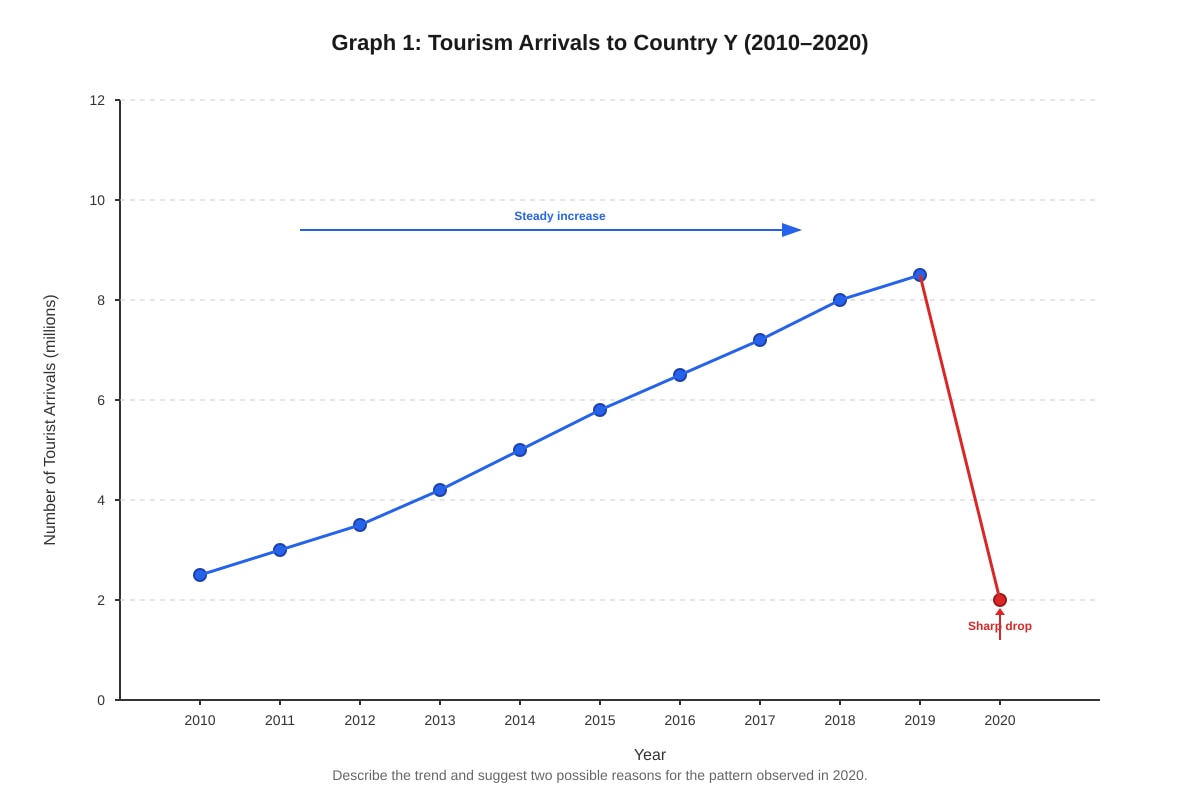
Trend: Steady increase in tourism arrivals from 2010-2019, followed by sharp decline in 2020 (1 mark)
Reason 1: COVID-19 pandemic caused international travel restrictions and border closures (1 mark with explanation)
Reason 2: Economic recession reduced disposable income for travel/tourism; health concerns made people avoid international travel (1 mark with explanation)
Alternative reasons: Natural disasters, political instability, currency fluctuations (accept any reasonable explanation with context)
Total: 35 marks
Grade Boundaries:
- A: 30-35 marks
- B: 25-29 marks
- C: 20-24 marks
- D: 15-19 marks