AI Generated Quiz
Secondary 4 English Language Use Quiz
Free Sec 4 English Language Use quiz, HY3 AI version, with questions, answers, and O Level-style practice for Singapore students.
These static practice materials are generated from the site's syllabus and paper-generation workflow, with source and model context shown so students and parents can evaluate the material before use.
Questions
Free quiz and exam paper access
Enter your details to view this paper
Your access is remembered on this device.
Answers
Secondary 4 English Quiz - Language Use (Answer Key)
Total Marks: 20
Topic: Language Use (syllabus-first; complements Stage 3 patterns, not claimed as past-year derived)
Section A: Grammar and Vocabulary
1. B) taken (1 mark)
Teaching note: "Has" is a present perfect auxiliary, so the past participle "taken" is required. "Took" is simple past; "tooken" is non-standard; "taking" is progressive participle.
Common mistake: choosing A because of spoken habit.
2. Adverb (1 mark)
Teaching note: "Calmly" modifies the verb "spoke" (how she spoke), so it is an adverb formed by adding -ly to the adjective "calm".
3. The student was praised by the teacher for his effort. (1 mark)
Teaching note: Passive voice moves the object ("the student") to subject position and uses be + past participle ("was praised"). The original subject becomes "by the teacher".
4. of (1 mark)
Teaching note: The fixed collocation is "accused of" + -ing form. "Accused with" or "accused for" are incorrect.
5. D) Both B and C are acceptable. (1 mark)
Teaching note: "Group" is a collective noun; Singapore English accepts both singular ("is") and plural ("was" with plural sense) in different contexts. A is wrong because "group" is singular.
6. courageous (1 mark)
Teaching note: The adjective form of "courage" is "courageous" (noun + -ous suffix).
7. To stop trying / to quit / to abandon an effort (1 mark)
Teaching note: "Give up" is a phrasal verb meaning to cease making an attempt. In context, after failures he stopped trying.
8. No punctuation error / sentence is correct (1 mark)
Teaching note: The comma before "and" joins two independent clauses after a dependent clause; this is acceptable. Some may wrongly remove the comma. If student inserts a period, mark as changed meaning.
Section B: Language for Effect
9. Effect: creates urgency, tension, and rapid pace; each short sentence adds a separate alarming image, making the scene feel chaotic. (2 marks)
Mark breakdown: 1 mark for identifying technique (short sentences / asyndeton), 1 mark for explaining effect on reader.
Teaching note: Short sentences after longer ones speed up reading and emphasise each action.
10. It compares the classroom to a zoo, suggesting noise, disorder, and lack of control; the image is vivid and humorous, helping reader picture the chaos better than "the classroom was noisy". (2 marks)
Mark breakdown: 1 mark for explaining comparison, 1 mark for effectiveness (vividness / humour).
11. The contrast shocks the reader, breaking the calm and signalling sudden disruption or danger. (1 mark)
12. Oxymoron (or paradox / personification of silence) (1 mark)
Teaching note: "Silence screamed" gives human action to non-human; commonly labelled oxymoron in Sec 4 contexts.
13. Repetition of "we will" emphasises determination and builds rhythmic persuasion; reinforces unity and resolve. (1 mark)
14. Aggressive / hostile / angry tone (1 mark)
Section C: Purpose, Audience and Context
15. Residents aged 50 and above at that community (1 mark)
16. To inform tenants of renovation and give instruction to keep corridor clear (1 mark)
17. B) This site teaches you simple ways to reduce your power bill. (1 mark)
Teaching note: Main purpose states what the webpage does for the user.
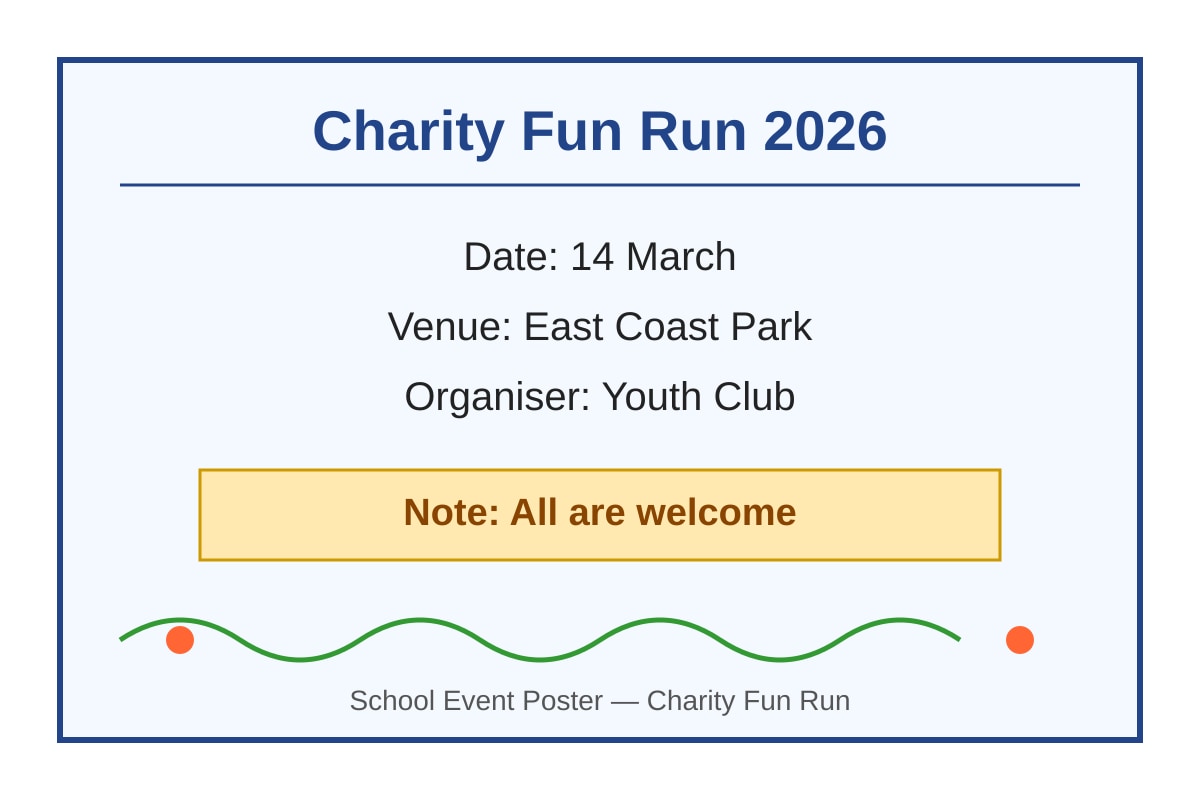
18. Audience: general public / all residents and youth; context: charity event at East Coast Park on 14 March by Youth Club, open to all. (1 mark)
Image note: Poster must show title, date, venue, organiser, "All are welcome".
19. "Hi Sir" and slang are too informal for a principal; register should be respectful and formal. (1 mark)
20. Audience: young casual readers / "foodies"; tone: friendly, informal, enthusiastic. (1 mark)