AI Generated Quiz
Secondary 4 English Comprehension Quiz
Free Sec 4 English Comprehension quiz, AI version, with questions, answers, and O Level-style practice for Singapore students.
These static practice materials are generated from the site's syllabus and paper-generation workflow, with source and model context shown so students and parents can evaluate the material before use.
Questions
Free quiz and exam paper access
Enter your details to view this paper
Your access is remembered on this device.
Answers
Secondary 4 English Quiz - Comprehension: Answer Key and Explanations
Total Marks: 50
Section A: Inference and Implication (Questions 1–5)
Question 1 (2 marks)
In 'his eyes scanning the rows of seats' – what does this suggest about the old man's state of mind?
Answer: The phrase suggests that the old man is looking for an available seat, perhaps feeling anxious or uncertain about whether one is available. The word 'scanning' implies a careful, searching gaze, indicating that he is actively and perhaps worriedly trying to find somewhere to sit, especially given his age and the bus's sudden movement.
Marking Notes:
- 1 mark: Identifies that he is looking for a seat.
- 1 mark: Explains the sense of anxiety, uncertainty, or careful searching implied by 'scanning'.
Common Trap: Students may simply say 'he was looking around' without explaining what 'scanning' specifically implies about his state of mind.
Question 2 (2 marks)
What can we infer about the young girl's feelings from the fact that she 'quickly looked down at her phone' after glancing at the old man?
Answer: We can infer that the girl feels uncomfortable, guilty, or is deliberately avoiding eye contact. Her quick movement to look down at her phone suggests she does not want to acknowledge the old man, possibly because she knows she should offer her seat but chooses not to. She avoids the moral dilemma by pretending to be occupied.
Marking Notes:
- 1 mark: Identifies avoidance, guilt, or discomfort.
- 1 mark: Explains why (e.g., not wanting to offer her seat, avoiding moral responsibility).
Common Trap: Students might say 'she was distracted by her phone' without inferring the deliberate choice to ignore the old man.
Question 3 (2 marks)
What does the old man's 'small sigh' suggest about how he feels?
Answer: The small sigh suggests feelings of resignation, disappointment, or weary acceptance. He may be tired from standing, perhaps saddened that no one—especially the young girl—offered him a seat. The sigh is 'small', suggesting he is not making a show of his feelings but quietly accepting the situation.
Marking Notes:
- 1 mark: Identifies resignation, disappointment, or weariness.
- 1 mark: Explains the sense of quiet acceptance without protest.
Common Trap: Students might say 'he was tired' without connecting the sigh to his emotional reaction to being ignored.
Question 4 (3 marks)
How does the author use contrast between the old man's and the girl's reactions to create tension?
Answer: The author creates contrast by juxtaposing the old man's active searching and physical struggle ('shuffled', 'staggered', 'grabbing the overhead rail') with the girl's passive indifference (she 'quickly looked down at her phone' and did not look up again). The contrast is heightened by their proximity—she is in a priority seat meant for the elderly, yet she deliberately ignores him. This creates tension because the reader expects her to act with kindness or at least acknowledge him, but she does not, creating a sense of unresolved moral conflict.
Marking Notes:
- 1 mark: Identifies the contrast (active struggle vs. passive avoidance).
- 1 mark: Explains how the contrast is created (juxtaposition, physical proximity).
- 1 mark: Explains the resulting tension (moral conflict, reader's expectation vs. reality).
Common Trap: Simply stating 'they are different' without explaining how the author uses language to create that contrast or why it generates tension.
Question 5 (3 marks)
What might the author be suggesting about relationships between generations in modern society? Use evidence.
Answer: The author may be suggesting a breakdown in intergenerational empathy and respect. The old man represents an older generation in need of consideration, while the girl represents a younger generation absorbed in technology and indifferent to others' needs. Evidence includes the girl's deliberate avoidance of eye contact, her refusal to offer her seat, and her continued focus on her phone despite the old man's visible struggle. The author may be implying that modern society, with its distractions and individualism, has weakened the natural courtesy that should exist between generations.
Marking Notes:
- 1 mark: Identifies a relevant theme (e.g., lack of empathy, generational divide).
- 1 mark: Uses specific textual evidence (e.g., looking down at phone, not offering seat, old man's sigh).
- 1 mark: Develops the interpretation with thoughtful analysis.
Common Trap: Making a general statement about 'old people vs. young people' without using evidence from the passage or developing the idea.
Section B: Language Effects & Contrast (Questions 6–10)
Question 6 (2 marks)
Explain the effect of the contrast: 'not with a whisper, but with a roar'.
Answer: The contrast emphasises the storm's suddenness and violence. 'Whisper' suggests something gentle, quiet, and unobtrusive, while 'roar' suggests something loud, powerful, and aggressive. By denying the whisper and affirming the roar, the author immediately establishes that this is no ordinary storm but a dramatic and destructive event. The contrast also creates a sense of surprise, as the reader's expectations of a gentle arrival are reversed.
Marking Notes:
- 1 mark: Identifies the contrast between quiet/gentle and loud/violent.
- 1 mark: Explains the effect (emphasis on power, surprise, dramatic arrival).
Common Trap: Identifying the contrast without explaining what effect it has on the reader's understanding of the storm.
Question 7 (2 marks)
How does the simile 'like a vengeful giant' help the reader understand the power of the storm?
Answer: The simile helps the reader understand the storm's power by comparing it to a giant—a being of immense size and strength. The word 'vengeful' adds a sense of intentional destruction, as if the storm is deliberately causing damage rather than simply being a natural phenomenon. This personification makes the storm seem more frightening and uncontrollable, as if it has a will of its own.
Marking Notes:
- 1 mark: Explains the giant comparison (immense size and strength).
- 1 mark: Explains the effect of 'vengeful' (intentionality, menace, fear).
Common Trap: Simply saying 'it shows the storm is powerful' without explaining how the words 'giant' and 'vengeful' contribute to that meaning.
Question 8 (3 marks)
Explain the effectiveness of the three short sentences: 'The wind screamed. The sea rose. And then, suddenly, there was silence.'
Answer: The three short sentences are effective because they create a staccato rhythm that mirrors the storm's abrupt, chaotic actions. Each sentence stands alone as a powerful image, and their brevity makes them feel urgent and dramatic. The first two sentences ('The wind screamed. The sea rose.') build tension and momentum. The final sentence ('And then, suddenly, there was silence.') provides an unexpected and shocking reversal—the sudden silence after the chaos. The word 'suddenly' reinforces the surprise, making the silence feel ominous and eerie rather than peaceful.
Marking Notes:
- 1 mark: Identifies the rhythm/pace effect (short = urgent, dramatic).
- 1 mark: Explains how the first two sentences build tension.
- 1 mark: Explains the effect of the final sentence (surprise, ominous silence, reversal).
Common Trap: Saying 'short sentences create suspense' without explaining how they work together as a sequence or why the final silence is effective.
Question 9 (2 marks)
Identify and explain the effect of one example of personification in the extract.
Answer: Example: 'The wind screamed' (personification). The wind is given the human ability to scream, which suggests the wind is not just loud but filled with fear, rage, or pain. This personification makes the storm feel alive and threatening, as if it has emotions and intentions. It also creates a more vivid and unsettling image for the reader than simply saying 'the wind was strong'.
Alternative answer: 'The storm tore through the town like a vengeful giant' also contains personification by attributing vengefulness (a human emotion) to the storm.
Marking Notes:
- 1 mark: Correctly identifies the example and names personification.
- 1 mark: Explains the effect (makes the storm seem alive, threatening, intentional).
Common Trap: Identifying personification but failing to explain why it is effective or what it adds to the reader's understanding.
Question 10 (2 marks)
How does the author's language in the final sentence create a sense of surprise or shock?
Answer: The final sentence creates surprise through the word 'suddenly', which signals an abrupt change, and the contrast between the previous chaos and the unexpected 'silence'. The reader, having been swept up in the storm's violence, expects the destruction to continue. The sudden silence is shocking because it is the opposite of what the passage had led the reader to expect. The short, simple structure of the sentence also adds to the impact—after the long, complex description of destruction, the brief 'silence' feels stark and unsettling.
Marking Notes:
- 1 mark: Identifies the technique (use of 'suddenly', contrast, sentence structure).
- 1 mark: Explains how it creates surprise or shock (unexpected reversal, unsettling quiet).
Common Trap: Simply saying 'it is surprising' without explaining how the language choices create that effect.
Section C: Vocabulary and Word Choice (Questions 11–15)
Question 11 (1 mark)
What does 'meticulous' suggest about Dr Maya's usual approach?
Answer: 'Meticulous' suggests that Dr Maya is very careful, thorough, and pays great attention to detail in her research.
Marking Notes:
- 1 mark: Correctly defines the word in context (careful, thorough, detail-oriented).
Common Trap: Giving a dictionary definition without connecting it to the context of research.
Question 12 (2 marks)
Why does the author use 'relentless' to describe Dr Maya's focus? What effect does this create?
Answer: 'Relentless' suggests that Dr Maya's focus is continuous and unyielding—she does not stop or take breaks. The word implies an almost obsessive intensity, as if she is driving herself forward without rest. The effect is to show that she is completely dedicated to her work, but perhaps also to suggest that her dedication is extreme or even unhealthy.
Marking Notes:
- 1 mark: Explains the meaning of 'relentless' in context (unstopping, continuous, intense).
- 1 mark: Explains the effect (shows extreme dedication, hints at obsession).
Common Trap: Simply saying 'it means she is focused' without explaining the intensity that 'relentless' implies.
Question 13 (2 marks)
What is the difference in connotation between 'obsessive' and 'thorough'? Explain with reference to the passage.
Answer: 'Obsessive' has a negative connotation, suggesting a lack of control, irrationality, and behaviour that is excessive or unhealthy. 'Thorough' has a positive connotation, suggesting diligence, care, and professionalism. In the passage, the colleague uses 'obsessive' to criticise Dr Maya, implying her behaviour is excessive. Dr Maya prefers 'thorough' because it reframes her actions as a deliberate choice and a virtue rather than a compulsion.
Marking Notes:
- 1 mark: Explains the connotation of each word (negative vs. positive).
- 1 mark: Links to the passage (colleague's criticism vs. Dr Maya's self-perception).
Common Trap: Simply defining the words without explaining their connotations or how they are used in the passage.
Question 14 (2 marks)
What does Dr Maya's defence of her approach in the final sentence reveal about her character?
Answer: Dr Maya's defence reveals that she is self-aware, articulate, and values control and intentionality. She distinguishes between being driven by compulsion ('obsession') and making a deliberate choice ('thoroughness'). This shows she is proud of her work ethic and wants to be seen as professional and in control, not as someone who is irrational or excessive.
Marking Notes:
- 1 mark: Identifies a relevant character trait (self-aware, proud, values control).
- 1 mark: Explains the trait with reference to the passage.
Common Trap: Saying 'she is determined' without explaining the significance of the distinction she makes.
Question 15 (2 marks)
What does the detail about adjusting her glasses with 'characteristic precision' add to our understanding of her personality?
Answer: This detail reinforces the idea that Dr Maya is meticulous and precise in everything she does, even in small, unconscious gestures. The word 'characteristic' suggests this is a consistent part of her personality, not a one-time action. It shows that her attention to detail is not just for her research but is a fundamental aspect of who she is.
Marking Notes:
- 1 mark: Connects the detail to her meticulous/ precise personality.
- 1 mark: Explains that 'characteristic' suggests consistency and fundamentality.
Common Trap: Simply saying 'it shows she is precise' without explaining the significance of 'characteristic' or how this connects to her work ethic.
Section D: Extended Comprehension and Evaluation
Question 16 (2 marks)
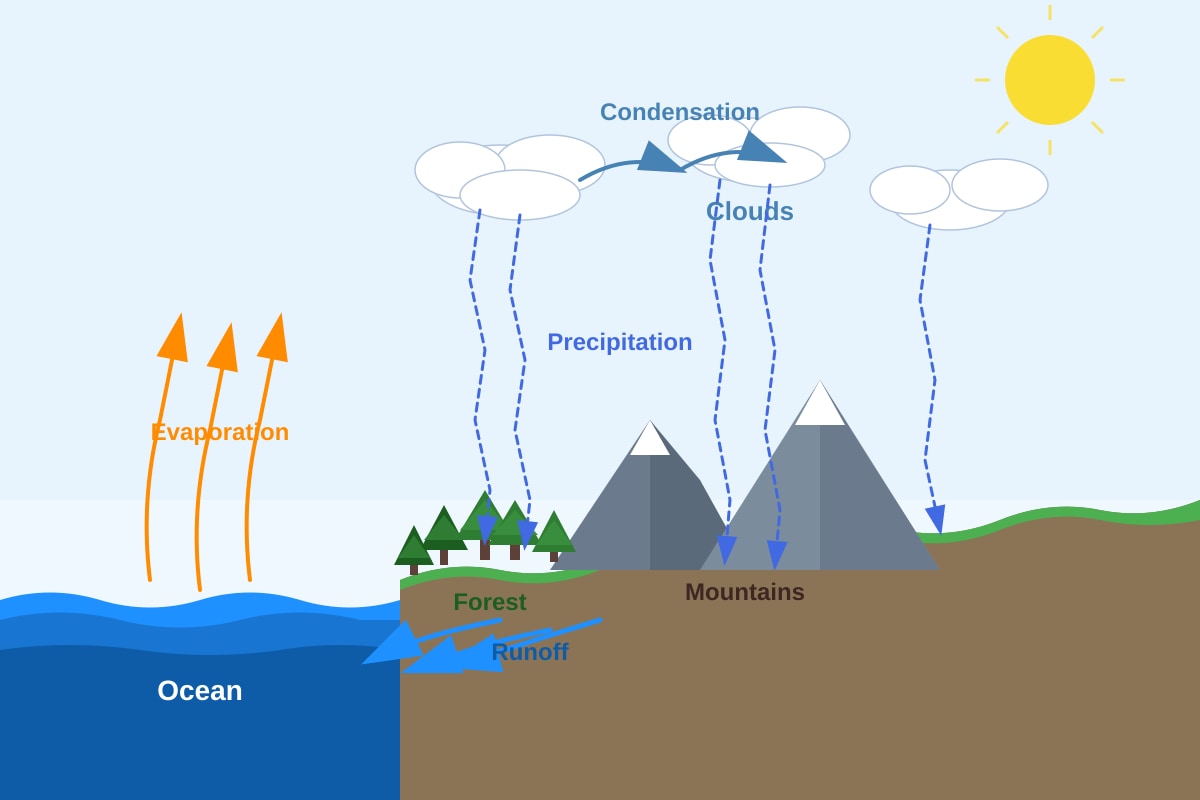
Referring to the diagram, identify the stage in the water cycle most directly affected by deforestation, and explain why.
Answer: The stage most directly affected by deforestation is runoff (or precipitation). Deforestation removes trees that absorb water through their roots and release it through transpiration. Without trees, the land cannot hold water as effectively, leading to increased surface runoff and reduced water absorbed into the soil. This can also affect precipitation patterns because less water is being returned to the atmosphere.
Marking Notes:
- 1 mark: Correctly identifies the stage (runoff or precipitation) with reference to the diagram.
- 1 mark: Explains the link to deforestation (loss of tree roots, reduced absorption, altered water flow).
Common Trap: Identifying a stage without explaining the connection to deforestation.
Question 17 (2 marks)
What does 'in ways that were once thought impossible' reveal about the unexpected nature of environmental change?
Answer: The phrase reveals that the severity and speed of environmental disruption have exceeded scientists' predictions and expectations. It suggests that human activity has caused changes that were previously considered unlikely or unimaginable, highlighting the unprecedented scale of the problem. This makes the situation seem more urgent and alarming.
Marking Notes:
- 1 mark: Explains that the changes were unexpected or exceeded predictions.
- 1 mark: Explains the effect (heightens urgency, alarm, seriousness).
Common Trap: Simply paraphrasing the phrase without explaining its significance.
Question 18 (3 marks)
Explain how the sentence about droughts in some regions and floods in others emphasises the scale of the problem.
Answer: The sentence uses a contrast structure ('In some regions...; in others...') to show that the effects of climate change are not uniform but varied and widespread. By juxtaposing two extreme and opposite outcomes (drought vs. flood), the author demonstrates that no region is spared—some suffer from too little water, others from too much. The semi-colon structure also creates parallelism, making the contrast stark and memorable. This emphasises the global scale of the problem and the fact that the entire water cycle, across the whole planet, is being disrupted.
Marking Notes:
- 1 mark: Identifies the contrast between drought and flood.
- 1 mark: Explains how the structure (parallelism, 'some regions... others') emphasises global reach.
- 1 mark: Explains the overall effect (shows the scale and varied impact of the problem).
Common Trap: Simply saying 'it shows that climate change causes both droughts and floods' without explaining how the sentence structure contributes to emphasising the scale.
Question 19 (2 marks)
What evidence suggests the disruption is not limited to one part of the world? How does this support the main argument?
Answer: Evidence: 'In some regions... in others' shows the effects are occurring in different places. The passage also states that the consequences 'will be felt by every living creature', suggesting global reach. This supports the main argument that the disruption is a global crisis, not a localised problem, and that urgent action is needed because the water cycle's balance sustains all life on Earth.
Marking Notes:
- 1 mark: Provides evidence from the text (some regions/others, every living creature).
- 1 mark: Explains how this supports the argument (global nature of the crisis, urgency).
Common Trap: Quoting the passage without explaining how it supports the main argument.
Question 20 (3 marks)
Evaluate the effectiveness of the word 'delicate' to describe the balance of the water cycle. Consider what it implies about nature and human activity.
Answer: 'Delicate' is highly effective because it suggests the water cycle is fragile, easily disrupted, and requires careful handling. The word implies that the balance is not robust or resilient, but can be tipped by relatively small changes. This directly contrasts with human activity, which the passage describes as large-scale and forceful (urbanisation, deforestation, climate change). The implication is that human activity is powerful and destructive, while nature's systems are vulnerable and in need of protection. The choice of 'delicate' therefore supports the author's argument that the consequences of disruption will be severe.
Marking Notes:
- 1 mark: Evaluates the word's effectiveness (fragile, easily disrupted).
- 1 mark: Explains what it implies about nature vs. human activity (vulnerability vs. force).
- 1 mark: Links the analysis to the author's overall argument (need for protection, severe consequences).
Common Trap: Simply saying 'delicate means fragile' without evaluating why the word is a good choice or how it connects to the passage's argument.