AI Generated Quiz
Secondary 4 English Argument Evaluation Quiz
Free Sec 4 English Argument Evaluation quiz, HY3 AI version, with questions, answers, and O Level-style practice for Singapore students.
These static practice materials are generated from the site's syllabus and paper-generation workflow, with source and model context shown so students and parents can evaluate the material before use.
Questions
Free quiz and exam paper access
Enter your details to view this paper
Your access is remembered on this device.
Answers
Secondary 4 English Quiz - Argument Evaluation (Answer Key)
Total Marks: 40
Topic: Argument Evaluation
Level: Secondary 4
Note: This quiz is syllabus-first, generated from LLM-inferred patterns. It is not claimed to be derived from past-year exam papers.
Section A: Identifying Claims and Arguments
Q1. [1 mark]
Answer: "Schools should ban mobile phones"
Teaching note: A claim is the point the writer wants you to accept. The reason ("because…") supports it.
Common mistake: Picking the reason instead of the claim.
Q2. [1 mark]
Answer: "all students must eat breakfast before school"
Teaching note: The conclusion is the final position, often after "therefore".
Marking: 1 mark for correct conclusion.
Q3. [2 marks]
Answer: It uses a single example (brother) to generalise to everyone; ignores other factors.
Teaching note: Generalising from one case is a hasty generalisation.
Marking: 1 mark for identifying single example, 1 mark for stating it cannot apply to all.
Q4. [1 mark]
Answer: That voting Clean Park will make the town greener / that they will deliver.
Teaching note: An assumption is unstated but needed for the claim to work.
Q5. [2 marks]
Answer: No, because Country X may differ in other ways (culture, teaching). One example does not prove homework useless.
Teaching note: Evaluate by checking if evidence fits conclusion.
Marking: 1 mark for "no", 1 mark for valid reason.
Section B: Evaluating Evidence and Support
Q6. [1 mark]
Answer: Neighbour's son scored A without tuition.
Teaching note: Evidence = fact used to support claim.
Q7. [2 marks]
Answer: Single case not representative; ignores students who benefited from tuition.
Marking: 1 mark each point.
Q8. [2 marks]
Answer: Larger sample (500) and clear percentage give broader view; less biased than one story.
Marking: 1 mark sample size, 1 mark representativeness.
Q9. [2 marks]
(a) Clean
(b) Quiet
Marking: 1 mark each.
Q10. [1 mark]
Answer: Personal opinion / subjective reasoning.
Teaching note: "I dislike" is not objective evidence.
Section C: Tone, Counter-Argument and Evaluation
Q11. [1 mark]
Answer: Dismissive / arrogant.
Teaching note: Name the tone in one word.
Q12. [2 marks]
Answer: Bullies may target shoes or bags instead, so uniforms alone may not stop bullying.
Marking: 1 mark for counter, 1 mark for explanation.
Q13. [1 mark]
Answer: Data / evidence / proof.
Teaching note: Claim needs support.
Q14. [2 marks]
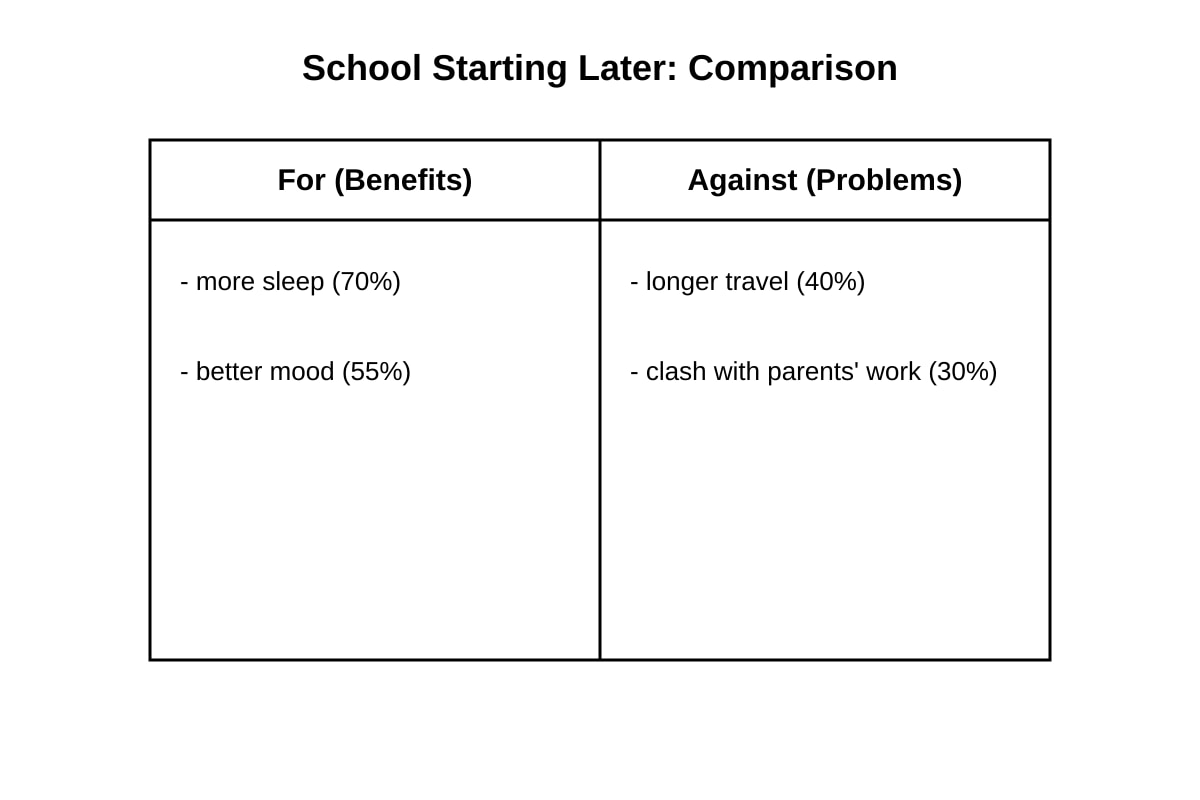
(a) For: more sleep (70%) or better mood (55%)
(b) Against: longer travel (40%) or clash with parents' work (30%)
Visual check: Table must show headings and percentages as tagged.
Marking: 1 mark each.
Q15. [1 mark]
Answer: "or" (implies only two extremes) / "must".
Teaching note: Extreme words remove middle ground.
Section D: Synthesis and Extended Evaluation
Q16. [2 marks]
(a) Pro: build character and friendships
(b) Con: costly / some parents cannot pay
Marking: 1 mark each.
Q17. [3 marks]
Answer: Fair, because text says it "hits low-income students hardest" showing unequal impact.
Marking: 1 mark fair, 2 marks using evidence from text.
Teaching note: Evaluate by linking criticism to stated effect.
Q18. [2 marks]
Answer: Argument B, because it mentions people need transport (daily need).
Marking: 1 mark B, 1 mark reason.
Q19. [1 mark]
Answer: Balancing views / weighing both sides.
Q20. [4 marks]
(a) No evidence given for "best"
(b) Uses command "Buy now" to pressure; no counter-view
Marking: 2 marks each.
Teaching note: Balanced arguments show evidence and other views.