From Real Exams Quiz
Secondary 4 English Language Use Quiz
Free Sec 4 English Language Use quiz, Exam version, with questions, answers, and O Level-style practice for Singapore students.
These static practice materials are generated from the site's syllabus and paper-generation workflow, with source and model context shown so students and parents can evaluate the material before use.
Questions
Free quiz and exam paper access
Enter your details to view this paper
Your access is remembered on this device.
Answers
Secondary 4 English Quiz - Language Use – ANSWER KEY
Total Marks: 30
Section A: Vocabulary in Context (Questions 1–5)
1. What does the word 'forlorn' (line 1) suggest about the library? [1 mark]
Answer: The word 'forlorn' suggests that the library looks sad, abandoned, and neglected, as if it has been left alone and uncared for.
Marking Notes: Accept any answer that conveys a sense of sadness, abandonment, or neglect. Do not accept answers that only say "old" or "ugly" without the emotional quality of being pitiful or deserted.
Teaching Point: 'Forlorn' is a word that combines the idea of being alone (forlorn = forsaken) with a feeling of sadness or hopelessness. It is stronger than just 'lonely' because it implies that someone or something has been left behind or forgotten.
2. Find a word in the passage which means 'not able to be seen through'. [1 mark]
Answer: Opaque
Marking Notes: Accept only 'opaque'. Do not accept 'grime' or 'stale'.
Teaching Point: 'Opaque' is the opposite of 'transparent'. If something is opaque, light cannot pass through it, so you cannot see through it. In the passage, the windows are opaque because of the grime covering them.
3. What does the word 'legible' (line 3) mean? [1 mark]
Answer: Legible means clear enough to be read.
Marking Notes: Accept any answer that conveys the idea of being readable or decipherable. Do not accept 'visible' alone.
Teaching Point: 'Legible' specifically refers to writing or print that is clear enough to read. If text is faded, smudged, or too small, it is 'illegible' (the opposite).
4. Explain what the word 'stale' (line 4) suggests about the air in the library. [1 mark]
Answer: The word 'stale' suggests that the air is old, stuffy, and unpleasant, lacking freshness because it has not been circulated or renewed.
Marking Notes: Accept any answer that conveys the idea of air being old, musty, or not fresh. Do not accept 'dirty' alone without the idea of staleness.
Teaching Point: 'Stale' is often used to describe air that has become unpleasant because it has been enclosed for a long time. It is also used for food that is no longer fresh (e.g., stale bread). The word carries a negative connotation of being old and unappealing.
5. What does the word 'indeterminate' (line 5) suggest about the librarian's age? [1 mark]
Answer: The word 'indeterminate' suggests that the librarian's age is not clear or cannot be easily determined; she could be any age.
Marking Notes: Accept any answer that conveys uncertainty or vagueness about her age. Do not accept 'old' or 'young' as these are specific.
Teaching Point: 'Indeterminate' means not exactly known, established, or defined. When used to describe a person's age, it suggests that the person looks neither particularly young nor particularly old, making it difficult to guess their age.
Section B: Language for Effect (Questions 6–10)
6. Identify the simile used in the first two sentences of the passage. What is being compared? [2 marks]
Answer: The simile is 'like a beast stirring from a long sleep' (1 mark). The low, rumbling growl of the storm is being compared to a beast waking up (1 mark).
Marking Notes:
- 1 mark for correctly identifying the simile phrase.
- 1 mark for correctly identifying what is being compared (the storm's sound / a beast stirring).
- Do not accept 'the storm arrived without warning' as this is not a simile.
Teaching Point: A simile is a figure of speech that compares two different things using the words 'like' or 'as'. In this case, the writer compares the sound of the approaching storm to the sound of a beast waking up, which makes the storm seem powerful, dangerous, and alive.
7. The writer uses the word 'shriek' (line 2) to describe the wind. What is the effect of this word choice? [2 marks]
Answer: The word 'shriek' suggests that the wind is making a loud, high-pitched, and frightening sound (1 mark). This creates a sense of danger and violence, as if the wind is screaming in anger or pain, which makes the storm seem more threatening and alive (1 mark).
Marking Notes:
- 1 mark for identifying the sound quality (loud, high-pitched, piercing).
- 1 mark for explaining the effect on the reader or the atmosphere (frightening, threatening, violent, alive).
- Accept any reasonable interpretation that links the word to fear, danger, or violence.
Teaching Point: 'Shriek' is a powerful verb that is usually used for a person's scream of fear or pain. By using it for the wind, the writer personifies the wind, making it seem like a living thing that is angry or in distress. This is much more vivid than saying 'the wind blew loudly'.
8. Explain how the word 'lashing' (line 3) contributes to the overall tone of the passage. [2 marks]
Answer: The word 'lashing' suggests a violent, whipping action, as if the rain is attacking the windows with force and anger (1 mark). This contributes to the tone of danger, violence, and intensity, making the storm seem aggressive and hostile (1 mark).
Marking Notes:
- 1 mark for explaining the meaning of 'lashing' (violent whipping/beating action).
- 1 mark for linking it to the tone (dangerous, violent, aggressive, intense, hostile).
- Do not accept answers that only say 'it is descriptive' without explaining the effect.
Teaching Point: 'Lashing' is a verb that implies a whipping or beating motion, often with a sense of punishment or attack. It is much stronger than 'hitting' or 'falling'. The word choice makes the rain seem intentional and aggressive, contributing to the overall tone of the storm as a hostile force.
9. The writer personifies the house by saying it 'groaned and creaked' and 'protesting' (lines 4–5). What is the effect of this personification? [2 marks]
Answer: The personification makes the house seem like a living thing that is suffering under the storm's attack (1 mark). This creates sympathy for the house and emphasises the power and relentlessness of the storm, as even the sturdy house is struggling to withstand it (1 mark).
Marking Notes:
- 1 mark for identifying that the house is being described as if it were alive or human.
- 1 mark for explaining the effect (sympathy, emphasising the storm's power, showing the house's vulnerability).
- Accept any reasonable interpretation that links the personification to the storm's intensity or the house's vulnerability.
Teaching Point: Personification is a figure of speech where human qualities are given to non-human things. 'Groaned' and 'protesting' are actions that humans do when they are in pain or disagreeing with something. By using these words for the house, the writer makes the reader feel that the house is alive and suffering, which makes the storm seem even more powerful and destructive.
10. What is the overall tone of the passage? Give one word or phrase to describe it. [1 mark]
Answer: The tone is threatening / menacing / ominous / violent / intense / dramatic.
Marking Notes: Accept any single word or short phrase that accurately describes the tone. Do not accept 'scary' alone unless it is clearly explained in context. Common acceptable answers: threatening, menacing, ominous, violent, intense, dramatic, fearful, sinister.
Teaching Point: Tone refers to the writer's attitude towards the subject, as conveyed through word choice, sentence structure, and imagery. In this passage, the writer uses violent verbs (shriek, lashing, tearing, hurling) and personification to create a tone of danger and threat.
Section C: Writer's Craft and Contrast (Questions 11–15)
11. The writer creates a contrast between the partygoers and the old man. Identify one word or phrase used to describe the partygoers and one word or phrase used to describe the old man. [2 marks]
Answer:
| Partygoers | Old Man |
|---|---|
| 'danced with abandon' / 'faces flushed with joy' / 'cheerful symphony' / 'laughter erupted' / 'music blared' | 'perfectly still' / 'motionless' / 'did not smile' / 'did not move' / 'simply watched' |
Marking Notes:
- 1 mark for a correct word/phrase describing the partygoers (any one from the list).
- 1 mark for a correct word/phrase describing the old man (any one from the list).
- Accept any accurate quotation from the passage.
Teaching Point: Contrast is a technique where a writer places two opposite or different things close together to highlight their differences. Here, the lively, energetic partygoers are contrasted with the still, silent old man. This makes the old man's isolation and stillness even more striking.
12. Explain the effect of the short sentence 'He was perfectly still.' (line 3) in the context of the paragraph. [2 marks]
Answer: The short, simple sentence creates a sudden pause in the fast-paced description of the party (1 mark). This draws the reader's attention to the old man and emphasises his complete stillness, which contrasts sharply with the movement and noise around him (1 mark).
Marking Notes:
- 1 mark for identifying the structural effect (pause, change of pace, abruptness).
- 1 mark for explaining the effect on meaning (emphasises stillness, highlights contrast).
- Accept any reasonable interpretation that links the sentence structure to the contrast.
Teaching Point: Short sentences are often used to create emphasis, urgency, or a change in pace. After a long, flowing sentence describing the party's energy, the short sentence 'He was perfectly still.' forces the reader to stop and focus on the old man. The brevity of the sentence mirrors the stillness it describes.
13. The writer uses the phrase 'in the corner, however' (line 2). What is the effect of the word 'however' here? [2 marks]
Answer: The word 'however' signals a contrast or shift from what has been described before (1 mark). It prepares the reader for a change in focus from the lively party to the isolated old man, highlighting the difference between the two (1 mark).
Marking Notes:
- 1 mark for identifying that 'however' signals a contrast or shift.
- 1 mark for explaining how it prepares the reader for the change in focus.
- Do not accept answers that only say 'it is a linking word' without explaining the contrast.
Teaching Point: 'However' is a conjunctive adverb that signals a contrast or contradiction with what has just been said. In this passage, it tells the reader that the next part of the description will be different from the party scene, creating a smooth but clear transition to the contrasting image of the old man.
14. What is the effect of the repetition of 'He did not...' in lines 4–5? [2 marks]
Answer: The repetition of 'He did not...' creates a rhythmic, emphatic effect (1 mark). It reinforces the old man's complete lack of participation and his isolation, emphasising everything he is not doing while everyone else is enjoying the party (1 mark).
Marking Notes:
- 1 mark for identifying the structural technique (repetition, anaphora).
- 1 mark for explaining the effect (emphasis, reinforcement of isolation/inaction).
- Accept any reasonable interpretation that links the repetition to the contrast with the partygoers.
Teaching Point: Repetition of a phrase at the beginning of successive clauses (called anaphora) is a powerful rhetorical device. Here, the repeated 'He did not...' structure lists all the things the old man is not doing, which makes his stillness and detachment even more pronounced when compared to the active partygoers.
15. The writer describes the party as a 'cheerful symphony' (line 2). What does this metaphor suggest about the party? [2 marks]
Answer: The metaphor suggests that the various sounds of the party (music, laughter, clinking glasses) come together in a harmonious and pleasant way, like a musical performance (1 mark). It implies that the party is lively, joyful, and well-orchestrated, with all the elements working together to create a happy atmosphere (1 mark).
Marking Notes:
- 1 mark for identifying the comparison (party sounds to a symphony/orchestra).
- 1 mark for explaining what it suggests (harmony, joy, organisation, pleasantness).
- Do not accept answers that only say 'it means the party is loud' without the idea of harmony or pleasantness.
Teaching Point: A metaphor is a figure of speech that describes something as if it were something else, without using 'like' or 'as'. A 'symphony' is a complex musical composition played by an orchestra, implying harmony, skill, and beauty. By calling the party a 'cheerful symphony', the writer suggests that the noise of the party is not chaotic but pleasant and well-blended.
Section D: Purpose, Audience, and Context (Questions 16–20)
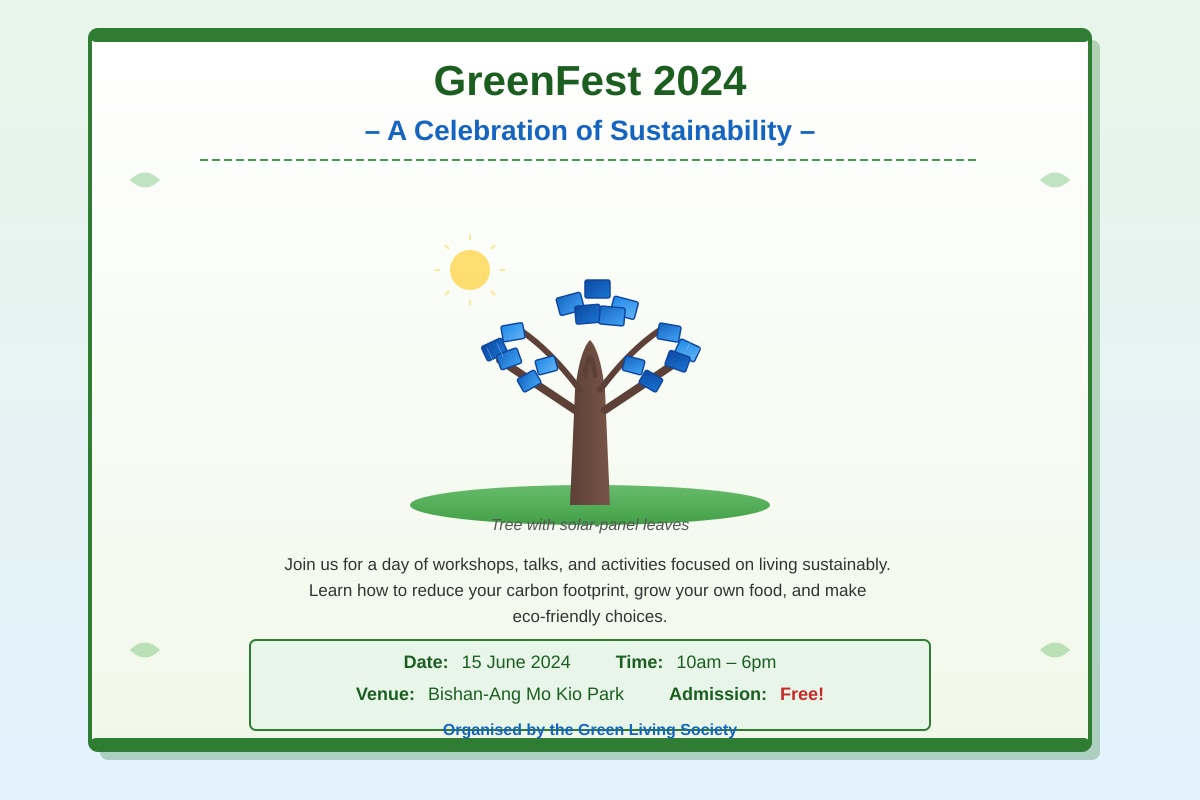
16. Who is the target audience of this poster? Give a reason for your answer. [2 marks]
Answer: The target audience is people who are interested in the environment / sustainability / living an eco-friendly lifestyle (1 mark). The reason is that the poster uses words like 'sustainability', 'reduce your carbon footprint', 'grow your own food', and 'eco-friendly choices', which would appeal to people who care about environmental issues (1 mark).
Marking Notes:
- 1 mark for identifying the target audience (people interested in sustainability/environment/eco-friendly living).
- 1 mark for a valid reason supported by evidence from the poster.
- Accept 'general public' or 'residents of Bishan' only if the reason is well-supported.
- Do not accept 'everyone' without a specific reason.
Teaching Point: Target audience refers to the specific group of people that a text is intended to reach. To identify the target audience, look at the language, content, and context of the text. Here, the specific focus on sustainability and eco-friendly activities suggests that the poster is aimed at people who already have some interest in environmental issues.
17. What is the main purpose of this poster? [1 mark]
Answer: The main purpose is to promote / advertise the GreenFest 2024 event and encourage people to attend.
Marking Notes: Accept any answer that conveys the idea of promotion, advertising, or encouraging attendance. Do not accept 'to inform' alone without the idea of persuasion or promotion.
Teaching Point: Purpose refers to the reason why a text was created. Common purposes include to inform, to persuade, to entertain, or to instruct. This poster primarily aims to persuade people to attend the event, though it also informs them about the details.
18. The poster uses the phrase 'A Celebration of Sustainability'. What is the effect of the word 'Celebration'? [2 marks]
Answer: The word 'Celebration' creates a positive, joyful tone (1 mark). It suggests that sustainability is something to be happy about and enjoyed, rather than being a burden or a chore. This makes the event seem appealing and fun, encouraging people to attend (1 mark).
Marking Notes:
- 1 mark for identifying the positive/joyful connotation.
- 1 mark for explaining the persuasive effect (makes sustainability seem fun/appealing).
- Accept any reasonable interpretation that links the word choice to the persuasive purpose.
Teaching Point: Word choice (diction) is carefully selected to create a specific effect on the reader. 'Celebration' has positive connotations of joy, festivity, and community. By using this word, the organisers frame sustainability as something enjoyable rather than difficult, which is more likely to attract attendees.
19. The poster says 'Admission: Free!'. Why is this information included? What effect does it have on the reader? [2 marks]
Answer: This information is included to remove a potential barrier to attendance (cost) (1 mark). The word 'Free!' creates a positive response in the reader, making the event seem more accessible and appealing, and encouraging people to attend without worrying about expense (1 mark).
Marking Notes:
- 1 mark for identifying that it removes the cost barrier or makes the event accessible.
- 1 mark for explaining the effect on the reader (appealing, encouraging, positive response).
- Accept any reasonable interpretation that links the information to the persuasive purpose.
Teaching Point: Persuasive texts often anticipate and address potential objections or barriers. Cost is a common reason why people might not attend an event. By prominently stating 'Admission: Free!', the poster removes this objection and makes the event more attractive. The exclamation mark adds emphasis and enthusiasm.
20. The poster is organised by the 'Green Living Society'. What does this name suggest about the organisation's values? [1 mark]
Answer: The name suggests that the organisation values environmental sustainability / eco-friendly living / protecting the planet.
Marking Notes: Accept any answer that conveys a commitment to environmental or sustainable values. Do not accept answers that only say 'they like green' without the environmental connection.
Teaching Point: An organisation's name often reflects its core values and mission. 'Green' is commonly associated with environmentalism and nature, while 'Living Society' suggests a community focused on lifestyle and daily practices. Together, the name signals that the organisation promotes an environmentally sustainable way of life.
END OF ANSWER KEY