From Real Exams Quiz
Secondary 4 English Comprehension Quiz
Free Sec 4 English Comprehension quiz, HY3 Exam version, with questions, answers, and O Level-style practice for Singapore students.
These static practice materials are generated from the site's syllabus and paper-generation workflow, with source and model context shown so students and parents can evaluate the material before use.
Questions
Free quiz and exam paper access
Enter your details to view this paper
Your access is remembered on this device.
Answers
Secondary 4 English Quiz - Comprehension (Answer Key)
Total Marks: 40
Duration: 60 minutes
Section A: Answers 1–5 (Visual & Short Text)
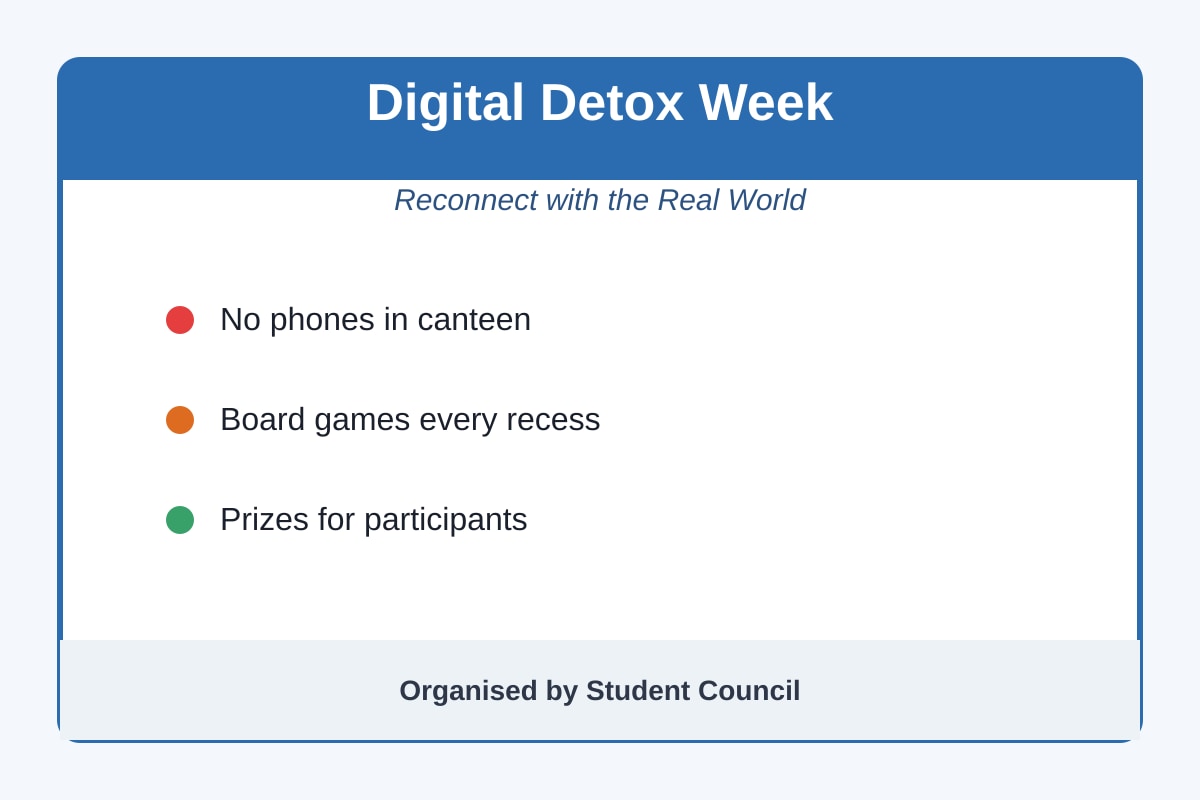
1. [1 mark] Target audience: Students (or school students / pupils).
Teaching note: The poster is organised by the Student Council and mentions recess and canteen — school contexts. Common mistake: writing "public" or "parents"; the visual labels show school-specific terms.
2. [1 mark] Main purpose: To promote / encourage participation in "Digital Detox Week" (a campaign to reduce phone use in school).
Teaching note: Posters aim to inform and persuade. The bullets are activities, so purpose is promotion, not instruction alone.
3. [2 marks] (i) "Digital Detox" (ii) "No phones" (accept "Detox" or "Reconnect" if justified, but best are explicit break words). 1 mark each.
Teaching note: "Detox" implies removal of digital; "No phones" is literal tech break. Do not accept "prizes" — not tech-related.
4. [1 mark] "Organised by Student Council" (or "canteen", "recess" — any school-based detail).
Teaching note: Shows entity running it is school body.
5. [1 mark] Tone: Encouraging / hopeful / positive (accept one).
Teaching note: "Reconnect" implies warmth, not scolding. Avoid "commanding".
Section B: Answers 6–13 (Narrative)
6. [1 mark] Tone: Frustrated (or annoyed / exasperated).
Teaching note: Template 1 — name tone only. "Muttered" + "never listen" = frustration. Not "angry" (too strong) or "sad".
7. [1 mark] "His eyes ached, but he pressed on" (or "graded essays late into the night").
Teaching note: Ache + late night = tiredness evidence.
8. [1 mark] Suggests he was fair / caring / reflective (or "could be moved by genuine student effort").
Teaching note: Template 2 — inference from language. Whispered smile shows soft side; not harsh despite earlier mood.
9. [2 marks] Effect: The short sentence after the longer reflection emphasises his shift from criticism to kindness (1). It creates a clear, abrupt turn that shows resolution (1).
Teaching note: Template 3 — contrast effect. Long = description, short = action; highlights change.
10. [1 mark] "hammered" (or "rained" as harsh weather context).
Teaching note: "Hammered" personifies rain as violent.
11. [2 marks] From frustration/scolding (para 2) to warmth/praise (para 4) (1). Shows he recognised student sincerity (1).
Teaching note: Track attitude arc with evidence.
12. [2 marks] Compares writing to a voice that is honest (1). Helps reader see Amelia's work as authentic, not polished (1).
Teaching note: Template 4 — metaphor. "Rang true" = sincerity, not literal sound.
13. [2 marks] (i) Graded essays late into night (ii) Pressed on despite aching eyes (or praised specifically). 1 each.
Teaching note: Dedication = effort beyond comfort.
Section C: Answers 14–20 (Non-Narrative)
14. [1 mark] To inform / raise awareness about hawker centres' cultural role and succession issue.
Teaching note: Non-narrative extract = expository.
15. [1 mark] "80% of residents visit a hawker centre at least weekly."
Teaching note: Statistic = usage evidence.
16. [2 marks] Highlights tension between value and decline (1). Makes reader see urgency of preservation (1).
Teaching note: Contrast positive→problem = evaluative effect.
17. [2 marks] Shows hawking is physically hard (hot), poorly rewarded (low-paid), and socially unseen (unglamorous) (2 from 3 = 2 marks; all 3 = full).
Teaching note: Triple adjective list = challenges.
18. [1 mark] "government" + "launched" (or "Scheme", "grants"). 1 for one, but question asks two: e.g., "launched" and "grants".
Teaching note: Official support = state action.
19. [2 marks] They would say fewer youth are hawking (1), so scheme trains under-40s to preserve heritage (1).
Teaching note: Template 5 — perspective using para 6.
20. [2 marks] (i) "cultural anchors" (ii) "preserve this heritage". 1 each.
Teaching note: Culture words = importance.