From Real Exams Quiz
Secondary 4 English Composition Situational Writing Quiz
Free Sec 4 English Situational Writing quiz, Exam version, with questions, answers, and O Level-style practice for Singapore students.
These static practice materials are generated from the site's syllabus and paper-generation workflow, with source and model context shown so students and parents can evaluate the material before use.
Questions
Free quiz and exam paper access
Enter your details to view this paper
Your access is remembered on this device.
Answers
Secondary 4 English Quiz - Composition Situational Writing: Answer Key
Total Marks: 40
Section A: Identifying Purpose, Audience, and Context (10 marks)
1. State the purpose of the report you are writing. [2 marks]
Answer: The purpose of the report is to summarise the outcomes of the school's recycling drive and to recommend ways for the school to sustain the recycling efforts.
Marking Notes:
- 1 mark for identifying the purpose as summarising/reporting on the event.
- 1 mark for identifying the recommendation/sustainability aspect.
Teaching Notes: In Situational Writing, the "purpose" answers the question: "Why am I writing this?" It is the core goal you need to achieve. Always look for the action words in the prompt (e.g., "summarising," "recommending," "informing," "persuading").
2. Identify the audience for this report. [1 mark]
Answer: The School Management Committee.
Marking Notes: Accept "Principal and School Management Committee".
Teaching Notes: "Audience" means the person/people who will read your text. The pronoun used ("your Principal has asked you to write…") and the formality of the situation usually give this away. Getting the audience wrong changes the entire tone and content of your writing.
3. State the context or situation that has prompted this piece of writing. [2 marks]
Answer: The context is that the Green Club successfully organised a recycling drive, and the Principal has requested a formal report for the School Management Committee to share the results and discuss future plans.
Marking Notes:
- 1 mark for mentioning the successful event.
- 1 mark for mentioning the Principal's instruction/report requirement.
Teaching Notes: Context is the "who, what, when, where, and why" of the situation. It helps you decide the format, tone, and level of detail. For example, since this is a requested report, you know it is formal and official.
4. Explain why a formal tone is appropriate for this writing task. [2 marks]
Answer: A formal tone is appropriate because the audience is the School Management Committee (a professional body), the purpose is to submit an official report, and the relationship between the writer (a student) and the audience (school authorities) is hierarchical and requires respect.
Marking Notes:
- 1 mark for identifying the audience/relationship (formal, hierarchical).
- 1 mark for linking to the purpose/official nature of a report.
Teaching Notes: Tone is determined by Purpose (P), Audience (A), and Context (C). Formal tone uses complete sentences, avoids slang, and uses respectful language. Common mistake: writing informally because the writer is a student.
5. Identify two specific details from the scenario that help you determine the format of the report (e.g., salutation, sign-off). Explain your choices. [3 marks]
Answer:
- Detail 1: The report is addressed to the "School Management Committee." Therefore, a formal salutation such as "Dear Members of the School Management Committee" is appropriate.
- Detail 2: The writer is the "President of the Green Club." Therefore, the sign-off should include the writer's full name and position, such as "Yours faithfully, [Name], President of the Green Club."
Marking Notes:
- 1 mark for each detail identified (2 marks total).
- 1 mark for clear explanation connecting the detail to the format choice.
Teaching Notes: Format choices are not random; they are dictated by P-A-C. "Yours faithfully" is used for formal letters/reports when you do not know the recipient by name ("Dear Sir/Madam") or when addressing a group. "President" is a title that should be included to establish authority.
Section B: Analysing Visual Texts for Writing Tasks (10 marks)
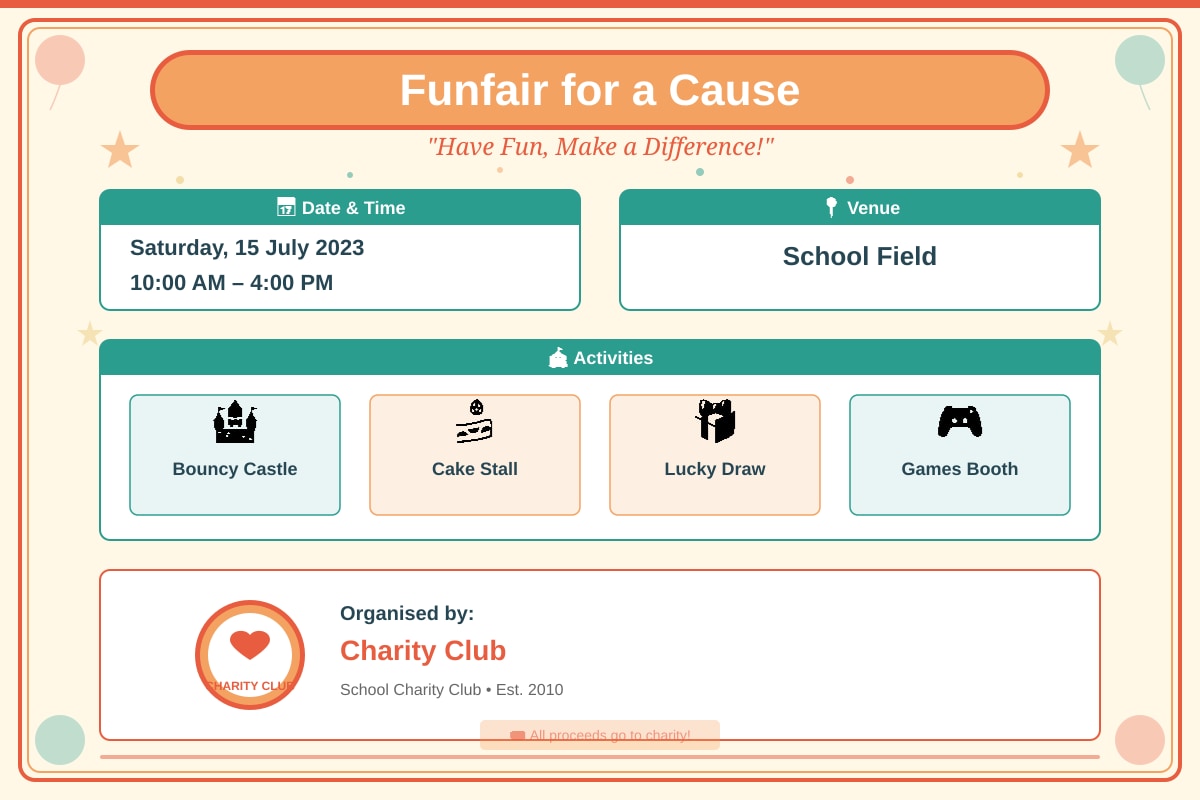
6. What is the event being advertised in the poster? [1 mark]
Answer: The event is a school fundraising funfair called "Funfair for a Cause."
Marking Notes: Accept "Funfair for a Cause" or "a fundraising funfair."
Teaching Notes: Always look for the event name, which is usually in a larger font at the top of the poster. This is a one-mark question, so a short, accurate answer is enough.
7. List two key details from the poster that you would include in the email to inform students about the event. [2 marks]
Answer:
- Detail 1: The event is on Saturday, 15 July 2023, from 10:00 AM to 4:00 PM at the School Field.
- Detail 2: The activities include a Bouncy Castle, Cake Stall, Lucky Draw, and Games Booth.
Marking Notes:
- 1 mark for each relevant detail (date/time/venue or activities).
- Additional acceptable details: the organiser is the Charity Club.
Teaching Notes: In an email informing about an event, the basic "5 Ws and 1 H" (What, When, Where, Why, Who, How) are essential. Choose the most factual and helpful details.
8. Explain how you would use the slogan "Have Fun, Make a Difference!" to persuade students to attend. [2 marks]
Answer: I would use the slogan as a persuasive hook by presenting the event as having two benefits: it promises an enjoyable experience ("Have Fun") and appeals to students' sense of social responsibility ("Make a Difference"), suggesting that their participation will contribute to a meaningful cause.
Marking Notes:
- 1 mark for identifying the persuasive appeal (fun + helping a cause).
- 1 mark for explaining how these two elements work together.
Teaching Notes: Persuasion in Situational Writing often uses rhetorical appeals:
- Pathos (emotion): "Have Fun" appeals to the desire for enjoyment.
- Ethos (ethics/values): "Make a Difference" appeals to the desire to do good. Combining the two creates a powerful message.
9. Besides the details from the poster, suggest one additional piece of information you could add to the email to make it more appealing. [2 marks]
Answer: I could add that there will be attractive prizes for the Lucky Draw, such as vouchers or a new pair of headphones, to create more excitement and encourage attendance.
Marking Notes:
- 1 mark for a relevant, realistic suggestion.
- 1 mark for explaining why it makes the email more appealing.
- Accept other reasonable ideas: a personal invitation to participate, information about the charity being supported, or a call for volunteers.
Teaching Notes: "More appealing" means more engaging or persuasive. Think about what would motivate the audience. For students, prizes, fun, and social recognition are strong motivators.
10. What is the relationship between you (the writer) and the recipients (all students)? How would this affect the tone of your email? [3 marks]
Answer: The writer and recipients are fellow students—peers. This relationship means the tone should be friendly and encouraging but still respectful and organised, as it is a formal announcement from the Charity Club. It should be less formal than a letter to the Principal but more formal than a text message to a friend.
Marking Notes:
- 1 mark for identifying the peer relationship.
- 2 marks for a well-developed explanation of how the tone balances friendliness and formality.
Teaching Notes: A common mistake is to write too casually ("Hey guys, come to the funfair!"). Even among peers, a school-organised email has a degree of formality. The key is warm professionalism.
Section C: Task Fulfilment and Content Development (12 marks)
11. Identify the format you will use for this task. State one reason for your choice. [2 marks]
Answer: The format is a notice to be read out during morning assembly. A notice is the correct format because it is an official communication directed at all students, is read aloud publicly, and conveys important information and instructions about a school incident.
Marking Notes:
- 1 mark for identifying "notice" as the format.
- 1 mark for a clear reason linked to the context (oral delivery to all students).
Teaching Notes: A notice is a brief public announcement. Other possibilities might include an email or a letter to parents, but the prompt specifically says "to be read out during morning assembly," which is the key detail.
12. Give two points you would include to inform students about what happened. [2 marks]
Answer:
- Point 1: A large tree fell in the school compound due to a heavy storm, damaging the canteen roof and blocking the main walkway.
- Point 2: No one was hurt in the incident.
Marking Notes:
- 1 mark for each point. Points must be factual and directly from the scenario.
Teaching Notes: "Inform" means to give facts. Stick to the 5 Ws: What (a tree fell), Where (school compound, canteen roof, main walkway), and the key fact that no one was hurt. Do not add opinions or unnecessary details.
13. Write one sentence you could use to reassure students and their parents. [2 marks]
Answer: "Please be assured that the school administration is working closely with the relevant authorities to clear the walkway and repair the canteen roof, and all necessary safety measures have been put in place."
Marking Notes:
- 1 mark for including a reassuring message.
- 1 mark for demonstrating a sense of control and action (e.g., "working on it," "safety measures").
- Do not accept vague comfort ("Don't worry").
Teaching Notes: Reassurance must be concrete. Telling people what is being done is more effective than simply saying "everything is fine." Use phrases like "be assured," "taking immediate action," "safety is our priority."
14. List two clear instructions you would give to students regarding movement in the school compound. [2 marks]
Answer:
- Instruction 1: All students are to use the alternative route through the science block to get to the canteen until further notice.
- Instruction 2: Students must stay behind the safety barriers that have been set up around the affected area.
Marking Notes:
- 1 mark for each clear, actionable instruction relevant to the scenario.
- Instructions must be specific and logical (e.g., avoiding the blocked area).
Teaching Notes: Instructions must be clear, direct, and safe. Use imperative verbs (e.g., "use," "stay," "avoid," "do not"). Think about what a student actually needs to know to move safely in the school.
15. Explain why it is important to include a call to action at the end of the notice. [2 marks]
Answer: A call to action is important because it tells the audience exactly what they need to do next, ensuring the notice has a practical outcome. It moves the audience from passive listeners to active participants in following the school's safety procedures.
Marking Notes:
- 1 mark for defining the purpose of a call to action (directs the audience's next step).
- 1 mark for linking it to the context (safety/compliance).
Teaching Notes: A "call to action" (CTA) is a statement designed to get an immediate response. In a notice, the CTA often reinforces the main instruction (e.g., "Please cooperate and stay safe"). Without a CTA, the notice feels incomplete.
16. Suggest an appropriate sign-off for this notice, explaining why it is suitable for the audience and context. [2 marks]
Answer: Sign-off: "Thank you for your cooperation. — [Name], Head Prefect."
Marking Notes:
- 1 mark for a suitable sign-off (e.g., "Thank you," "Stay safe," or simply the name and title).
- 1 mark for a clear explanation linking it to the audience (students) and context (official school notice).
Teaching Notes: The sign-off for a notice read aloud is often more direct than a letter. Since the Head Prefect is a student leader addressing fellow students, the tone can be authoritative yet collaborative. "Thank you for your cooperation" acknowledges their role in keeping the school safe.
Section D: Language, Tone, and Register (8 marks)
17. Write a subject line for this email that is clear and professional. [1 mark]
Answer: "Thank You for Your Mentorship During My Internship"
Marking Notes:
- 1 mark for a clear, professional, and relevant subject line.
- Do not accept vague lines like "Thank You" or "Internship."
Teaching Notes: A good subject line should immediately tell the reader what the email is about. In a professional context, use complete words and a formal tone.
18. Write the first sentence of the email that appropriately greets Mr. Tan and states your purpose. [2 marks]
Answer: "Dear Mr. Tan, I am writing to express my sincere gratitude for the invaluable mentorship you provided me during my internship at your firm."
Marking Notes:
- 1 mark for a correct and appropriate salutation ("Dear Mr. Tan").
- 1 mark for a sentence that clearly states the purpose (thanking him) and is grammatically correct.
- Common mistake: starting with "Hi Mr. Tan" (too informal for a professional setting).
Teaching Notes: The opening of a professional email should be direct. Use a formal salutation, state your name/reference to the internship if needed, and immediately state your purpose.
19. You want to mention one specific experience: Mr. Tan allowed you to sit in on a client consultation, which taught you the importance of listening carefully. Write two sentences that describe this experience and express your appreciation. [3 marks]
Answer: "I especially appreciated the opportunity to sit in on the client consultation you conducted last Thursday. Observing how you listened carefully to the client's concerns taught me the value of patience and attention to detail in legal practice, and I am truly grateful for that learning experience."
Marking Notes:
- 1 mark for correctly describing the specific experience.
- 1 mark for connecting the experience to a personal takeaway (what they learned).
- 1 mark for expressing genuine appreciation in a professional manner.
- Award full marks for any two sentences that fulfil the task.
Teaching Notes: Specificity is key to a good thank-you note. Instead of "I learned a lot," show what you learned and why it was meaningful. This makes the gratitude feel genuine and shows you were paying attention.
20. Write an appropriate closing sentence and sign-off for the email. [2 marks]
Answer: "Once again, thank you for your guidance and support. I hope to apply the lessons I have learned as I continue my studies. Yours sincerely, [Your Full Name]."
Marking Notes:
- 1 mark for a closing sentence that reiterates gratitude.
- 1 mark for a correct sign-off ("Yours sincerely" is used for named recipients in formal/thank-you letters).
- Accept "Best regards" or "With sincere thanks" as alternatives.
Teaching Notes: The sign-off "Yours sincerely" is used when you have addressed the recipient by name (e.g., "Dear Mr. Tan"). "Yours faithfully" is used when you have used "Dear Sir/Madam." Getting this right shows attention to register and format.