From Real Exams Exam Paper
Secondary 4 English Preliminary Examination Paper 1
Free Sec 4 English Prelim Paper 1, HY3 Exam version, with questions, answers, and O Level-style practice for Singapore students.
These static practice materials are generated from the site's syllabus and paper-generation workflow, with source and model context shown so students and parents can evaluate the material before use.
Questions
TuitionGoWhere Practice Paper - English Secondary 4 (PRELIM)
School: TuitionGoWhere Exam Practice (AI)
Subject: English
Level: Secondary 4
Paper: Comprehension Practice (Version 1 of 5)
Duration: 1 hr 50 min
Total Marks: 50
Name: ___________________________
Class: ________
Date: ____________
Instructions:
- This paper contains three sections. Answer all questions.
- Read each passage carefully before answering.
- Write your answers in the spaces provided.
- Section C includes a summary task of 80 words.
Section A: Visual Text and Short Comprehension (5 marks)
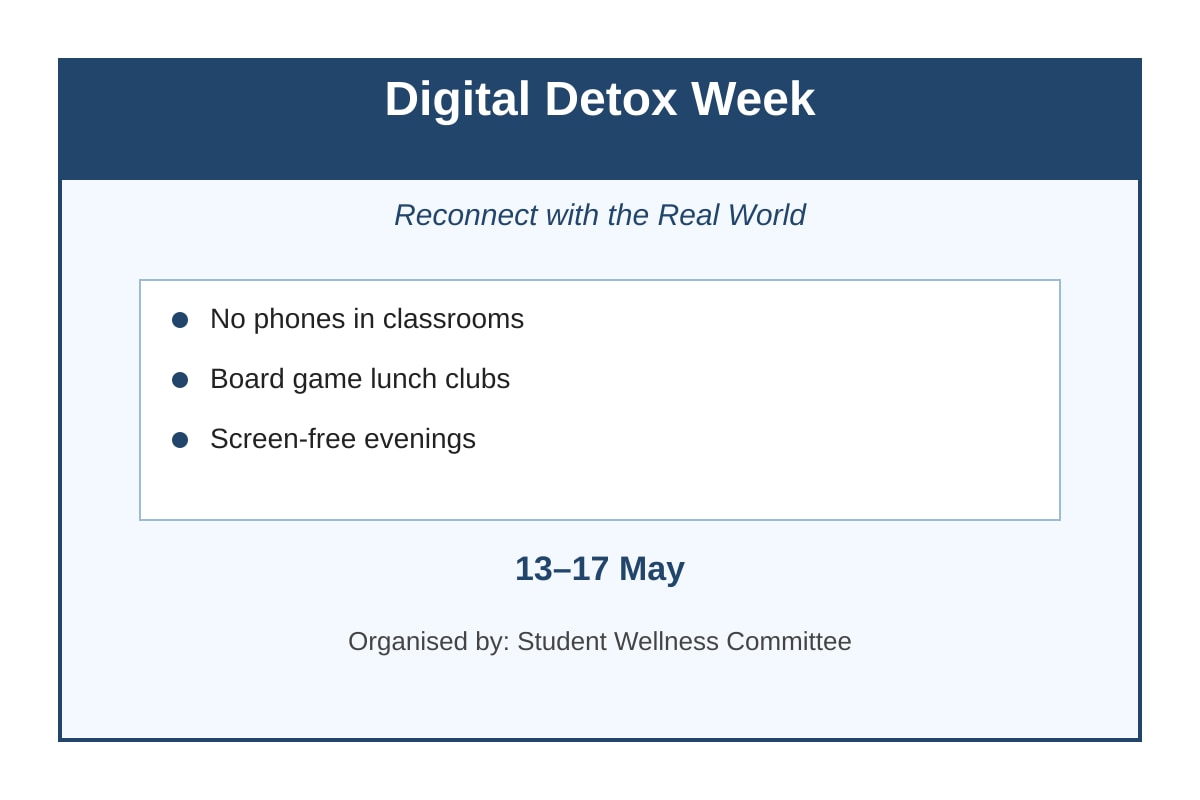
Read the following poster and answer Questions 1–5.
Image pending generation: source_image for Q1.
-
Who is the target audience of this poster? (1 mark)
-
What is the main purpose of the poster? (1 mark)
-
Find a word or phrase on the poster that suggests students are spending too much time on devices. (1 mark)
-
Which committee is organising the event? (1 mark)
-
Based on the poster, give one reason why the school is running this campaign. (1 mark)
Section A Total: 5 marks
Section B: Narrative Comprehension and Language Use (20 marks)
Read the passage below and answer Questions 6–15.
(1) The rain hammered against the windows as Mr. Tan paced the empty classroom. He had stayed behind to finish the term reports, but his mind kept drifting to the argument he had with his daughter that morning.
(2) "You never listen to me!" she had shouted, her voice cracking with frustration.
(3) He sighed and rubbed his temples. The stack of papers before him blurred into grey.
(4) Outside, a lone figure with an umbrella hurried past — a student, perhaps, late for tuition. Mr. Tan envied the simplicity of her hurry.
(5) He picked up his pen, then set it down. "I do listen," he muttered to no one.
(6) The clock ticked. The rain softened to a drizzle.
(7) In the corridor, a cleaner hummed a familiar tune. Mr. Tan closed his eyes and let the melody settle his thoughts.
(8) When he opened them, the reports seemed less daunting. He began to write — slowly, then with ease.
-
What is the tone of Mr. Tan's comment in line 5 ("I do listen")? (1 mark)
-
In paragraph 2, what does the phrase "her voice cracking with frustration" suggest about the daughter's emotional state? (1 mark)
-
Give two pieces of evidence from paragraph 1 that show Mr. Tan was distracted. (2 marks)
(a) __________________________________________________
(b) __________________________________________________ -
What does the sentence "The stack of papers before him blurred into grey" (line 3) suggest about Mr. Tan's state of mind? (1 mark)
-
The writer creates a contrast by following the long description in paragraph 4 with the short sentence "He picked up his pen, then set it down." (line 5). What is the effect of this contrast? (2 marks)
- How is the sentence "The clock ticked. The rain softened to a drizzle." (line 6) effective in showing the change in mood? (2 marks)
- Find words in paragraph 4 which suggest Mr. Tan felt a sense of longing for a simpler life. (1 mark)
- What does paragraph 7 reveal about how Mr. Tan coped with his stress? (2 marks)
- Explain how the writer uses the rain as a symbol throughout the passage. (3 marks)
- With reference to paragraphs 5–8, how would Mr. Tan explain his change in attitude? (5 marks)
Section B Total: 20 marks
Section C: Non-Narrative Comprehension and Summary (25 marks)
Read the passage below and answer Questions 16–20.
(1) Community gardens have become a quiet revolution in urban Singapore. These shared plots transform rooftops and vacant land into green sanctuaries.
(2) Firstly, they promote food security. Residents grow herbs and vegetables, reducing reliance on imports.
(3) Secondly, they build social bonds. Neighbours who once passed silently now exchange tips over tomato plants.
(4) Thirdly, they improve mental well-being. Tending soil lowers stress and offers a break from screens.
(5) However, challenges remain. Limited space and pests test even devoted gardeners.
(6) Despite this, the movement grows, supported by town councils and schools.
- What is the writer's main purpose in this passage? (1 mark)
-
Identify two benefits of community gardens from paragraphs 2 and 3. (2 marks)
(a) __________________________________________________
(b) __________________________________________________ -
According to paragraph 5, what are two challenges faced by gardeners? (2 marks)
(a) __________________________________________________
(b) __________________________________________________ -
How does the writer use the word "revolution" in line 1 affect the reader's view of community gardens? (2 marks)
- Summary Task (18 marks)
Refer to paragraphs 2–4. Summarise the benefits of community gardens in no more than 80 words. Use your own words as far as possible.
Section C Total: 25 marks
Total Marks: 50
Answers
Answer Key – TuitionGoWhere Practice Paper - English Secondary 4 (PRELIM) Version 1
Section A: Visual Text (5 marks)
-
Target audience: Students of the school (or school community). (1 mark)
Teaching note: The poster is from "Student Wellness Committee" and mentions "classrooms" and "lunch clubs", so it is clearly aimed at students. Common mistake: writing "parents" — not supported by text. -
Main purpose: To promote / inform students about "Digital Detox Week" and encourage reduced screen use. (1 mark)
Teaching note: Purpose is identified from title and bullet points. Marking: 1 mark for stating promotion/awareness of campaign. -
"Reconnect with the Real World" (or implied by "Digital Detox"). (1 mark)
Teaching note: This phrase suggests current disconnection via devices. Accept "Digital Detox" as it implies overuse. -
Student Wellness Committee. (1 mark)
Direct recall from poster label. -
To help students reduce screen time / reconnect with real world / improve wellbeing. (1 mark)
Teaching note: Any one inference from bullets. Marking: 1 mark for valid reason from poster.
Section A Total: 5 marks
Section B: Narrative (20 marks)
-
Defensive / resigned (accept "murmured" tone as defensive). (1 mark)
Teaching note: He mutters to no one, insisting he listens — tone is defensive. Trap: "angry" is too strong; "frustrated" also possible but defensive fits mutter. -
She was upset / emotionally distressed / frustrated. (1 mark)
Teaching note: "Cracking with frustration" shows emotional strain. State emotion linked to word. -
Two evidences: (2 marks – 1 each)
(a) "his mind kept drifting to the argument"
(b) "stayed behind to finish… but" (or "paced the empty classroom")
Teaching note: Both show lack of focus on reports. -
He was overwhelmed / mentally foggy / unable to concentrate. (1 mark)
Teaching note: Blurring suggests loss of clarity due to distraction. -
Effect: The short sentence shows his indecision / restlessness; contrast with calm description highlights his inner turmoil. (2 marks)
Breakdown: 1 mark contrast identified (long vs short), 1 mark effect on reader (abruptness, hesitation). -
Effective because ticking clock and softening rain mirror his calming mind; shows time passing and tension easing. (2 marks)
Breakdown: 1 mark for linking weather to mood, 1 mark for explaining mood shift. -
"envied the simplicity" (1 mark)
Teaching note: "Envied" shows longing. -
He used the cleaner's humming tune to relax / closed eyes and let melody settle thoughts. (2 marks)
Breakdown: 1 mark action, 1 mark effect (stress coped). -
Rain symbolises his troubled mind at start (hammering = stress), then softens as he calms (drizzle = peace). (3 marks)
Descriptors: 1 mark rain as symbol, 1 mark start state, 1 mark end state.
Teaching note: Symbolism = object representing emotion. -
Explanation (5 marks):
- He would say he was initially distracted by argument (1)
- He felt guilty/defensive about daughter's words (1)
- The quiet melody helped him reflect (1)
- He realised reports were manageable (1)
- He chose to focus and write calmly (1)
Teaching note: Use paragraphs 5–8 evidence; mark per content point.
Section B Total: 20 marks
Section C: Non-Narrative (25 marks)
-
To inform / explain benefits of community gardens. (1 mark)
-
(a) Food security (grow own food) (b) Social bonds (neighbours interact). (2 marks)
-
(a) Limited space (b) Pests. (2 marks)
-
"Revolution" makes gardens seem powerful/transformative, not just hobby. (2 marks: 1 word effect, 1 explanation)
-
Summary (18 marks):
Expected content points (from para 2–4): food security (1), reduce imports (1), social bonds (1), neighbour exchange (1), mental wellbeing (1), lower stress (1), break from screens (1).
Own words & organisation: up to 7 marks for sustained own words & coherence (approx 1 per point + flow).
Sample summary (68 words):
Community gardens aid food security as residents cultivate produce, cutting import need. They also foster friendships, with neighbours sharing advice. Moreover, they boost mental health by lowering tension and offering screen-free relief.
Marking: 7 content (x1) + 7 language/own words + 4 organisation = 18. Word count must be ≤80.
Section C Total: 25 marks
Total: 50 marks
Free quiz and exam paper access
Enter your details to view this paper
Your access is remembered on this device.