From Real Exams Quiz

Secondary 4 Elementary Mathematics Statistics Probability Quiz

Free Sec 4 E Maths Statistics quiz with questions, answers, and O Level-style practice for Singapore students preparing for school assessments.

These static practice materials are generated from the site's syllabus and paper-generation workflow, with source and model context shown so students and parents can evaluate the material before use.

Secondary 4 Elementary Mathematics From Real Exams Generated by Kimi K2.6 Free Updated 2026-06-12

Questions

<!-- TuitionGoWhere generation metadata: stage=3-0; model=moonshotai/kimi-k2.6:free; model_label=Kimi K2.6 Free; generated=2026-06-10; Sources: Stage 2-1 real exam-derived templates and Stage 2-2 exam-enriched syllabus. -->

Secondary 4 Elementary Mathematics Quiz - Statistics Probability

Name: _________________________ Class: __________ Date: __________
Duration: 50 minutes
Total Marks: 40
Score: ________ / 40

Instructions: Answer all questions. Show all working clearly. Non-exact numerical answers should be rounded to 3 significant figures, or 1 decimal place for angles, unless stated otherwise.


Section A: Data Analysis and Measures of Central Tendency (Questions 1–5)

[12 marks]


1. The following marks were obtained by 15 students in a Mathematics test: 52, 48, 65, 72, 48, 55, 61, 48, 78, 64, 55, 80, 55, 67, 55

(a) Find the mode and the median.
(b) Calculate the mean mark.
(c) If the mean mark for the class of 40 students is 62.5, and these 15 students are from the same class, find the total marks of the other 25 students.

[4 marks]

Answer: _________________________


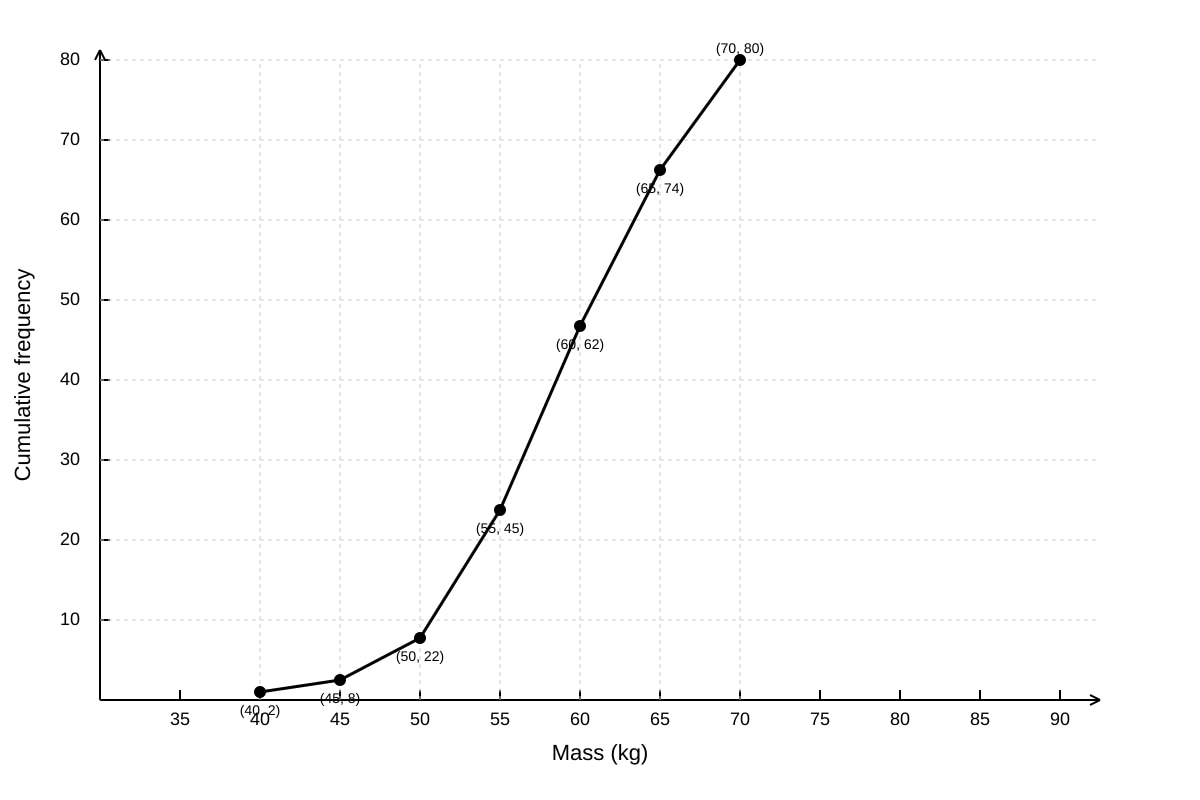
2. The cumulative frequency curve shows the distribution of masses of 80 students in a school.

<image_placeholder> id: Q2-fig1 type: graph linked_question: Q2 description: Cumulative frequency curve (ogive) showing masses of 80 students labels: x-axis "Mass (kg)", y-axis "Cumulative frequency", points at (40, 2), (45, 8), (50, 22), (55, 45), (60, 62), (65, 74), (70, 80) values: x-axis scale: 35 to 75 kg, y-axis scale: 0 to 80 must_show: Smooth S-shaped curve passing through all plotted points, labelled axes with units, correct scaling </image_placeholder>

Use the curve to estimate:

(a) the median mass,
(b) the interquartile range,
(c) the percentage of students whose mass exceeds 58 kg.

[3 marks]

Answer: (a) ___________ kg (b) ___________ kg (c) ___________ %


3. The table shows the distribution of monthly expenses for a group of university students.

Monthly expense ($x)Number of students
400 ≤ x < 6008
600 ≤ x < 80014
800 ≤ x < 100022
1000 ≤ x < 120012
1200 ≤ x < 14004

(a) Write down the modal class.
(b) Calculate an estimate of the mean monthly expense.
(c) Explain why your calculated mean is only an estimate.

[4 marks]

Answer: (a) _________________________

(b) $ _________________________

(c) _________________________


4. The mean of the numbers 3, 7, 8, 12, and kk is 8.

(a) Find the value of kk.
(b) If the number 16 is added to this set of six numbers, find the new mean.

[2 marks]

Answer: (a) ___________ (b) ___________


5. For a set of data, the sum of the values is 240 and the sum of the squares of the values is 7250. There are 10 values in the set.

(a) Find the mean.
(b) Find the standard deviation.
(c) If each value in the set is multiplied by 2 and then increased by 3, write down the new mean and the new standard deviation.

[3 marks]

Answer: (a) ___________ (b) ___________ (c) New mean: ___________, New SD: ___________


Section B: Probability (Questions 6–12)

[16 marks]


6. A fair six-sided die is thrown and a fair coin is tossed simultaneously.

(a) List all the possible outcomes in the sample space.
(b) Find the probability of obtaining an even number on the die and a head on the coin.
(c) Find the probability of obtaining a number greater than 4 or a tail (or both).

[3 marks]

Answer: (b) ___________ (c) ___________


7. A bag contains 5 red balls, 3 blue balls, and 2 green balls. Two balls are drawn at random from the bag without replacement.

(a) Draw a tree diagram to show all possible outcomes and their probabilities.
(b) Find the probability that both balls are of the same colour.
(c) Find the probability that at least one ball is red.

[4 marks]

Answer: (b) ___________ (c) ___________


8. In a class of 30 students, 18 play basketball, 15 play tennis, and 7 play neither sport.

(a) Find the number of students who play both basketball and tennis.
(b) If a student is chosen at random, find the probability that this student plays basketball only.
(c) If a student who plays tennis is chosen at random, find the probability that this student also plays basketball.

[3 marks]

Answer: (a) ___________ (b) ___________ (c) ___________


9. Events AA and BB are such that P(A)=0.6P(A) = 0.6, P(B)=0.5P(B) = 0.5, and P(AB)=0.85P(A \cup B) = 0.85.

(a) Find P(AB)P(A \cap B).
(b) Determine whether events AA and BB are independent, giving a reason.

[2 marks]

Answer: (a) ___________ (b) _________________________


10. The probability that it rains on any particular day in November is 25\frac{2}{5}. The probability that John carries an umbrella is 45\frac{4}{5} if it rains, and 110\frac{1}{10} if it does not rain.

(a) Draw a tree diagram to represent this information, showing all probabilities.
(b) Find the probability that John carries an umbrella on a particular day in November.
(c) Given that John is carrying an umbrella, find the probability that it is not raining.

[3 marks]

Answer: (b) ___________ (c) ___________


11. Three fair coins are tossed simultaneously.

(a) List all 8 possible outcomes.
(b) Find the probability of obtaining exactly two heads.
(c) Find the probability of obtaining at least one head.

[2 marks]

Answer: (b) ___________ (c) ___________


12. A game consists of spinning a fair spinner divided into four equal sectors labelled 1, 2, 3, 4, and then throwing a fair tetrahedral die numbered 1, 2, 3, 4.

(a) Find the probability that the sum of the two scores is 6.
(b) Find the probability that the spinner score is greater than the die score.

[2 marks]

Answer: (a) ___________ (b) ___________


Section C: Statistical Diagrams and Interpretation (Questions 13–17)

[8 marks]


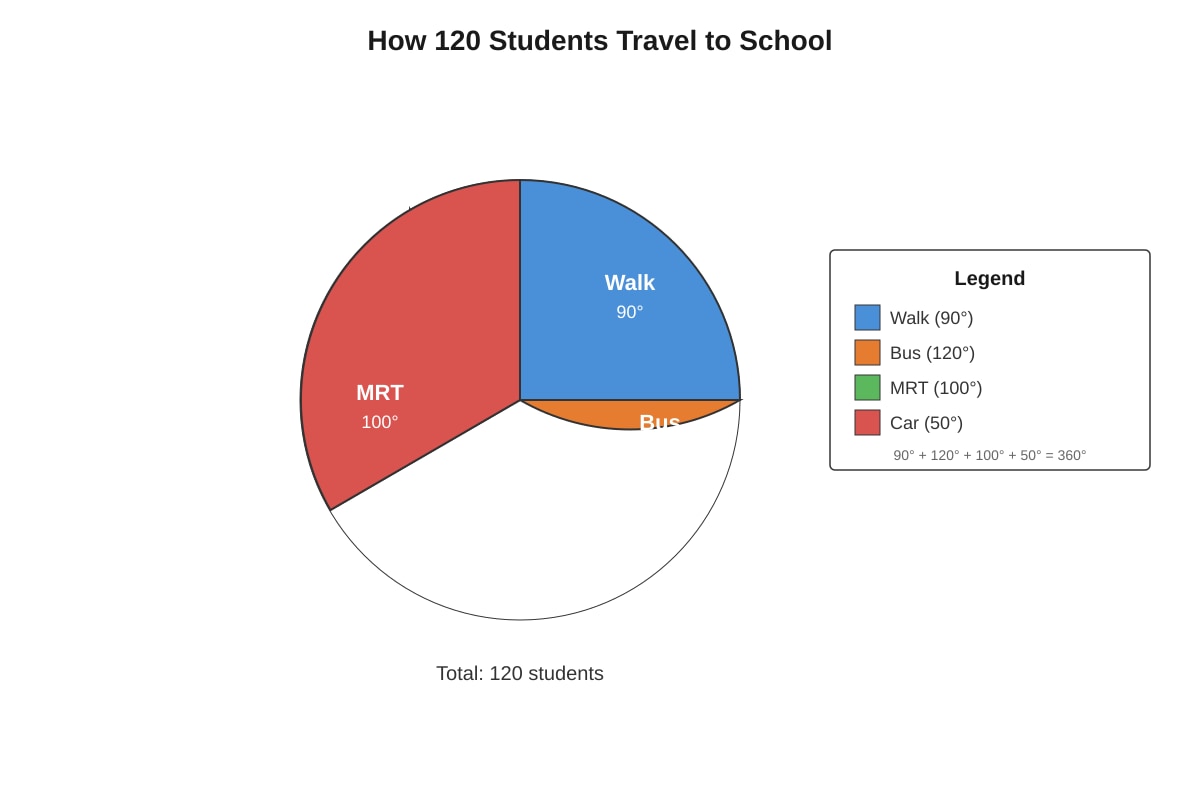
13. The pie chart shows how 120 students travel to school.

<image_placeholder> id: Q13-fig1 type: chart linked_question: Q13 description: Pie chart showing transport modes for 120 students labels: Sectors labelled "Walk" (90°), "Bus" (120°), "MRT" (100°), "Car" (50°) values: Total 120 students, angles given in labels must_show: Clearly labelled sectors with angles, mode of transport labels, indication that total represents 120 students </image_placeholder>

(a) Find the number of students who travel by bus.
(b) Find the angle of the sector representing students who walk to school.
(c) If the information were displayed in a bar chart instead, what would be the height of the bar for "Car" if the bar for "Walk" has height 6 cm?

[3 marks]

Answer: (a) ___________ (b) ___________° (c) ___________ cm


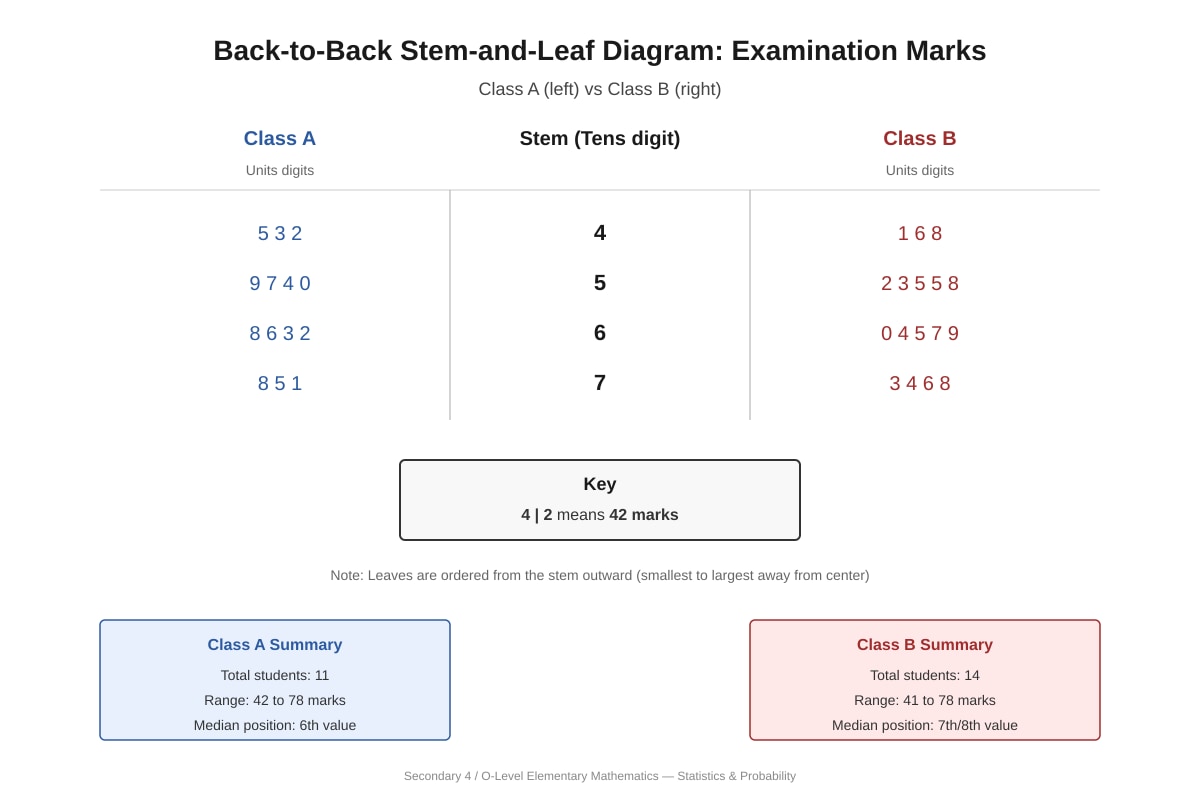
14. The back-to-back stem-and-leaf diagram shows the marks obtained by students in two different classes, Class A and Class B, in the same examination.

<image_placeholder> id: Q14-fig1 type: diagram linked_question: Q14 description: Back-to-back stem-and-leaf diagram for examination marks labels: Stem "Tens digit", leaves "Units digits", Class A on left, Class B on right values: Stem 4: Class A 2,3,5; Class B 1,6,8. Stem 5: Class A 0,4,7,9; Class B 2,3,5,5,8. Stem 6: Class A 2,3,6,8; Class B 0,4,5,7,9. Stem 7: Class A 1,5,8; Class B 3,4,6,8. Key: 4|2 means 42 marks must_show: Clear stem in centre, leaves ordered, title, key explanation, no commas between leaves </image_placeholder>

(a) Write down the number of students in Class A.
(b) Find the median mark for Class B.
(c) Compare the performance of the two classes, giving two reasons.

[3 marks]

Answer: (a) ___________ (b) ___________ (c) _________________________


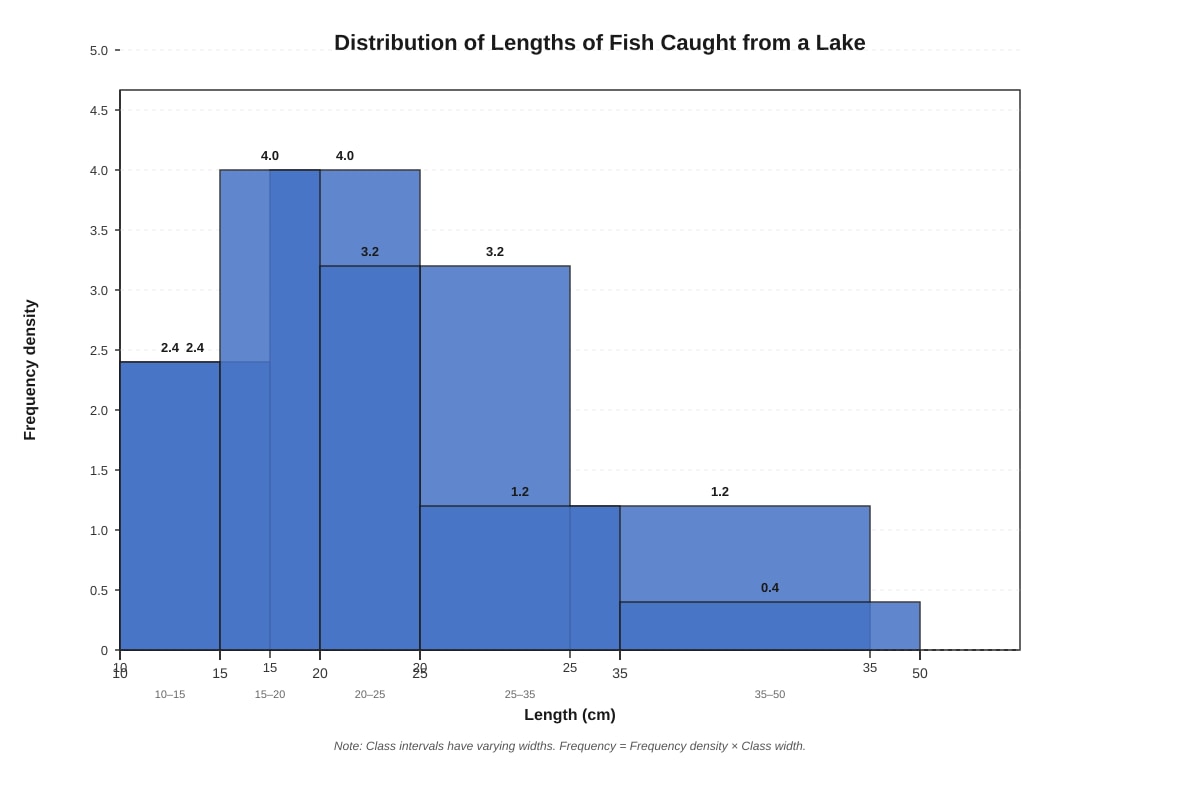
15. The histogram shows the distribution of the lengths of 100 fish caught from a lake.

<image_placeholder> id: Q15-fig1 type: graph linked_question: Q15 description: Histogram of fish lengths with varying class widths labels: x-axis "Length (cm)", y-axis "Frequency density", class intervals marked values: 10-15 cm: freq density 2.4; 15-20 cm: freq density 4.0; 20-25 cm: freq density 3.2; 25-35 cm: freq density 1.2; 35-50 cm: freq density 0.4 must_show: Bars with correct widths proportional to class intervals, labelled axes, frequency density scale, correct bar heights </image_placeholder>

(a) Find the frequency of fish with lengths between 15 cm and 20 cm.
(b) Find the total number of fish with lengths greater than 25 cm.
(c) Explain why the modal class cannot be determined directly from the histogram without calculation.

[2 marks]

Answer: (a) ___________ (b) ___________ (c) _________________________


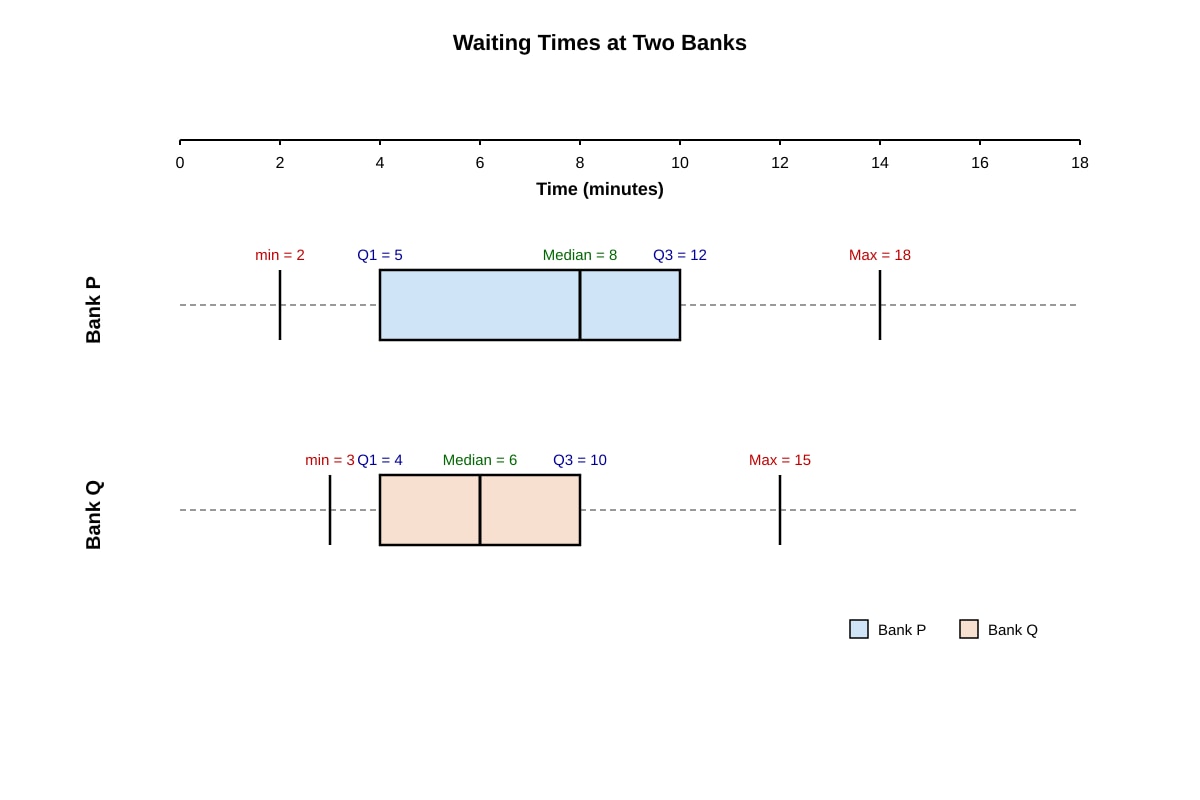
16. The box-and-whisker plot shows the distribution of waiting times (in minutes) at two different banks, Bank P and Bank Q.

<image_placeholder> id: Q16-fig1 type: graph linked_question: Q16 description: Parallel box-and-whisker plots for waiting times at two banks labels: Bank P: min=2, Q1=5, median=8, Q3=12, max=18; Bank Q: min=3, Q1=4, median=6, Q3=10, max=15; y-axis labels "Bank P" and "Bank Q" values: Scale 0 to 20 minutes, all five-number summaries labelled must_show: Two horizontal box plots aligned on same scale, whiskers, boxes with median line, labelled values, minutes unit </image_placeholder>

(a) Find the range and interquartile range for Bank P.
(b) Make two comparisons between the waiting times at the two banks.

[2 marks]

Answer: (a) Range: ___________ min, IQR: ___________ min

(b) _________________________


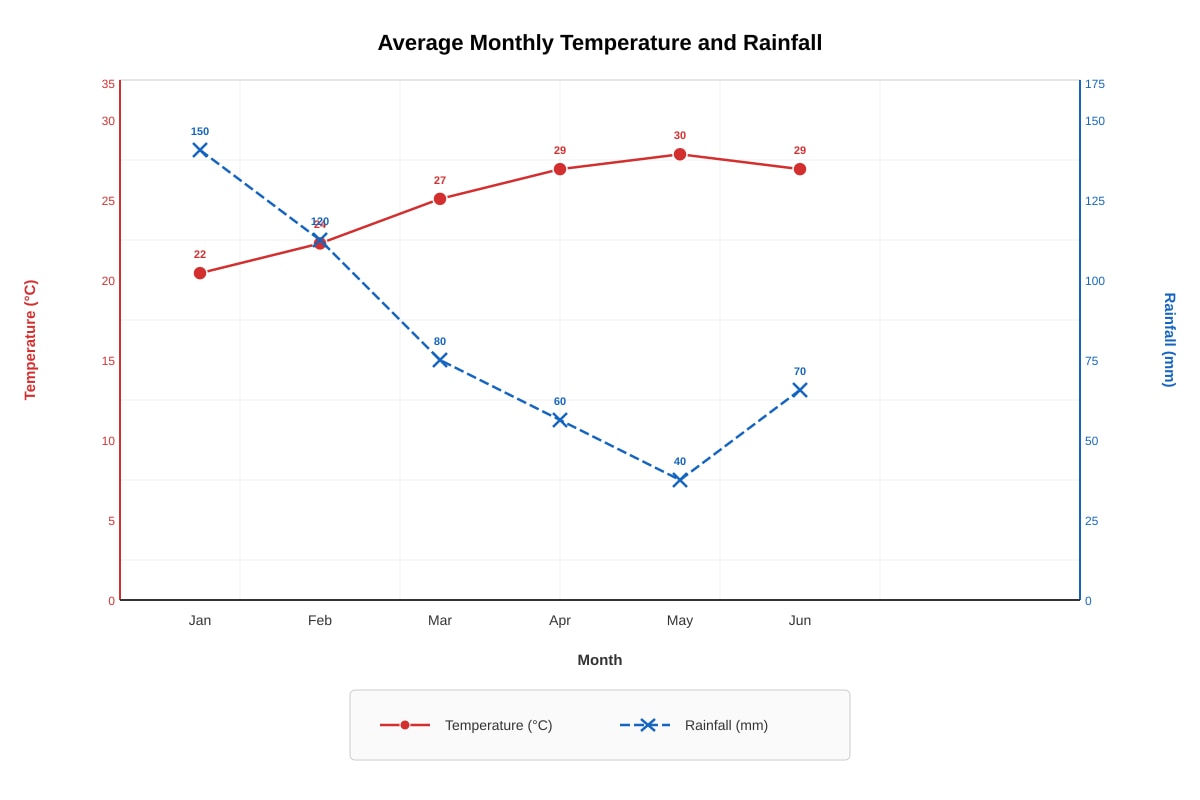
17. The line graph shows the average monthly temperature and the amount of rainfall for a city over 6 months.

<image_placeholder> id: Q17-fig1 type: graph linked_question: Q17 description: Dual-axis line graph showing temperature and rainfall over 6 months labels: x-axis "Month" (Jan-Jun), left y-axis "Temperature (°C)", right y-axis "Rainfall (mm)", Temperature line with circles, Rainfall line with crosses values: Temperature: Jan 22, Feb 24, Mar 27, Apr 29, May 30, Jun 29. Rainfall: Jan 150, Feb 120, Mar 80, Apr 60, May 40, Jun 70 must_show: Two distinct line styles, dual y-axes with scales, monthly labels, legend distinguishing temperature and rainfall, grid lines </image_placeholder>

(a) In which month was the temperature highest?
(b) Describe the relationship between temperature and rainfall shown in the graph.
(c) Calculate the mean rainfall per month over this 6-month period.

[1 mark]

Answer: (a) ___________ (b) _________________________ (c) ___________ mm


Section D: Combined and Conditional Probability (Questions 18–20)

[4 marks]


18. In a survey of 200 people, 120 are female and 80 are male. Of the females, 75 own a smartphone. Of the males, 55 own a smartphone. A person is chosen at random from the 200 people.

(a) Find the probability that the person chosen is a female who does not own a smartphone.
(b) Given that the person chosen owns a smartphone, find the probability that this person is male.

[2 marks]

Answer: (a) ___________ (b) ___________


19. A bag contains 8 white counters and nn black counters. The probability that two counters drawn at random without replacement are both white is 1445\frac{14}{45}.

(a) Show that n2+15n36=0n^2 + 15n - 36 = 0.
(b) Hence find the value of nn.

[2 marks]

Answer: (b) ___________


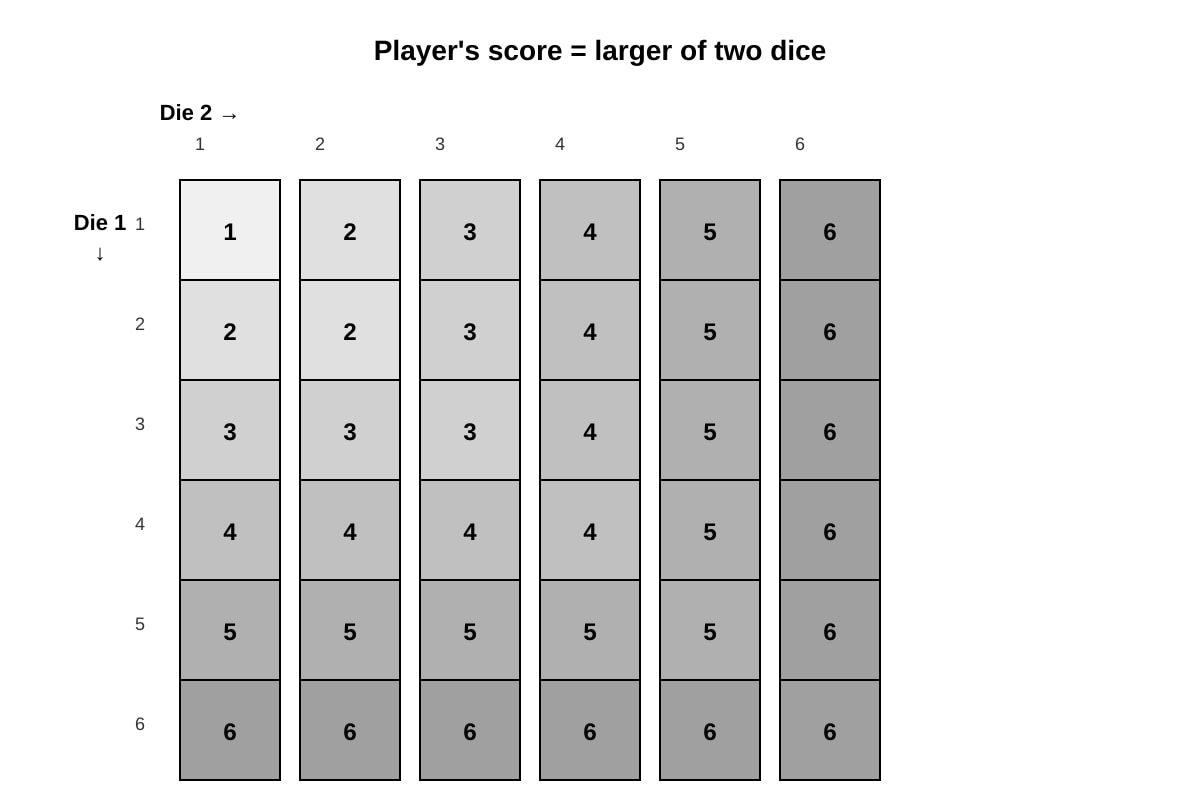
20. In a game, a player rolls two fair six-sided dice simultaneously. The player's score is the larger of the two numbers thrown, or the common value if both numbers are equal.

(a) Complete the possibility diagram showing the player's score for each combination.

<image_placeholder> id: Q20-fig1 type: table linked_question: Q20 description: Possibility diagram (table) for two dice showing maximum score labels: Rows labelled "Die 1" 1-6, columns labelled "Die 2" 1-6, cells show max of row and column values values: Standard 6×6 grid, each cell contains max(row value, column value) must_show: Clear row and column headers, all 36 cells filled with correct maximum values, title "Player's score = larger of two dice" </image_placeholder>

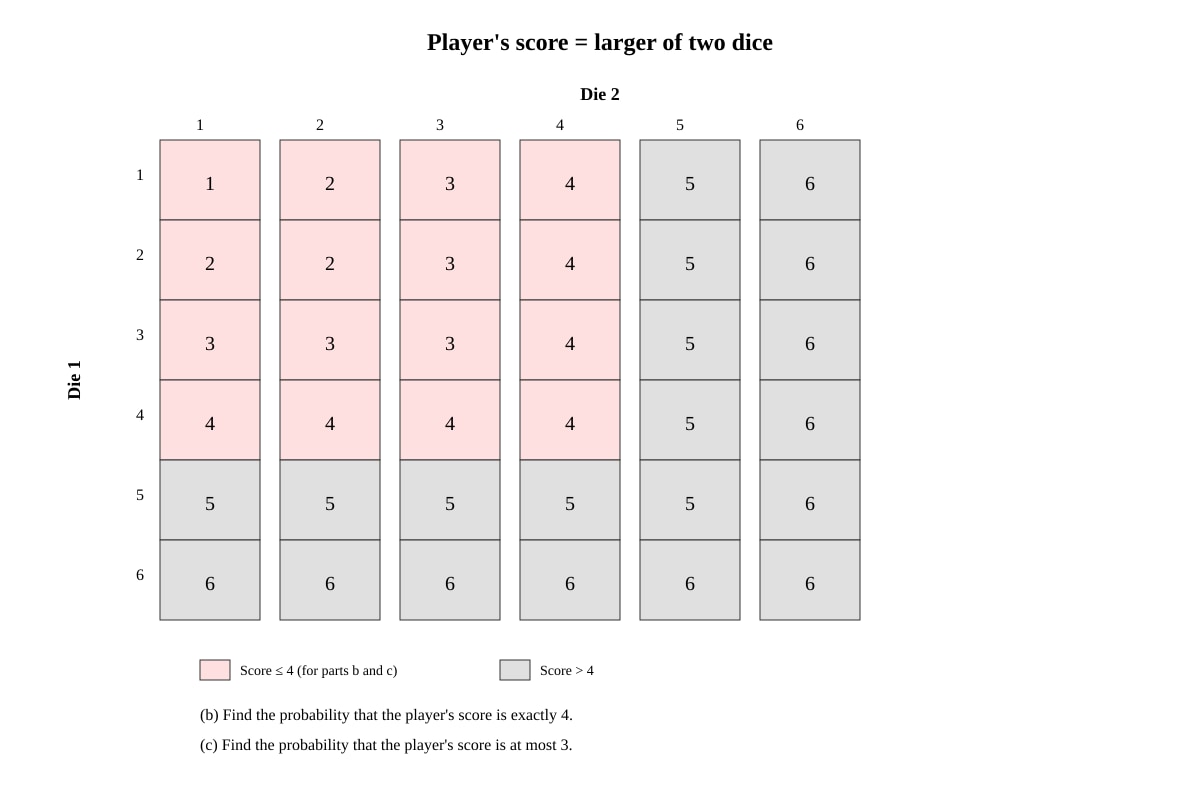
(b) Find the probability that the player's score is exactly 4.
(c) Find the probability that the player's score is at most 3.

<image_placeholder> id: Q20-fig2 type: table linked_question: Q20 description: Completed possibility diagram with highlighted cells for scores of 4 or less labels: Same as Q20-fig1 but with cells for score ≤ 4 highlighted or marked values: Highlight pattern showing all cells where max(row, column) = 4 or max(row, column) ≤ 3 must_show: Same structure as first table, with visual indication of relevant cells for parts (b) and (c) </image_placeholder>

[2 marks]

Answer: (b) ___________ (c) ___________


END OF QUIZ

Answers

<!-- TuitionGoWhere generation metadata: stage=3-0; model=moonshotai/kimi-k2.6:free; model_label=Kimi K2.6 Free; generated=2026-06-10; Sources: Stage 2-1 real exam-derived templates and Stage 2-2 exam-enriched syllabus. -->

Secondary 4 Elementary Mathematics Quiz - Statistics Probability: Answer Key

Total Marks: 40


Section A: Data Analysis and Measures of Central Tendency


1. [4 marks]

Given data: 52, 48, 65, 72, 48, 55, 61, 48, 78, 64, 55, 80, 55, 67, 55

(a) Mode and Median [2 marks]

Method: The mode is the most frequent value. The median is the middle value when data is ordered.

Ordered data: 48, 48, 48, 52, 55, 55, 55, 55, 61, 64, 65, 67, 72, 78, 80

  • Mode = 55 (appears 4 times, most frequent) [1 mark]
  • Median = 55 (8th value out of 15, i.e. the middle position 15+12=8\frac{15+1}{2} = 8) [1 mark]

Common mistake: Forgetting to order data before finding median, or confusing mode with mean.


(b) Mean mark [1 mark]

Mean=Sum of all valuesNumber of values=48+48+48+52+55+55+55+55+61+64+65+67+72+78+8015\text{Mean} = \frac{\text{Sum of all values}}{\text{Number of values}} = \frac{48+48+48+52+55+55+55+55+61+64+65+67+72+78+80}{15}

=90315=60.2= \frac{903}{15} = \mathbf{60.2} [1 mark]


(c) Total marks of other 25 students [1 mark]

Total marks of 40 students = 40×62.5=250040 \times 62.5 = 2500

Total marks of 15 students = 903 (from part b)

Total marks of other 25 students = 2500903=15972500 - 903 = \mathbf{1597} [1 mark]

Teaching note: The mean of combined groups is NOT the average of the two means unless the groups are equal in size. Always work with totals.


2. [3 marks]

Expected visual features: Smooth cumulative frequency curve passing through (40,2), (45,8), (50,22), (55,45), (60,62), (65,74), (70,80). Median at cumulative frequency 40 (half of 80), lower quartile at 20, upper quartile at 60.

(a) Median mass [1 mark]

At cumulative frequency 40, read across to curve then down to x-axis: approximately 54-55 kg (accept ~54.5 kg)

(b) Interquartile range [1 mark]

  • Lower quartile Q1Q_1: at cumulative frequency 20, approximately 50 kg
  • Upper quartile Q3Q_3: at cumulative frequency 60, approximately 58 kg

IQR=Q3Q15850=8 kg\text{IQR} = Q_3 - Q_1 \approx 58 - 50 = \mathbf{8 \text{ kg}} (accept 7-9 kg)

(c) Percentage with mass > 58 kg [1 mark]

At 58 kg, cumulative frequency ≈ 62. Number above 58 kg = 8062=1880 - 62 = 18

Percentage=1880×100%=22.5%\text{Percentage} = \frac{18}{80} \times 100\% = \mathbf{22.5\%} (accept 20-25% depending on graph reading)

Marking note: Allow ±1 kg for readings from curve; method marks awarded for correct procedure even with slight reading errors.


3. [4 marks]

(a) Modal class [1 mark]

The modal class is the class with the highest frequency: 800x<1000800 \leq x < 1000 [1 mark]


(b) Estimated mean [2 marks]

ClassMid-value (xx)Frequency (ff)fxfx
400 ≤ x < 60050084000
600 ≤ x < 800700149800
800 ≤ x < 10009002219800
1000 ≤ x < 120011001213200
1200 ≤ x < 1400130045200
Total6052000

Estimated mean=fxf=5200060=866.67$867 (3 sf)\text{Estimated mean} = \frac{\sum fx}{\sum f} = \frac{52000}{60} = \mathbf{866.67} \approx \mathbf{\$867} \text{ (3 sf)} [2 marks]

Method mark: Correct mid-values and attempt at fxf\frac{\sum fx}{\sum f}. Accuracy mark: Correct calculation.


(c) Why the mean is an estimate [1 mark]

The exact values of individual data within each class are not known; we only know they fall within intervals. Using mid-values assumes values are evenly distributed within each class, which may not be true. [1 mark]


4. [2 marks]

(a) Finding kk [1 mark]

3+7+8+12+k5=8\frac{3+7+8+12+k}{5} = 8

30+k=4030 + k = 40

k=10k = \mathbf{10} [1 mark]


(b) New mean with 16 added [1 mark]

New sum = 40+16=5640 + 16 = 56; new count = 6

New mean=566=9.33 (3 sf)\text{New mean} = \frac{56}{6} = \mathbf{9.33} \text{ (3 sf)} or exactly 283\frac{28}{3} [1 mark]


5. [3 marks]

(a) Mean [1 mark]

xˉ=xn=24010=24\bar{x} = \frac{\sum x}{n} = \frac{240}{10} = \mathbf{24} [1 mark]


(b) Standard deviation [1 mark]

σ=x2nxˉ2=725010242=725576=149=12.2 (3 sf)\sigma = \sqrt{\frac{\sum x^2}{n} - \bar{x}^2} = \sqrt{\frac{7250}{10} - 24^2} = \sqrt{725 - 576} = \sqrt{149} = \mathbf{12.2} \text{ (3 sf)} [1 mark]

Formula note: This is the population standard deviation. For sample standard deviation, divide by n1n-1, but for Sec 4 E-Math, population SD is standard unless specified.


(c) New mean and new SD after transformation [1 mark]

Transformation: y=2x+3y = 2x + 3

  • New mean = 2×24+3=512 \times 24 + 3 = \mathbf{51} [0.5 mark]
  • New SD = 2×12.2=24.42 \times 12.2 = \mathbf{24.4} (SD is multiplied by 2 only; adding 3 does not affect spread) [0.5 mark]

Teaching note: For y=ax+by = ax + b: new mean = axˉ+ba\bar{x} + b, new SD = a×|a| \times old SD (adding constant doesn't change spread).


Section B: Probability


6. [3 marks]

Sample space: There are 6×2=126 \times 2 = 12 equally likely outcomes.

All outcomes: (1,H), (1,T), (2,H), (2,T), (3,H), (3,T), (4,H), (4,T), (5,H), (5,T), (6,H), (6,T) [1 mark for complete list]

(b) P(even and head) [1 mark]

Even numbers: 2, 4, 6. Favourable: (2,H), (4,H), (6,H)

P=312=14P = \frac{3}{12} = \mathbf{\frac{1}{4}} [1 mark]

(c) P(>4 or tail or both) [1 mark]

Method 1 — Direct: Numbers > 4: 5, 6. Tail on coin: any number with T.

  • (5,H), (6,H), (1,T), (2,T), (3,T), (4,T), (5,T), (6,T): 8 outcomes... wait, let's be careful.

Better — Complement or direct count:

  • 4: 5, 6 → (5,H), (5,T), (6,H), (6,T)

  • Tail: (1,T), (2,T), (3,T), (4,T), (5,T), (6,T)

Union: (5,H), (6,H), (1,T), (2,T), (3,T), (4,T), (5,T), (6,T) = 8 outcomes

No — let's use formula: P(>4 or T)=P(>4)+P(T)P(>4 and T)=412+612212=812=23P(>4 \text{ or } T) = P(>4) + P(T) - P(>4 \text{ and } T) = \frac{4}{12} + \frac{6}{12} - \frac{2}{12} = \frac{8}{12} = \mathbf{\frac{2}{3}} [1 mark]


7. [4 marks]

(a) Tree diagram [1 mark]

Expected structure:

  • First branch: R (5/10), B (3/10), G (2/10)
  • From R: R (4/9), B (3/9), G (2/9)
  • From B: R (5/9), B (2/9), G (2/9)
  • From G: R (5/9), B (3/9), G (1/9)

(b) P(same colour) [2 marks]

P(RR)=510×49=2090P(\text{RR}) = \frac{5}{10} \times \frac{4}{9} = \frac{20}{90}

P(BB)=310×29=690P(\text{BB}) = \frac{3}{10} \times \frac{2}{9} = \frac{6}{90}

P(GG)=210×19=290P(\text{GG}) = \frac{2}{10} \times \frac{1}{9} = \frac{2}{90}

P(same colour)=20+6+290=2890=1445P(\text{same colour}) = \frac{20+6+2}{90} = \frac{28}{90} = \mathbf{\frac{14}{45}} [2 marks]


(c) P(at least one red) [1 mark]

Method — Complement: 1P(no red)1 - P(\text{no red})

P(no red)=P(BB)+P(BG)+P(GB)+P(GG)P(\text{no red}) = P(\text{BB}) + P(\text{BG}) + P(\text{GB}) + P(\text{GG})... or simpler: second draw from non-reds.

First draw not red: 5/10, then second not red: 4/9. Or:

P(at least one R)=1510×49=12090=7090=79P(\text{at least one R}) = 1 - \frac{5}{10} \times \frac{4}{9} = 1 - \frac{20}{90} = \frac{70}{90} = \mathbf{\frac{7}{9}} [1 mark]

Alternatively: P(RR)+P(RB)+P(RG)+P(BR)+P(GR)=20+15+10+15+1090=7090=79P(\text{RR}) + P(\text{RB}) + P(\text{RG}) + P(\text{BR}) + P(\text{GR}) = \frac{20+15+10+15+10}{90} = \frac{70}{90} = \frac{7}{9}


8. [3 marks]

Venn diagram approach: Let xx = both basketball and tennis.

Total = Basketball only + Tennis only + Both + Neither 30=(18x)+(15x)+x+730 = (18-x) + (15-x) + x + 7 30=40x30 = 40 - x x=10x = 10

(a) Both sports [1 mark]

10 students play both basketball and tennis. [1 mark]


(b) P(basketball only) [1 mark]

Basketball only = 1810=818 - 10 = 8

P=830=415P = \frac{8}{30} = \mathbf{\frac{4}{15}} [1 mark]


(c) P(basketball | tennis) [1 mark]

P(BT)=P(B and T)P(T)=10301530=1015=23P(\text{B}|\text{T}) = \frac{P(\text{B and T})}{P(\text{T})} = \frac{\frac{10}{30}}{\frac{15}{30}} = \frac{10}{15} = \mathbf{\frac{2}{3}}

Or directly: of 15 tennis players, 10 also play basketball: 1015=23\frac{10}{15} = \frac{2}{3} [1 mark]


9. [2 marks]

(a) P(AB)P(A \cap B) [1 mark]

Using: P(AB)=P(A)+P(B)P(AB)P(A \cup B) = P(A) + P(B) - P(A \cap B)

0.85=0.6+0.5P(AB)0.85 = 0.6 + 0.5 - P(A \cap B)

P(AB)=1.10.85=0.25P(A \cap B) = 1.1 - 0.85 = \mathbf{0.25} [1 mark]


(b) Independent? [1 mark]

For independence: P(A)×P(B)=P(AB)P(A) \times P(B) = P(A \cap B)

P(A)×P(B)=0.6×0.5=0.3P(A) \times P(B) = 0.6 \times 0.5 = 0.3

P(AB)=0.250.3P(A \cap B) = 0.25 \neq 0.3

Not independent because P(A)×P(B)P(AB)P(A) \times P(B) \neq P(A \cap B) [1 mark]


10. [3 marks]

(a) Tree diagram [1 mark]

Expected structure:

  • First branch: Rain (2/5), No rain (3/5)
  • From Rain: Umbrella (4/5), No umbrella (1/5)
  • From No rain: Umbrella (1/10), No umbrella (9/10)

(b) P(carry umbrella) [1 mark]

P(Umbrella)=25×45+35×110=825+350=16+350=1950=0.38P(\text{Umbrella}) = \frac{2}{5} \times \frac{4}{5} + \frac{3}{5} \times \frac{1}{10} = \frac{8}{25} + \frac{3}{50} = \frac{16+3}{50} = \frac{19}{50} = \mathbf{0.38} [1 mark]


(c) P(no rain | umbrella) [1 mark]

P(No rainUmbrella)=P(No rain and Umbrella)P(Umbrella)=35×1101950=3501950=319P(\text{No rain}|\text{Umbrella}) = \frac{P(\text{No rain and Umbrella})}{P(\text{Umbrella})} = \frac{\frac{3}{5} \times \frac{1}{10}}{\frac{19}{50}} = \frac{\frac{3}{50}}{\frac{19}{50}} = \mathbf{\frac{3}{19}} [1 mark]


11. [2 marks]

(a) All 8 outcomes: HHH, HHT, HTH, HTT, THH, THT, TTH, TTT [not separately marked but required]

(b) P(exactly two heads) [1 mark]

Favourable: HHT, HTH, THH — 3 outcomes

P=38P = \mathbf{\frac{3}{8}} [1 mark]

(c) P(at least one head) [1 mark]

Complement: 1P(TTT)=118=781 - P(\text{TTT}) = 1 - \frac{1}{8} = \mathbf{\frac{7}{8}} [1 mark]


12. [2 marks]

Total outcomes: 4×4=164 \times 4 = 16

(a) P(sum = 6) [1 mark]

Favourable: (2,4), (3,3), (4,2) — 3 outcomes

P=316P = \mathbf{\frac{3}{16}} [1 mark]

(b) P(spinner > die) [1 mark]

Favourable: (2,1), (3,1), (3,2), (4,1), (4,2), (4,3) — 6 outcomes

P=616=38P = \frac{6}{16} = \mathbf{\frac{3}{8}} [1 mark]


Section C: Statistical Diagrams and Interpretation


13. [3 marks]

Expected visual: Pie chart with angles: Walk 90°, Bus 120°, MRT 100°, Car 50° (total 360°)

(a) Number by bus [1 mark]

Bus=120°360°×120=40 students\text{Bus} = \frac{120°}{360°} \times 120 = \mathbf{40 \text{ students}} [1 mark]

(b) Angle for walk [1 mark]

Already given as 90° in diagram (or verify: walk = 120 - 40 - (100360×120\frac{100}{360} \times 120 = 33.3) - (50360×120\frac{50}{360} \times 120 = 16.7)... actually from given: walk students = 90360×120=30\frac{90}{360} \times 120 = 30). Angle is 90° [1 mark]


(c) Height of bar for Car [1 mark]

Walk: 30 students → 6 cm, so scale is 5 students per cm.

Car: 50°360°×120=50316.67\frac{50°}{360°} \times 120 = \frac{50}{3} \approx 16.67 students... wait let me check: total should be 120.

Actually: walk = 90/360 × 120 = 30, bus = 120/360 × 120 = 40, MRT = 100/360 × 120 = 33.33... this doesn't give whole numbers. The problem states angles, so we work with given info.

Height proportional to frequency: CarWalk=50°90°=59\frac{\text{Car}}{\text{Walk}} = \frac{50°}{90°} = \frac{5}{9}

Height for Car = 59×6=103=3.33\frac{5}{9} \times 6 = \mathbf{\frac{10}{3}} = 3.33 cm [1 mark]

Or if using actual count assuming rounded: Car ≈ 16.7 students, Walk = 30, ratio ≈ 5:9, height ≈ 3.33 cm.


14. [3 marks]

Expected visual: Back-to-back stem-and-leaf with Class A: 42,43,45, 50,54,57,59, 62,63,66,68, 71,75,78 (14 students) Class B: 41,46,48, 52,53,55,55,58, 60,64,65,67,69, 73,74,76,78 (17 students)

(a) Students in Class A [1 mark]

Count leaves: 14 students [1 mark]


(b) Median for Class B [1 mark]

17 values: median is 9th value. Ordered: 41, 46, 48, 52, 53, 55, 55, 58, 60, 64, 65, 67, 69, 73, 74, 76, 78

Median = 60 marks [1 mark]


(c) Two comparisons [1 mark]

  • Central tendency: Class B has higher median (60 vs Class A median of 63... let me recheck Class A: 14 values, median is average of 7th and 8th = (59+62)/2 = 60.5. Class B median = 60. So medians are similar, OR Class A slightly higher.
  • Spread: Class B has wider range (78-41 = 37) vs Class A (78-42 = 36), similar. Class B IQR: Q1 = 53, Q3 = 67, IQR = 14. Class A Q1 = 50, Q3 = 66, IQR = 16. So Class A slightly more spread out.
  • Performance: Generally similar, but Class B has more students (17 vs 14).

Any two valid, supported comparisons: [1 mark]


15. [2 marks]

Expected visual: Histogram with frequency densities: 10-15 (width 5, fd 2.4), 15-20 (width 5, fd 4.0), 20-25 (width 5, fd 3.2), 25-35 (width 10, fd 1.2), 35-50 (width 15, fd 0.4)

(a) Frequency 15-20 cm [1 mark]

Frequency = frequency density × class width = 4.0×5=20 fish4.0 \times 5 = \mathbf{20 \text{ fish}} [1 mark]


(b) Number > 25 cm [1 mark]

25-35 cm: 1.2×10=121.2 \times 10 = 12 35-50 cm: 0.4×15=60.4 \times 15 = 6

Total = 12+6=18 fish12 + 6 = \mathbf{18 \text{ fish}} [1 mark]


(c) Why modal class needs calculation [1 mark]

The modal class is the class with the highest frequency, not highest frequency density. Since class widths vary, a class with high frequency density but narrow width may have lower actual frequency than a wider class with lower density. [1 mark]

Example: 15-20 cm has fd 4.0, width 5, frequency = 20. But 25-35 cm has fd 1.2, width 10, frequency = 12. Need to calculate frequencies to compare.


16. [2 marks]

Expected visual: Box plots with Bank P: min=2, Q1=5, med=8, Q3=12, max=18; Bank Q: min=3, Q1=4, med=6, Q3=10, max=15

(a) Range and IQR for Bank P [1 mark]

  • Range = 182=1618 - 2 = \mathbf{16} min [0.5 mark]
  • IQR = 125=712 - 5 = \mathbf{7} min [0.5 mark]

(b) Two comparisons [1 mark]

  • Median waiting time: Bank P's median (8 min) > Bank Q's median (6 min), so Bank P typically has longer waits.
  • Spread: Bank P has larger range (16 vs 12) and larger IQR (7 vs 6), so waiting times at Bank P are more variable.
  • Consistency: Bank Q is more consistent with generally shorter waits.

Any two valid comparisons: [1 mark]


17. [1 mark]

Expected visual: Dual line graph; temperature peaks in May at 30°C.

(a) Highest temperature [0 mark embedded in total]

May [no separate mark]


(b) Relationship [0.5 mark]

As temperature increases from January to May, rainfall decreases (negative correlation). Rainfall increases slightly in June as temperature drops slightly. [0.5 mark]


(c) Mean rainfall [0.5 mark]

Mean=150+120+80+60+40+706=5206=86.7 mm (3 sf)\text{Mean} = \frac{150+120+80+60+40+70}{6} = \frac{520}{6} = \mathbf{86.7 \text{ mm}} \text{ (3 sf)} [0.5 mark]


Section D: Combined and Conditional Probability


18. [2 marks]

Table of information:

SmartphoneNo smartphoneTotal
Female7545120
Male552580
Total13070200

(a) P(female and no smartphone) [1 mark]

P=45200=940=0.225P = \frac{45}{200} = \mathbf{\frac{9}{40}} = 0.225 [1 mark]


(b) P(male | smartphone) [1 mark]

P=55130=1126P = \frac{55}{130} = \mathbf{\frac{11}{26}} or ≈ 0.423 [1 mark]


19. [2 marks]

(a) Showing n2+15n36=0n^2 + 15n - 36 = 0 [1 mark]

Total counters: 8+n8 + n

P(WW)=88+n×77+n=1445P(\text{WW}) = \frac{8}{8+n} \times \frac{7}{7+n} = \frac{14}{45}

56(8+n)(7+n)=1445\frac{56}{(8+n)(7+n)} = \frac{14}{45}

Cross multiply: 56×45=14×(8+n)(7+n)56 \times 45 = 14 \times (8+n)(7+n)

2520=14(56+15n+n2)2520 = 14(56 + 15n + n^2)

180=56+15n+n2180 = 56 + 15n + n^2

n2+15n+56180=0n^2 + 15n + 56 - 180 = 0

n2+15n36=0n^2 + 15n - 36 = 0 [1 mark] ✓


(b) Solving for nn [1 mark]

(n+18)(n3)=0(n+18)(n-3) = 0 (or quadratic formula)

n=18n = -18 (reject, since n0n \geq 0) or n=3n = \mathbf{3} [1 mark]


20. [2 marks]

Expected visual: 6×6 table with cell (i,j) showing max(i,j)

(a) Table completed with max values [not separately marked]


(b) P(score = 4) [1 mark]

Score = 4 when: max = 4. This occurs when both ≤ 4 and at least one = 4.

  • Both = 4: (4,4)
  • One = 4, other < 4: (4,1), (4,2), (4,3), (1,4), (2,4), (3,4)

Total favourable: 7 cells

Wait — let me recount using the table structure:

Cells where max = 4:

  • Row 4: max(4,1)=4, max(4,2)=4, max(4,3)=4, max(4,4)=4, max(4,5)=5, max(4,6)=6 → 4 cells
  • Rows 1,2,3 with column 4: max(1,4)=4, max(2,4)=4, max(3,4)=4 → 3 cells (excluding row 4 already counted)

Total: 7 cells? But (4,4) counted once. So 4 + 3 = 7.

Actually let's be systematic. |Die 2 values across, Die 1 values down|:

For max(i,j) = 4: need all cells where largest entry is exactly 4.

  • (4,1), (4,2), (4,3), (4,4), (1,4), (2,4), (3,4)

That's 7 cells out of 36.

P(score=4)=736P(\text{score} = 4) = \mathbf{\frac{7}{36}} [1 mark]

Wait — let me verify: (4,5), (4,6), (5,4), (6,4) all give max > 4. Yes.


(c) P(score ≤ 3) [1 mark]

Score ≤ 3 means max ≤ 3, so both dice ≤ 3. Favourable cells: 3 × 3 = 9 cells: (1,1), (1,2), (1,3), (2,1), (2,2), (2,3), (3,1), (3,2), (3,3)

P=936=14P = \frac{9}{36} = \mathbf{\frac{1}{4}} [1 mark]


END OF ANSWER KEY