From Real Exams Quiz
Secondary 4 Elementary Mathematics Graphs Coordinate Geometry Quiz
Free Sec 4 E Maths Graphs Geometry quiz, HY3 Exam version, with questions, answers, and O Level-style practice for Singapore students.
These static practice materials are generated from the site's syllabus and paper-generation workflow, with source and model context shown so students and parents can evaluate the material before use.
Questions
Secondary 4 Elementary Mathematics Quiz - Graphs Coordinate Geometry
Name: ___________________________
Class: ____________
Date: ____________
Score: ____________ / 40
Duration: 60 minutes
Total Marks: 40
Instructions:
- Answer all 20 questions.
- Show your working clearly where required.
- Use a ruler and graph paper if needed.
- Write your answers in the spaces provided.
Section A (Questions 1–5) — Short Answer [10 marks]
1. The points A(2,3) and B(6,7) lie on a straight line. Find the gradient of line AB. [2]
2. Write down the coordinates of the midpoint of the line segment joining P(−4,2) and Q(6,−8). [2]
3. A line has equation y=3x−5. What is the y-intercept of this line? [1]
4. The point R(1,−2) lies on the circle with centre C(4,2). Find the radius of the circle. [2]
5. State the equation of a line parallel to y=2x+1 that passes through the origin. [1]
Section B (Questions 6–10) — Structured Response [10 marks]
6. The vertices of triangle ABC are A(1,1), B(5,1) and C(1,4).
(a) Find the length of AB. [1]
(b) Find the length of AC. [1]
(c) Show that ∠BAC=90∘. [1]
7. A straight line passes through (0,4) and (3,0).
(a) Find its gradient. [1]
(b) Write down its equation in the form y=mx+c. [1]
(c) Find the x-intercept. [1]
8. The line L has equation 2x−y=3.
(a) Rearrange to make y the subject. [1]
(b) Hence state the gradient of L. [1]
9. Points D(2,3), E(8,3) and F(5,9) form a triangle.
(a) Find the midpoint of DE. [1]
(b) Find the length of the median from F to DE. [2]
10. The graph of y=x2−4x+3 crosses the x-axis at two points.
(a) Factorise x2−4x+3. [1]
(b) Write down the coordinates of the two x-intercepts. [2]
Section C (Questions 11–15) — Graph Interpretation [10 marks]
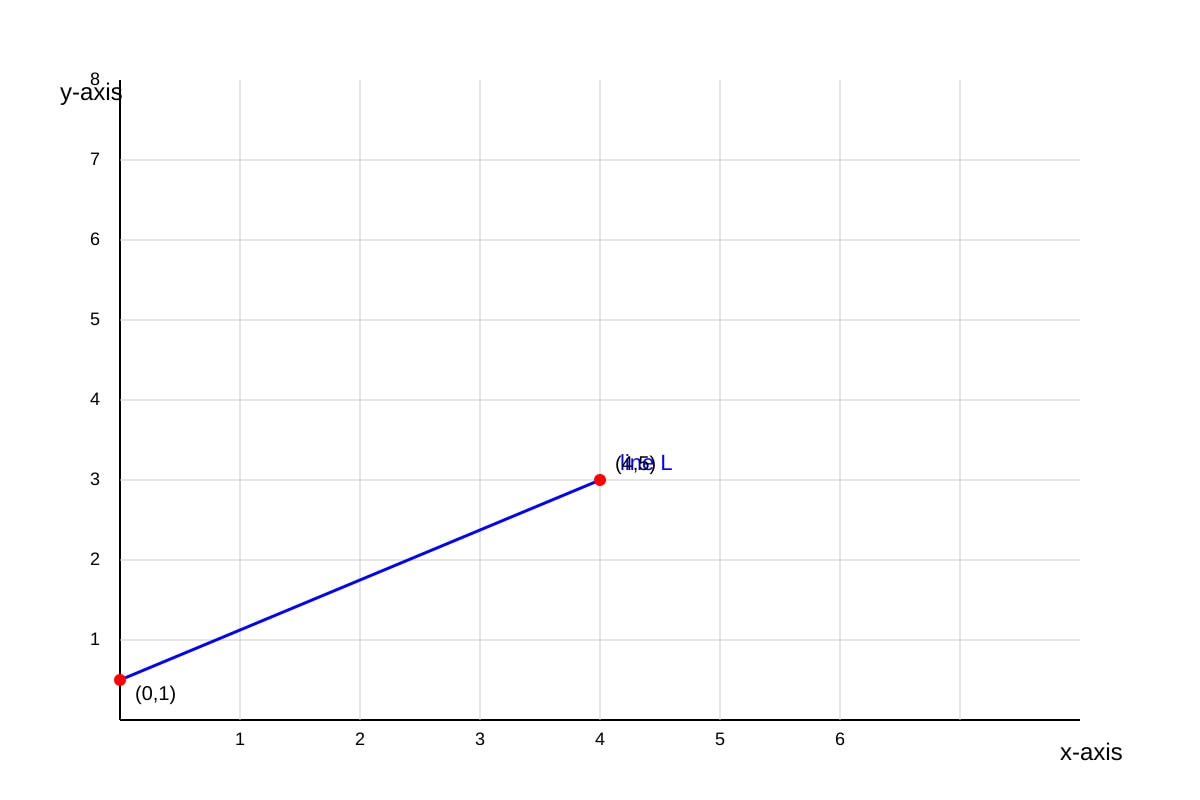
Image pending generation: graph for Q11.
11. Using the graph above, find the gradient of line L. [2]
Image pending generation: graph for Q12.
12. From the graph shown, write down the equation of the parabola in the form y=(x−a)(x−b). [2]
13. A distance-time graph is a straight line from (0,0) to (5,20) where distance is in km and time in hours. Find the speed represented by the graph. [2]
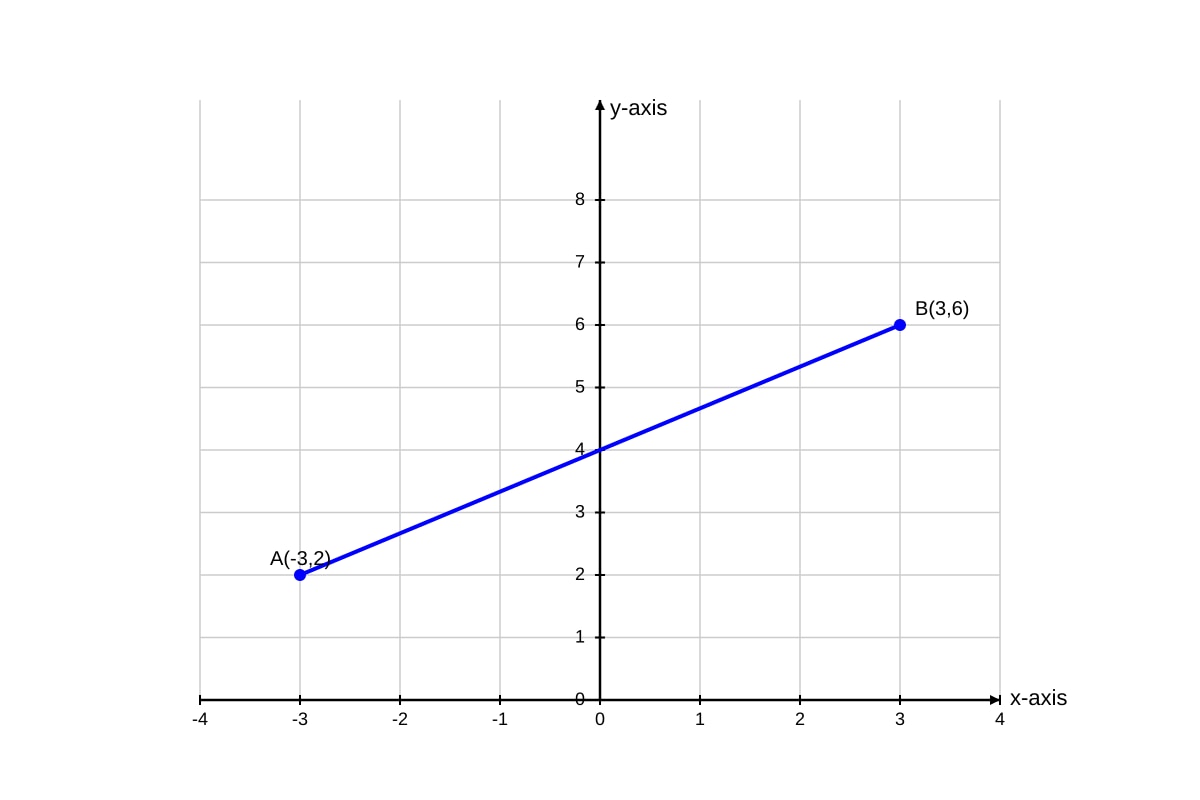
Image pending generation: graph for Q14.
14. Using the graph, find the length of segment AB. [2]
15. The point M is the midpoint of PQ where P(0,0) and Q(4,6). A line through M is parallel to the y-axis. Write the equation of this line. [2]
Section D (Questions 16–20) — Extended Problems [10 marks]
16. Triangle XYZ has vertices X(0,0), Y(6,0), Z(0,8).
(a) Find the length of YZ. [2]
(b) Find the area of triangle XYZ. [1]
17. A line passes through A(1,2) and is perpendicular to the line y=21x+3.
(a) State the gradient of the perpendicular line. [1]
(b) Find the equation of the line through A. [2]
18. The points P(2,1), Q(10,1) and R(6,7) form a triangle.
(a) Show that PQ is horizontal. [1]
(b) Find the perpendicular distance from R to PQ. [1]
(c) Hence find the area of △PQR. [1]
19. The circle centre is (3,−2) and radius is 5. Write down the equation of the circle in the form (x−a)2+(y−b)2=r2. [2]
20. A quadratic graph has vertex (1,4) and passes through (0,2).
(a) Write its equation in the form y=a(x−h)2+k. [1]
(b) Find the value of a. [1]
Answers
Answer Key — Secondary 4 Elementary Mathematics Quiz: Graphs Coordinate Geometry
Total Marks: 40
Topic: Graphs & Coordinate Geometry
Section A (Q1–5)
Q1. Gradient = 6−27−3=44=1. [2]
Teaching note: Gradient formula m=x2−x1y2−y1. Subtract y's then x's in same order. Common mistake: reversing order for x and y.
Q2. Midpoint = (2−4+6,22+(−8))=(1,−3). [2]
Teaching note: Midpoint averages the x-coordinates and y-coordinates.
Q3. y-intercept = −5. [1]
Teaching note: In y=mx+c, c is the y-intercept (value of y when x=0).
Q4. Radius = (4−1)2+(2−(−2))2=32+42=25=5. [2]
Teaching note: Radius is distance from centre to any point on circle. Use distance formula.
Q5. y=2x. [1]
Teaching note: Parallel lines have same gradient (m=2). Through origin means c=0.
Section B (Q6–10)
Q6.
(a) AB=∣5−1∣=4 (same y). [1]
(b) AC=∣4−1∣=3 (same x). [1]
(c) AB horizontal, AC vertical → perpendicular → ∠BAC=90∘. [1]
Teaching note: Lines with same y are horizontal; same x are vertical; they meet at right angle.
Q7.
(a) m=3−00−4=−34. [1]
(b) y=−34x+4. [1]
(c) x-intercept: set y=0 → 0=−34x+4 → x=3. [1]
Teaching note: y-intercept given by point (0,4); solve for x when y=0.
Q8.
(a) y=2x−3. [1]
(b) Gradient = 2. [1]
Teaching note: Rearranging to y=mx+c reveals gradient m.
Q9.
(a) Midpoint of DE=(22+8,23+3)=(5,3). [1]
(b) Median length = (5−5)2+(9−3)2=6. [2]
Teaching note: Median joins vertex to midpoint of opposite side.
Q10.
(a) x2−4x+3=(x−1)(x−3). [1]
(b) x-intercepts: (1,0) and (3,0). [2]
Teaching note: Set y=0; roots from factors give x-values.
Section C (Q11–15)
Q11. From graph, line through (0,1) and (4,5): m=4−05−1=1. [2]
Teaching note: Read two clear points from graph; apply gradient formula.
Q12. x-intercepts at 1 and 3 → y=(x−1)(x−3). [2]
Teaching note: Factored form uses roots a,b as (x−a)(x−b).
Q13. Speed = 5−020−0=4 km/h. [2]
Teaching note: On distance-time graph, gradient = speed.
Q14. Length AB=(3−(−3))2+(6−2)2=62+42=52=213. [2]
Teaching note: Distance formula from plotted points.
Q15. Midpoint M=(2,3). Vertical line → x=2. [2]
Teaching note: Parallel to y-axis means constant x.
Section D (Q16–20)
Q16.
(a) YZ=(6−0)2+(0−8)2=36+64=10. [2]
(b) Area = 21×6×8=24 sq units. [1]
Teaching note: Right triangle at origin; legs 6 and 8.
Q17.
(a) Perpendicular gradient = −2 (negative reciprocal of 21). [1]
(b) y−2=−2(x−1) → y=−2x+4. [2]
Teaching note: m1m2=−1 for perpendicular lines.
Q18.
(a) P and Q have same y=1 → horizontal. [1]
(b) Distance from R(6,7) to line y=1 is 7−1=6. [1]
(c) Area = 21×8×6=24 sq units. [1]
Teaching note: Base PQ=8; height = vertical gap.
Q19. (x−3)2+(y+2)2=25. [2]
Teaching note: Centre (a,b), radius r: (x−a)2+(y−b)2=r2.
Q20.
(a) y=a(x−1)2+4. [1]
(b) Sub (0,2): 2=a(1)+4 → a=−2. [1]
Teaching note: Vertex form uses (h,k); substitute known point to find a.
Free quiz and exam paper access
Enter your details to view this paper
Your access is remembered on this device.