From Real Exams Quiz

Secondary 4 Elementary Mathematics Graphs Coordinate Geometry Quiz

Free Exam-Derived DeepSeek V4 Pro Secondary 4 Elementary Mathematics Graphs Coordinate Geometry quiz with questions and answers for Singapore students. This page is rendered as a direct URL so the questions and answers can be discovered without pressing in-page buttons.

These static practice materials are generated from the site's syllabus and paper-generation workflow, with source and model context shown so students and parents can evaluate the material before use.

Secondary 4 Elementary Mathematics From Real Exams Generated by DeepSeek V4 Pro Updated 2026-06-03

Questions

<!-- TuitionGoWhere generation metadata: stage=3-0; model=deepseek/deepseek-v4-pro; model_label=DeepSeek V4 Pro; generated=2026-05-29; Sources: Stage 2-1 real exam-derived templates and Stage 2-2 exam-enriched syllabus. -->

Secondary 4 Elementary Mathematics Quiz - Graphs Coordinate Geometry

Name: _________________________ Class: _________________________ Date: _________________________ Score: ______ / 50

Duration: 45 minutes Total Marks: 50 Instructions: Answer ALL questions. Show all working clearly. Marks are indicated in brackets. Unless otherwise stated, give non-exact answers correct to 3 significant figures.


Section A: Basic Coordinate Geometry (Questions 1–5)

Each question carries 2 marks.

1. Find the gradient of the line passing through the points A(2, 5) and B(6, 13).

Answer: _________________________


2. Find the length of the line segment joining P(−3, 1) and Q(5, 7). Give your answer in surd form.

Answer: _________________________


3. Find the midpoint of the line segment joining R(4, −2) and S(10, 8).

Answer: ( ________ , ________ )


4. A line has gradient 3 and passes through the point (1, 4). Find the equation of the line in the form y = mx + c.

Answer: _________________________


5. Determine whether the lines y = 2x − 5 and 2y + x = 7 are parallel, perpendicular, or neither. Justify your answer.

Answer: _________________________


Section B: Equations of Lines and Applications (Questions 6–10)

Each question carries 3 marks.

6. Find the equation of the line that passes through the point (3, −1) and is parallel to the line y = 4x + 2. Give your answer in the form y = mx + c.

Answer: _________________________


7. Find the equation of the perpendicular bisector of the line segment joining A(1, 2) and B(7, 10). Give your answer in the form y = mx + c.

Answer: _________________________


8. The line L passes through the points (−2, 5) and (4, −1). (a) Find the gradient of L. (b) Find the equation of L in the form ax + by = c, where a, b, and c are integers.

Answer (a): _________________________

Answer (b): _________________________


9. A straight line has equation 3x − 2y = 12. (a) Find the x-intercept of the line. (b) Find the y-intercept of the line. (c) Find the gradient of the line.

Answer (a): _________________________

Answer (b): _________________________

Answer (c): _________________________


10. The points A(2, 3), B(6, 7), and C(8, k) lie on the same straight line. Find the value of k.

Answer: k = ________


Section C: Coordinate Geometry Problems (Questions 11–15)

Each question carries 3 marks.

11. A triangle has vertices P(1, 2), Q(5, 8), and R(9, 2). (a) Show that triangle PQR is isosceles. (b) Find the area of triangle PQR.

Answer (a): _________________________

Answer (b): _________________________ square units


12. The line y = 2x + 1 intersects the line y = −x + 7 at point A. (a) Find the coordinates of A. (b) Find the distance from A to the origin O(0, 0).

Answer (a): ( ________ , ________ )

Answer (b): _________________________


13. A line passes through the points (0, 4) and (6, 0). (a) Find the equation of the line. (b) Find the area of the triangle formed by this line and the coordinate axes.

Answer (a): _________________________

Answer (b): _________________________ square units


14. The points A(−1, 3), B(2, −1), and C(5, 5) are given. (a) Find the gradient of AB. (b) Find the gradient of BC. (c) Determine whether AB is perpendicular to BC. Justify your answer.

Answer (a): _________________________

Answer (b): _________________________

Answer (c): _________________________


15. A point P(x, y) is equidistant from A(2, 1) and B(8, 1). Given that P lies on the line y = x − 2, find the coordinates of P.

Answer: ( ________ , ________ )


Section D: Graphs and Coordinate Geometry Applications (Questions 16–20)

Each question carries 4 marks.

16. The diagram below shows a straight line passing through the points (0, 3) and (4, 11).

[Diagram: Line on coordinate plane with points (0, 3) and (4, 11) marked]

(a) Find the gradient of the line. (b) Find the equation of the line. (c) Find the value of p if the point (p, 19) lies on the line.

Answer (a): _________________________

Answer (b): _________________________

Answer (c): p = ________


17. A taxi company charges a flag-down fare of 3.50and3.50 and 0.40 for every 200 m travelled thereafter. The total fare $F is given by the equation F = 3.50 + 2d, where d is the distance travelled in kilometres.

(a) Explain why the coefficient of d is 2. (b) Find the fare for a journey of 5.5 km. (c) A passenger pays a fare of $15.50. How far did the passenger travel? (d) On the axes below, sketch the graph of F against d for 0 ≤ d ≤ 8.

[Grid provided for graph]

Answer (a): _________________________

Answer (b): $ ________

Answer (c): ________ km

Answer (d): [Graph to be drawn]


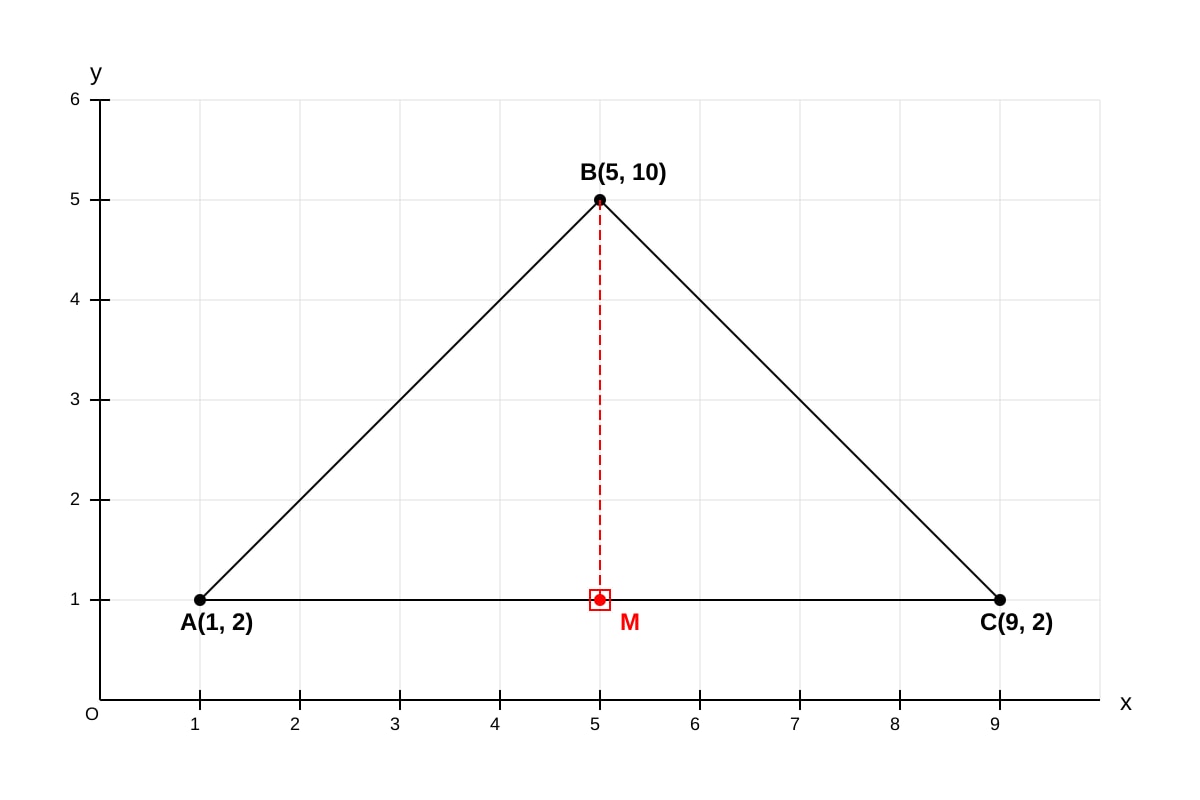
18. The points A(1, 2), B(5, 10), and C(9, 2) are the vertices of a triangle. (a) Find the coordinates of M, the midpoint of AC. (b) Find the gradient of BM. (c) Show that BM is perpendicular to AC. (d) Hence, or otherwise, find the area of triangle ABC.

Answer (a): ( ________ , ________ )

Answer (b): _________________________

Answer (c): _________________________

Answer (d): _________________________ square units


19. A straight line L₁ has equation 2x + y = 8. Another line L₂ passes through the point (3, 5) and is perpendicular to L₁. (a) Find the gradient of L₁. (b) Find the gradient of L₂. (c) Find the equation of L₂ in the form y = mx + c. (d) Find the coordinates of the point of intersection of L₁ and L₂.

Answer (a): _________________________

Answer (b): _________________________

Answer (c): _________________________

Answer (d): ( ________ , ________ )


20. The distance between two points A(2, 1) and B(10, y) is 10 units. (a) Form an equation in y and show that it simplifies to (y − 1)² = 36. (b) Hence, find the two possible values of y. (c) For each value of y, find the gradient of AB. (d) State which value of y gives a line AB with a positive gradient.

Answer (a): _________________________

Answer (b): y = ________ or y = ________

Answer (c): Gradient 1: ________ ; Gradient 2: ________

Answer (d): y = ________


END OF QUIZ

Answers

<!-- TuitionGoWhere generation metadata: stage=3-0; model=deepseek/deepseek-v4-pro; model_label=DeepSeek V4 Pro; generated=2026-05-29; Sources: Stage 2-1 real exam-derived templates and Stage 2-2 exam-enriched syllabus. -->

Secondary 4 Elementary Mathematics Quiz - Graphs Coordinate Geometry

ANSWER KEY AND MARKING SCHEME

Total Marks: 50


Section A: Basic Coordinate Geometry (Questions 1–5)

Each question carries 2 marks.

1. Gradient = (13 − 5)/(6 − 2) = 8/4 = 2 ✓✓

  • M1: Correct substitution into gradient formula
  • A1: Correct answer

2. Distance = √[(5 − (−3))² + (7 − 1)²] = √[8² + 6²] = √(64 + 36) = √100 = 10 ✓✓

  • M1: Correct substitution into distance formula
  • A1: Correct answer (accept √100 or 10)

3. Midpoint = ((4 + 10)/2, (−2 + 8)/2) = (7, 3) ✓✓

  • M1: Correct substitution into midpoint formula
  • A1: Correct coordinates

4. y − 4 = 3(x − 1) → y − 4 = 3x − 3 → y = 3x + 1 ✓✓

  • M1: Correct use of point-gradient form
  • A1: Correct equation in required form

5. Line 1: y = 2x − 5, gradient m₁ = 2 Line 2: 2y + x = 7 → 2y = −x + 7 → y = −½x + 3.5, gradient m₂ = −½ m₁ × m₂ = 2 × (−½) = −1 Therefore, the lines are perpendicular. ✓✓

  • M1: Correctly finding both gradients
  • A1: Correct conclusion with justification

Section B: Equations of Lines and Applications (Questions 6–10)

Each question carries 3 marks.

6. Parallel to y = 4x + 2, so m = 4 Using point (3, −1): y − (−1) = 4(x − 3) y + 1 = 4x − 12 y = 4x − 13 ✓✓✓

  • M1: Identifying gradient of parallel line
  • M1: Correct substitution into point-gradient form
  • A1: Correct equation

7. Midpoint of AB = ((1 + 7)/2, (2 + 10)/2) = (4, 6) Gradient of AB = (10 − 2)/(7 − 1) = 8/6 = 4/3 Gradient of perpendicular bisector = −3/4 Equation: y − 6 = −¾(x − 4) y − 6 = −¾x + 3 y = −¾x + 9 ✓✓✓

  • M1: Correct midpoint and gradient of AB
  • M1: Correct perpendicular gradient and substitution
  • A1: Correct equation

8. (a) Gradient = (−1 − 5)/(4 − (−2)) = −6/6 = −1(b) Using point (−2, 5): y − 5 = −1(x − (−2)) y − 5 = −x − 2 y = −x + 3 x + y = 3 ✓✓

  • M1 (a): Correct gradient calculation
  • M1 (b): Correct substitution
  • A1 (b): Correct equation in required form

9. 3x − 2y = 12 (a) x-intercept: set y = 0 → 3x = 12 → x = 4(b) y-intercept: set x = 0 → −2y = 12 → y = −6(c) Rearranging: −2y = −3x + 12 → y = (3/2)x − 6 → gradient = 3/2

  • A1 each for correct intercepts and gradient

10. Gradient of AB = (7 − 3)/(6 − 2) = 4/4 = 1 Since A, B, C are collinear, gradient of BC = 1 (k − 7)/(8 − 6) = 1 (k − 7)/2 = 1 k − 7 = 2 k = 9 ✓✓✓

  • M1: Finding gradient of AB
  • M1: Setting up equation using collinearity
  • A1: Correct value of k

Section C: Coordinate Geometry Problems (Questions 11–15)

Each question carries 3 marks.

11. (a) PQ = √[(5 − 1)² + (8 − 2)²] = √(16 + 36) = √52 QR = √[(9 − 5)² + (2 − 8)²] = √(16 + 36) = √52 Since PQ = QR, triangle PQR is isosceles. ✓✓ (b) Base PR = 9 − 1 = 8 units Height = 8 − 2 = 6 units Area = ½ × 8 × 6 = 24 square units ✓

  • M1 (a): Correct distance calculations
  • A1 (a): Correct conclusion
  • M1 (b): Correct area calculation
  • A1 (b): Correct area

12. (a) 2x + 1 = −x + 7 → 3x = 6 → x = 2 y = 2(2) + 1 = 5 A = (2, 5)(b) Distance OA = √[(2 − 0)² + (5 − 0)²] = √(4 + 25) = √29 (≈ 5.39) ✓✓

  • M1 (a): Correctly solving simultaneous equations
  • A1 (a): Correct coordinates
  • M1 (b): Correct distance formula
  • A1 (b): Correct distance

13. (a) Gradient = (0 − 4)/(6 − 0) = −4/6 = −2/3 y-intercept = 4 Equation: y = −⅔x + 4(b) Triangle has base 6 (on x-axis) and height 4 (on y-axis) Area = ½ × 6 × 4 = 12 square units ✓✓

  • M1 (a): Correct gradient and intercept
  • A1 (a): Correct equation
  • M1 (b): Correct identification of base and height
  • A1 (b): Correct area

14. (a) Gradient of AB = (−1 − 3)/(2 − (−1)) = −4/3 ✓ (b) Gradient of BC = (5 − (−1))/(5 − 2) = 6/3 = 2 ✓ (c) m₁ × m₂ = (−4/3) × 2 = −8/3 ≠ −1 Therefore, AB is not perpendicular to BC. ✓

  • A1 each for (a) and (b)
  • M1 (c): Correct product of gradients
  • A1 (c): Correct conclusion with justification

15. P is equidistant from A(2, 1) and B(8, 1), so P lies on the perpendicular bisector of AB. Midpoint of AB = (5, 1). Since A and B have same y-coordinate, perpendicular bisector is vertical line x = 5. P also lies on y = x − 2. Substituting x = 5: y = 5 − 2 = 3 P = (5, 3) ✓✓✓

  • M1: Identifying perpendicular bisector as x = 5
  • M1: Substituting into line equation
  • A1: Correct coordinates

Section D: Graphs and Coordinate Geometry Applications (Questions 16–20)

Each question carries 4 marks.

16. (a) Gradient = (11 − 3)/(4 − 0) = 8/4 = 2(b) y-intercept = 3, so equation is y = 2x + 3(c) Substitute (p, 19): 19 = 2p + 3 → 2p = 16 → p = 8 ✓✓

  • A1 (a): Correct gradient
  • A1 (b): Correct equation
  • M1 (c): Correct substitution
  • A1 (c): Correct value of p

17. (a) 0.40per200m=0.40 per 200 m = 0.40 per 0.2 km = 2.00perkm.Hencethecoefficientofdis2.(b)F=3.50+2(5.5)=3.50+11=2.00 per km. Hence the coefficient of d is 2. ✓ **(b)** F = 3.50 + 2(5.5) = 3.50 + 11 = **14.50** ✓ (c) 15.50 = 3.50 + 2d → 2d = 12 → d = 6 km(d) Graph: Straight line from (0, 3.50) to (8, 19.50). Axes labelled: F ($) vertical, d (km) horizontal. ✓

  • A1 each for (a), (b), (c)
  • A1 (d): Correct graph with labelled axes and correct line

18. (a) M = ((1 + 9)/2, (2 + 2)/2) = (5, 2)(b) Gradient of BM = (2 − 10)/(5 − 5) = −8/0 → undefined (vertical line)(c) Gradient of AC = (2 − 2)/(9 − 1) = 0/8 = 0 (horizontal line) Since BM is vertical and AC is horizontal, BM ⟂ AC. ✓ (d) AC = 9 − 1 = 8 units (base) Height = distance from B to AC = 10 − 2 = 8 units Area = ½ × 8 × 8 = 32 square units ✓

  • A1 each for (a), (b), (c), (d)

19. (a) 2x + y = 8 → y = −2x + 8 → gradient = −2(b) Perpendicular gradient = ½(c) Using point (3, 5): y − 5 = ½(x − 3) → y − 5 = ½x − 1.5 → y = ½x + 3.5(d) Intersection: −2x + 8 = ½x + 3.5 → −2.5x = −4.5 → x = 1.8 y = −2(1.8) + 8 = 4.4 Intersection = (1.8, 4.4)

  • A1 each for (a), (b), (c), (d)

20. (a) √[(10 − 2)² + (y − 1)²] = 10 √[64 + (y − 1)²] = 10 64 + (y − 1)² = 100 (y − 1)² = 36(b) y − 1 = ±6 → y = 7 or y = −5(c) For y = 7: gradient = (7 − 1)/(10 − 2) = 6/8 = ¾ For y = −5: gradient = (−5 − 1)/(10 − 2) = −6/8 = −¾(d) Positive gradient occurs when y = 7

  • A1 each for (a), (b), (c), (d)

END OF ANSWER KEY