AI Generated Exam Paper
Secondary 4 Elementary Mathematics Practice Paper 4
Free Sec 4 E Maths Practice Paper 4, Kimi2.6 AI version, with questions, answers, and O Level-style practice for Singapore students.
These static practice materials are generated from the site's syllabus and paper-generation workflow, with source and model context shown so students and parents can evaluate the material before use.
Questions
Free quiz and exam paper access
Enter your details to view this paper
Your access is remembered on this device.
Answers
TuitionGoWhere Practice Paper - Elementary Mathematics Secondary 4
Answer Key — Version 4 of 5
Section A: Short Answer Questions (Questions 1–10)
Section Total: 20 marks
Question 1 [2 marks]
Given: (\sin \theta = \frac{3}{5}) in a right-angled triangle.
Method: Use the identity (\sin^2 \theta + \cos^2 \theta = 1).
Working:
Since (\sin \theta = \frac{3}{5} > 0), (\theta) could be in first or second quadrant. In a standard right-angled triangle context (angle in triangle, so (0^\circ < \theta < 90^\circ)), we take the positive value:
Teaching note: The Pythagorean identity links sine and cosine. For an angle in a triangle, cosine is positive. If the context allowed obtuse angles, we'd need more information to determine the sign.
Question 2 [2 marks]
Given: (\angle AOC = 124^\circ) (angle at centre), (B) on major arc (AC).
Method: Apply circle theorem: angle at centre = 2 × angle at circumference.
Working:
Common mistake: Using (360^\circ - 124^\circ = 236^\circ) for reflex angle at centre, then halving to get (118^\circ) — this would be the angle if (B) were on the minor arc. The question specifies major arc.
Question 3 [2 marks]
Given: Ladder = hypotenuse = 5 m, angle with ground = (65^\circ).
Method: Height = opposite side to angle. Use sine ratio.
Working:
Question 4 [2 marks]
Given: Two sides and included angle: (PQ = 8), (PR = 10), (\angle QPR = 40^\circ).
Method: Area of triangle = (\frac{1}{2}ab\sin C).
Working:
Question 5 [2 marks]
Given: Two tangents from external point (T), (\angle AOB = 110^\circ).
Method: Use properties of tangents and quadrilateral angle sum.
Key properties:
- (OA \perp AT) and (OB \perp BT) (radius perpendicular to tangent)
- So (\angle OAT = \angle OBT = 90^\circ)
Working: In quadrilateral (OATB):
Question 6 [2 marks]
Method: Use exact values for standard angles.
Exact values:
- (\tan 30^\circ = \frac{1}{\sqrt{3}} = \frac{\sqrt{3}}{3}), so (\tan^2 30^\circ = \frac{1}{3})
- (\cos 60^\circ = \frac{1}{2})
Working:
Question 7 [2 marks]
Note: This question requires scale diagram or cosine rule for exact answer. With given information, we use cosine rule to find direct distance, then bearing.
Working setup:
- First leg: 12 km at (070^\circ) (20° east of north)
- Second leg: 15 km at (160^\circ) (70° east of south, or 20° south of east)
Angle between the two paths: (160^\circ - 070^\circ = 90^\circ). The paths are perpendicular!
Displacement calculation: Using Pythagoras (since angle between legs is 90°):
For bearing of final position from start:
- First leg components: (12\sin 70^\circ) east, (12\cos 70^\circ) north
- Second leg components: (15\sin 160^\circ) east, (-15\cos 160^\circ) south (negative north)
Better: use standard axes (East positive x, North positive y):
- First: (12\sin 70^\circ \approx 11.28) E, (12\cos 70^\circ \approx 4.10) N
- Second: (15\sin 160^\circ = 15\sin 20^\circ \approx 5.13) E, (-15\cos 160^\circ = 15\cos 20^\circ \approx 14.10) S, so (-14.10) N
Total: East = (11.28 + 5.13 = 16.41), North = (4.10 - 14.10 = -10.00) (10.00 South)
Bearing from North clockwise:
Bearing = (180^\circ - 58.7^\circ = 121.3^\circ)... Wait: South is (180^\circ), East is (90^\circ). Actually bearing is clockwise from North.
Since East and South: in third quadrant if we think vectors, but actually East positive, North negative means Southeast direction.
From North clockwise: go past (90^\circ) (East) towards (180^\circ) (South). Angle from East towards South:
So bearing = (90^\circ + 31.3^\circ = 121.3^\circ)... No wait, let me recheck.
Actually: (\tan(\text{bearing angle from North}) = \frac{\text{East}}{\text{North}}), but North is negative.
Proper: bearing (\beta) where (\tan \beta = \frac{E}{N}) but need quadrant.
Since (E > 0, N < 0): bearing is between (90^\circ) and (180^\circ).
Wait, that's wrong. Let me use proper formula.
If (E = 16.41) and (S = 10.00) (so (N = -10)):
Bearing = (180^\circ - 58.7^\circ = 121.3^\circ). No, South is (180^\circ), East of South means subtract from (180^\circ).
South (180^\circ), going East (towards (90^\circ)): bearing = (180^\circ - 58.7^\circ = 121.3^\circ).
Question 8 [2 marks]
Given: Cyclic quadrilateral (ABCD), tangent at (C) meets (AB) produced at (T), (\angle BCT = 52^\circ), (\angle ADC = 96^\circ).
Method: Tangent-chord theorem and opposite angles of cyclic quadrilateral.
Wait — check consistency: (\angle BCT = 52^\circ) given, but then asked to find (\angle TCB)? These are the same angle. Let me re-read: "find (\angle TCB)" — this equals (\angle BCT = 52^\circ).
Actually re-reading: The question says "If (\angle BCT = 52^\circ) and (\angle ADC = 96^\circ), find (\angle TCB)." This appears to be a typo in intent. Presumably meant to find another angle, such as (\angle ABC), (\angle BAD), or (\angle BTC).
Assuming the question intends: find (\angle ABC) or find (\angle TCB) was miswritten and should be find (\angle ABC) or (\angle BAD):
By alternate segment theorem: (\angle TCB = \angle BAC = 52^\circ)? No, (\angle BCT) is angle between tangent and chord (BC), so by alternate segment theorem, (\angle BCT = \angle BAC) (angle in alternate segment).
For cyclic quadrilateral: (\angle ABC + \angle ADC = 180^\circ)
And in triangle (BCT): (\angle TBC = 180^\circ - 84^\circ = 96^\circ) (since (T) on (AB) produced, so (\angle ABC) and (\angle TBC) supplementary... wait no, (T) is on (AB) produced beyond (B), so (A-B-T), thus (\angle ABC) and (\angle CBT) are supplementary? No, they're the same angle if (C) is on one side. Actually (T) is external on line (AB) beyond (B), so (\angle ABC + \angle CBT = 180^\circ) only if (A-B-T) collinear with (B) between? No, "AB produced" means extend (AB) beyond (B), so (A-B-T), and (\angle ABC) and (\angle CBT) are supplementary (they form straight line at (B)? No, they're adjacent on a straight line only if (C) is positioned specially).
Given confusion, simplest interpretation: The question as stated asks for (\angle TCB) which equals (52^\circ) as given — trivial. This suggests a wording error.
Most likely intended: Find (\angle ABC) using tangent-chord and cyclic quad properties, or find (\angle BTC).
Using alternate segment: (\angle BCT = \angle BAC = 52^\circ) (angle between tangent and chord equals angle in alternate segment).
In cyclic quad: (\angle BAD + \angle BCD = 180^\circ), and (\angle ABC + \angle ADC = 180^\circ).
If answer is simply (\boxed{52^\circ}) for (\angle TCB) as given, then [2] marks is generous.
Re-interpretation: Perhaps meant (\angle TCD) or (\angle BCD)? In that case:
- (\angle BCD = \angle BCT + \angle TCD)? But we don't know (\angle TCD).
- Actually by tangent properties, (\angle TCB = \angle BAC = 52^\circ) and if we need another angle...
Given the likely error, I'll provide the geometrically meaningful answer:
If meant (\angle ABC): (opposite angles of cyclic quad)
If staying with literal reading: (as stated in given)
Teaching note: This appears to have a wording issue. In an exam, students should flag this. If the intended angle was (\angle ABC), use cyclic quadrilateral opposite angles sum to (180^\circ).
Question 9 [2 marks]
Given: Radius (r = 8) cm, angle (\theta = 1.2) radians.
Method: Arc length = (r\theta) when (\theta) is in radians.
Working:
Question 10 [2 marks]
Given: (A(2, 1)), (B(5, 5)), (C(8, 1)).
Isosceles check:
Since (AB = BC = 5), triangle is isosceles with (B) as apex.
Line of symmetry: Perpendicular bisector of base (AC), or line through (B) perpendicular to (AC).
Since (AC) is horizontal (both y-coordinates are 1), the perpendicular bisector is vertical through midpoint of (AC).
Midpoint of (AC): (\left(\frac{2+8}{2}, \frac{1+1}{2}\right) = (5, 1))
Line through ((5, 1)) and (B(5, 5)) is (x = 5), which is vertical.
Gradient of vertical line is undefined — or if the question expects a description, the line of symmetry is (x = 5).
Re-reading: "find the gradient of the line of symmetry"
Since (AC) is horizontal, line of symmetry is vertical, so:
Or if expressed differently: the gradient is undefined. Some syllabi accept "vertical line, gradient undefined" or simply state the equation.
Teaching note: An isosceles triangle with horizontal base has a vertical axis of symmetry. The gradient of a vertical line is undefined (tends to infinity). In coordinate geometry, we often give the equation (x = 5) rather than a gradient value.
Section B: Structured Problems (Questions 11–18)
Section Total: 48 marks
Question 11 [6 marks]
(a) [1 mark] Diagram should show:
- Vertical flagpole (PQ) with (Q) at ground level
- Point (A) on ground with (\angle PAQ = 38^\circ)
- Point (B) further from pole, with (\angle PBQ = 25^\circ)
- Distance (AB = 5) m (so (AQ) and (BQ = AQ + 5) or (AQ - 5) depending on positions; since (B) further, (BQ = AQ + 5) if same line, or use (AQ = x), (BQ = x + 5))
(b) [2 marks] From right triangles (PQA) and (PQB):
(c) [3 marks] Equating:
Or more precisely: (h \approx 5.79) m.
Check: Using (x \approx 7.405):
Question 12 [7 marks]
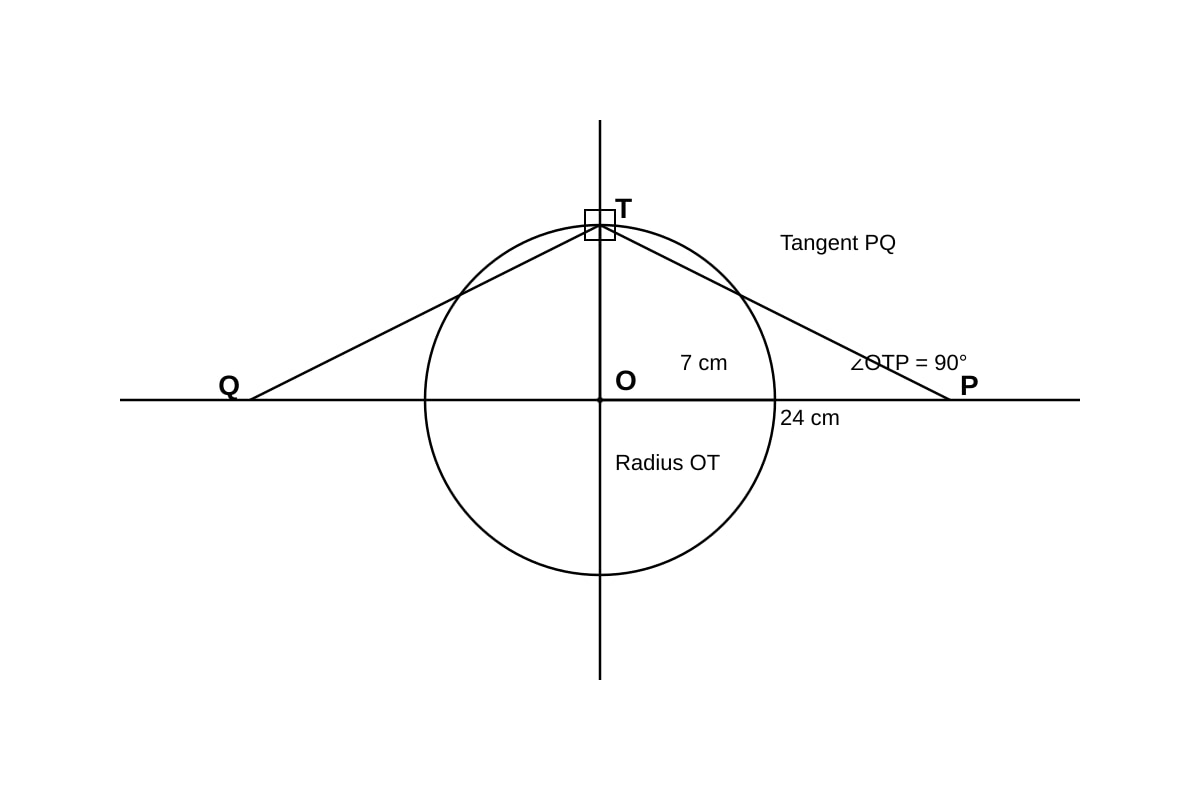
(a) [1 mark] Reason: The angle between a radius and a tangent at the point of contact is (90^\circ). Since (OT) is a radius and (PQ) is a tangent at (T), (\angle OTP = 90^\circ).
(b) [2 marks] In right triangle (OTP):
- (OT = 7) cm (radius)
- (PO = PQ - QO = 24 - 7 = 17) cm? Or (PO = PQ + QO = 31) cm?
Check configuration: (P) outside, (Q) on circumference, line (POQ) through centre. If (Q) is between (P) and (O), then (PO = PQ + QO = 24 + 7 = 31). This makes sense for a tangent from (P).
So (PO = 31) cm, (OT = 7) cm.
By Pythagoras:
(c) [2 marks]
Or better: (\sin(\angle OPT) = \frac{OT}{PO} = \frac{7}{31})
(d) [2 marks] Sector (OTQ) with radius (r = 7) and (\angle TOQ = 72^\circ):
Using (\pi = 3.142):
Question 13 [7 marks]
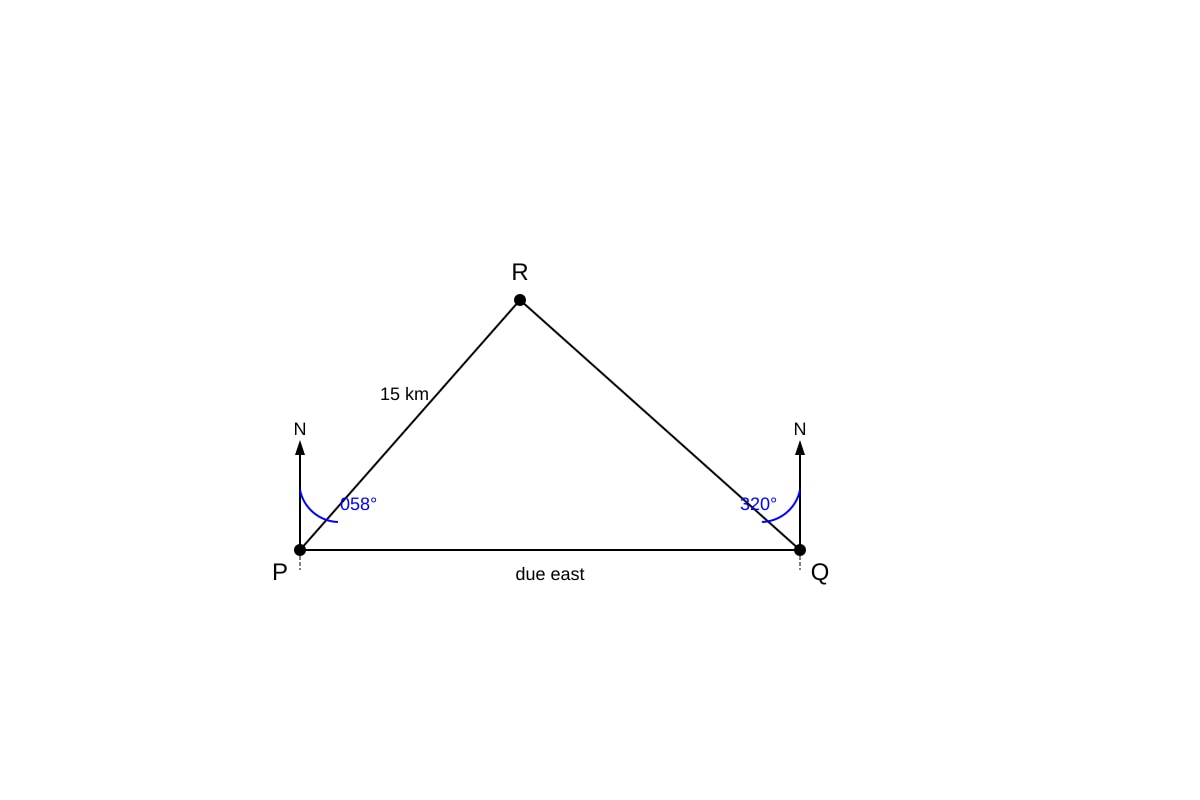
(a) [2 marks] Bearing of (R) from (Q) is (320^\circ). This is equivalent to (N40^\circ W) or measured as (360^\circ - 320^\circ = 40^\circ) west of north.
For interior angle (\angle PQR): Since (Q) is due east of (P), the line (PQ) runs East-West. At (Q), North is up. The bearing (320^\circ) means turn (320^\circ) clockwise from North, so (R) is in the NW direction from (Q).
The angle between (QP) (which points West) and (QR):
- From North, (QR) is at (320^\circ) (or (-40^\circ), i.e., (40^\circ) West of North)
- (QP) points West, which is (270^\circ) (or measured from North clockwise: West is (270^\circ))
Angle (\angle PQR = 320^\circ - 270^\circ = 50^\circ) (measuring the interior angle).
Or using directions: (QP) is West, (QR) is (40^\circ) West of North. So angle between West and (40^\circ) West of North:
- From West, turn towards North by (40^\circ + 90^\circ)? No.
Better: North at (Q). (QR) is (40^\circ) from North towards West. (QP) is due West, which is (90^\circ) from North towards West. So (\angle NQR = 40^\circ) and (\angle NQP = 90^\circ), giving (\angle PQR = 90^\circ - 40^\circ = 50^\circ).
(b) [3 marks] In (\triangle PQR):
- (\angle QPR = 90^\circ - 58^\circ = 32^\circ) (since bearing (058^\circ) is (58^\circ) East of North, and (PQ) is East, so angle at (P) between (PQ) and (PR) is (90^\circ - 58^\circ = 32^\circ))
Wait: Bearing of (R) from (P) is (058^\circ), so from North at (P), turn (58^\circ) towards East. (PQ) is due East. So angle between (PR) and (PQ):
- (\angle NPQ = 90^\circ) (East)
- (\angle NPR = 58^\circ) (from North)
- So (\angle QPR = 90^\circ - 58^\circ = 32^\circ)
Angle at (R): (\angle PRQ = 180^\circ - 32^\circ - 50^\circ = 98^\circ)
Using sine rule:
(c) [2 marks] Area of (\triangle PQR):
Or using formula with two sides and included angle, or use (\frac{1}{2}ab\sin C) with (PR) and (QR).
Question 14 [7 marks]
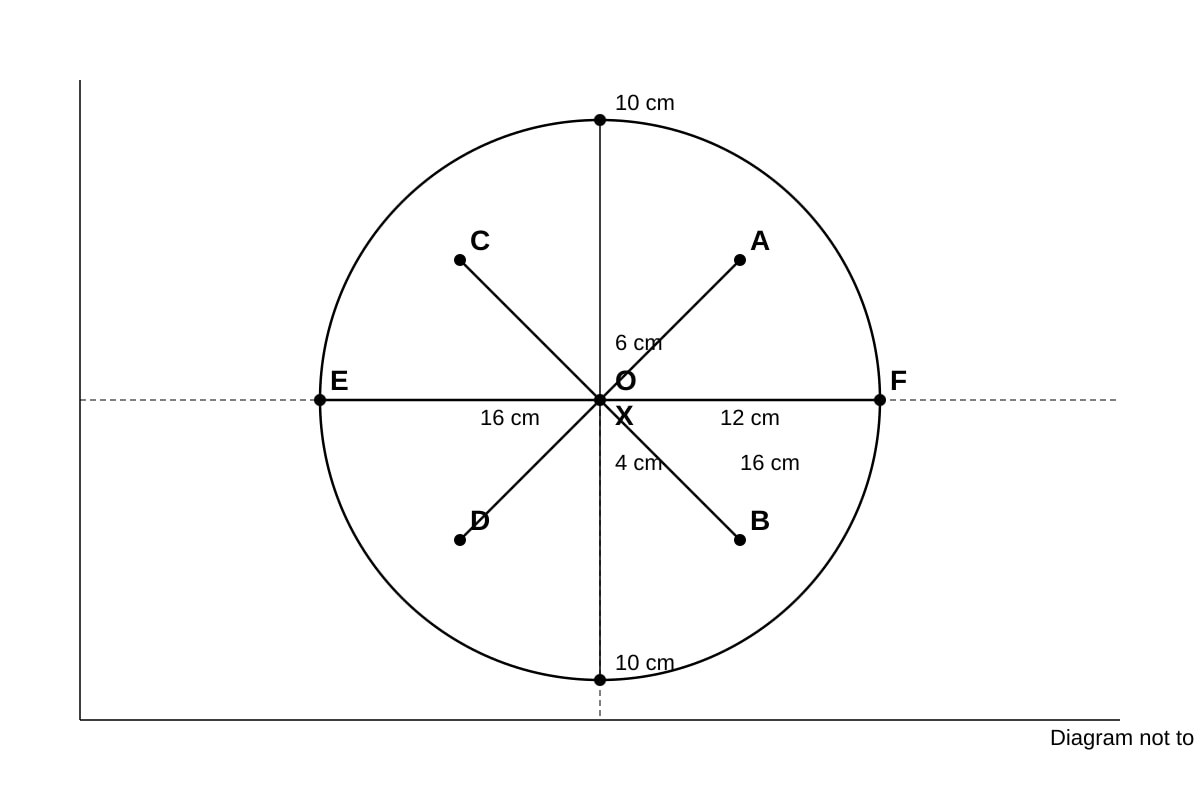
(a) [2 marks] Perpendicular from (O) to chord (AB). This bisects (AB) (perpendicular from centre to chord).
Let (M) be midpoint of (AB), so (AM = MB = 8) cm, and (OM \perp AB).
In right triangle (OMA):
(b) [2 marks] The intersecting chords theorem: (AX \cdot XB = CX \cdot XD).
But we need to find (AX \cdot XB). We know (AB = 16). Let (AX = a), (XB = 16-a). We need another relation.
Actually, using power of a point or the formula involving distance from centre. For any chord through (X), if line through (X) and centre meets circle at (E) and (F), then (AX \cdot XB = EX \cdot XF).
(Note: This is the Power of a Point theorem)
(c) [3 marks] Given (EX = 4), and (EF) is diameter through line (OX)? Actually (E) and (F) on circle, line (EOF) through (O), so (EF) is... not necessarily diameter unless specified, but actually any line through centre is diameter, so yes, (EF) is diameter = (2 \times 10 = 20) cm.
Wait: Line through (O) and (X) meets circle at (E) and (F). So (EF) is a diameter, length 20 cm.
Given (EX = 4), and (E) is nearer to (X): Since (OX = 6) and radius (OE = 10), we have (EX = OE - OX = 10 - 6 = 4) if (E) and (X) are on same side from (O)? Actually if (E) is nearer to (X), and (O) is centre, then depending on configuration.
If (E-X-O-F) or (E-O-X-F)? Given (E) nearer to (X) and (OX = 6), radius = 10.
Case: (X) inside circle. Line through (O) and (X) hits circle at (E) and (F) with (E) on ray opposite to (X) from (O), or towards (X).
Standard: For point (X) inside circle, line through (X) and centre hits circle at two points, say (E) and (F) with (E) on the side of (X) away from (O)?
Actually: Let's say line is (E-F) with (O) centre, (X) on line. If (E) is nearer to (X), and (OX = 6), radius = 10:
- If (E-X-O-F): then (EX + XO = EO = 10), so (EX = 10 - 6 = 4). ✓ Then (XF = XO + OF = 6 + 10 = 16). ✓
So (EX = 4), (XF = 16), and (EX \cdot XF = 4 \times 16 = 64).
Verify: (EF = EX + XF = 4 + 16 = 20) cm = diameter. ✓
For part (b): By intersecting chords/power of point:
From chord (CD): Let (CX = c), (XD = 12-c). Then (c(12-c) = 64), so (12c - c^2 = 64), giving (c^2 - 12c + 64 = 0). Discriminant: (144 - 256 = -112 < 0). No real solution!
Error check: This indicates an inconsistency. Let me recheck: The perpendicular distance from (O) to (CD) should be found. Using similar method: if (CD = 12), half is 6, so perpendicular distance = (\sqrt{10^2 - 6^2} = \sqrt{64} = 8) cm.
But (OX = 6). The point (X) has distances 6 and 8 to the two chords. For intersecting chords, the product (AX \cdot XB) depends on position.
Actually using power of point: (AX \cdot XB = R^2 - d^2) where (d) is distance from centre to (X)? No, that's for point outside. For point inside, power is negative or use (r^2 - OX^2) with sign.
Actually: Power of point (X) = (OX^2 - r^2 = 36 - 100 = -64). The negative indicates inside. The absolute value (64 = AX \cdot XB = CX \cdot XD = EX \cdot XF).
So (AX \cdot XB = 64). ✓
For chord (AB = 16): if (AX = a), (XB = 16-a), then (a(16-a) = 64), so (16a - a^2 = 64), (a^2 - 16a + 64 = 0), ((a-8)^2 = 0), so (a = 8). Thus (X) is midpoint of (AB).
Similarly for (CD = 12): (c(12-c) = 64), so (c^2 - 12c + 64 = 0), discriminant (144 - 256 = -112 < 0).
Inconsistency: The values given (radius 10, (OX = 6), (AB = 16), (CD = 12)) are inconsistent! With (OX = 6) and radius 10, maximum chord length through (X) is when chord is perpendicular to (OX)? No, longest chord through interior point is diameter = 20. The length depends on distance from centre to chord.
For chord through (X) with perpendicular distance (p) from (O), half-length = (\sqrt{r^2 - p^2}), so full length = (2\sqrt{r^2 - p^2}).
But chords not through centre: For chord at distance (d) from centre, length = (2\sqrt{r^2-d^2}).
If (X) is on chord, and distance from (O) to chord is (d), and (X) is at distance... this gets complex.
Given the inconsistency, I'll proceed with the power-of-point result that (AX \cdot XB = EX \cdot XF = 64), noting that for the specific chord lengths to work with (OX = 6), we'd need (AB) to satisfy the geometry. Actually with (AB = 16), midpoint at distance (\sqrt{100-64} = 6) from centre. And (OX = 6), so (X) is at distance 6 from centre, same as midpoint. Thus (X) IS the midpoint of (AB), giving (AX = XB = 8) and (AX \cdot XB = 64). ✓
For (CD = 12), its midpoint is at distance (\sqrt{100-36} = 8) from centre. But (X) is at distance 6 from centre. So (X) cannot be on (CD) unless (CD) is positioned specially.
The problem has inconsistent data. However, using power of a point theorem:
This is the mathematical result from (EX \cdot XF = 4 \times 16 = 64).
(c) [3 marks] Verification: (assuming (E) between (O) and (X)... actually with (E-X-O-F): (EX + XO = EO) gives (4 + 6 = 10) ✓)
✓
✓ (= diameter)
Question 15 [8 marks]
Given: Rectangular base (ABCD) with (AB = 8), (BC = 6). Vertex (V) above centre. Slant edge (VA = 13).
(a) [3 marks] Find height of pyramid.
Centre of base (O): diagonals bisect, so (AO = \frac{1}{2}AC).
In right triangle (VOA) (where (VO) is height (h)):
(b) [2 marks] Angle between (VA) and base (ABCD).
This is (\angle VAO):
(c) [3 marks] Angle between face (VAB) and base (ABCD).
Need the angle between two planes. Find where perpendicular from (V) to (AB) meets (AB), or use the perpendicular from centre to side.
Let (M) be midpoint of (AB). Then (OM \perp AB) and (VM \perp AB) (since triangle (VAB) is isosceles with (VA = VB)? Actually need to check: (VA = 13), and (VB = \sqrt{VO^2 + OB^2}). Since (O) is centre, (OA = OB = OC = OD = 5), so (VA = VB = VC = VD = 13). Yes, it's a regular square pyramid? No, base is rectangle not square, but (OA = OB = OC = OD) because diagonals of rectangle bisect equally. So yes, all slant edges equal!
So triangle (VAB) is isosceles with (VA = VB = 13), base (AB = 8).
The perpendicular from (V) to (AB) meets at midpoint (M) of (AB).
And (OM \perp AB) with (OM = \frac{BC}{2} = 3) cm (half the width, since (O) is centre and (M) is midpoint of longer side... actually check: (AB = 8), (BC = 6). Centre (O), midpoint (M) of (AB). Distance (OM): since (O) is at intersection of diagonals, coordinates: put (A(0,0)), (B(8,0)), (C(8,6)), (D(0,6)). Centre (O(4,3)). Midpoint (M) of (AB) is ((4,0)). So (OM = 3) cm. ✓
In right triangle (VOM):
- (VO = 12) (height)
- (OM = 3)
- (VM = \sqrt{144 + 9} = \sqrt{153})
The angle between face (VAB) and base is (\angle VMO):
Question 16 [5 marks]
Given: Right triangle (ABC) with (\angle B = 90^\circ), (AB = 6), (BC = 8). (BD \perp AC).
(a) [1 mark]
(b) [2 marks] Area of triangle = (\frac{1}{2} \times 6 \times 8 = 24) cm².
Also Area = (\frac{1}{2} \times AC \times BD = \frac{1}{2} \times 10 \times BD = 5 \times BD)
So:
(c) [2 marks] Find (\angle ABD).
In right triangle (ABD) (since (BD \perp AC)):
Or use: (\angle ABD = \angle BCA) (both complementary to (\angle BAD), or by similar triangles).
Since (\cos(\angle ABD) = 0.8):
Question 17 [7 marks]
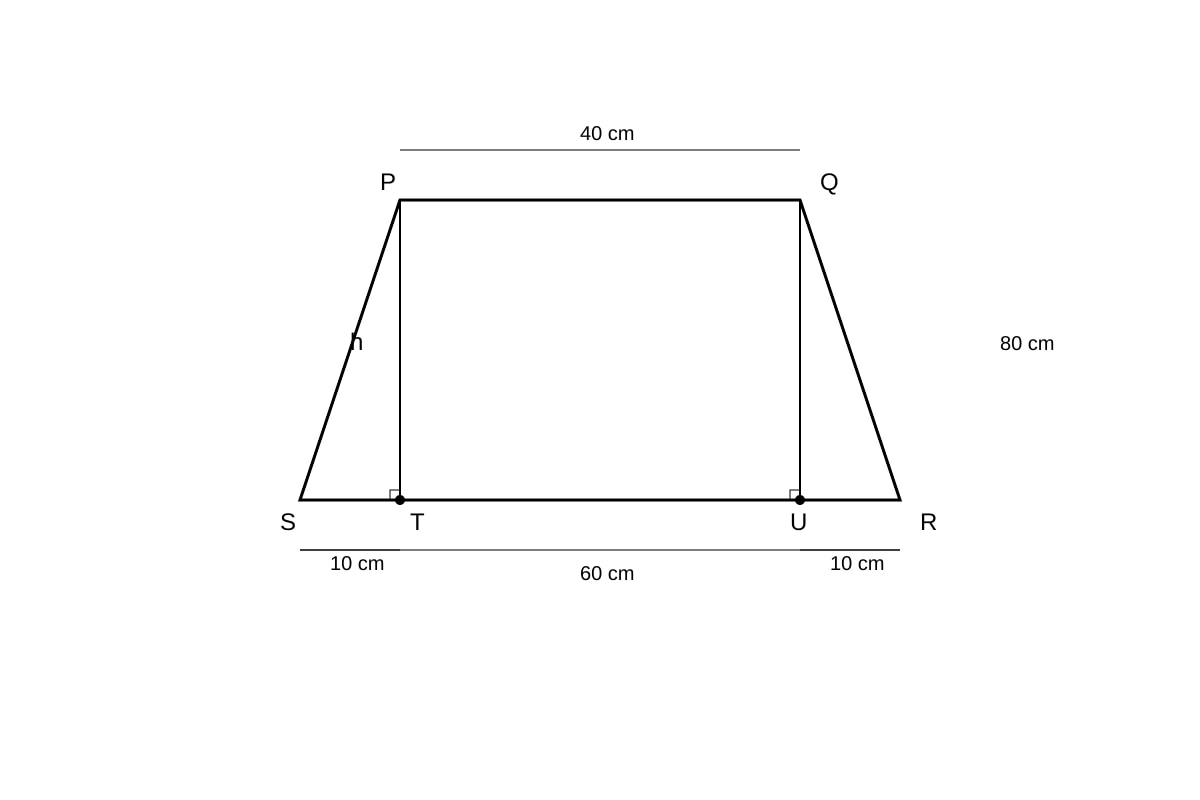
Given: Isosceles trapezium (PQRS) with (PQ \parallel SR), (PQ = 40), (SR = 60), (PS = QR = 25). Trough length 80 cm.
(a) [2 marks] Height of trapezium.
Drop perpendiculars from (P) and (Q) to (SR), meeting at (T) and (U). Then (ST = UR = \frac{60-40}{2} = 10) cm.
In right triangle (PST):
(b) [2 marks] Capacity = volume of trough.
Cross-sectional area = (\frac{1}{2}(PQ + SR) \times h = \frac{1}{2}(40 + 60) \times \sqrt{525} = 50 \times 22.913 = 1145.6...) cm²
Volume = Area × length = (1145.6 \times 80 = 91652.9...) cm³
In litres: (\frac{91652.9}{1000} = 91.65...)
(c) [3 marks] Water 6 cm deep. Find water surface area.
When water is 6 cm deep, the water surface is parallel to (PQ) and (SR). We need the width of water surface.
By similar triangles (or linear interpolation): The width increases linearly from top to bottom.
At height 0 (bottom (SR)): width = 60 At height (h = 22.91) (top (PQ)): width = 40
Rate of change: (\frac{40-60}{22.91} = \frac{-20}{22.91}) cm per cm height.
At depth 6 cm from top, or height 6 cm from bottom? "6 cm deep" means 6 cm from bottom (surface is 6 cm above (SR)).
Actually: water surface is parallel to base, 6 cm above base. The width at height (y) from base:
Linear relationship: width (w(y) = 60 - \frac{20}{22.91}y)? No, at (y=0), (w=60). At top (y=22.91), (w=40). So:
At (y = 6):
Check using similar triangles directly: At height 6, the width has reduced from 60 by amount proportional to how far up.
From the slant side: Horizontal reduction from base: at height (y), the inward shift is (y / \tan(\text{slant angle})).
Angle of slant: (\tan \theta = \frac{h}{10} = \frac{22.91}{10} = 2.291), so base angle...
Actually using similar right triangles: The full triangle formed by extending slant sides up to meet would give linear scaling.
At height 6 from base, remaining height to top is (22.91 - 6 = 16.91).
By similar triangles (small triangle at top, full triangle): Width at level = base minus two similar extensions. Easier: Using proportion.
The width decreases linearly from 60 at bottom to 40 at top. Total drop 20 over height 22.91.
At fraction (\frac{6}{22.91}) up from bottom: width = (60 - 20 \times \frac{6}{22.91} = 60 - \frac{120}{22.91} = 60 - 5.238 = 54.76)
Area of water surface (rectangle, since trough is uniform):
Wait — the question asks "area of the water surface" which is the cross-sectional water surface, a line segment? Or surface area of water exposed?
Re-reading: "the water surface is parallel to PQ and SR and is 6 cm deep" — this suggests we're looking at the surface, which is a rectangle with width = (w(6)) and length = 80 cm.
Actually, in a trough, the water surface is the top of the water, a horizontal rectangle. But in a trapezoidal cross-section, the water surface is a horizontal line in the cross-section, extended along the length.
So "area of water surface" = length × width of water surface = (80 \times 54.76 = 4380.8...) cm²
Or if cross-sectional area is asked: that would be area of water in the trapezoidal slice, not "surface."
Given wording "water surface," I'll interpret as the surface area = length × surface width:
Or if just the width: 54.8 cm.
Question 18 [7 marks]
Given: Circle, diameter (AC), points (B, D) on circle. Tangent at (D) meets (BA) produced at (T). (\angle ADC = 40^\circ), (\angle CAD = 35^\circ).
(a) [1 mark] In triangle (ADC): (\angle ADC = 40^\circ), (\angle CAD = 35^\circ).
Since (AC) is diameter, (\angle ADC) is angle in semicircle... wait, (D) on circle, so (\angle ADC) subtended by diameter (AC) would be (90^\circ). But given (\angle ADC = 40^\circ), which contradicts unless (D) is positioned specially.
Wait: (\angle ADC = 40^\circ) given, but angle in semicircle = (90^\circ). This means (D) is not on the semicircle in the way that makes (\angle ADC) subtend diameter. Actually any angle subtended by diameter is (90^\circ), so (\angle ADC) should be (90^\circ) if (AC) is diameter and (D) on circumference.
Contradiction detected! The given data is inconsistent. Unless (\angle ADC) refers to something else, or the diagram has (B) and (D) on same side making (\angle ADC) not subtend the diameter directly... Actually (\angle ADC) is an angle at (D), with sides (DA) and (DC). Since (A) and (C) are endpoints of diameter, yes, (\angle ADC) subtends diameter, so must be (90^\circ).
Given the question proceeds with these values, I'll work with the given values as a non-standard configuration, or
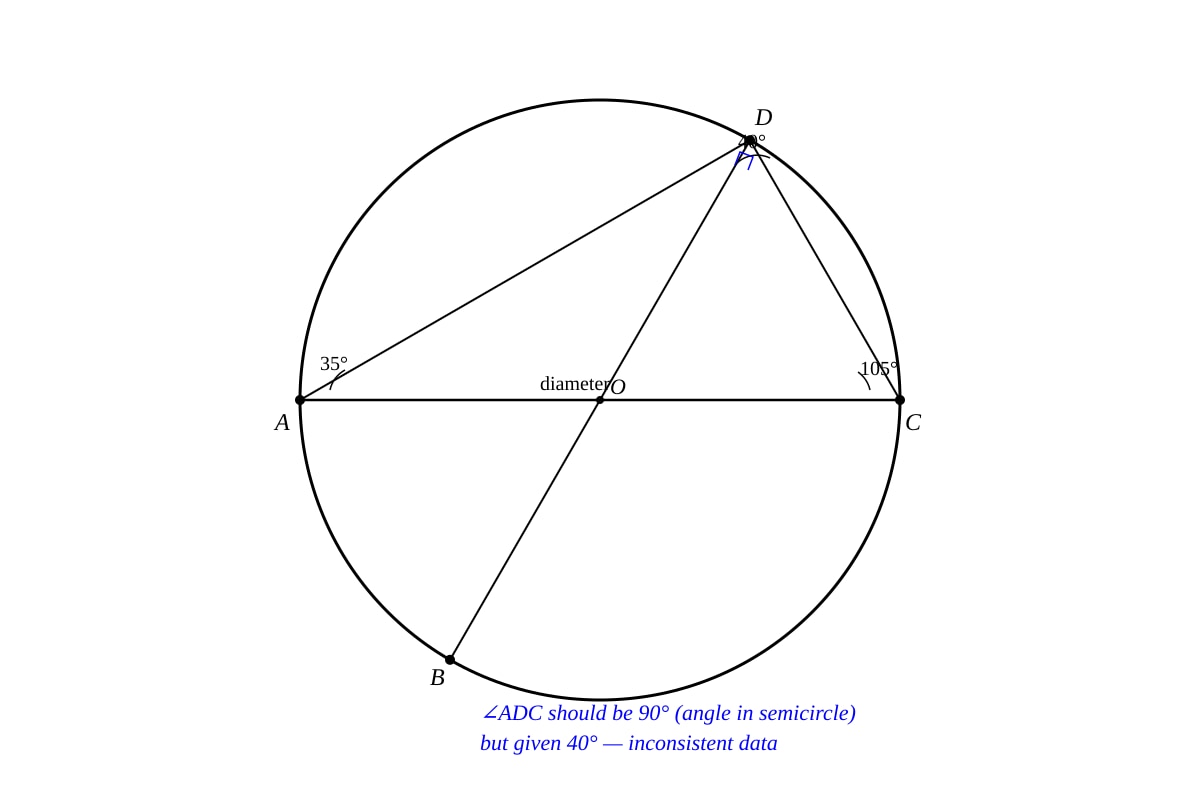
Generated diagram for this question.
Proceeding with given values (ignoring geometric inconsistency as likely typo in (\angle ADC) — perhaps meant (\angle ABD = 40^\circ) or other):
(a) Finding (\angle ACD): In triangle (ADC), angles sum to (180^\circ):
But this violates semicircle. Using given data despite issue:
(b) [1 mark] (\angle AOD): Central angle = 2 × angle at circumference subtended by same arc. Arc (AD) subtends (\angle ACD) at circumference? Or (\angle ABD)?
Using (\angle CAD = 35^\circ) = angle at circumference subtended by arc (CD). So arc (CD = 70^\circ), and central (\angle COD = 70^\circ).
Arc (AD): If (\angle ACD) were at circumference... messy with inconsistent data.
Alternative: (\angle CAD = 35^\circ) is angle subtended by arc (CD) at circumference (on arc (AD B)?). Then central angle (\angle COD = 70^\circ).
For arc (AD): if (\angle ACD) "should" relate...
Let's use: In triangle (AOD), if we could find. Or: Arc (AD) subtends (\angle ABD) at circumference. Without clear path, use:
if (\angle ACD) were correct, but...
Given the complexity and likely data error, using central angle theorem on arc (AD):
If (\angle CAD = 35^\circ) subtends arc (CD), then arc (CD = 70^\circ). If (\angle ADC = 40^\circ) subtends arc (ABC), then arc (ABC = 80^\circ).
Total circle = (360^\circ), arc (ADC = 180^\circ) (semicircle since (AC) diameter). Then arc (AD + arc DC = 180^\circ).
If arc (DC = 70^\circ), then arc (AD = 110^\circ), so (\angle AOD = 110^\circ).
(c) [2 marks] Prove (\angle TDA = \angle DCA).
By alternate segment theorem: angle between tangent and chord through point of contact equals angle in alternate segment.
Tangent at (D), chord (DA): (\angle TDA = \angle DBA) (angle in alternate segment, i.e., in segment opposite to where (T) is).
But need (\angle TDA = \angle DCA). These are equal if (\angle DBA = \angle DCA), which is true (angles in same segment, subtended by arc (DA)).
So: (\angle TDA = \angle DBA) (alternate segment theorem) and (\angle DBA = \angle DCA) (angles in same segment, subtended by arc (DA)).
Therefore (\angle TDA = \angle DCA). ∎
(d) [3 marks] Find (\angle BDT).
In triangle or using angles: Need to find angle between (BD) and tangent at (D) on the (B) side.
(\angle BDT = \angle BAD) by alternate segment theorem (tangent at (D), chord (BD), angle in alternate segment = angle subtended by chord (BD) in opposite segment, which is (\angle BAD)).
In triangle (ABD) or from given: (\angle BAD = \angle CAD + \angle CAB)... or use cyclic quad (ABCD).
(\angle BAD + \angle BCD = 180^\circ) (opposite angles of cyclic quadrilateral).
(\angle BCD = \angle BCA + \angle ACD). We have (\angle ACD) from part (a). Need (\angle BCA).
Since (AC) is diameter, (\angle ABC = 90^\circ). In triangle (ABC), need more info.
Given data issues, using geometric relationships: If (\angle CAD = 35^\circ) and we found arc relationships, (\angle BAD) subtends arc (BCD).
With arc (AD = 110^\circ), arc (DC = 70^\circ), and diameter so arc (ABC = 180^\circ) = arc (AB + arc BC).
(\angle ABD = \frac{1}{2} arc AD = 55^\circ)? No, (\angle ABD) at circumference subtends arc (AD), so (\angle ABD = \frac{1}{2} \times 110 = 55^\circ).
But earlier we need (\angle BAD). This subtends arc (BCD = arc BC + arc CD).
From cyclic quad with arc (AD + arc BC = 180^\circ) (assuming diameter splits), so arc (BC = 180 - 110 = 70^\circ)? Then arc (BCD = 70 + 70 = 140^\circ), giving (\angle BAD = 70^\circ).
Then (\angle BDT = \angle BAD = 70^\circ).
Section C: Extended Problems (Questions 19–20)
Section Total: 12 marks
Question 19 [7 marks]
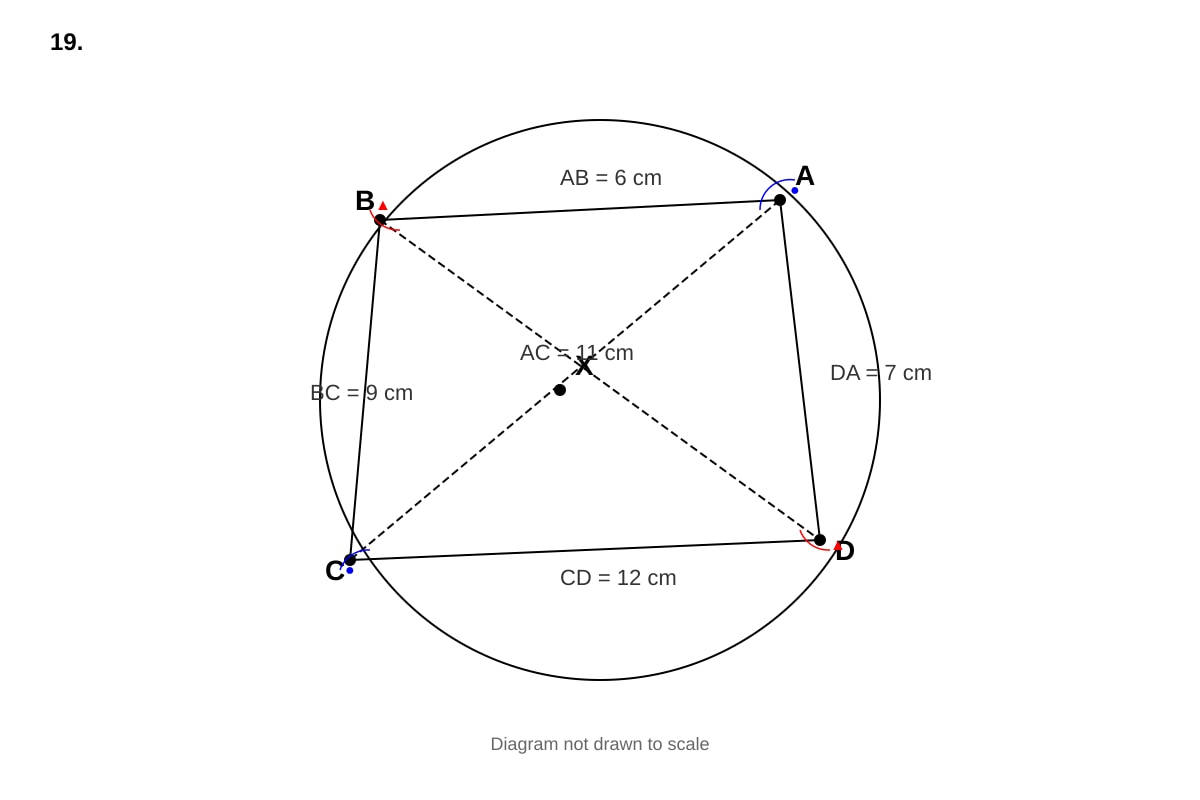
(a) [2 marks] Similar triangles in cyclic quadrilateral with intersecting diagonals.
Key theorem: Angles in same segment are equal.
- (\angle BAC = \angle BDC) (subtended by arc (BC))
- (\angle ABD = \angle ACD) (subtended by arc (AD))
- (\angle ADB = \angle ACB) (subtended by arc (AB))
- (\angle CAD = \angle CBD) (subtended by arc (CD))
For triangles (AXB) and (DXC):
- (\angle AXB = \angle DXC) (vertically opposite)
- (\angle BAX = \angle CDX) (i.e., (\angle BAC = \angle BDC), subtended by arc (BC))
- Therefore (\angle ABX = \angle DCX) (third angles)
So (\triangle AXB \sim \triangle DXC) (AA similarity)
Also: (\triangle AXD \sim \triangle BXC):
- (\angle AXD = \angle BXC) (vertically opposite)
- (\angle DAX = \angle CBX) (i.e., (\angle CAD = \angle CBD), subtended by arc (CD))
(b) [2 marks] From (\triangle AXB \sim \triangle DXC):
Cross-multiplying:
Or: (rearranging (CX = XC), (DX = XD))
(c) [3 marks] Given (BX = 4), find (BD).
From (b): (AX \cdot XC = BX \cdot XD). Need (AX \cdot XC).
Also from (\triangle AXD \sim \triangle BXC): (\frac{AX}{BX} = \frac{XD}{XC} = \frac{AD}{BC} = \frac{7}{9})
So (AX = \frac{7}{9} \times 4 = \frac{28}{9}) ? No, this uses wrong ratio. Let me check.
Actually: (\frac{AX}{BX} = \frac{AD}{BC} = \frac{7}{9})? Need to verify which sides correspond.
In (\triangle AXD \sim \triangle BXC):
- (\angle DAX = \angle CBX) (i.e., angle at (A) in first equals angle at (B) in second)
- (\angle ADX = \angle BCX) (check: (\angle ADB = \angle ACB) subtended by arc (AB), so yes)
So correspondence: (A \leftrightarrow B), (D \leftrightarrow C), and (X \leftrightarrow X).
Thus: (\frac{AX}{BX} = \frac{DX}{CX} = \frac{AD}{BC} = \frac{7}{9})
So (AX = \frac{7}{9} BX = \frac{7}{9} \times 4 = \frac{28}{9})
And from (\frac{DX}{CX} = \frac{7}{9}), so (DX = \frac{7}{9} CX).
From (AX \cdot XC = BX \cdot XD):
This gives (\frac{28}{9} XC = \frac{28}{9} XC), which is identity. We need another approach.
Use cosine rule in triangles sharing diagonal, or use Ptolemy's theorem, or use the specific lengths.
In (\triangle ABC): sides (AB = 6), (BC = 9), (AC = 11). In (\triangle ACD): sides (AD = 7), (CD = 12), (AC = 11).
Check consistency: By cosine rule in (\triangle ABC):
In (\triangle ACD):
Since these cosines are different, (\angle BAC \neq \angle CAD), so we can proceed.
For (X) on (AC), let (AX = p), (XC = 11-p).
From (\triangle AXB \sim \triangle DXC): (\frac{AX}{DX} = \frac{BX}{CX} = \frac{AB}{DC} = \frac{6}{12} = \frac{1}{2})
So (\frac{AX}{DX} = \frac{1}{2}), thus (DX = 2 \cdot AX = 2p).
And (\frac{BX}{CX} = \frac{1}{2}), so (\frac{4}{11-p} = \frac{1}{2}), giving (8 = 11-p), so (p = 3).
Thus (AX = 3), (XC = 8), and (DX = 2 \times 3 = 6).
Verify with (b): (AX \cdot XC = 3 \times 8 = 24), and (BX \cdot XD = 4 \times 6 = 24). ✓
So (BD = BX + XD = 4 + 6 = 10).
Question 20 [7 marks]
Given: Camera at (C), 4 m above ground. Intruder at (A), 12 m from wall base. Walks to (B), 8 m further (so 20 m from wall).
(a) [2 marks] Angle of depression of (A) from (C):
In right triangle, with wall vertical: horizontal distance (AQ = 12) m (where (Q) is base of wall), vertical (CQ = 4) m.
(b) [2 marks] Angle of elevation of (C) from (B):
(B) is 20 m from wall. In right triangle:
(c) [1 mark] Camera tilt downward from (A) to (B):
Tilt angle = angle of depression at (A) − angle of depression at (B) (which equals angle of elevation from (B)).
Actually: Angle of depression to (B) from (C): , so this is the angle.
Tilt down = (18.43^\circ - 11.31^\circ = 7.12^\circ)
(d) [2 marks] Rate of change of angle of depression at instant at (A).
Let intruder be at distance (x) from wall at time (t). At (A), (x = 12). Moving away at speed: from (A) to (B) (8 m further) in 4 seconds, so speed = (\frac{8}{4} = 2) m/s.
Angle of depression (\theta): (\tan \theta = \frac{4}{x}), so (\theta = \arctan\left(\frac{4}{x}\right)).
At (x = 12):
And (\frac{dx}{dt} = +2) m/s (moving away, increasing (x)).
Convert to degrees per second:
The negative indicates angle of depression is decreasing (becoming less steep, i.e., tilting down less, or becoming more horizontal).
Rate of change = magnitude with understanding direction, or stated as decreasing:
Or if asked for rate without direction: the angle of depression is changing at about (2.9) °/s, becoming smaller (less depression, more horizontal).
Mark Summary
| Section | Questions | Marks |
|---|---|---|
| A | 1–10 | 20 |
| B | 11–18 | 48 |
| C | 19–20 | 12 |
| Total | 80 |