AI Generated Exam Paper

Secondary 4 Elementary Mathematics Practice Paper 1

Free Sec 4 E Maths Practice Paper 1, HY3 AI version, with questions, answers, and O Level-style practice for Singapore students.

These static practice materials are generated from the site's syllabus and paper-generation workflow, with source and model context shown so students and parents can evaluate the material before use.

Secondary 4 Elementary Mathematics AI Generated Generated by Tencent HY3 Free Updated 2026-09-16

Questions

Free quiz and exam paper access

Enter your details to view this paper

Your access is remembered on this device.

Answers

TuitionGoWhere Practice Paper - Elementary Mathematics Secondary 4 (Answers)

Version: 1 of 5
Total Marks: 60

Section A Answers (2 marks each)

Q1. AC=13AC = 13 cm.
Working: Pythagoras: AC2=AB2+BC2=52+122=25+144=169AC^2 = AB^2 + BC^2 = 5^2 + 12^2 = 25+144=169, AC=169=13AC = \sqrt{169}=13.
[2 marks: 1 for method, 1 for answer]

Q2. sin⁡∠P=513\sin \angle P = \frac{5}{13}.
Working: Opposite to ∠P\angle P is QR=132−52=12QR = \sqrt{13^2-5^2}=12; sin⁡P=opphyp=QRPQ=1213\sin P = \frac{opp}{hyp} = \frac{QR}{PQ} = \frac{12}{13}? Wait: given PR=5PR=5 adjacent to P? Actually ∠R=90\angle R=90, so PQPQ hyp. Side opposite P is QRQR, QR=169−25=12QR=\sqrt{169-25}=12, so sin⁡P=12/13\sin P = 12/13. Correction: sin⁡∠P=1213\sin \angle P = \frac{12}{13}.
[2 marks: 1 calc QR, 1 for ratio]

Q3. Angle = 36.9∘36.9^\circ.
Working: cos⁡θ=45=0.8\cos \theta = \frac{4}{5}=0.8, θ=cos⁡−1(0.8)≈36.9∘\theta = \cos^{-1}(0.8) \approx 36.9^\circ.
[2 marks]

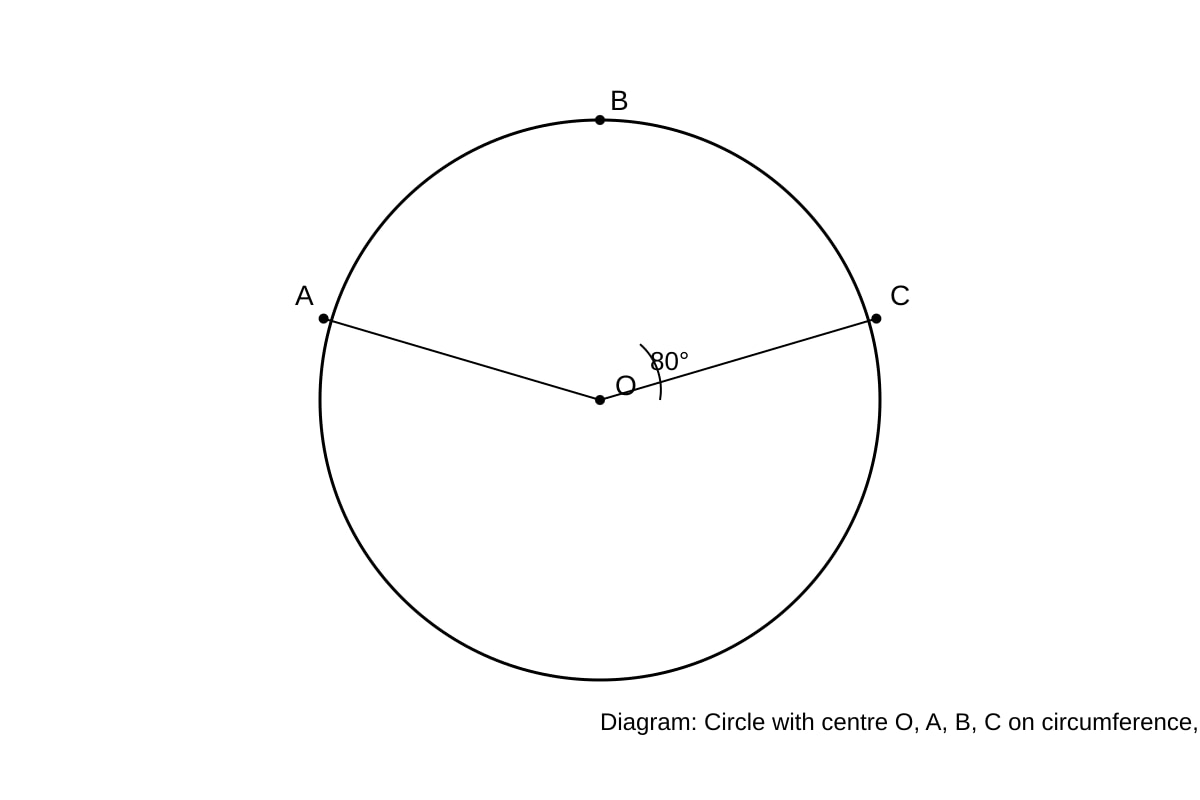
Q4. ∠ABC=40∘\angle ABC = 40^\circ.
Reason: Angle at centre = 2×2 \times angle at circumference subtended by same arc ACAC. So ∠ABC=80∘/2=40∘\angle ABC = 80^\circ / 2 = 40^\circ.
[2 marks: 1 theorem, 1 answer]

Q5. AA (Angle-Angle) criterion.
[2 marks: 1 for two angles, 1 for naming AA]

Q6. tan⁡∠B=86=43\tan \angle B = \frac{8}{6} = \frac{4}{3}.
Working: Opposite to B is AC=8AC=8, adjacent is AB=6AB=6, tan⁡B=8/6\tan B = 8/6.
[2 marks]

Q7. Angle = 59.0∘59.0^\circ.
Working: tan⁡θ=106=1.6667\tan \theta = \frac{10}{6}=1.6667, θ=tan⁡−1(1.6667)≈59.0∘\theta = \tan^{-1}(1.6667) \approx 59.0^\circ.
[2 marks]

Q8. ∠BCD=80∘\angle BCD = 80^\circ.
Reason: Opposite angles in cyclic quadrilateral sum to 180∘180^\circ, so 100+∠BCD=180100 + \angle BCD = 180.
[2 marks]

Q9. LN=15LN = 15 cm.
Working: LM2=LN2+MN2⇒172=LN2+82⇒LN2=289−64=225LM^2 = LN^2 + MN^2 \Rightarrow 17^2 = LN^2 + 8^2 \Rightarrow LN^2 = 289-64=225, LN=15LN=15.
[2 marks]

Q10. x=72+102−2(7)(10)cos⁡60∘=49+100−140(0.5)=79≈8.89x = \sqrt{7^2+10^2 - 2(7)(10)\cos 60^\circ} = \sqrt{49+100-140(0.5)} = \sqrt{79} \approx 8.89 cm.
[2 marks: 1 substitution, 1 answer]

Section B Answers (3 marks each)

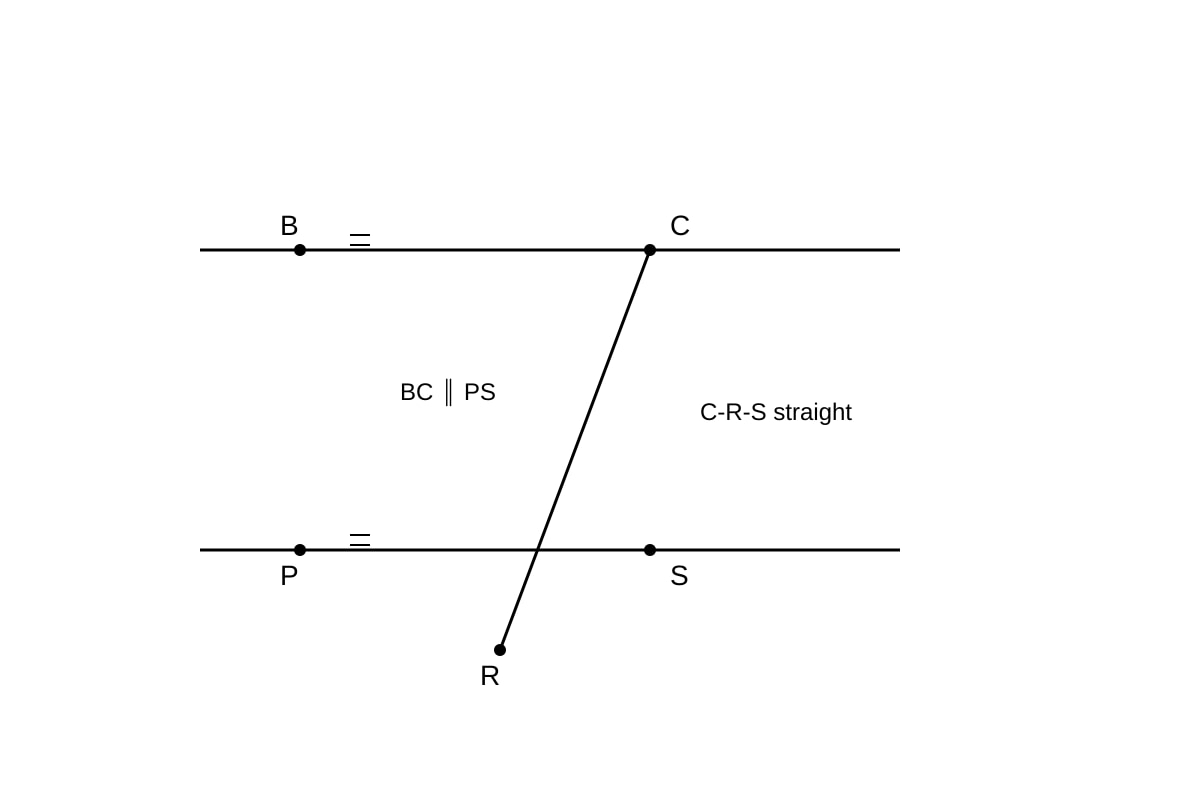
Q11. ∠BCR\angle BCR is shared; ∠CBR=∠CPS\angle CBR = \angle CPS (corresponding angles, BC∥PSBC \parallel PS); therefore △BCR∼△PCS\triangle BCR \sim \triangle PCS by AA.
[3 marks: 1 shared, 1 corresponding, 1 conclusion]

Q12. AC2=64+36=100=102AC^2 = 64+36=100=10^2 matches; so ∠B=90∘\angle B = 90^\circ. sin⁡A=BCAC=6/10=0.6\sin A = \frac{BC}{AC} = 6/10 = 0.6.
[3 marks: 1 pythag, 1 angle, 1 sin]

Q13. Bearing = 053∘053^\circ (or 53.1∘53.1^\circ).
Working: tan⁡θ=15/20=0.75\tan \theta = 15/20=0.75, θ=36.9∘\theta=36.9^\circ east of north → bearing 090−36.9=053.1090-36.9=053.1.
[3 marks: 1 diagram, 1 angle, 1 bearing]

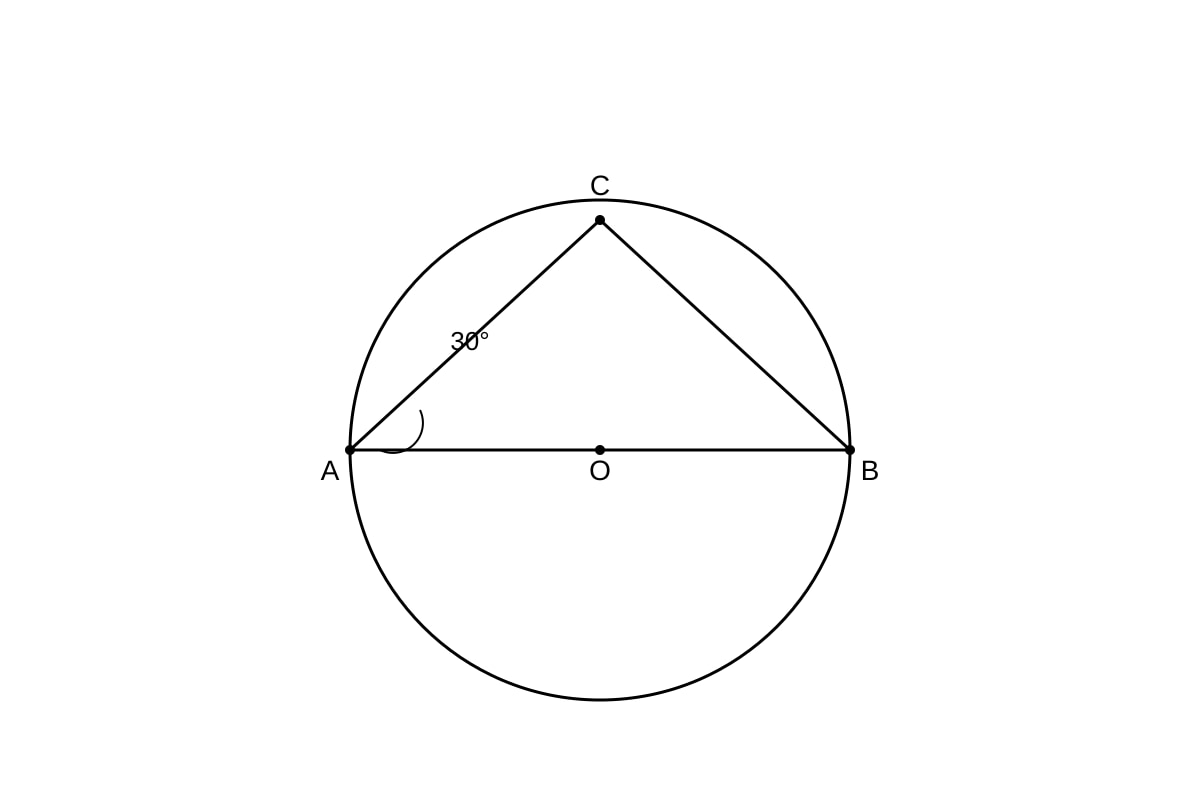
Q14. ∠BOC=60∘\angle BOC = 60^\circ.
Reason: ∠BAC=30∘\angle BAC = 30^\circ at circumference subtends arc BCBC; angle at centre ∠BOC=2×30=60∘\angle BOC = 2 \times 30 = 60^\circ.
[3 marks]

Q15. In right △ABD\triangle ABD, sin⁡∠ADB=ABAD=12\sin \angle ADB = \frac{AB}{AD} = \frac{1}{2}, so ∠ADB=sin⁡−1(0.5)=π6\angle ADB = \sin^{-1}(0.5) = \frac{\pi}{6} rad.
[3 marks: 1 ratio, 1 inverse, 1 rad]

Q16. QR2=92+72−2(9)(7)cos⁡50∘=81+49−126(0.6428)≈130−81.0=49.0QR^2 = 9^2+7^2 - 2(9)(7)\cos 50^\circ = 81+49 - 126(0.6428) \approx 130-81.0 = 49.0, QR≈7.00QR \approx 7.00 cm.
[3 marks: 1 formula, 1 calc, 1 ans]

Section C Answers (5 marks each)

Q17. Height hh: From 30 m: tan⁡40=h/30⇒h=30tan⁡40=25.17\tan 40 = h/30 \Rightarrow h = 30\tan40 = 25.17. From 20 m: tan⁡55=h/20⇒h=20tan⁡55=28.56\tan 55 = h/20 \Rightarrow h = 20\tan55 = 28.56 → inconsistent? Use two equations: h=xtan⁡55h = x\tan55, h=(x+10)tan⁡40h=(x+10)\tan40; solve xtan⁡55=(x+10)tan⁡40⇒x(1.4281)=(x+10)(0.8391)⇒1.4281x=0.8391x+8.391⇒0.589x=8.391⇒x=14.24x\tan55 = (x+10)\tan40 \Rightarrow x(1.4281)= (x+10)(0.8391) \Rightarrow 1.4281x = 0.8391x+8.391 \Rightarrow 0.589x=8.391 \Rightarrow x=14.24, h=14.24×1.4281=20.3h=14.24\times1.4281=20.3 m.
[5 marks: 2 setup, 2 solve, 1 ans]

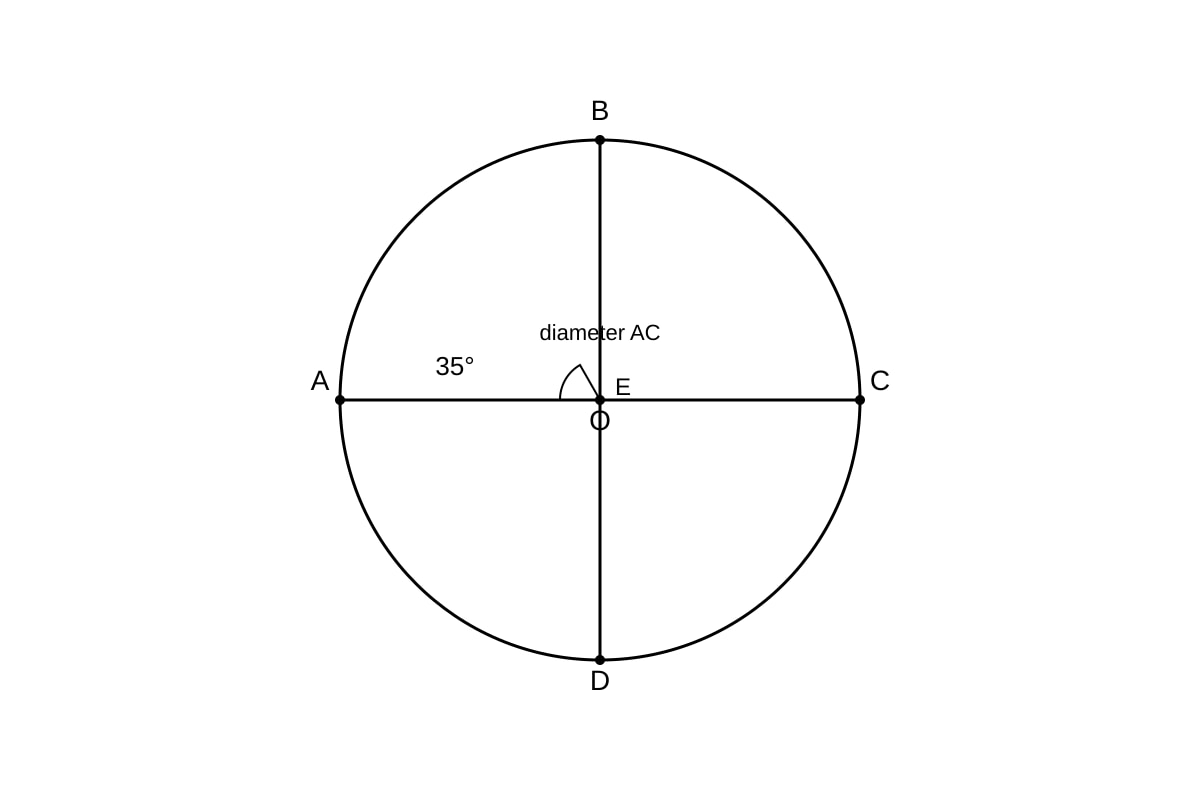
Q18. ∠BDC=35∘\angle BDC = 35^\circ (same segment as ∠BAC\angle BAC). ∠CAD=55∘\angle CAD = 55^\circ since ∠ADC=90∘\angle ADC = 90^\circ (angle in semicircle), ∠CAD=90−35=55∘\angle CAD = 90-35=55^\circ.
[5 marks: 2 BDC, 3 CAD]

Q19. All sides 5 → equilateral. Area = 12(5)(5)sin⁡60∘=12.5×0.8660=10.8\frac{1}{2}(5)(5)\sin 60^\circ = 12.5 \times 0.8660 = 10.8 cm².
[5 marks: 2 proof, 3 area]

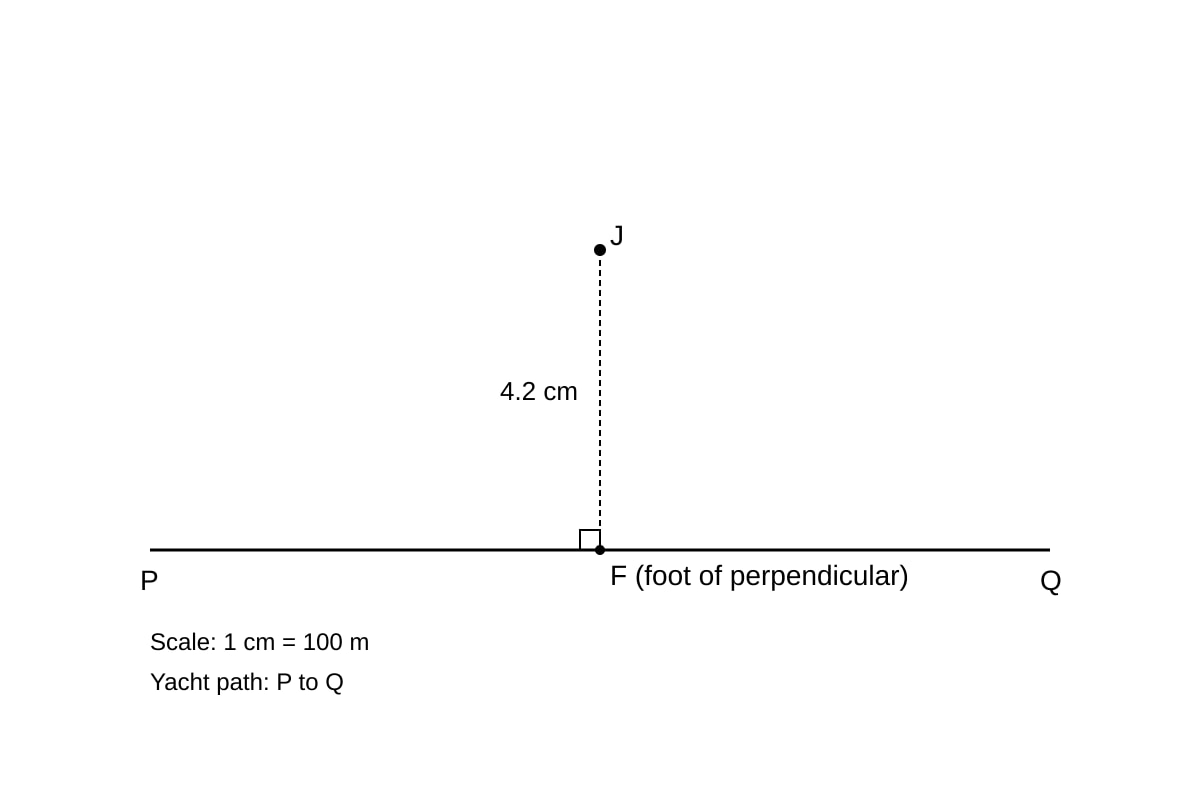
Q20. Shortest distance = 4.2 cm×100 m/cm=4204.2 \text{ cm} \times 100 \text{ m/cm} = 420 m.
[5 marks: 2 draw perp, 1 measure, 2 scale convert]

End of Answer Key