AI Generated Exam Paper

Secondary 4 Elementary Mathematics Practice Paper 1

Free AI-Generated Secondary 4 Elementary Mathematics Practice Paper 1 practice paper with questions and answers for Singapore students. This page is rendered as a direct URL so the questions and answers can be discovered without pressing in-page buttons.

These static practice materials are generated from the site's syllabus and paper-generation workflow, with source and model context shown so students and parents can evaluate the material before use.

Secondary 4 Elementary Mathematics AI Generated Generated by Claude Sonnet 4 Updated 2026-06-03

Questions

TuitionGoWhere Practice Paper - Elementary Mathematics Secondary 4

TuitionGoWhere Practice Paper (AI)

Subject: Elementary Mathematics
Level: Secondary 4
Paper: 2
Duration: 2 hours 15 minutes
Total Marks: 90

Name: _________________________ Class: _______ Date: ___________


Instructions to Candidates

  1. This paper consists of Section A and Section B.
  2. Answer ALL questions.
  3. Write your answers in the spaces provided.
  4. Show all necessary working clearly.
  5. Marks will be awarded for correct methods even if the final answer is wrong.
  6. Give your final answers to 3 significant figures unless otherwise stated.
  7. The use of calculators is allowed.
  8. Take π = 3.142 or use the π key on your calculator.

Section A [40 marks]

Answer all questions in this section.

Question 1 [8 marks]

A telecommunications company offers two mobile phone plans:

Plan A: 25monthlyfeeplus15¢perminuteforcallsPlanB:25 monthly fee plus 15¢ per minute for calls **Plan B:** 40 monthly fee plus 8¢ per minute for calls

(a) Write down expressions for the total monthly cost for each plan if a customer makes t minutes of calls. [2]

Plan A: $________________

Plan B: $________________

(b) On the grid below, draw graphs to represent both plans for 0 ≤ t ≤ 300. [4]

[Grid provided - 300 units on x-axis, 00-85 on y-axis]

(c) Use your graph to find the number of minutes of calls for which both plans cost the same amount. [1]

________________ minutes

(d) A customer makes 180 minutes of calls per month. Which plan should they choose and how much will they save per month? [1]

Plan: _______ Savings: $_______ per month

Question 2 [6 marks]

The speed-time graph shows the motion of a car during a 50-second journey.

[Graph shows: 0-10s acceleration to 20 m/s, 10-30s constant 20 m/s, 30-50s deceleration to 0 m/s]

(a) Find the acceleration during the first 10 seconds. [1]

Acceleration = _______ m/s²

(b) Calculate the total distance travelled during the 50-second journey. [3]

Working:

Total distance = _______ m

(c) Find the average speed for the entire journey. [2]

Average speed = _______ m/s

Question 3 [7 marks]

In triangle ABC, AB = 9 cm, BC = 12 cm, and AC = 15 cm.

(a) Show that triangle ABC is a right-angled triangle. [2]

Working:

(b) Find sin A. [1]

sin A = _______

(c) Find the area of triangle ABC. [2]

Area = _______ cm²

(d) The triangle is enlarged by a scale factor of 1.5. Find the area of the enlarged triangle. [2]

Area of enlarged triangle = _______ cm²

Question 4 [6 marks]

A bag contains 8 red balls and 12 blue balls. Two balls are drawn at random without replacement.

(a) Find the probability that both balls are red. Give your answer as a fraction in its simplest form. [3]

Working:

P(both red) = _______

(b) Find the probability that the two balls are of different colours. [3]

Working:

P(different colours) = _______

Question 5 [6 marks]

The volume V of a sphere is directly proportional to the cube of its radius r.

(a) Write down the relationship between V and r. [1]

V = _______

(b) When r = 3 cm, V = 113 cm³. Find the value of the constant of proportionality. [2]

Working:

k = _______

(c) Find the percentage increase in volume when the radius is increased by 20%. [3]

Working:

Percentage increase = _______%

Question 6 [7 marks]

Solve the following equations:

(a) 3x² - 7x + 2 = 0 [3]

Working:

x = _______ or x = _______

(b) 2/(x-1) + 3/(x+2) = 1 [4]

Working:

x = _______ or x = _______


Section B [50 marks]

Answer all questions in this section.

Question 7 [12 marks]

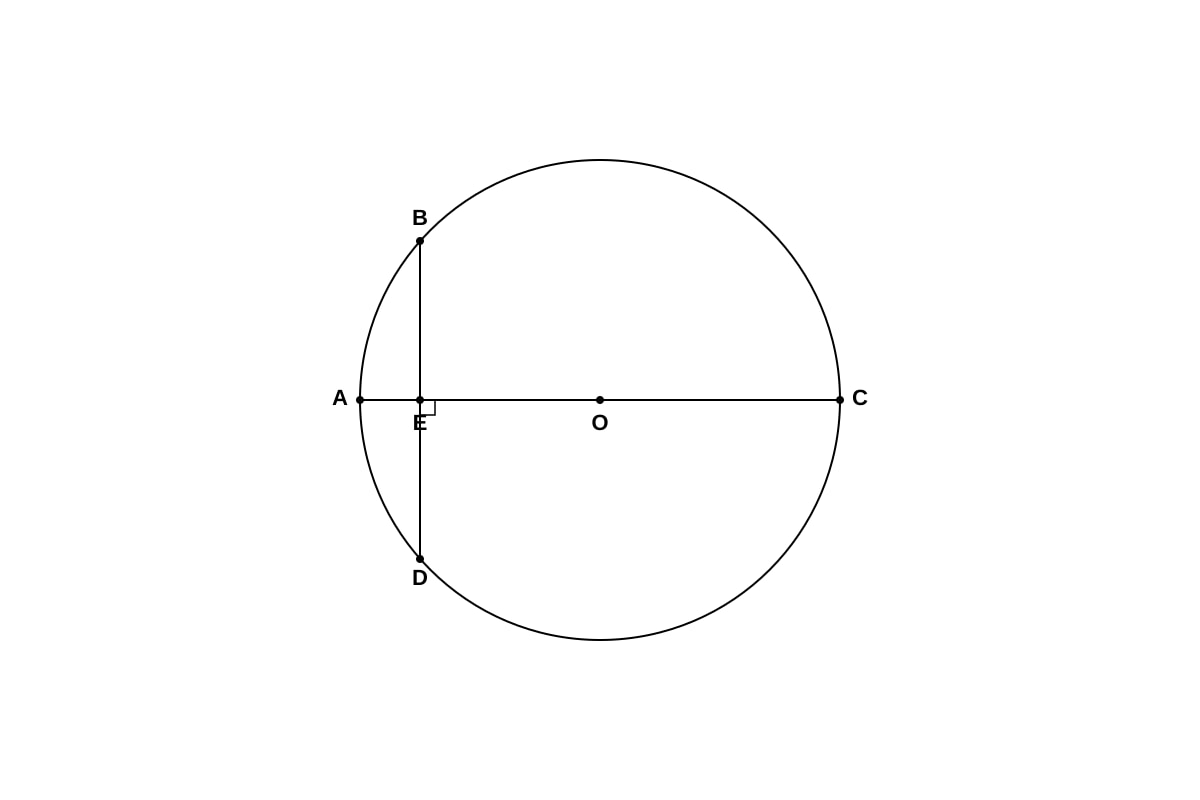
The diagram shows a circle with centre O and radius 8 cm. Points A, B, C, and D lie on the circle. AC is a diameter, and BD is a chord perpendicular to AC, intersecting AC at point E.

[Diagram shows circle with the described configuration]

(a) Given that AE = 2 cm, find EC. [1]

EC = _______ cm

(b) Find the length of BE. [3]

Working:

BE = _______ cm

(c) Find the area of triangle ABE. [2]

Working:

Area = _______ cm²

(d) Find ∠BAC. [3]

Working:

∠BAC = _______°

(e) Hence find the area of the minor segment cut off by chord AB. [3]

Working:

Area of segment = _______ cm²

Question 8 [13 marks]

A factory produces two types of furniture: chairs and tables. Let x be the number of chairs and y be the number of tables produced per week.

The constraints are:

  • Wood constraint: 2x + 5y ≤ 100
  • Labour constraint: 3x + 2y ≤ 84
  • Non-negativity: x ≥ 0, y ≥ 0

The profit is 30perchairand30 per chair and 50 per table.

(a) Write down the objective function to be maximized. [1]

P = _______

(b) On the grid provided, draw the feasible region defined by the constraints. Shade the feasible region clearly. [5]

[Grid provided with appropriate scale]

(c) Find the coordinates of all corner points of the feasible region. [3]

Corner points: (,), (,), (,), (,)

(d) Determine the optimal production plan that maximizes profit. [2]

Optimal plan: x = _____, y = _____

(e) Calculate the maximum weekly profit. [2]

Maximum profit = $_______

Question 9 [12 marks]

A survey was conducted among 200 students about their participation in sports. The results showed:

  • 120 students play football (F)
  • 80 students play basketball (B)
  • 45 students play both sports
  • The remaining students play neither sport

(a) Draw a Venn diagram to represent this information. [3]

[Space for Venn diagram]

(b) Find the number of students who play: (i) only football [1] (ii) only basketball [1]
(iii) neither sport [1]

(i) _______ students (ii) _______ students
(iii) _______ students

(c) A student is selected at random. Find the probability that the student: (i) plays at least one sport [2] (ii) plays football but not basketball [2] (iii) plays basketball, given that the student plays football [2]

(i) P(at least one sport) = _______ (ii) P(football only) = _______ (iii) P(basketball | football) = _______

Question 10 [13 marks]

This question involves a real-world application of mathematics.

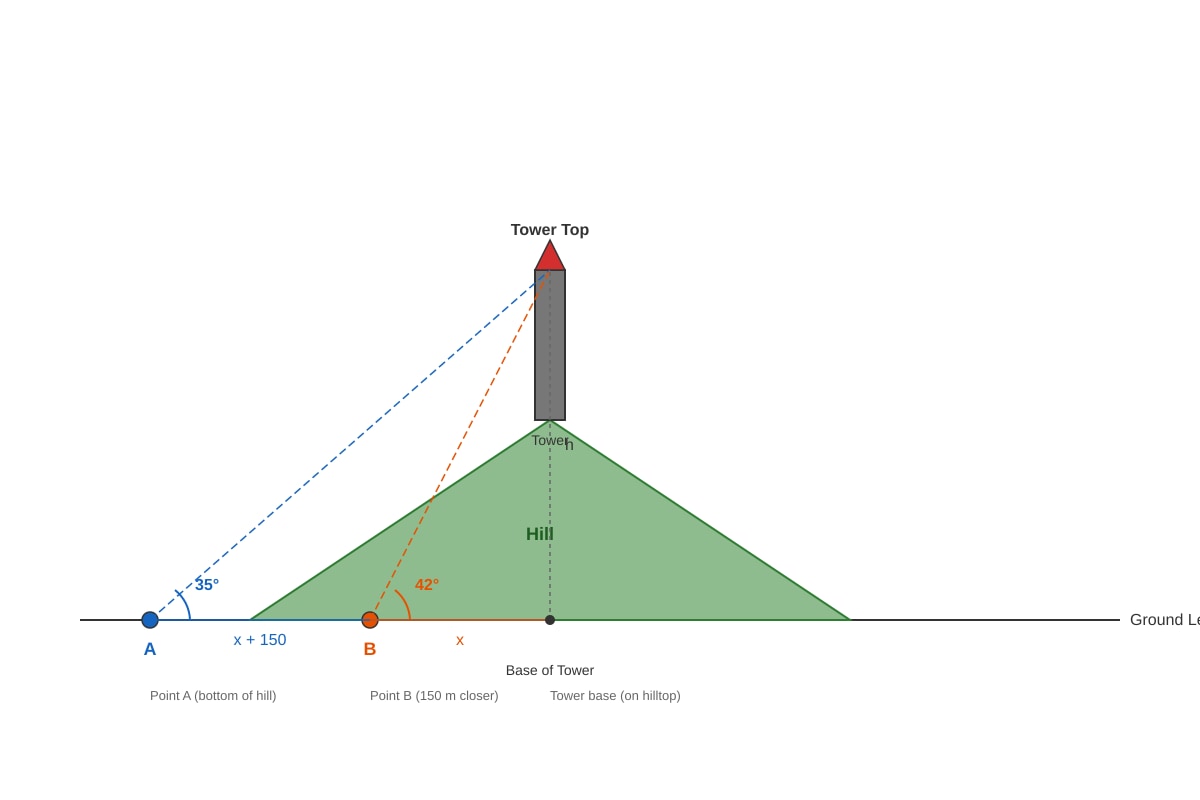
A telecommunications tower is built on top of a hill. From point A at the bottom of the hill, the angle of elevation to the top of the tower is 35°. From point B, which is 150 m closer to the hill along the same horizontal line, the angle of elevation to the top of the tower is 42°.

[Diagram shows the hill, tower, and observation points with appropriate angles marked]

(a) Let h be the height of the tower above the horizontal line through points A and B. Set up equations involving h and the horizontal distances. [3]

Equation 1: _______________________

Equation 2: _______________________

(b) Solve these equations to find the height h. [4]

Working:

h = _______ m

(c) Find the horizontal distance from point A to the base of the tower. [2]

Distance = _______ m

(d) If the tower itself is 25 m tall, find the height of the hill above the horizontal line through A and B. [2]

Height of hill = _______ m

(e) A radio signal from the tower has a range of 15 km. Will the signal reach a town that is 12 km horizontally from the base of the tower and 200 m below the level of points A and B? Show your working. [2]

Working:

Answer: _______


END OF PAPER

Answers

TuitionGoWhere Practice Paper - Elementary Mathematics Secondary 4

MARKING SCHEME

Total Marks: 90


Section A [40 marks]

Question 1 [8 marks]

(a) Plan A: 25 + 0.15t [1] Plan B: 40 + 0.08t [1]

(b) [Graph drawing - 4 marks] - Correct y-intercepts (25 and 40) [1] - Correct gradients (0.15 and 0.08) [1]
- Both lines drawn accurately [1] - Appropriate scale and labels [1]

(c) 214 minutes (accept 210-220) [1] From graph intersection or solving 25 + 0.15t = 40 + 0.08t

(d) Plan: A [0.5] Savings: *5.40permonth[0.5]PlanA:25+0.15(180)=5.40** per month [0.5] *Plan A: 25 + 0.15(180) = 52, Plan B: 40 + 0.08(180) = $54.40

Question 2 [6 marks]

(a) Acceleration = 2 m/s² [1] a = (20-0)/(10-0) = 2

(b) Distance = Area under graph = ½(10)(20) + (20)(20) + ½(20)(20) = 100 + 400 + 200 = 700 m [3] Award 1 mark for each section calculated correctly

(c) Average speed = 700/50 = 14 m/s [2] 1 mark for method, 1 mark for answer

Question 3 [7 marks]

(a) Check: 9² + 12² = 81 + 144 = 225 = 15² [1] Since AB² + BC² = AC², triangle is right-angled at B [1]

(b) sin A = opposite/hypotenuse = BC/AC = 12/15 = 4/5 [1]

(c) Area = ½ × base × height = ½ × 9 × 12 = 54 cm² [2]

(d) Scale factor = 1.5, so area scale factor = 1.5² = 2.25 New area = 54 × 2.25 = 121.5 cm² [2]

Question 4 [6 marks]

(a) P(both red) = (8/20) × (7/19) = 56/380 = 14/95 [3] 1 mark for first probability, 1 mark for second probability, 1 mark for simplification

(b) P(different) = P(RB) + P(BR) = (8/20)(12/19) + (12/20)(8/19) = 96/380 + 96/380 = 192/380 = 48/95 [3] Alternative: 1 - P(same colour) = 1 - (14/95 + 66/380) = 48/95

Question 5 [6 marks]

(a) V = kr³ [1]

(b) 113 = k(3³) = 27k k = 113/27 = 4.19 (to 3 s.f.) [2]

(c) New radius = 1.2r New volume = k(1.2r)³ = k(1.728r³) = 1.728V Percentage increase = (1.728 - 1) × 100% = 72.8% [3]

Question 6 [7 marks]

(a) Using quadratic formula: x = (7 ± √(49-24))/6 = (7 ± 5)/6 x = 2 or x = 1/3 [3]

(b) Multiply through by (x-1)(x+2): 2(x+2) + 3(x-1) = (x-1)(x+2) 2x + 4 + 3x - 3 = x² + x - 2 5x + 1 = x² + x - 2 x² - 4x - 3 = 0 x = (4 ± √28)/2 = 2 ± √7 [4]


Section B [50 marks]

Question 7 [12 marks]

(a) Since AC is diameter, AC = 16 cm EC = 16 - 2 = 14 cm [1]

(b) In right triangle OEB: OE = |8 - 2| = 6 cm BE² = OB² - OE² = 8² - 6² = 64 - 36 = 28 BE = √28 = 2√7 ≈ 5.29 cm [3]

(c) Area of triangle ABE = ½ × AE × BE = ½ × 2 × 2√7 = 2√7 ≈ 5.29 cm² [2]

(d) In right triangle ABE: tan(∠BAE) = BE/AE = 2√7/2 = √7 ∠BAC = tan⁻¹(√7) = 69.3° [3]

(e) Area of sector AOB = (69.3/360) × π × 8² ≈ 38.7 cm² Area of triangle AOB = ½ × 8 × 8 × sin(69.3°) ≈ 29.9 cm² Area of segment = 38.7 - 29.9 = 8.8 cm² [3]

Question 8 [13 marks]

(a) P = 30x + 50y [1]

(b) [Graph with feasible region - 5 marks] - Correct line 2x + 5y = 100 [1] - Correct line 3x + 2y = 84 [1] - Correct axes constraints [1] - Feasible region correctly shaded [1] - Clear labeling [1]

(c) Corner points: (0,0), (0,20), (28,0), intersection of constraints Solving: 2x + 5y = 100 and 3x + 2y = 84 From first: y = (100-2x)/5, substitute: 3x + 2(100-2x)/5 = 84 15x + 400 - 4x = 420, 11x = 20, x = 20/11 y = (100-40/11)/5 = 96/11 Corner points: (0,0), (0,20), (28,0), (20/11, 96/11) [3]

(d) Evaluate P at each corner: P(0,0) = 0, P(0,20) = 1000, P(28,0) = 840, P(20/11,96/11) ≈ 491 Optimal: x = 0, y = 20 [2]

(e) Maximum profit = $1000 [2]

Question 9 [12 marks]

(a) [Venn diagram showing: - Only F: 75 - Both: 45
- Only B: 35 - Neither: 45] [3]

(b) (i) Only football: 75 students [1] (ii) Only basketball: 35 students [1] (iii) Neither sport: 45 students [1]

(c) (i) P(at least one) = 155/200 = 31/40 [2] (ii) P(football only) = 75/200 = 3/8 [2] (iii) P(B|F) = 45/120 = 3/8 [2]

Question 10 [13 marks]

(a) Let d be distance from A to base of tower From A: tan 35° = h/d, so h = d tan 35° [1.5] From B: tan 42° = h/(d-150), so h = (d-150) tan 42° [1.5]

(b) Setting equal: d tan 35° = (d-150) tan 42° d(0.7002) = (d-150)(0.9004) 0.7002d = 0.9004d - 135.06 -0.2002d = -135.06 d = 674.8 m h = 674.8 × tan 35° = 472 m [4]

(c) Distance from A = 675 m [2]

(d) Height of hill = 472 - 25 = 447 m [2]

(e) Distance to town = √(12000² + (472+200)²) = √(144000000 + 451584) ≈ 12013 m = 12.0 km Since 12.0 km < 15 km, Yes, signal will reach [2]


Grade Boundaries:

  • A1: 81-90 marks (90-100%)
  • A2: 72-80 marks (80-89%)
  • B3: 63-71 marks (70-79%)
  • B4: 54-62 marks (60-69%)
  • C5: 45-53 marks (50-59%)
  • C6: 36-44 marks (40-49%)
  • D7: 27-35 marks (30-39%)
  • E8: 18-26 marks (20-29%)
  • F9: Below 18 marks (<20%)