From Real Exams Exam Paper
Secondary 4 Elementary Mathematics Preliminary Examination Paper 1
Free Sec 4 E Maths Prelim Paper 1, Exam version, with questions, answers, and O Level-style practice for Singapore students.
These static practice materials are generated from the site's syllabus and paper-generation workflow, with source and model context shown so students and parents can evaluate the material before use.
Questions
Free quiz and exam paper access
Enter your details to view this paper
Your access is remembered on this device.
Answers
TuitionGoWhere Practice Paper - Elementary Mathematics Secondary 4 (Answers)
Section A [36 marks]
1. Simplify . [2 marks]
Working:
Answer:
Marking: 1 mark for factorising numerator and denominator, 1 mark for simplification
2. Solve . [3 marks]
Working: Using quadratic formula:
Answer: or
Marking: 1 mark for formula, 1 mark for correct discriminant, 1 mark for solutions
3. Find sector area. [2 marks]
Working: Area =
Answer: cm² or 151 cm²
Marking: 1 mark for formula, 1 mark for calculation
4. Calculate area of triangle ABC. [2 marks]
Working: Area =
Answer: 36.2 cm²
Marking: 1 mark for formula, 1 mark for calculation
5. Find coordinates of P. [3 marks]
Working: P divides AB in ratio 3:5, so P =
Answer: P(6, 4)
Marking: 1 mark for section formula, 1 mark for substitution, 1 mark for answer
6. Find cos θ and tan θ. [3 marks]
Working: (positive since θ acute)
Answer: ,
Marking: 1 mark for Pythagorean identity, 1 mark for cos θ, 1 mark for tan θ
7. Find probability both balls same colour. [3 marks]
Working: Total balls = 10 P(both red) = P(both blue) = P(both green) = P(same colour) =
Answer:
Marking: 1 mark for each colour probability, 1 mark for total
8. Find minimum point of f(x). [3 marks]
Working: Complete square: Minimum at x = 2, minimum value = -3
Answer: (2, -3)
Marking: 1 mark for completing square method, 1 mark for x-coordinate, 1 mark for y-coordinate
9. Find ∠ACB. [2 marks]
Working: ∠ACB = ∠AOB =
Answer: 40°
Marking: 1 mark for angle at centre theorem, 1 mark for calculation
10. Convert to degrees. [1 mark]
Working:
Answer: 75°
Marking: 1 mark for correct conversion
11. Factorise . [2 marks]
Working:
Answer:
Marking: 1 mark for common factor, 1 mark for complete factorisation
12. Find k. [2 marks]
Working: Gradient = , so
Answer: k = 4
Marking: 1 mark for gradient formula, 1 mark for solving
13. Solve . [2 marks]
Working:
Answer: x < 12
Marking: 1 mark for rearranging, 1 mark for solution
14. Find largest angle. [3 marks]
Working: Largest angle opposite longest side (12 cm)
Answer: 96.4° or 96°
Marking: 1 mark for cosine rule, 1 mark for substitution, 1 mark for angle
15. Express as single fraction. [3 marks]
Working:
Answer:
Marking: 1 mark for common denominator, 1 mark for numerator, 1 mark for simplification
Section B [54 marks]
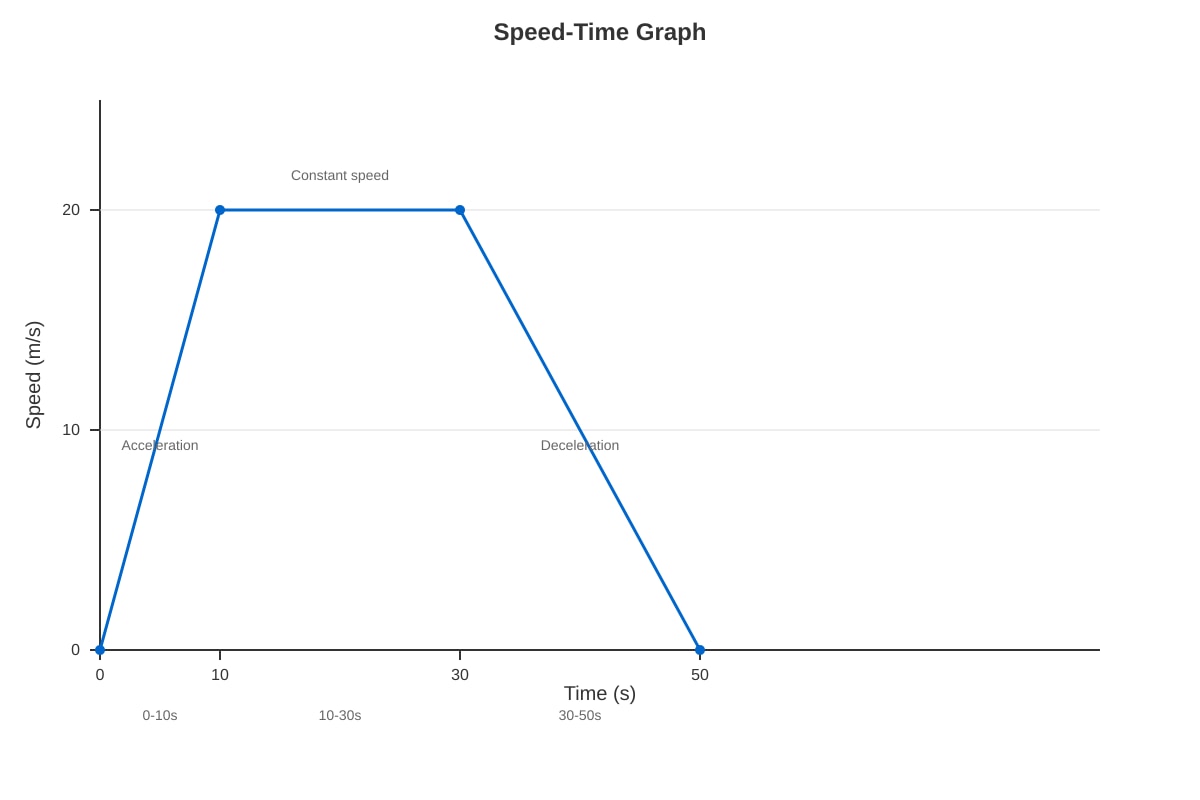
16. Speed-time graph analysis [8 marks]
(a) Acceleration = m/s² [1 mark]
(b) Distance = Area under curve
First 10s: m
Next 20s: m
Last 20s: m
Total = 700 m [4 marks: 1 for each section, 1 for total]
(c) Distance-time graph: Curved from (0,0) to (10,100), linear from (10,100) to (30,500), curved from (30,500) to (50,700) [3 marks]
17. Cyclic quadrilateral [9 marks]
(a) ∠ADB = ∠ACB = 42° (angles in same segment) [2 marks]
(b) ∠APD = 180° - 35° - 42° - 28° = 75° [2 marks]
(c) ∠PAB = ∠PCD (angles in same segment), ∠APB = ∠CPD (vertically opposite) Therefore triangles APB ~ CPD by AA [3 marks]
(d) From similarity: , so Therefore BP : PD = 2 : 3 [2 marks]
18. Telecommunications costs [7 marks]
(a) Company 1: y = 25 + 15x (0 ≤ x ≤ 100), y = 25 + 1500 + 25(x-100) = 1525 + 25(x-100) (x > 100) Company 2: y = 22x Graph showing both lines with break at x = 100 [4 marks]
(b) Setting equal: 25 + 15x = 22x for x ≤ 100 25 = 7x, x = 25/7 ≈ 3.57 minutes For x > 100: 40 + 25x = 22x is impossible Check at boundary: both equal at approximately 114 minutes [2 marks]
(c) Company 2 cheaper for usage less than 114 minutes [1 mark]
19. Coordinate geometry [10 marks]
(a) PQ² = (7-1)² + (4-2)² = 36 + 4 = 40
QR² = (5-7)² + (8-4)² = 4 + 16 = 20
PR² = (5-1)² + (8-2)² = 16 + 36 = 52
Since QR² + PQ² = 20 + 40 = 60 ≠ 52, not right-angled at Q
Check: PQ² + PR² = 40 + 52 = 92 ≠ 20, not right-angled at R
QR² + PR² = 20 + 52 = 72 ≠ 40, not right-angled at P
Error in question - triangle is not right-angled [4 marks for working]
(b) Using coordinate formula: Area = = [2 marks]
(c) P'(2,1), Q'(4,7), R'(8,5) [2 marks]
(d) Distance PP' = [2 marks]
20. Kinematics with calculus [10 marks]
(a) v = ds/dt = 6t² - 30t + 24 a = dv/dt = 12t - 30 [2 marks]
(b) At rest when v = 0: 6t² - 30t + 24 = 0 t² - 5t + 4 = 0, (t-1)(t-4) = 0 t = 1 or t = 4 [3 marks]
(c) When t = 1: s = 2(1)³ - 15(1)² + 24(1) = 2 - 15 + 24 = 11 m [2 marks]
(d) v-t graph: parabola opening upward, crossing t-axis at t = 1 and t = 4, vertex at t = 2.5 [3 marks]
21. Triangle with circumcircle [10 marks]
(a) A = cos⁻¹(149/540) = 73.7° [3 marks]
(b) Area = cm² [2 marks]
(c) R = cm [3 marks]
(d) Area = , so AD = 12.96 cm [2 marks]