AI Generated Quiz
Secondary 4 Combined Science Physics Summary Quiz
Free Sec 4 Comb Sci Phy Summary quiz, Claude AI version, with questions, answers, and O Level-style practice for Singapore students.
These static practice materials are generated from the site's syllabus and paper-generation workflow, with source and model context shown so students and parents can evaluate the material before use.
Questions
Free quiz and exam paper access
Enter your details to view this paper
Your access is remembered on this device.
Answers
Secondary 4 Combined Science Physics Quiz - Summary (Answers)
Section A: Multiple Choice [10 marks]
1. B. 15 m/s
- Speed = distance/time = 120 m ÷ 8 s = 15 m/s
2. B. Particles vibrate about fixed positions
- In solids, particles have kinetic energy and vibrate, but are held in fixed positions by strong intermolecular forces
3. C. Equal to the applied force
- At constant velocity, acceleration = 0, so net force = 0. Therefore friction force = applied force (Newton's First Law)
4. C. The other bulb goes out
- In series circuits, current flows through all components. If one component fails, the circuit is broken and no current flows
5. C. Glass to air at angles greater than the critical angle
- Total internal reflection occurs when light travels from denser to less dense medium at angles greater than the critical angle
Section B: Structured Questions [25 marks]
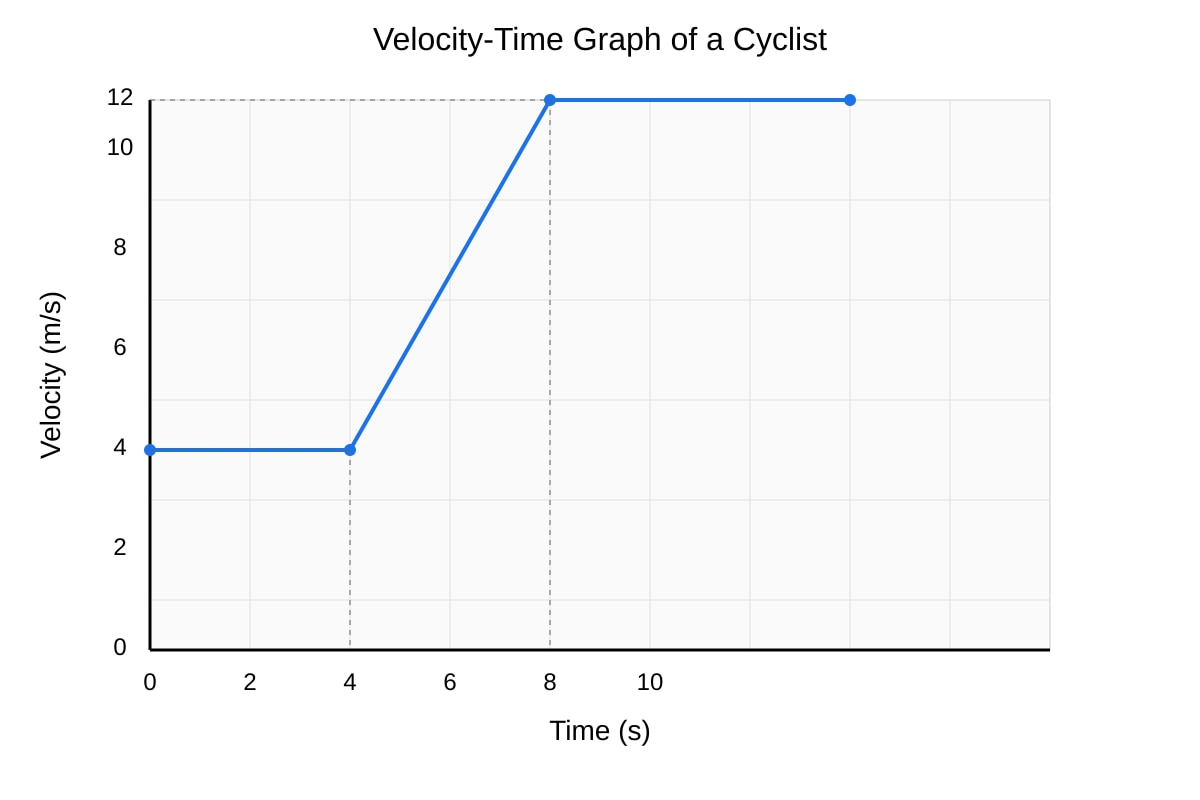
6.(a) [2 marks]
- Acceleration = change in velocity / time taken
- a = (12 - 4) / (6 - 2) = 8/4 = 2 m/s²
- Award 1 mark for correct formula, 1 mark for correct answer with units
6.(b) [3 marks]
- Distance = area under velocity-time graph
- Area 1 (0-2s): 4 × 2 = 8 m
- Area 2 (2-6s): ½ × (4 + 12) × 4 = 32 m
- Area 3 (6-10s): 12 × 4 = 48 m
- Total distance = 8 + 32 + 48 = 88 m
- Award 1 mark for method, 1 mark for calculation, 1 mark for correct answer
7.(a) [2 marks]
- P = VI, so I = P/V
- I = 500/230 = 2.17 A (accept 2.2 A)
- Award 1 mark for correct formula, 1 mark for correct answer
7.(b) [3 marks]
- Energy = Power × time
- Time = 5 minutes = 5/60 hours = 1/12 hours
- Energy = 0.5 kW × 1/12 h = 0.042 kWh (accept 0.04 kWh)
- Award 1 mark for time conversion, 1 mark for formula, 1 mark for answer
8.(a)(i) [1 mark]
- Particles move faster / gain kinetic energy / vibrate more vigorously
- Accept any reference to increased particle motion
8.(a)(ii) [1 mark]
- Particles move from fixed/regular positions to more random arrangement / particles can move past each other
- Accept description of transition from ordered to less ordered arrangement
8.(b) [2 marks]
- Energy is used to break intermolecular bonds/forces (1 mark)
- Rather than increasing kinetic energy of particles (1 mark)
- Must mention both bond breaking and kinetic energy for full marks
Section C: Extended Response [15 marks]
9.(a) [2 marks - 1 mark each] Accept any two from:
- Air resistance/drag
- Shape/size of ball
- Mass of ball
- Wind conditions
- Height of drop
- Surface the ball lands on
9.(b) [3 marks]
- Air resistance opposes motion (1 mark)
- Reduces the net downward force on the ball (1 mark)
- Therefore acceleration is less than g, so takes longer to fall (1 mark)
- Must show understanding of force reduction leading to time increase
9.(c) [4 marks]
- Initially: gravitational potential energy converts to kinetic energy (1 mark)
- Some energy is converted to thermal energy due to air resistance (1 mark)
- As speed increases, more energy is lost to air resistance (1 mark)
- Total energy is conserved but not all converts to kinetic energy (1 mark)
- Award marks for clear energy transformation sequence
10.(a) [2 marks]
- Correct diagram showing plank with weight acting downward at center (1 mark)
- Two upward reaction forces at support positions (1 mark)
- Diagram must be clear with forces labeled
10.(b) [4 marks]
- Taking moments about left support:
- R₂ × 1.2 = 100 × (1.0 - 0.4) (1 mark)
- R₂ × 1.2 = 100 × 0.6 = 60 (1 mark)
- R₂ = 50 N (1 mark)
- For equilibrium: R₁ + R₂ = 100, so R₁ = 50 N (1 mark)
- Accept alternative moment points with correct working
Total: 50 marks
Grade Boundaries:
- A: 45-50 marks (90-100%)
- B: 40-44 marks (80-89%)
- C: 35-39 marks (70-79%)
- D: 30-34 marks (60-69%)