AI Generated Quiz
Secondary 4 Combined Science Physics Comprehension Quiz
Free Sec 4 Comb Sci Phy Comprehension quiz, HY3 AI version, with questions, answers, and O Level-style practice for Singapore students.
These static practice materials are generated from the site's syllabus and paper-generation workflow, with source and model context shown so students and parents can evaluate the material before use.
Questions
Secondary 4 Combined Science Physics Quiz - Comprehension
Name: ___________________________
Class: ___________________________
Date: ___________________________
Score: _______ / 40
Duration: 50 minutes
Total Marks: 40
Instructions:
- This quiz tests your comprehension of Secondary 4 Combined Science Physics concepts based on syllabus-first practice content.
- Answer all 20 questions. Section A: 10 short structured questions (1 mark each). Section B: 6 questions with subparts (2 marks each). Section C: 4 extended comprehension questions (3 marks each).
- Show all working where calculation is required. Use SI units.
- This is AI-generated syllabus practice content (Version 1 of 5). It is not derived from past-year exam papers.
Section A (Questions 1–10, 1 mark each, total 10 marks)
1. A car travels at constant velocity. State what this tells you about the net force acting on the car.
2. In the kinetic particle model, what happens to the average kinetic energy of particles when a substance is heated but remains in the same state?
3. A student reads a velocity–time graph. Between two points the line is horizontal. State the acceleration value.
4. State the unit for moment of a force.
5. A 12 V battery is connected to a resistor. If current is 2 A, state the power dissipated.
6. Name the process by which thermal energy is transferred through a vacuum.
7. An object is in equilibrium under three forces. State the condition for the sum of moments about any point.
8. A wave has crests and troughs perpendicular to direction of travel. State the type of wave.
9. State the formula for average speed in words.
10. A switch in a household circuit is open. State whether current flows.
Section B (Questions 11–16, 2 marks each, total 12 marks)
11. A bus moves from rest with acceleration a=1.5 m/s2 for 4 s.
(a) Calculate the final velocity.
(b) State what the area under a velocity–time graph represents.
(a) ________________________
(b) ________________________
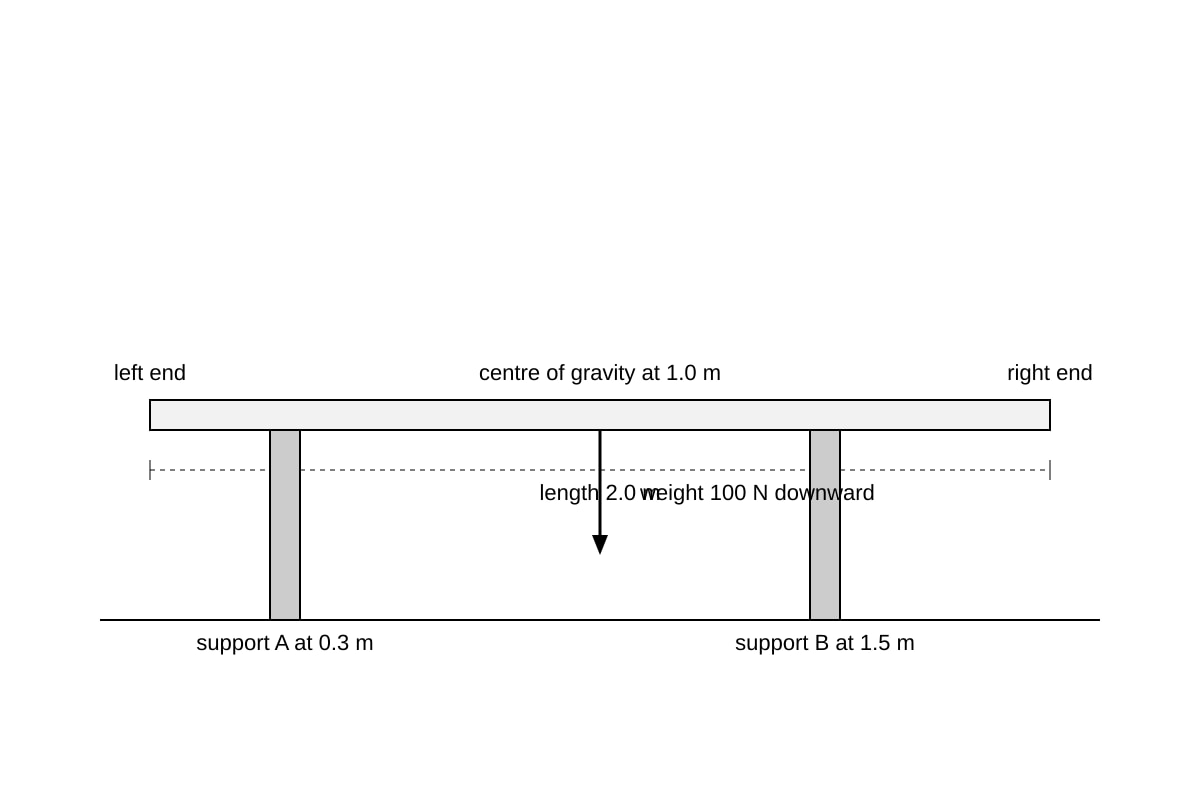
12. The diagram below shows a uniform plank on two supports.
Image pending generation: diagram for Q12.
(a) Calculate the reaction force at support B by taking moments about A.
(b) State the reaction force at support A.
(a) ________________________
(b) ________________________
13. Water is heated from 20°C to 80°C. Explain in terms of particles what happens to the movement and arrangement during heating.
14. A 24 W lamp is used for 5 minutes.
(a) Calculate the energy transferred in joules.
(b) State one form of energy the electrical energy becomes.
(a) ________________________
(b) ________________________
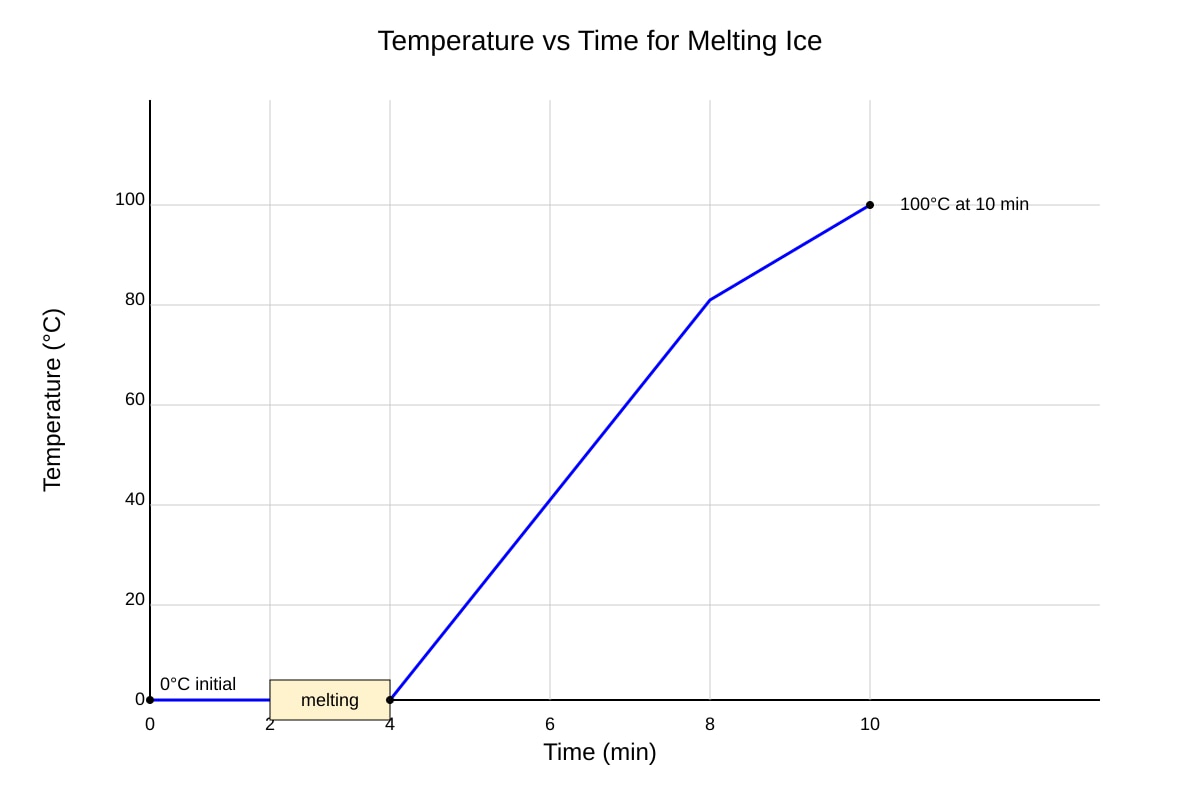
15. The graph shows temperature vs time for melting ice.
Image pending generation: graph for Q15.
(a) State the temperature at which melting occurs.
(b) Explain why temperature stays constant during the plateau.
(a) ________________________
(b) ________________________
16. A circuit has two resistors in series, R1=4 Ω, R2=6 Ω, with 10 V supply.
(a) Calculate total resistance.
(b) Calculate current in the circuit.
(a) ________________________
(b) ________________________
Section C (Questions 17–20, 3 marks each, total 12 marks)
17. A cyclist travels 100 m in 20 s, rests 10 s, then 200 m in 40 s.
(a) Calculate total distance. (1 mark)
(b) Calculate total time. (1 mark)
(c) Calculate average speed for whole journey. (1 mark)
(a) ________________________
(b) ________________________
(c) ________________________
18. Read the passage: "A shuttlecock of mass 0.005 kg is dropped from 10 m. Air resistance acts upwards and increases with speed. It reaches terminal velocity before hitting ground."
(a) State what is meant by terminal velocity. (1 mark)
(b) Explain why time taken is longer than t=2h/g. (1 mark)
(c) Name the energy change from start to terminal velocity. (1 mark)
(a) ________________________
(b) ________________________
(c) ________________________
19. A student says: "Friction always slows things down, so a block pushed at constant speed has zero force on it."
(a) State if the statement about net force is correct. (1 mark)
(b) Explain the role of friction at constant speed. (1 mark)
(c) State the size of friction if applied force is 5 N. (1 mark)
(a) ________________________
(b) ________________________
(c) ________________________
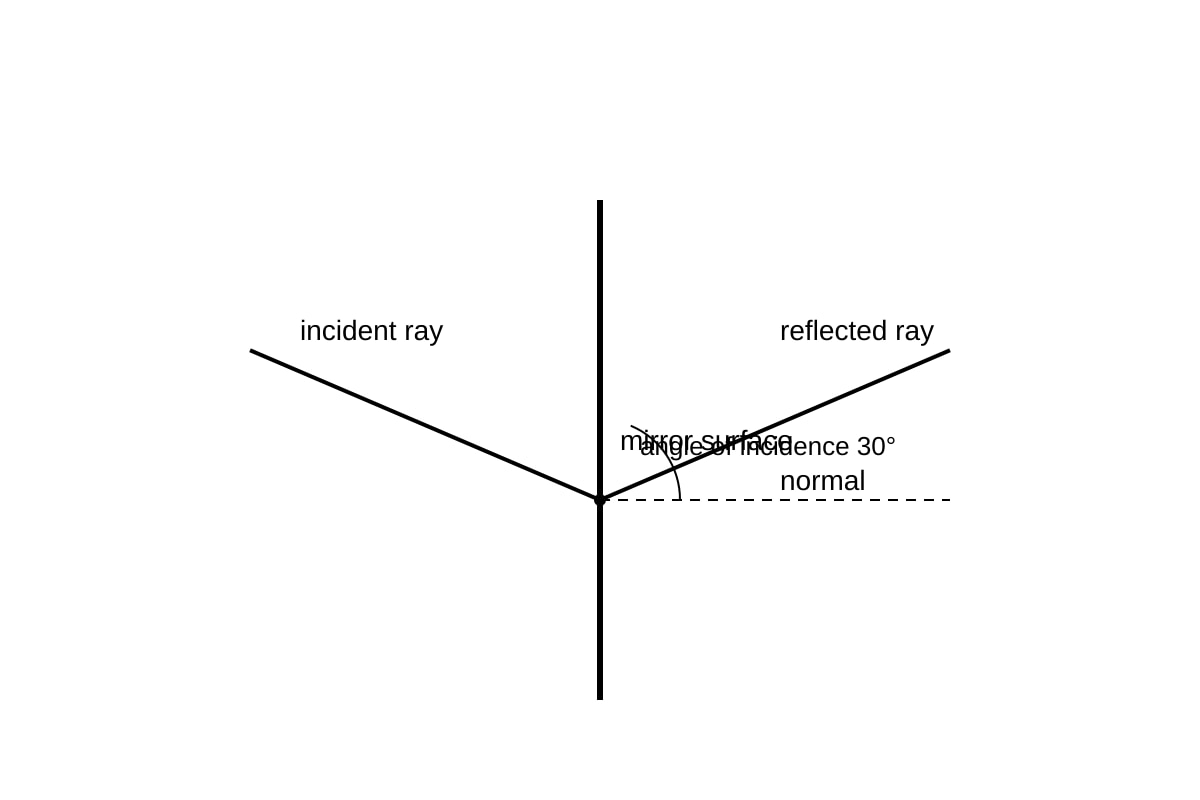
20. The figure shows a ray hitting a plane mirror at 30° to the normal.
Image pending generation: diagram for Q20.
(a) State angle of reflection. (1 mark)
(b) State the law of reflection. (1 mark)
(c) Draw/describe the reflected ray direction. (1 mark)
(a) ________________________
(b) ________________________
(c) ________________________
Answers
Secondary 4 Combined Science Physics Quiz - Comprehension (Answer Key)
Total Marks: 40
Version: 1 of 5 (AI-generated syllabus practice, not past-year derived)
Section A Answers (1 mark each)
1. Net force is zero.
Teaching note: Constant velocity means acceleration = 0, so by Newton’s First Law net force = 0.
2. Average kinetic energy increases.
Teaching note: Heating same state raises temperature → particles move faster → higher KE.
3. Acceleration = 0 m/s².
Teaching note: Horizontal line on v–t graph means constant velocity, so gradient = 0.
4. N m (newton-metre).
Teaching note: Moment = force × perpendicular distance, unit N × m.
5. 24 W.
Teaching note: P = V I = 12 × 2 = 24 W.
6. Radiation.
Teaching note: Radiation transfers heat via EM waves, needs no medium.
7. Sum of clockwise moments = sum of anticlockwise moments.
Teaching note: Equilibrium condition for moments.
8. Transverse wave.
Teaching note: Crests/troughs perpendicular to travel = transverse.
9. Total distance divided by total time.
Teaching note: Average speed = distance / time, scalar.
10. No, current does not flow.
Teaching note: Open switch breaks circuit.
Section B Answers (2 marks each)
11. (a) v=u+at=0+1.5×4=6.0 m/s. [1]
(b) Distance travelled. [1]
Teaching note: Area under v–t graph = displacement (same as distance if forward).
12. (a) Moments about A: RB×(1.5−0.3)=100×(1.0−0.3) → RB×1.2=70 → RB=58.3 N. [1]
(b) RA+RB=100 → RA=41.7 N. [1]
Teaching note: Weight acts at centre of uniform plank.
13. Particles gain energy, move faster, spacing increases slightly, arrangement less ordered. [2]
Marking: 1 mark movement, 1 mark arrangement.
14. (a) E=Pt=24×(5×60)=7200 J. [1]
(b) Heat/light. [1]
15. (a) 0°C. [1]
(b) Energy breaks bonds, KE constant so temp constant. [1]
16. (a) RT=4+6=10 Ω. [1]
(b) I=V/R=10/10=1.0 A. [1]
Section C Answers (3 marks each)
17. (a) 100 + 200 = 300 m [1]
(b) 20 + 10 + 40 = 70 s [1]
(c) vavg=300/70=4.29 m/s [1]
18. (a) Constant max speed when air resistance = weight. [1]
(b) Air resistance reduces acceleration, so slower than free fall. [1]
(c) Gravitational PE → KE + thermal. [1]
19. (a) Correct (net force zero). [1]
(b) Friction equals applied force, opposes motion. [1]
(c) 5 N. [1]
20. (a) 30°. [1]
(b) Angle of incidence = angle of reflection. [1]
(c) Reflected ray at 30° on other side of normal. [1]
Common mistakes: Using angle to mirror not normal; forgetting normal is perpendicular.
Free quiz and exam paper access
Enter your details to view this paper
Your access is remembered on this device.