AI Generated Quiz
Secondary 4 Combined Science Physics Composition Situational Writing Quiz
Free Sec 4 Comb Sci Phy Situational Writing quiz, Gemma31B AI version, with questions, answers, and O Level-style practice for Singapore students.
These static practice materials are generated from the site's syllabus and paper-generation workflow, with source and model context shown so students and parents can evaluate the material before use.
Questions
Free quiz and exam paper access
Enter your details to view this paper
Your access is remembered on this device.
Answers
Answer Key - Secondary 4 Combined Science Physics Quiz
1. . The rate of change of velocity per unit time. (1)
2. Constant speed. (1)
3. Particles are far apart / widely spaced (1) and arranged randomly (1).
4. Conduction. (1)
5. High penetration power / can penetrate soft tissue but absorbed by dense bone. (1)
6. (a) . Deceleration is . (2) (b) Distance = . (2)
7. (a) . (1) (b) Since the block moves at constant speed, acceleration is zero. According to Newton's First Law, the resultant force must be zero, so the frictional force must equal the applied force. (2)
8. (a) Particles vibrate more vigorously / move faster (1) but the spacing remains relatively constant as they are changing state (1). (b) The energy is being used to overcome the intermolecular forces of attraction (1) to change the state from solid to liquid (1).
9. (a) . (2) (b) 1. Light must travel from a denser to a less dense medium (1). 2. Angle of incidence must be greater than the critical angle (1).
10. (a)
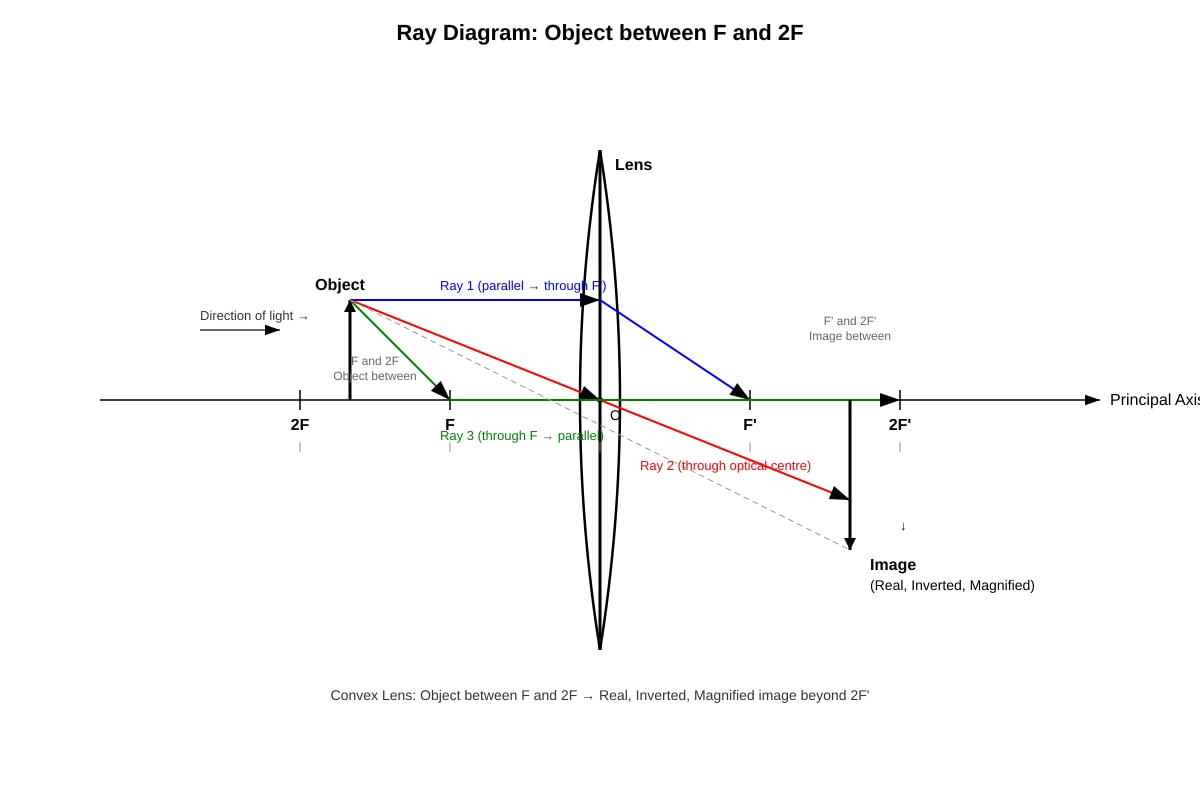
Generated diagram for this question.
(2) (b) Real, Inverted, Magnified (Any two). (2)
11. (a) . (2) (b) . (2)
12. (a) . (2) (b) . (2)
13. (a) . (2) (b) To reduce the voltage to a safer
<stage5_quiz_answers_md>
# Answer Key - Secondary 4 Combined Science Physics Quiz
**1.** $\text{m/s}^2$. The rate of change of velocity per unit time. (1)
**2.** Constant speed. (1)
**3.** Particles are far apart / widely spaced (1) and arranged randomly (1).
**4.** Conduction. (1)
**5.** High penetration power / can penetrate soft tissue but absorbed by dense bone. (1)
**6.**
(a) $a = (0 - 15) / 5 = -3\text{m/s}^2$. Deceleration is $3\text{m/s}^2$. (2)
(b) Distance = $(15 \times 10) + [0.5 \times (15+0) \times 5] = 150 + 37.5 = 187.5\text{m}$. (2)
**7.**
(a) $12\text{N}$. (1)
(b) Since the block moves at constant speed, acceleration is zero. According to Newton's First Law, the resultant force must be zero, so the frictional force must equal the applied force. (2)
**8.**
(a) Particles vibrate more vigorously / move faster (1) but the spacing remains relatively constant as they are changing state (1).
(b) The energy is being used to overcome the intermolecular forces of attraction (1) to change the state from solid to liquid (1).
**9.**
(a) $\sin \theta_c = 1/1.5 \rightarrow \theta_c = \arcsin(0.667) \approx 41.8^\circ$. (2)
(b) 1. Light must travel from a denser to a less dense medium (1). 2. Angle of incidence must be greater than the critical angle (1).
**10.**
(a)
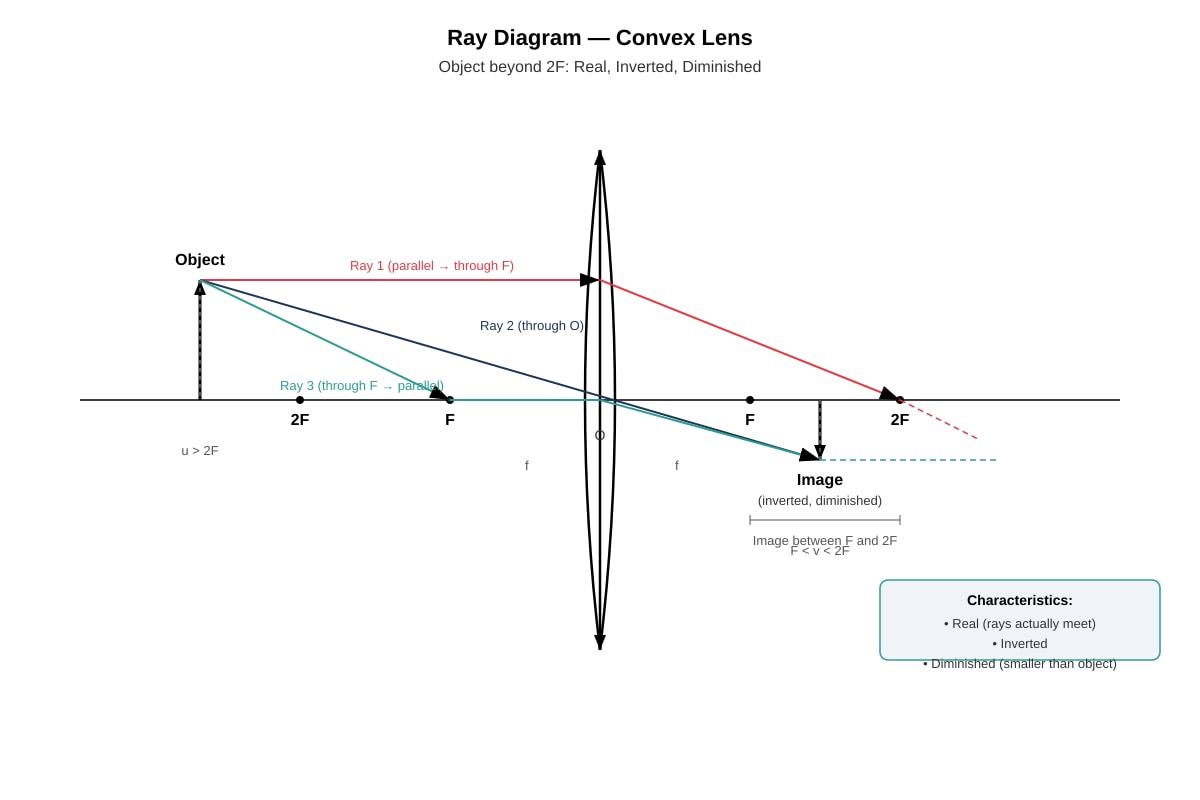
*Generated diagram for this question.*
(2)
(b) Real, Inverted, Magnified (Any two). (2)
**11.**
(a) $I = P/V = 2400 / 240 = 10\text{A}$. (2)
(b) $E = P \times t = 2400 \times (5 \times 60) = 2400 \times 300 = 720,000\text{J}$. (2)
**12.**
(a) $1/R = 1/6 + 1/3 = 3/6 \rightarrow R = 2\Omega$. (2)
(b) $I = V/R = 12 / 2 = 6\text{A}$. (2)
**13.**
(a) $V_s = (200/1000) \times 240 = 0.2 \times 240 = 48\text{V}$. (2)
(b) To reduce the voltage to a safer level suitable for the internal components of the electronic device. (2)
**14.**
(a) $W = mgh = 5 \times 10 \times 3 = 150\text{J}$. (2)
(b) $\text{Efficiency} = (\text{Useful Power Out} / \text{Power In}) \times 100\%$.
$\text{Power Out} = 150\text{J} / 4\text{s} = 37.5\text{W}$.
$\text{Efficiency} = (37.5 / 150) \times 100\% = 25\%$. (2)
**15.** A matte black surface is a much better absorber of thermal radiation than a shiny silver surface, which reflects most of the radiation. (2)
**16.** Angle between rays = $35^\circ + 35^\circ = 70^\circ$. According to the law of reflection, the angle of incidence equals the angle of reflection. (2)
**17.** Tiles are better thermal conductors than carpet (1). Heat is conducted away from the foot more rapidly (1), leading to a faster drop in skin temperature and a colder sensation (1). (3)
**18.** Total Power = $2000\text{W} + 100\text{W} = 2100\text{W}$.
Total Current $I = P/V = 2100 / 240 = 8.75\text{A}$.
The $5\text{A}$ fuse is not suitable because the operating current ($8.75\text{A}$) exceeds the fuse rating, causing it to blow immediately. (3)
**19.** $v = f\lambda$. Frequency and wavelength are inversely proportional for a constant speed (1). If frequency doubles, the wavelength is halved (1) to maintain the same wave speed (1). (3)
**20.** Initially, only weight acts downwards, so the ball accelerates (1). As speed increases, air resistance (drag) increases (1). Eventually, air resistance equals weight, the resultant force becomes zero, and the ball moves at a constant terminal velocity (1). (3)