AI Generated Quiz
Secondary 4 Combined Science Physics Argument Evaluation Quiz
Free Sec 4 Comb Sci Phy Argument Evaluation quiz, HY3 AI version, with questions, answers, and O Level-style practice for Singapore students.
These static practice materials are generated from the site's syllabus and paper-generation workflow, with source and model context shown so students and parents can evaluate the material before use.
Questions
Free quiz and exam paper access
Enter your details to view this paper
Your access is remembered on this device.
Answers
Secondary 4 Combined Science Physics Quiz - Argument Evaluation (Answer Key)
Total Marks: 40
Topic: Argument Evaluation (syllabus-first, Stage 4/5 generated; not claimed as exam-derived)
Section A Answers (1 mark each)
1. Yes
Teaching note: Newton's First Law states net force = 0 when acceleration = 0. Constant velocity ⇒ no acceleration ⇒ zero net force. Correct.
2. No
Teaching note: On the Moon (no air resistance), all objects fall with same acceleration regardless of mass (g ≈ 1.6 m/s²). Mass does not change fall speed. Argument invalid.
3. Yes
Teaching note: For same ΔT, energy needed ∝ mass (Q = mcΔT). Less mass needs less energy, so with same heater power, less time. Sound conclusion.
4. Yes
Teaching note: In parallel, branches independent; one open branch does not stop current in others. Valid practical advantage.
5. Yes
Teaching note: Closer particles in solids allow faster vibration transfer; sound speed higher in steel. Reasoning acceptable.
6. Yes
Teaching note: Terminal velocity ⇒ constant velocity ⇒ a = 0 ⇒ resultant force = 0 (air resistance = weight). Correct.
7. No
Teaching note: Concave (diverging) lens always forms virtual, diminished, upright image. "Real image" is false.
8. Yes
Teaching note: Liquid pressure p = ρgh increases with depth, so dam base bears more force; thicker base is sound engineering inference.
9. No
Teaching note: Transformer needs changing magnetic flux (AC). DC gives constant flux ⇒ no induction. Argument wrong.
10. Yes
Teaching note: Temperature reflects average KE of particles. Correct definition.
Section B Answers (2 marks each)
11. (2 marks)
- Student A partial: speed contributes (KE = ½mv²) but ignores mass. (1 mark)
- Student B more complete: both mass and speed determine KE. (1 mark)
Teaching: KE depends on mass and velocity squared; B correct.
12. (2 marks)
- Incorrect: particles still move (vibrate) at 0 °C in liquid state. (1 mark)
- Energy breaks bonds (latent heat), KE unchanged so temp constant. (1 mark)
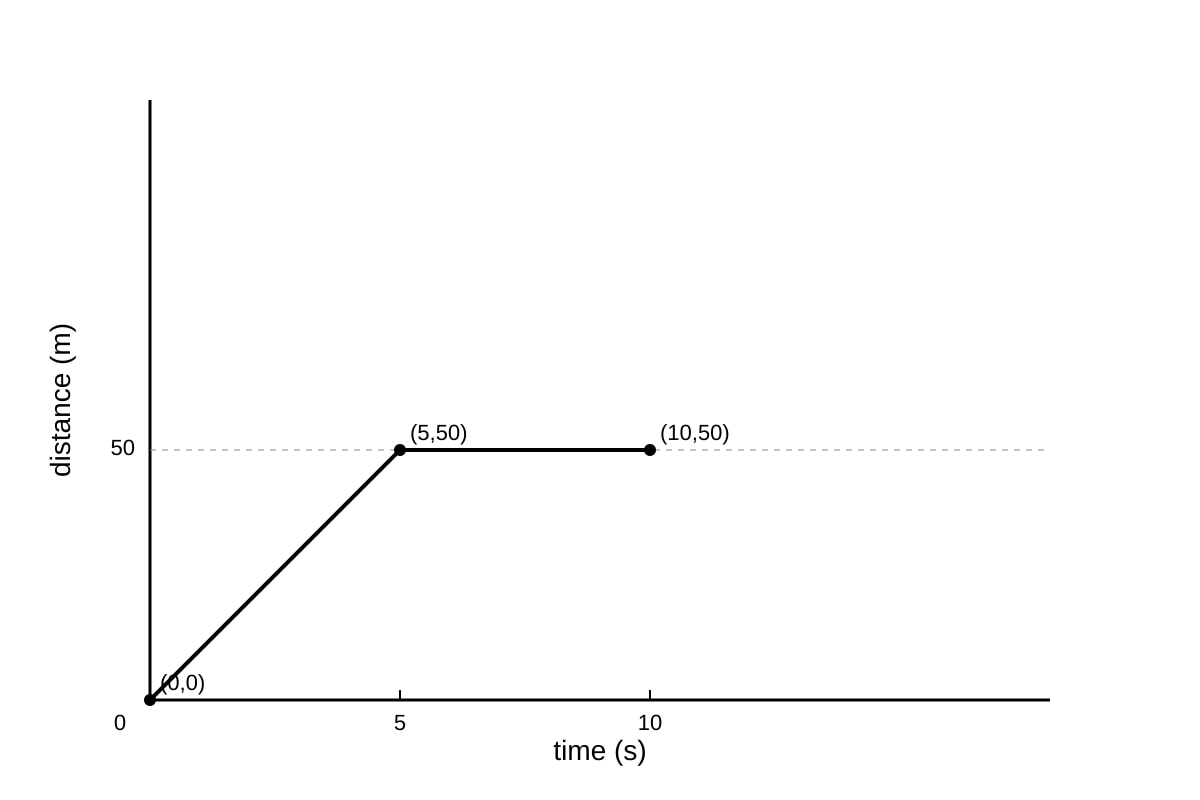
13. (2 marks)
- Conclusion wrong: horizontal line means constant distance (stationary), not return. (1 mark)
- Graph shows end at 50 m, not 0 m; object did not go back. (1 mark)
14. (2 marks)
- Valid: no direct local pollution. (1 mark)
- Incomplete: manufacturing, rare materials, weather dependence, storage issues ignored. (1 mark)
15. (2 marks)
- "Waste" true in machines (heat loss). (1 mark)
- "Necessary" true: friction gives grip for walking. (1 mark)
16. (2 marks)
- False: more bulbs in series ⇒ total R increases ⇒ I decreases ⇒ each dimmer. (1 mark)
- Correct physics: V per bulb drops. (1 mark)
Section C Answers (3 marks each)
17. (3 marks)
- Flaw: floating ≠ lighter; ship mass > water displaced mass? No, floats because avg density < water. (1 mark)
- Upthrust = weight (Archimedes); shape displaces enough water. (1 mark)
- Correct: overall density < water, not "lighter than water". (1 mark)
18. (3 marks)
- False: energy not created; vacuum removes air damping only. (1 mark)
- Without friction, ME conserved, swings with same amplitude. (1 mark)
- Real world has damping ⇒ loses ME to heat; creation claim wrong. (1 mark)
19. (3 marks)
- Wrong: space is vacuum, conduction needs matter. (1 mark)
- Sun heats Earth by radiation (EM waves). (1 mark)
- Air then distributes by convection/conduction, but incoming is radiation. (1 mark)
20. (3 marks)
- Partial: no tailpipe emission. (1 mark)
- But charging may use fossil plants ⇒ indirect emission. (1 mark)
- Balanced: cleaner locally, total depends on grid source. (1 mark)