From Real Exams Quiz
Secondary 4 Combined Science Physics Summary Quiz
Free Sec 4 Comb Sci Phy Summary quiz, HY3 Exam version, with questions, answers, and O Level-style practice for Singapore students.
These static practice materials are generated from the site's syllabus and paper-generation workflow, with source and model context shown so students and parents can evaluate the material before use.
Questions
Secondary 4 Combined Science Physics Quiz - Summary
Name: ___________________________
Class: ___________________________
Date: ___________________________
Score: ___________ / 40
Duration: 60 minutes
Total Marks: 40
Instructions: Answer all 20 questions. Section A is multiple-choice. Section B is structured short-answer. Section C is calculation and explanation. Show all working where required. Use SI units.
Section A: Multiple Choice (Questions 1–5, 1 mark each)
-
Which of the following quantities is a vector?
A. Speed
B. Distance
C. Mass
D. DisplacementAnswer: ______
-
A block is pushed at constant speed across a rough table. Which statement is correct?
A. The net force is zero.
B. Friction is greater than the applied force.
C. The applied force is zero.
D. Acceleration is positive.Answer: ______
-
During boiling, the temperature of water remains constant because
A. no heat is supplied.
B. energy is used to break intermolecular bonds.
C. the mass decreases suddenly.
D. pressure increases.Answer: ______
-
In a series circuit with two identical resistors, the total resistance is
A. half of one resistor.
B. equal to one resistor.
C. twice one resistor.
D. zero.Answer: ______
-
Which type of thermal energy transfer does not require a medium?
A. Conduction
B. Convection
C. Radiation
D. All require a mediumAnswer: ______
Section B: Structured Response (Questions 6–15, 2 marks each)
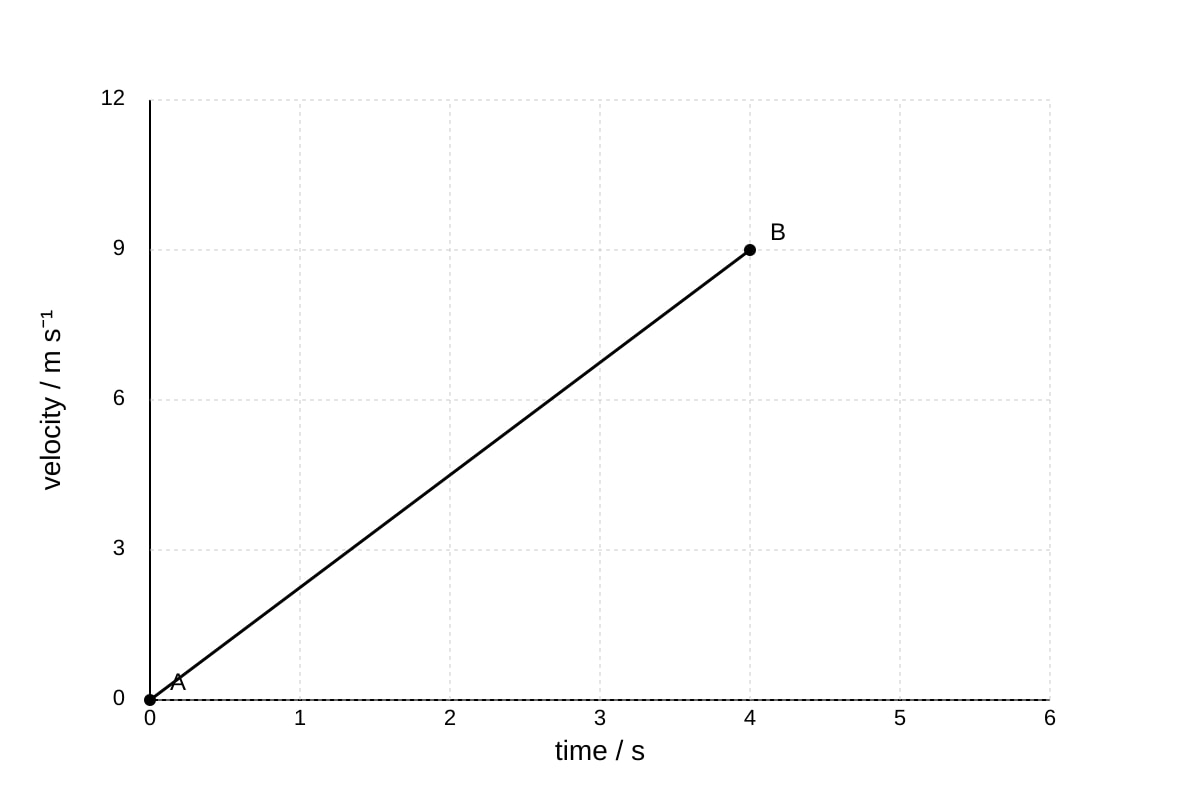
- State the magnitude of the acceleration of the object between point A and point B on the velocity–time graph below.
Image pending generation: graph for Q6.
Answer: ______ m/s²
-
A wooden block is pulled across a table at constant speed by a force of 5 N. State the frictional force and explain how you obtain the answer.
Answer: ___________________________
Explanation: ________________________________________________________ -
Describe, in terms of movement and arrangement of particles, what happens when ice melts at 0 °C.
Answer: ________________________________________________________
-
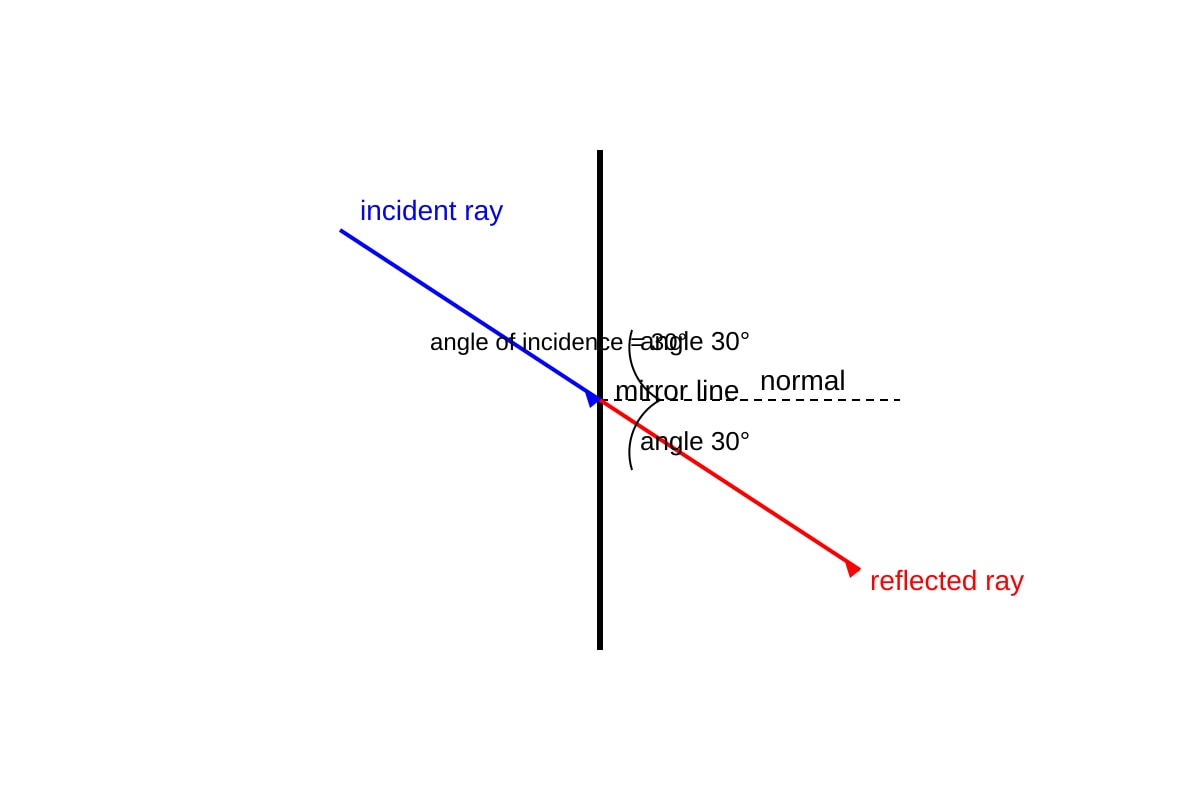
Complete the ray diagram to show the reflection of the incident ray from a plane mirror.
Image pending generation: diagram for Q9.
Answer: [draw reflected ray at ______° to normal]
-
State two differences between scalar and vector quantities.
Answer: (i) ___________________________ (ii) ___________________________
-
A 60 W immersion heater heats water. The temperature rises steadily then becomes flat. State one reason for the flat portion.
Answer: ________________________________________________________
-
A car travels 100 m in 5 s, then rests 5 s, then travels 200 m in 10 s. Calculate the average speed for the whole journey.
Answer: ______ m/s
-
State the direction of the magnetic field inside a current-carrying solenoid.
Answer: ________________________________________________________
-
Give one example of electromagnetic induction in daily life and name the device.
Answer: ________________________________________________________
-
Explain why a sealed plastic bottle floats in water but sinks in air, using density.
Answer: ________________________________________________________
Section C: Calculation and Explanation (Questions 16–20)
-
(3 marks) A force of 20 N moves a box 4 m in 8 s at constant speed. Calculate the work done and the power output.
Work done = ______ J
Power = ______ W -
(3 marks) A resistor of 6 Ω and another of 3 Ω are connected in parallel to a 9 V battery. Calculate the total resistance and total current.
Total resistance = ______ Ω
Total current = ______ A -
(3 marks) Water of mass 0.5 kg is heated from 20 °C to 100 °C. Specific heat capacity of water = 4200 J/(kg·°C). Calculate the heat energy required.
Q = ______ J
-
(3 marks) A bus accelerates from rest to 15 m/s in 10 s. Calculate the acceleration and the distance travelled.
Acceleration = ______ m/s²
Distance = ______ m -
(4 marks) A student says: "A heater at 100 °C boils water because temperature always increases during heating." Explain why this statement is wrong using particle theory and energy transfer.
Answer: ________________________________________________________
Answers
Secondary 4 Combined Science Physics Quiz - Summary: Answer Key
Total Marks: 40
Topic: Summary (Combined Science Physics Sec 4)
Section A (1 mark each)
-
D – Displacement is a vector (has magnitude and direction). Speed, distance, mass are scalars.
Teaching note: Vector = direction + magnitude; scalar = magnitude only. -
A – Constant speed ⇒ zero acceleration ⇒ net force = 0 (Newton's First Law).
Common mistake: Thinking constant speed means no forces act. -
B – At boiling, supplied energy breaks bonds (latent heat), temperature constant.
Teaching note: Boiling is a phase change; energy goes to potential not kinetic. -
C – Series: R_total = R₁ + R₂ = 2R for identical resistors.
Formula: R_series = sum of resistances. -
C – Radiation (infrared) travels through vacuum; conduction/convection need medium.
Section B (2 marks each)
-
3 m/s²
Method: a = Δv/Δt = (12 – 0)/(4 – 0) = 3 m/s².
From graph Q6-fig1: line from (0,0) to (4,12). -
Frictional force = 5 N.
Explanation: Constant speed ⇒ a = 0 ⇒ net force = 0 ⇒ friction = applied force = 5 N.
Marking: 1 mark value, 1 mark explanation. -
Particles gain energy, vibrate more, fixed positions lost, become free to move (liquid); arrangement less ordered.
Key: movement increases, arrangement changes from fixed to random. -
Reflected ray at 30° to normal (law of reflection: ∠i = ∠r).
From Q9-fig1: incident 30°, normal drawn, reflect equal angle. -
(i) Scalars have no direction, vectors have direction. (ii) Examples: scalar speed, vector velocity.
Any two valid differences. -
Flat portion: phase change (boiling/evaporation) or thermal equilibrium with surroundings.
Energy used for state change, not temperature rise. -
Average speed = total distance / total time = (100+200)/(5+5+10) = 300/20 = 15 m/s.
Include rest time in total. -
Along the axis of the solenoid (N to S inside).
Right-hand grip rule. -
Example: bicycle dynamo (generator) / transformer in charger.
EMI: changing magnetic field induces current. -
Bottle density < water density ⇒ floats; bottle density > air density ⇒ sinks in air.
Float if ρ_object < ρ_fluid.
Section C
-
(3 marks)
Work done W = F × d = 20 × 4 = 80 J (2 marks: 1 formula, 1 value)
Power P = W/t = 80/8 = 10 W (1 mark)
Constant speed ⇒ force equals friction but work uses applied force. -
(3 marks)
1/R_total = 1/6 + 1/3 = 1/6 + 2/6 = 3/6 = 1/2 ⇒ R_total = 2 Ω (2 marks)
I_total = V/R = 9/2 = 4.5 A (1 mark) -
(3 marks)
Q = mcΔT = 0.5 × 4200 × (100–20) = 0.5 × 4200 × 80 = 168 000 J (3 marks: formula 1, sub 1, ans 1) -
(3 marks)
a = (v–u)/t = (15–0)/10 = 1.5 m/s² (1.5 mark)
s = ut + ½at² = 0 + ½ × 1.5 × 10² = 75 m (1.5 mark)
Or s = (u+v)/2 × t = 7.5 × 10 = 75 m. -
(4 marks)
- Wrong because during phase change (boiling) temp constant (1)
- Energy supplied becomes latent heat, breaks bonds not KE (1)
- Particle theory: particles gain potential energy, move apart (1)
- Heater at 100 °C can transfer to water at 100 °C only if water below boiling point; once boiling, temp steady (1)
Marking descriptors: identifies error, uses energy/particle concepts, clear explanation.
Free quiz and exam paper access
Enter your details to view this paper
Your access is remembered on this device.