From Real Exams Quiz
Secondary 4 Combined Science Physics Summary Quiz
Free Exam-Derived Secondary 4 Combined Science Physics Summary quiz with questions and answers for Singapore students. This page is rendered as a direct URL so the questions and answers can be discovered without pressing in-page buttons.
These static practice materials are generated from the site's syllabus and paper-generation workflow, with source and model context shown so students and parents can evaluate the material before use.
Questions
Secondary 4 Combined Science Physics Quiz - Summary
Name: _________________ Class: _______ Date: _____________
Score: _____ / 25 Duration: 30 minutes
Instructions:
- Answer ALL questions in the spaces provided
- Show all working for calculations
- Use appropriate units where required
- Write clearly and use scientific terminology
Section A: Multiple Choice [8 marks]
Choose the best answer for each question. Write the letter in the box provided.
1. A wooden block is pushed across a table at constant speed. Which statement is correct?
A. The net force on the block is greater than zero B. The frictional force equals the applied force C. No energy is transferred during the motion D. The block will continue moving when the push stops
Answer: [ ]
2. The diagram shows a simple pendulum swinging between points X and Z.
Which sequence should be timed to find the period of the pendulum?
A. X to Y only
B. Y to Z only
C. X to Z to X
D. X to Y to Z
Answer: [ ]
3. For total internal reflection to occur, light must travel from:
A. Air to glass B. Glass to air C. Air to water D. Any medium to any other medium
Answer: [ ]
4. A kitchen hood contains a 2.0 kW fan and a 60 W lamp. If both operate for 3 hours, the total energy consumed is:
A. 2.06 kWh B. 6.18 kWh C. 2060 J D. 6.18 J
Answer: [ ]
Section B: Structured Response [17 marks]
5. The graph shows the motion of a car during a journey.
[Velocity-time graph showing: 0-10s acceleration to 20 m/s, 10-30s constant 20 m/s, 30-40s deceleration to 0 m/s]
(a) State the magnitude of the acceleration between 0 and 10 seconds.
_________________ m/s² [1]
(b) Calculate the average speed for the entire journey.
Working:
Average speed = _________________ m/s [2]
6. A student uses a 3000 W immersion heater to heat water. The graph shows how temperature changes with time.
[Temperature-time graph showing linear increase from 20°C to 80°C over 5 minutes, then plateau at 80°C]
(a) Explain why the temperature remains constant after 5 minutes, even though the heater continues to operate.
_________________________________________________________________ [2]
(b) Calculate the energy supplied by the heater in the first 5 minutes.
Working:
Energy = _________________ J [2]
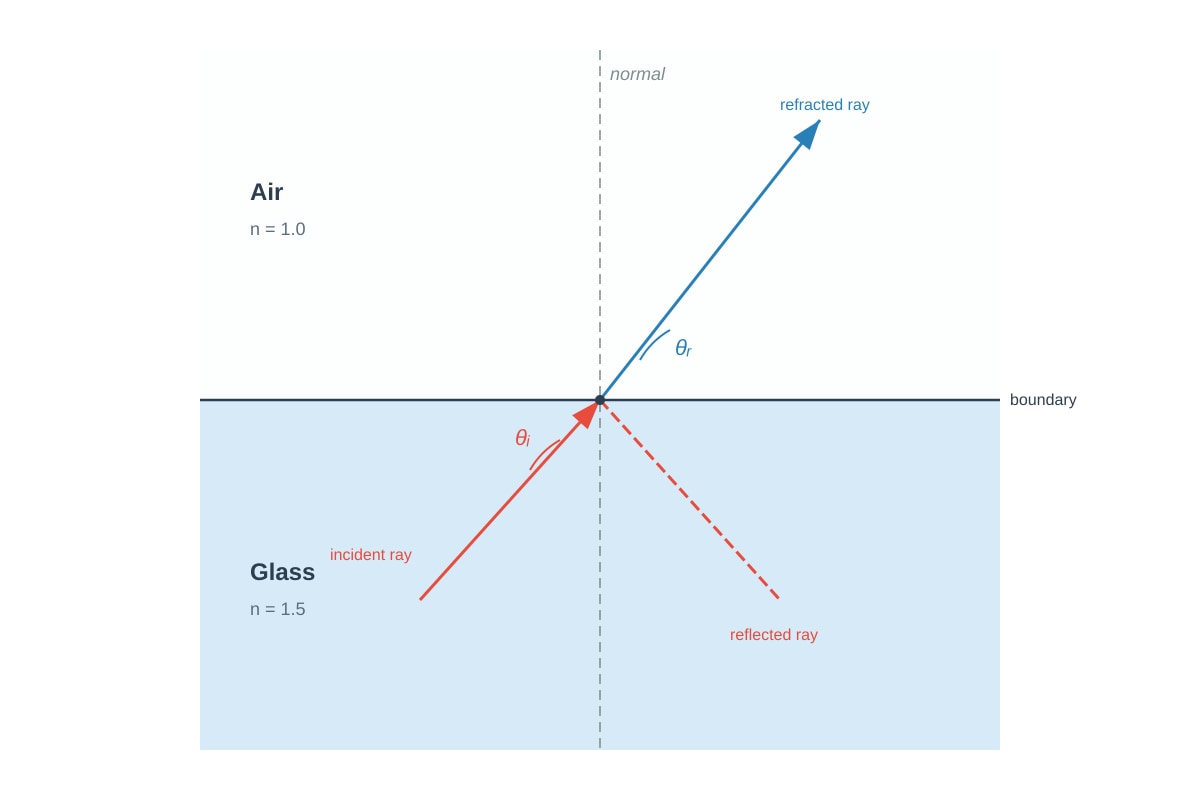
7. A ray of light travels from glass into air as shown in the diagram.
[Diagram showing light ray at glass-air boundary with incident angle marked]
(a) Complete the ray diagram to show what happens to the light ray. [2]
(b) State one condition required for total internal reflection to occur.
_________________________________________________________________ [1]
8. During a heating experiment, wax changes from solid to liquid between t = 3 min and t = 7 min.
Describe what effect this energy has on the wax particles during this time interval in terms of:
(a) Motion: ___________________________________________________
_________________________________________________________________ [1]
(b) Spacing: __________________________________________________
_________________________________________________________________ [1]
9. A fuse rated at 13 A is used to protect a circuit containing three appliances:
- Electric kettle: 2400 W
- Toaster: 1200 W
- Microwave: 800 W
All appliances operate at 240 V and can be used simultaneously.
Discuss whether the 13 A fuse is suitable for this circuit. Include calculations in your answer.
Working:
Conclusion: ___________________________________________________
_________________________________________________________________ [4]
Answers
Secondary 4 Combined Science Physics Quiz - Summary (Answers)
Section A: Multiple Choice [8 marks]
1. B - The frictional force equals the applied force At constant speed, acceleration = 0, so net force = 0. Therefore, friction = applied force.
2. C - X to Z to X
One complete period requires the pendulum to return to its starting position after a full oscillation.
3. B - Glass to air Total internal reflection occurs when light travels from a denser medium to a less dense medium.
4. B - 6.18 kWh Total power = 2.0 + 0.06 = 2.06 kW; Energy = 2.06 × 3 = 6.18 kWh
Section B: Structured Response [17 marks]
5.(a) 2.0 m/s² [1] Acceleration = (20 - 0)/(10 - 0) = 2.0 m/s²
5.(b) Average speed = 16 m/s [2] Working:
- Distance 0-10s: ½ × 20 × 10 = 100 m
- Distance 10-30s: 20 × 20 = 400 m
- Distance 30-40s: ½ × 20 × 10 = 100 m
- Total distance = 600 m, Total time = 40 s
- Average speed = 600/40 = 15 m/s
6.(a) The water has reached its boiling point. Energy is used for the phase change (latent heat of vaporization) rather than increasing temperature. [2]
6.(b) Energy = 900,000 J (or 900 kJ) [2] Working: E = Pt = 3000 × (5 × 60) = 3000 × 300 = 900,000 J
7.(a) Ray should show refraction away from normal at glass-air boundary, with correct angle. [2]
7.(b) The angle of incidence must be greater than the critical angle. [1]
8.(a) Motion: Particles move faster / kinetic energy increases [1]
8.(b) Spacing: Spacing between particles increases significantly [1]
9. [4 marks total] Working:
- Kettle current: I = P/V = 2400/240 = 10 A
- Toaster current: I = 1200/240 = 5 A
- Microwave current: I = 800/240 = 3.33 A
- Total current = 10 + 5 + 3.33 = 18.33 A
Conclusion: The 13 A fuse is NOT suitable. The total current (18.33 A) exceeds the fuse rating (13 A), so the fuse would blow during normal operation. A higher rated fuse (e.g., 20 A) would be needed.
Marking scheme:
- Correct current calculations (2 marks)
- Correct total current (1 mark)
- Appropriate conclusion with reasoning (1 mark)