From Real Exams Quiz
Secondary 4 Combined Science Physics Language Use Quiz
Free Sec 4 Comb Sci Phy Language Use quiz, HY3 Exam version, with questions, answers, and O Level-style practice for Singapore students.
These static practice materials are generated from the site's syllabus and paper-generation workflow, with source and model context shown so students and parents can evaluate the material before use.
Questions
Free quiz and exam paper access
Enter your details to view this paper
Your access is remembered on this device.
Answers
Answer Key: Secondary 4 Combined Science Physics Quiz - Language Use
Total Marks: 40
Topic: Language Use (scientific terminology and explanation)
Section A: Defining and Stating
1. [1 mark] Displacement
Teaching note: Displacement is a vector quantity: distance in a given direction from a reference point. Do not confuse with "distance", which has no direction.
2. [1 mark] m/s² (metres per second squared)
Teaching note: Acceleration = change in velocity per unit time, so unit is (m/s)/s = m/s².
3. [1 mark] Friction
Teaching note: Friction acts opposite to the direction of relative motion between surfaces.
4. [1 mark] symbol = p, unit = Pa (or N/m²)
Teaching note: Pressure p = F / A; unit pascal (Pa) = N m⁻².
5. [1 mark] Internal energy (or thermal energy)
Teaching note: The total kinetic and potential energy of particles due to random motion and arrangement.
Section B: Describing in Scientific Language
6. [2 marks]
- Particles gain energy and vibrate more. (1 mark)
- Arrangement becomes less ordered; particles break free from fixed positions but remain close. (1 mark)
Teaching note: During melting, temperature stays constant while particles overcome attractive forces.
7. [2 marks]
- Net force = 0 N. (1 mark)
- Constant speed in straight line means acceleration is zero, so by Newton's First Law net force is zero. (1 mark)
Teaching note: Use "net force" not "no force"; forces are balanced.
8. [2 marks]
"The cup is at a lower temperature than my hand, so thermal energy flows from my hand to the cup." (accept equivalent using "temperature" and "heat transfer") (2 marks: 1 for temperature, 1 for heat flow)
Teaching note: Objects do not "have no heat"; they have temperature and internal energy.
9. [2 marks]
The magnetic field lines are concentric circles around the wire. (2 marks: "concentric" 1, circles/around wire 1)
Teaching note: Direction given by right-hand grip rule; not needed here.
10. [2 marks]
- Refraction. (1 mark)
- Speed decreases in glass. (1 mark)
Teaching note: Light slows when entering denser medium (higher refractive index).
Section C: Explaining and Applying Language
11. [3 marks]
- Frictional force = 5 N. (1 mark)
- At constant speed, acceleration = 0, so net force = 0 (Newton's First Law). (1 mark)
- Therefore friction equals applied force of 5 N opposite to motion. (1 mark)
Marking: 1 for value, 2 for correct reasoning with equilibrium.
12. [3 marks]
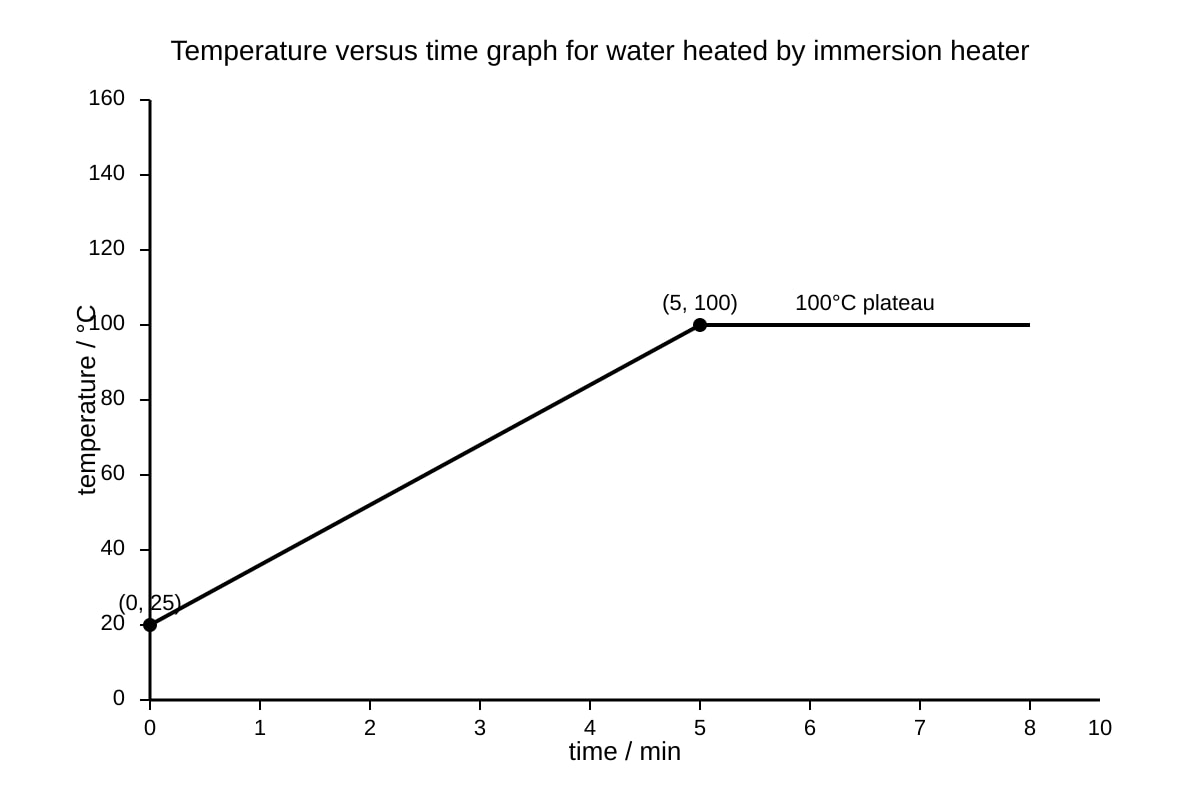
- At 100°C, water boils (phase change). (1 mark)
- Energy supplied breaks intermolecular bonds rather than raising temperature. (1 mark)
- Particles gain potential energy, not kinetic, so temperature constant. (1 mark)
Visual needed: graph plateau at 100°C as described.
13. [3 marks]
"The battery provides a potential difference that gives electrons energy; this causes a current, transferring energy around the circuit." (3 marks: PD 1, current 1, energy 1)
Teaching note: Avoid "push" and "go round faster".
14. [3 marks]
- Total resistance = R_T. (1 mark)
- R_T = R_1 + R_2. (1 mark)
- Total resistance is larger than either single resistor. (1 mark)
15. [3 marks]
"For a floating object in equilibrium, the upthrust is equal to the weight of the object." (3 marks: upthrust 1, weight 1, equal 1)
Section D: Interpreting and Correcting Language
16. [2 marks]
- Acceleration = 0 m/s². (1 mark)
- Gradient of velocity-time graph is zero (horizontal line). (1 mark)
17. [2 marks]
"Friction is a force that opposes the relative motion between surfaces." (2 marks: force 1, opposes motion 1)
18. [2 marks]
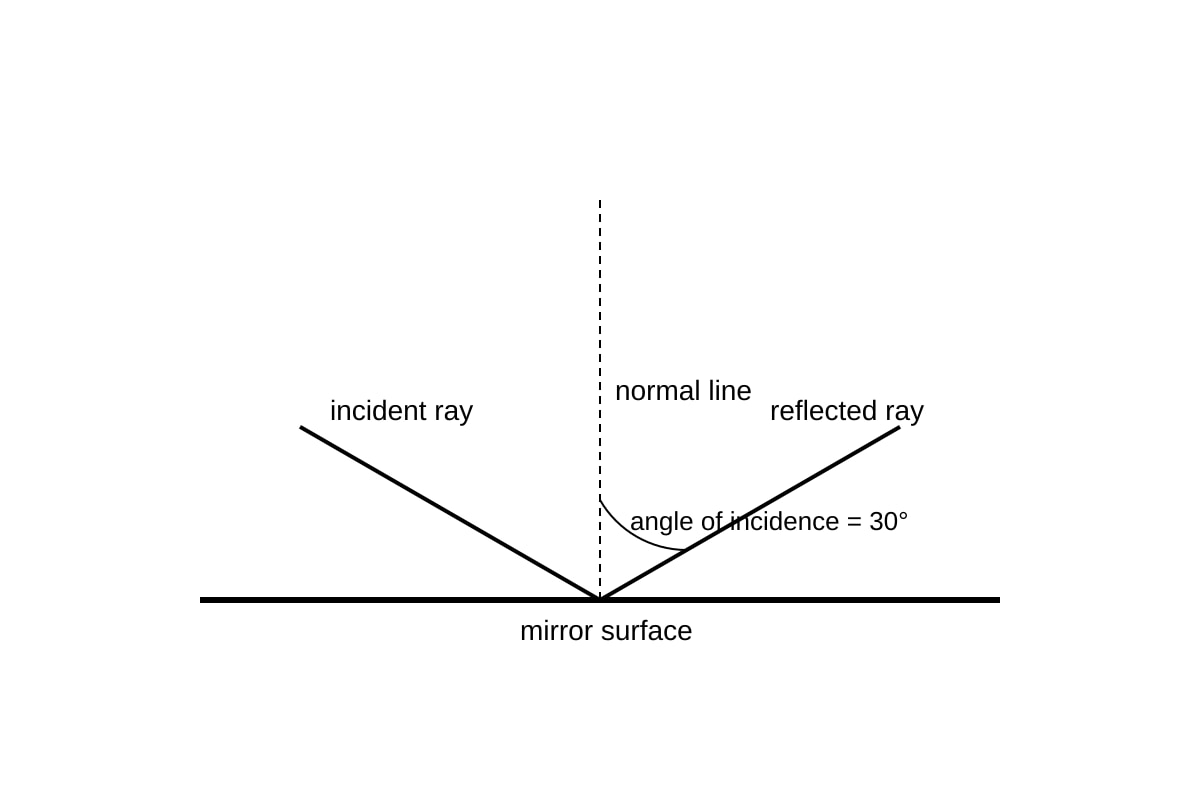
- Angle of incidence. (1 mark)
- Law of reflection: angle of incidence = angle of reflection. (1 mark)
Visual: 30° to normal as labelled.
19. [2 marks]
"Power is the rate at which energy is transferred or work is done per unit time." (2 marks: rate 1, time 1)
20. [2 marks]
- Mass is amount of matter, unit kg. (1 mark)
- Weight is gravitational force, unit N. (1 mark)
Teaching note: Weight = mg; mass is scalar, weight is vector.