From Real Exams Quiz
Secondary 4 Combined Science Physics Comprehension Quiz
Free Sec 4 Comb Sci Phy Comprehension quiz, HY3 Exam version, with questions, answers, and O Level-style practice for Singapore students.
These static practice materials are generated from the site's syllabus and paper-generation workflow, with source and model context shown so students and parents can evaluate the material before use.
Questions
Secondary 4 Combined Science Physics Quiz - Comprehension
Name: ___________________________
Class: ___________________________
Date: ___________________________
Score: _______ / 40
Duration: 60 minutes
Total Marks: 40
Instructions:
- This quiz tests your comprehension of Secondary 4 Combined Science Physics concepts based on exam-derived patterns.
- Answer all 20 questions.
- Show your working clearly where calculations are required.
- Use the spaces provided.
Section A: Comprehension of Passages and Data (Questions 1–10)
1. Read the passage below.
"A badminton shuttlecock falls to the ground after being hit high into the air. The wide skirt at the back experiences air resistance as it moves. This air resistance acts upwards against the downward motion of the shuttlecock."
State what direction the air resistance acts on the shuttlecock. [1]
2. Using the same passage in Q1, explain in your own words why the shuttlecock slows down as it falls. [2]
3. A kitchen hood uses a fan to remove smoke. The passage says: "When the switch is closed, the fan motor turns and draws air upwards through the hood."
State the energy transfer that takes place in the fan motor. [1]
4. Read the extract:
"Water was heated in a beaker using a 100 W immersion heater. The temperature rose from 25 °C to 65 °C in 80 s before staying constant."
Calculate the energy supplied by the heater in this time. [2]
5. From the extract in Q4, suggest why the temperature stayed constant after 80 s. [1]
6. Read the statement: "A wooden block is pushed across a table at constant speed. The applied force is 5 N to the right."
State the size and direction of the frictional force. [1]
7. Explain, using Newton's First Law, why the frictional force in Q6 equals the applied force. [2]
8. The passage states: "Sound travels faster in water than in air because particles are closer together."
State what type of wave sound is. [1]
9. A student reads: "The ray of light hits a plane mirror at 30° to the normal and reflects."
State the angle of reflection. [1]
10. Read: "A car accelerates from rest to 20 m/s in 10 s. The acceleration is constant."
Calculate the acceleration of the car. [2]
Section B: Diagram and Graph Comprehension (Questions 11–15)
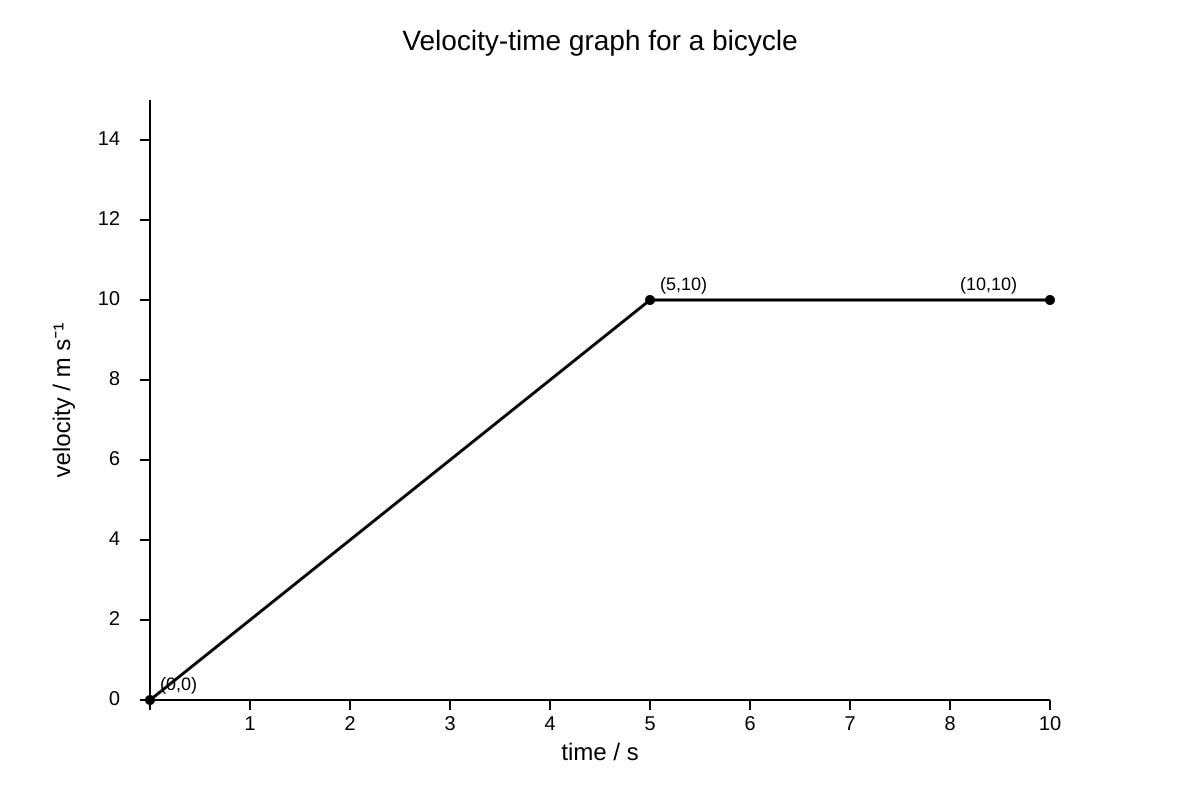
11.
Image pending generation: graph for Q11.
State the acceleration of the bicycle between 0 s and 5 s. [1]
12. Using the graph in Q11, calculate the total distance travelled by the bicycle in 10 s. [2]
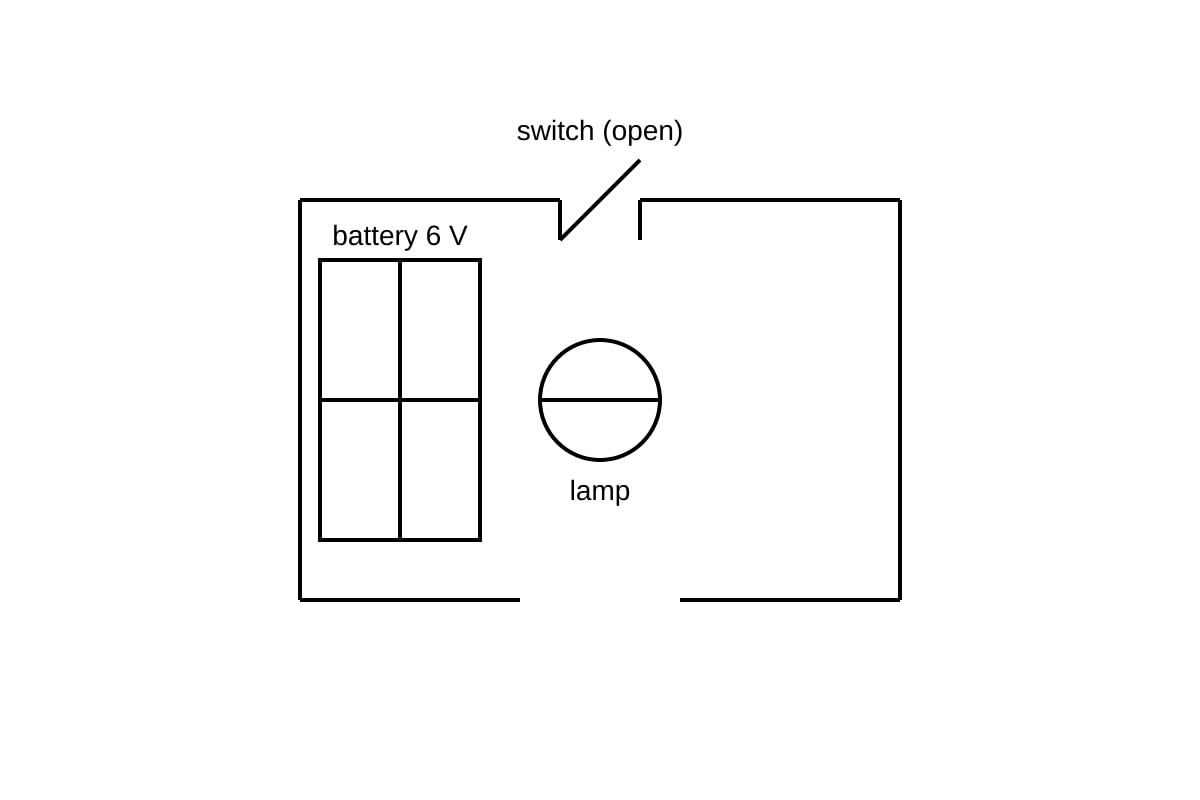
13.
Image pending generation: diagram for Q13.
State whether the lamp lights up. Give a reason. [1]
14. Read the diagram description in Q13. State what must be done to make the lamp light up. [1]
15. A temperature-time graph for heating ice shows a plateau at 0 °C for several minutes.
Explain in terms of particles what is happening during the plateau. [2]
Section C: Extended Comprehension (Questions 16–20)
16. Read the passage:
"A transformer has a primary coil of 100 turns and a secondary coil of 200 turns. It is connected to a 12 V a.c. supply. The output voltage is stepped up."
Calculate the output voltage of the transformer. [2]
17. From Q16, state one application of a step-up transformer in the national grid. [1]
18. Read: "A 2 kg object is lifted by 3 m. The gravitational field strength is 10 N/kg."
Calculate the work done against gravity. [2]
19. A student says: "Average speed is found by adding the two speeds and dividing by two."
Explain why this is wrong using an example of a journey of 100 m at 5 m/s then 100 m at 10 m/s. [2]
20. Read the extract:
"Radiation does not need a medium to transfer thermal energy. The Sun warms the Earth through radiation across empty space."
State one other method of thermal energy transfer and whether it needs a medium. [1]
Answers
Secondary 4 Combined Science Physics Quiz - Comprehension: Answer Key
Total Marks: 40
Question Count: 20 (exactly)
Section A Answers (Q1–10)
Q1. [1 mark]
Answer: Upwards (or against the downward motion).
Teaching note: Air resistance always opposes motion. The passage says it acts upwards against downward motion.
Q2. [2 marks]
Answer: The air resistance acts upwards / opposite to motion (1). This reduces the net downward force so the shuttlecock slows (1).
Marking: 1 for direction, 1 for effect on speed.
Q3. [1 mark]
Answer: Electrical energy → kinetic energy (of fan) / sound / thermal.
Teaching note: Motor converts electrical to mechanical (kinetic) energy.
Q4. [2 marks]
Working:
E=P×t
E=100×80=8000 J
Answer: 8000 J.
Marking: 1 for formula, 1 for correct value.
Q5. [1 mark]
Answer: Energy supplied equals energy lost to surroundings (or phase change if water boiled).
Teaching note: Temperature constant means no net gain.
Q6. [1 mark]
Answer: 5 N to the left.
Teaching note: Friction opposes applied force.
Q7. [2 marks]
Answer: Constant speed means acceleration = 0 (1). Net force = 0 so friction = applied force (1).
Marking: 1 for Newton's First Law link, 1 for equality.
Q8. [1 mark]
Answer: Longitudinal wave.
Teaching note: Sound is a longitudinal mechanical wave.
Q9. [1 mark]
Answer: 30°.
Teaching note: Law of reflection: angle of incidence = angle of reflection.
Q10. [2 marks]
Working:
a=tΔv=1020−0=2 m/s2
Answer: 2 m/s².
Marking: 1 formula, 1 value.
Section B Answers (Q11–15)
Q11. [1 mark]
Answer: 2 m/s².
From graph: a=5−010−0=2.
Q12. [2 marks]
Working:
Area = triangle + rectangle
=21×5×10+5×10=25+50=75 m
Answer: 75 m.
Marking: 1 for method, 1 for answer.
Q13. [1 mark]
Answer: No, because switch is open / circuit incomplete.
Q14. [1 mark]
Answer: Close the switch.
Q15. [2 marks]
Answer: Particles gain energy but do not move faster (1); arranged to change from solid to liquid (1).
Marking: 1 for energy, 1 for arrangement change.
Section C Answers (Q16–20)
Q16. [2 marks]
Working:
VpVs=NpNs
Vs=12×100200=24 V
Answer: 24 V.
Marking: 1 formula, 1 answer.
Q17. [1 mark]
Answer: To step up voltage for transmission (reduce current, less loss).
Q18. [2 marks]
Working:
W=mgh=2×10×3=60 J
Answer: 60 J.
Marking: 1 formula, 1 value.
Q19. [2 marks]
Working:
Correct avg speed = total dist/total time = 200 / (20+10) = 6.67 m/s.
Wrong method gives (5+10)/2 = 7.5 m/s.
Answer: Average speed uses total distance over total time, not mean of speeds.
Marking: 1 for example, 1 for explanation.
Q20. [1 mark]
Answer: Conduction (needs medium) or convection (needs medium).
Teaching note: Only radiation needs no medium.
Free quiz and exam paper access
Enter your details to view this paper
Your access is remembered on this device.