AI Generated Exam Paper
Secondary 4 Combined Science Physics Practice Paper 5
Free Sec 4 Comb Sci Phy Practice Paper 5, HY3 AI version, with questions, answers, and O Level-style practice for Singapore students.
These static practice materials are generated from the site's syllabus and paper-generation workflow, with source and model context shown so students and parents can evaluate the material before use.
Questions
TuitionGoWhere Practice Paper - Combined Science Physics Secondary 4
TuitionGoWhere Practice Paper (AI) — Version 5
Subject: Combined Science Physics
Level: Secondary 4
Paper: Practice Paper (Topic: Summary)
Duration: 45 minutes
Total Marks: 40
Name: ________________________
Class: ____________
Date: ____________
Instructions:
- This practice paper covers a summary of key Secondary 4 Combined Science Physics topics based on syllabus-first inference.
- Answer all 20 questions.
- Show your working clearly where calculations are involved.
- Use the spaces provided.
- Marks for each question are shown in brackets [ ].
Section A: Multiple Choice (1 mark each) [5 marks] Questions 1–5
Section B: Short Structured Questions (2 marks each) [20 marks] Questions 6–15
Section C: Extended Response (3 marks each) [15 marks] Questions 16–20
Section A
1. Which of the following quantities is a vector? [1]
A. Speed
B. Distance
C. Mass
D. Displacement
2. A object moves at constant speed in a straight line. What is the net force acting on it? [1]
A. Zero
B. Equal to its weight
C. Equal to friction
D. Cannot be determined
3. During melting, the temperature of a pure substance remains constant because the energy supplied is used to: [1]
A. Increase kinetic energy of particles
B. Break intermolecular bonds
C. Cool the surroundings
D. Decrease potential energy
4. In a series circuit with two identical resistors, the total resistance is: [1]
A. Half of one resistor
B. Equal to one resistor
C. Twice one resistor
D. Zero
5. The SI unit for power is: [1]
A. Joule
B. Watt
C. Newton
D. Pascal
Section B
6. A car travels 100 m in 5 s, then 200 m in 10 s. Calculate its average speed for the whole journey. [2]
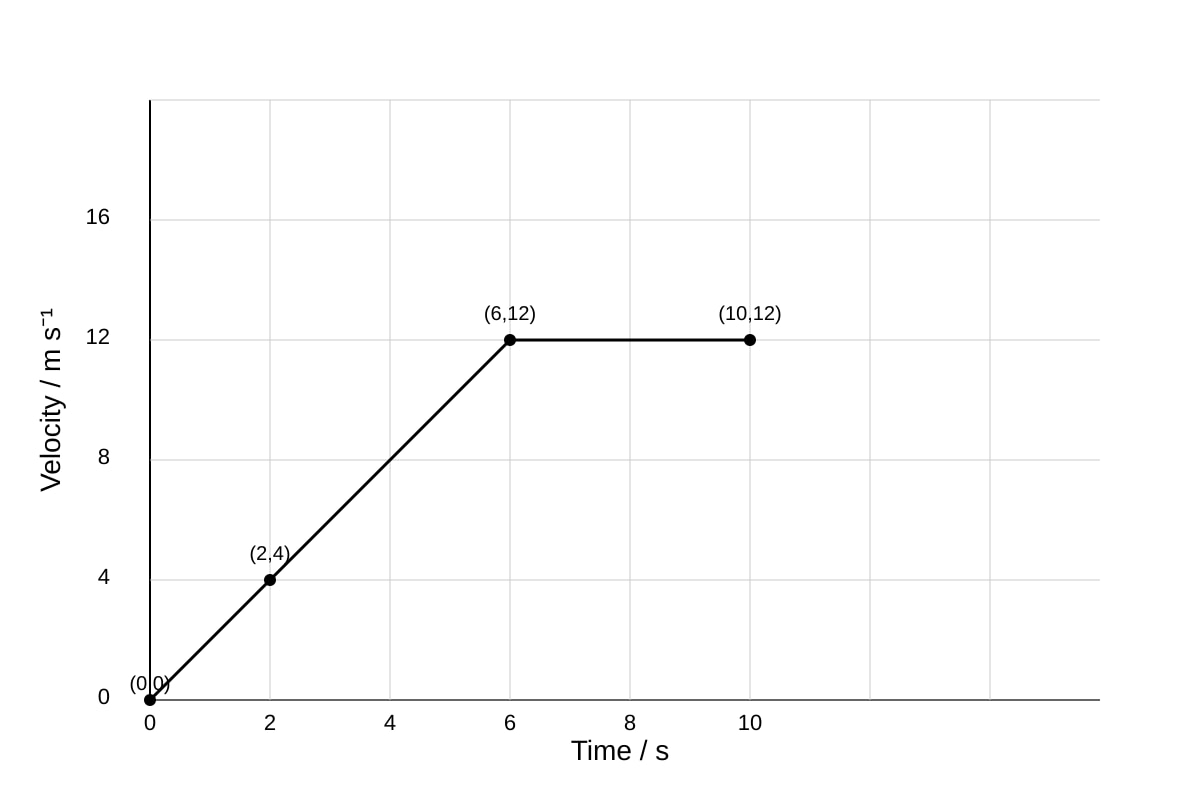
7. State the magnitude of the acceleration of an object between t = 2 s and t = 6 s from the velocity-time graph below. [2]
Image pending generation: graph for Q7.
8. A wooden block is pushed across a table at constant speed by a force of 5 N. State the frictional force and explain your answer. [2]
9. A 12 V battery is connected to a resistor of 4 Ω. Calculate the current flowing through the resistor. [2]
10. Describe, in terms of movement and arrangement of particles, what happens when water boils at 100 °C. [2]
11. A uniform plank of length 2.0 m and weight 20 N is pivoted at its centre. A 10 N force is applied 0.5 m to the left of the pivot. State the moment due to this force about the pivot. [2]
12. An immersion heater of power 50 W heats 0.1 kg of water. Calculate the energy supplied in 60 s. [2]
13. State one difference between conduction and convection in thermal energy transfer. [2]
14. A ray of light strikes a plane mirror at an angle of incidence of 30°. State the angle of reflection. [2]
15. A cyclist moves with velocity-time graph showing constant velocity of 8 m/s for 10 s. Calculate the distance travelled. [2]
Section C
16. A shuttlecock of mass 0.05 kg is dropped from a height of 10 m. Explain why the actual time to reach the ground is longer than the time calculated using s=21gt2 with no air resistance. Include energy changes. [3]
17. A 2 m uniform plank of mass 10 kg rests on two supports: one at 0.3 m from the left end, the other at 1.5 m from the left end. Calculate the reaction force at each support. (Take g = 10 m/s²) [3]
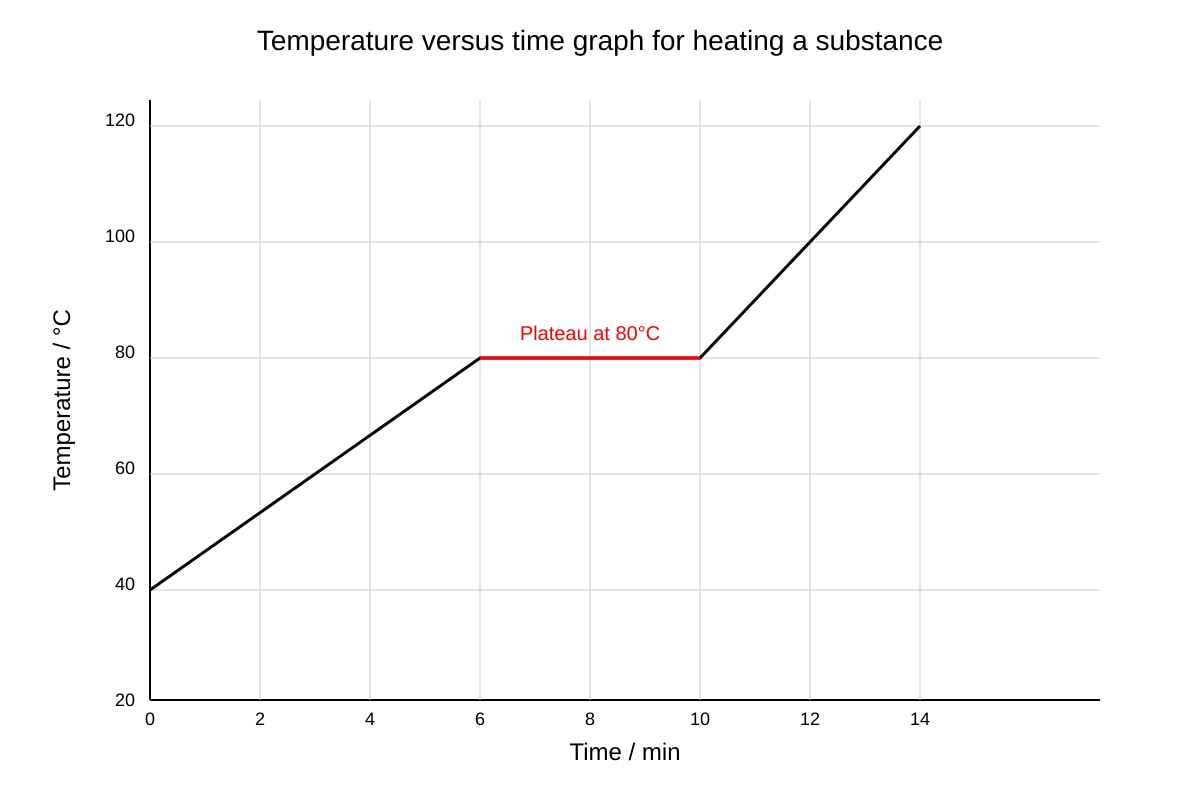
18. The graph shows temperature vs time for a substance heated from solid. It rises to a plateau at 80 °C for 4 minutes, then rises again. Explain the particle behaviour during the plateau. [3]
Image pending generation: graph for Q18.
19. Compare the total resistance of two identical resistors when connected in series versus in parallel. Show calculations for each if one resistor is 6 Ω. [3]
20. A student connects a circuit with a 9 V battery and two resistors (2 Ω and 4 Ω) in series. Calculate the total current and the power dissipated by the 4 Ω resistor. [3]
Answers
TuitionGoWhere Practice Paper — Answer Key (Version 5)
Subject: Combined Science Physics
Level: Secondary 4
Paper: Practice Paper (Topic: Summary)
Total Marks: 40
Section A (1 mark each)
1. D — Displacement is a vector (has magnitude and direction). Speed, distance, mass are scalars.
2. A — Constant speed in straight line ⇒ zero acceleration ⇒ net force = 0 (Newton’s 1st Law).
3. B — Energy breaks intermolecular bonds (latent heat), kinetic energy unchanged so temperature constant.
4. C — Series: Rtotal=R1+R2=2R.
5. B — Watt (W) is unit of power; Joule is energy, Newton force, Pascal pressure.
Section B (2 marks each)
6. [2]
Total distance = 100 + 200 = 300 m
Total time = 5 + 10 = 15 s
Average speed = total distance / total time = 300 / 15 = 20 m/s
(Marks: 1 for total dist/time, 1 for correct answer)
7. [2]
From graph: at t=2 s, v=4 m/s; at t=6 s, v=12 m/s.
Acceleration = (12 − 4) / (6 − 2) = 8 / 4 = 2 m/s²
(Marks: 1 for reading values, 1 for calc)
8. [2]
Frictional force = 5 N.
Explanation: constant speed ⇒ net force zero ⇒ friction equals applied force (5 N) opposite direction.
(Marks: 1 for value, 1 for explanation)
9. [2]
V=IR ⇒ I=V/R=12/4= 3 A
(Marks: 1 formula, 1 answer)
10. [2]
Particles gain energy, move faster; at boiling, they break free from liquid arrangement, become widely spaced gas particles moving randomly. (2 pts: movement + arrangement)
11. [2]
Moment = force × perpendicular distance = 10 N × 0.5 m = 5 N m (clockwise).
(Marks: 1 formula, 1 answer)
12. [2]
Energy = P × t = 50 × 60 = 3000 J (3 kJ)
(Marks: 1 formula, 1 answer)
13. [2]
Conduction: transfer through direct contact / vibrations of particles in solid; Convection: transfer by movement of fluid (liquid/gas) due to density changes. (1 each)
14. [2]
Angle of reflection = 30° (law of reflection: ∠i = ∠r).
15. [2]
Distance = v × t = 8 × 10 = 80 m
Section C (3 marks each)
16. [3]
- Air resistance acts upward, reducing net downward force (1)
- Acceleration less than g, so slower fall ⇒ longer time (1)
- Gravitational PE → KE + thermal energy (air resistance); not all PE to KE (1)
17. [3]
Weight = mg = 10×10 = 100 N at centre (1.0 m from left).
Take moments about left support (0.3 m): R₂ × 1.2 = 100 × 0.7 ⇒ R₂ = 58.3 N (1)
R₁ + R₂ = 100 ⇒ R₁ = 41.7 N (1)
18. [3]
- At plateau, substance melts (1)
- Particles gain energy but KE unchanged, temperature constant (1)
- Energy breaks bonds, particles move from fixed to free arrangement (1)
19. [3]
Series: R = 6 + 6 = 12 Ω (1)
Parallel: 1/R = 1/6 + 1/6 = 2/6 ⇒ R = 3 Ω (1)
Series has higher resistance than parallel (1)
20. [3]
Total R = 2 + 4 = 6 Ω
I = V/R = 9/6 = 1.5 A (1)
P = I²R = (1.5)² × 4 = 2.25 × 4 = 9 W (2: 1 for current, 1 for power)
Free quiz and exam paper access
Enter your details to view this paper
Your access is remembered on this device.