AI Generated Exam Paper
Secondary 4 Combined Science Physics Practice Paper 4
Free AI-Generated DeepSeek V4 Pro Secondary 4 Combined Science Physics Practice Paper 4 practice paper with questions and answers for Singapore students. This page is rendered as a direct URL so the questions and answers can be discovered without pressing in-page buttons.
These static practice materials are generated from the site's syllabus and paper-generation workflow, with source and model context shown so students and parents can evaluate the material before use.
Questions
TuitionGoWhere Practice Paper - Combined Science Physics Secondary 4
TuitionGoWhere Practice Paper (AI) Subject: Combined Science (Physics) Level: Secondary 4 Paper: Physics Theory Version: 4 Duration: 1 hour 15 minutes Total Marks: 65
Name: _________________________________________ Class: _________ Date: _______________
Instructions to Candidates
- This paper consists of three sections: Section A, Section B, and Section C.
- Answer all questions.
- Write your answers in the spaces provided.
- Show all working for calculation questions. Marks are awarded for correct method and final answer with appropriate units.
- The number of marks is given in brackets [ ] at the end of each question or part question.
- Take g = 10 N/kg where necessary.
Section A: Multiple Choice (10 marks)
Answer all questions. Circle the correct answer (A, B, C, or D).
1. Which of the following is a vector quantity?
A. Mass B. Speed C. Energy D. Displacement
[1]
2. A car travels 300 km in 4 hours. What is its average speed?
A. 75 km/h B. 1200 km/h C. 0.013 km/h D. 304 km/h
[1]
3. A student measures the length of a pencil using a ruler. The reading is 12.3 cm. Which of the following best describes the precision of this measurement?
A. 12.3 ± 0.1 cm B. 12.3 ± 0.5 cm C. 12.3 ± 1.0 cm D. 12.3 ± 0.01 cm
[1]
4. An object is moving at constant velocity. Which statement about the forces acting on the object is correct?
A. There are no forces acting on the object. B. The resultant force is zero. C. The applied force is greater than friction. D. The object must be accelerating.
[1]
5. Which method of thermal energy transfer can occur in a vacuum?
A. Conduction only B. Convection only C. Radiation only D. Conduction and convection
[1]
6. A wave has a frequency of 50 Hz and a wavelength of 6.8 m. What is the speed of the wave?
A. 0.14 m/s B. 7.4 m/s C. 340 m/s D. 3000 m/s
[1]
7. A student investigates the pressure at different depths in a liquid. Which formula should the student use to calculate the pressure due to the liquid?
A. p = F/A B. p = ρgh C. p = mv D. p = W/t
[1]
8. An electric heater is rated at 240 V, 1200 W. What current does it draw?
A. 0.2 A B. 5.0 A C. 288 A D. 1440 A
[1]
9. Which colour surface is the best absorber of thermal radiation?
A. White and shiny B. Black and dull C. White and dull D. Black and shiny
[1]
10. A transformer has 500 turns on the primary coil and 50 turns on the secondary coil. The primary voltage is 240 V. What is the secondary voltage?
A. 24 V B. 48 V C. 1200 V D. 2400 V
[1]
Section B: Structured Questions (35 marks)
Answer all questions in the spaces provided.
11. A student investigates the motion of a toy car. The car moves along a straight track. The student records the distance travelled by the car at different times.
| Time / s | Distance / m |
|---|---|
| 0 | 0 |
| 2 | 3.0 |
| 4 | 6.0 |
| 6 | 9.0 |
| 8 | 12.0 |
| 10 | 15.0 |
(a) Plot a distance-time graph for the toy car on the grid below. Label both axes clearly.
[3]
(b) Describe the motion of the toy car.
_______________________________________________________________________________ [1]
(c) Calculate the speed of the toy car.
Speed = ____________________ [2]
12. A wooden block of mass 2.0 kg rests on a horizontal table. A student pulls the block with a horizontal force of 8.0 N. The block moves at constant speed.
(a) State the size of the frictional force acting on the block.
_______________________________________________________________________________ [1]
(b) Explain how you obtained your answer to part (a).
_______________________________________________________________________________ [2]
(c) The student now pulls the block with a horizontal force of 12.0 N. Calculate the acceleration of the block.
Acceleration = ____________________ [3]
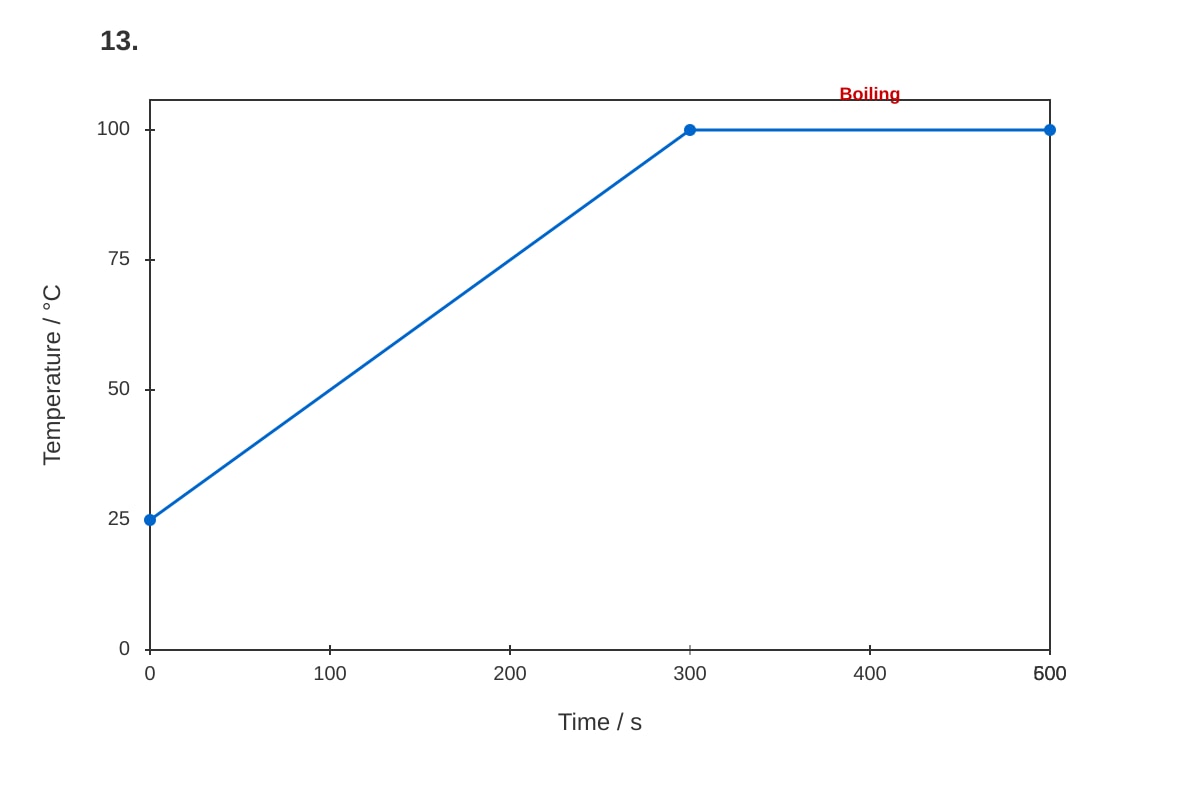
13. A student heats a beaker of water using an immersion heater. The graph below shows how the temperature of the water changes with time.
[Graph: Temperature vs Time. Linear increase from 25°C at t=0 to 100°C at t=300 s, then horizontal line at 100°C from t=300 s to t=600 s]
(a) Describe the motion and arrangement of water particles between t = 0 s and t = 300 s.
_______________________________________________________________________________ [2]
(b) Explain why the temperature remains constant between t = 300 s and t = 600 s, even though heating continues.
_______________________________________________________________________________ [2]
(c) The immersion heater has a power rating of 50 W. Calculate the energy supplied to the water between t = 0 s and t = 300 s.
Energy = ____________________ [2]
14. A ray of light travels from air into a glass block. The angle of incidence is 45°. The refractive index of the glass is 1.5.
(a) State what is meant by the term "refraction".
_______________________________________________________________________________ [1]
(b) Calculate the angle of refraction in the glass.
Angle of refraction = ____________________ [2]
(c) The ray of light now travels from the glass block back into air. State the condition required for total internal reflection to occur.
_______________________________________________________________________________ [1]
15. A uniform metre rule of weight 1.5 N is pivoted at the 40 cm mark. A 3.0 N weight is hung at the 10 cm mark.
(a) Draw a diagram showing the metre rule, pivot, and the forces acting on the rule.
[2]
(b) Calculate the distance from the pivot where a 4.0 N weight must be hung to balance the rule.
Distance from pivot = ____________________ [3]
16. A student investigates electromagnetic induction. She moves a bar magnet into a coil of wire connected to a sensitive ammeter.
(a) State what is observed on the ammeter as the magnet moves into the coil.
_______________________________________________________________________________ [1]
(b) Explain why this observation occurs.
_______________________________________________________________________________ [2]
(c) State two ways in which the student could increase the size of the induced current.
-
-
____________________________________________________________________________ [2]
Section C: Data-Based and Extended Response (20 marks)
Answer all questions in the spaces provided.
17. A household electric kettle is rated at 240 V, 1800 W. It is used to heat 1.5 kg of water from 25°C to 100°C. The specific heat capacity of water is 4200 J/(kg°C).
(a) Calculate the energy required to heat the water.
Energy = ____________________ [2]
(b) Calculate the minimum time needed to heat the water, assuming no energy losses.
Time = ____________________ [2]
(c) In practice, the kettle takes longer than the calculated time. Explain why.
_______________________________________________________________________________ [2]
(d) The kettle is fitted with a 13 A fuse in its plug. Discuss whether this fuse rating is suitable for the kettle.
_______________________________________________________________________________ [3]
18. A student investigates the efficiency of an electric motor. The motor lifts a 5.0 kg mass through a vertical height of 2.0 m in 4.0 s. The motor consumes 150 J of electrical energy during this time.
(a) Calculate the useful work done by the motor.
Useful work = ____________________ [2]
(b) Calculate the efficiency of the motor.
Efficiency = ____________________ [2]
(c) State where the wasted energy is transferred.
_______________________________________________________________________________ [1]
(d) Suggest one way the student could improve the efficiency of this system.
_______________________________________________________________________________ [1]
19. A student reads an article about the dangers of exposure to different types of electromagnetic radiation. The article mentions ultraviolet (UV) radiation and X-rays.
(a) State one harmful effect of excessive exposure to UV radiation.
_______________________________________________________________________________ [1]
(b) State one harmful effect of excessive exposure to X-rays.
_______________________________________________________________________________ [1]
(c) Explain why X-rays are generally more dangerous than UV radiation, even though both are types of ionising radiation.
_______________________________________________________________________________ [2]
(d) State one beneficial use of X-rays.
_______________________________________________________________________________ [1]
20. A student investigates the factors affecting the resistance of a wire. She uses wires of different lengths, all made of the same material and having the same cross-sectional area. She measures the current through each wire when a constant potential difference of 3.0 V is applied.
| Length / m | Current / A |
|---|---|
| 0.20 | 1.50 |
| 0.40 | 0.75 |
| 0.60 | 0.50 |
| 0.80 | 0.38 |
| 1.00 | 0.30 |
(a) Calculate the resistance of the 0.40 m wire.
Resistance = ____________________ [2]
(b) Describe the relationship between the length of the wire and its resistance.
_______________________________________________________________________________ [1]
(c) Explain this relationship using the particle model of electrical conduction.
_______________________________________________________________________________ [2]
(d) The student repeats the experiment using a wire of the same material and length but with a larger cross-sectional area. Predict how the current would change. Explain your answer.
_______________________________________________________________________________ [2]
END OF PAPER
Answers
TuitionGoWhere Practice Paper - Combined Science Physics Secondary 4
Answer Key and Marking Scheme (Version 4)
Total Marks: 65
Section A: Multiple Choice (10 marks)
| Question | Answer | Mark |
|---|---|---|
| 1 | D | 1 |
| 2 | A | 1 |
| 3 | A | 1 |
| 4 | B | 1 |
| 5 | C | 1 |
| 6 | C | 1 |
| 7 | B | 1 |
| 8 | B | 1 |
| 9 | B | 1 |
| 10 | A | 1 |
Explanations:
- D. Displacement has both magnitude and direction; mass, speed, and energy are scalars.
- A. Average speed = total distance / total time = 300 km / 4 h = 75 km/h.
- A. A standard ruler measures to the nearest 0.1 cm (1 mm), so the uncertainty is ±0.1 cm.
- B. Constant velocity means zero acceleration, so resultant force = 0 (Newton's First Law).
- C. Radiation (infrared/electromagnetic waves) does not require a medium; conduction and convection require particles.
- C. v = fλ = 50 Hz × 6.8 m = 340 m/s.
- B. Pressure in a liquid = ρgh, where ρ is density, g is gravitational field strength, and h is depth.
- B. I = P/V = 1200 W / 240 V = 5.0 A.
- B. Black, dull surfaces are the best absorbers (and emitters) of thermal radiation.
- A. V_s / V_p = N_s / N_p → V_s = (50/500) × 240 V = 24 V.
Section B: Structured Questions (35 marks)
11. Distance-time graph and motion
(a) Graph plotting [3 marks]
- Correct axes labelled: Time/s on x-axis, Distance/m on y-axis [1]
- All points plotted correctly [1]
- Straight line drawn through points (through origin) [1]
(b) Description [1 mark]
- The toy car moves at constant speed / uniform speed / steady speed. [1]
(c) Speed calculation [2 marks]
- Speed = gradient = change in distance / change in time
- Using any two points, e.g., (10, 15.0) and (0, 0): speed = (15.0 - 0) / (10 - 0) = 1.5 m/s [1 for method, 1 for correct answer with units]
- Answer: 1.5 m/s
12. Wooden block and forces
(a) Frictional force [1 mark]
- 8.0 N [1]
(b) Explanation [2 marks]
- The block moves at constant speed, so acceleration = 0. [1]
- By Newton's First Law, resultant force = 0, so frictional force = applied force = 8.0 N. [1]
(c) Acceleration calculation [3 marks]
- Resultant force = applied force - friction = 12.0 N - 8.0 N = 4.0 N [1]
- F = ma → 4.0 = 2.0 × a [1]
- a = 2.0 m/s² [1]
- Answer: 2.0 m/s²
13. Heating water
(a) Particle description (0–300 s) [2 marks]
- Particles gain kinetic energy / move faster / vibrate more vigorously. [1]
- Spacing between particles increases slightly (thermal expansion). [1]
(b) Constant temperature explanation [2 marks]
- At 100°C, water is boiling / changing state from liquid to gas. [1]
- Energy supplied is used to overcome attractive forces between particles (latent heat of vaporisation) rather than increasing kinetic energy, so temperature remains constant. [1]
(c) Energy calculation [2 marks]
- E = Pt = 50 W × 300 s [1]
- E = 15 000 J (or 15 kJ) [1]
- Answer: 15 000 J
14. Refraction and total internal reflection
(a) Definition [1 mark]
- Refraction is the bending/changing direction of light as it passes from one medium to another due to a change in speed. [1]
(b) Angle of refraction [2 marks]
- n = sin i / sin r → 1.5 = sin 45° / sin r [1]
- sin r = sin 45° / 1.5 = 0.707 / 1.5 = 0.471 → r = sin⁻¹(0.471) = 28.1° (accept 28°) [1]
- Answer: 28.1° (or 28°)
(c) Condition for total internal reflection [1 mark]
- The angle of incidence must be greater than the critical angle AND light must travel from a denser medium to a less dense medium (e.g., glass to air). [1 for either condition; accept both]
15. Principle of moments
(a) Diagram [2 marks]
- Metre rule drawn with pivot at 40 cm mark [1]
- Forces shown: weight of rule (1.5 N) at 50 cm mark (centre), 3.0 N downward at 10 cm mark, 4.0 N downward at unknown position on other side of pivot [1]
(b) Calculation [3 marks]
- Taking moments about pivot:
- Anticlockwise moment: 3.0 N × (0.40 m - 0.10 m) = 3.0 × 0.30 = 0.90 N m [1]
- Clockwise moment from rule's weight: 1.5 N × (0.50 m - 0.40 m) = 1.5 × 0.10 = 0.15 N m [1]
- For balance: anticlockwise moments = clockwise moments
- 0.90 = 0.15 + (4.0 × d) → 4.0d = 0.75 → d = 0.1875 m = 18.75 cm [1]
- Answer: 18.8 cm (or 0.188 m) from pivot on the clockwise side (i.e., at 58.8 cm mark)
16. Electromagnetic induction
(a) Observation [1 mark]
- The ammeter needle deflects / shows a reading / current flows. [1]
(b) Explanation [2 marks]
- Moving the magnet changes the magnetic field / magnetic flux through the coil. [1]
- By Faraday's law, a changing magnetic field induces an e.m.f. / voltage, which drives a current through the circuit. [1]
(c) Increasing induced current [2 marks]
- Any two from:
- Move the magnet faster. [1]
- Use a stronger magnet. [1]
- Use a coil with more turns. [1]
- Use a coil with a soft iron core. [1]
Section C: Data-Based and Extended Response (20 marks)
17. Electric kettle
(a) Energy required [2 marks]
- Q = mcΔθ = 1.5 kg × 4200 J/(kg°C) × (100°C - 25°C) [1]
- Q = 1.5 × 4200 × 75 = 472 500 J [1]
- Answer: 472 500 J (or 472.5 kJ)
(b) Minimum time [2 marks]
- E = Pt → t = E/P = 472 500 J / 1800 W [1]
- t = 262.5 s (accept 263 s or 4 min 23 s) [1]
- Answer: 262.5 s
(c) Explanation for longer time [2 marks]
- Energy is lost / transferred to the surroundings (as heat). [1]
- Not all electrical energy is converted to thermal energy in the water; some heats the kettle itself / is radiated away / lost through convection. [1]
(d) Fuse suitability discussion [3 marks]
- Calculate operating current: I = P/V = 1800 W / 240 V = 7.5 A. [1]
- The 13 A fuse is rated higher than the normal operating current (7.5 A), so it will not blow during normal use. [1]
- However, 13 A is significantly higher than 7.5 A; a 10 A fuse would be more appropriate. The 13 A fuse would still protect against short circuits (very high currents) but may allow the kettle to operate with a fault that draws, for example, 12 A, which could cause overheating. The 13 A fuse is acceptable but not optimal. [1]
- Accept reasoned arguments for or against, with supporting calculations.
18. Motor efficiency
(a) Useful work [2 marks]
- Work done = force × distance = weight × height = mg × h [1]
- Work = 5.0 kg × 10 N/kg × 2.0 m = 100 J [1]
- Answer: 100 J
(b) Efficiency [2 marks]
- Efficiency = (useful energy output / total energy input) × 100% [1]
- Efficiency = (100 J / 150 J) × 100% = 66.7% (accept 67%) [1]
- Answer: 66.7%
(c) Wasted energy [1 mark]
- Energy is transferred as thermal energy (heat) to the surroundings / motor / friction in the pulley or string. [1]
(d) Improvement [1 mark]
- Any one from:
- Lubricate moving parts to reduce friction.
- Use a more efficient motor.
- Reduce the mass of the string/pulley system.
19. Electromagnetic radiation dangers
(a) Harmful effect of UV [1 mark]
- Skin cancer / sunburn / premature skin ageing / eye damage (cataracts). [1]
(b) Harmful effect of X-rays [1 mark]
- Cancer / cell damage / genetic mutations / tissue damage. [1]
(c) Why X-rays are more dangerous [2 marks]
- X-rays have higher frequency / shorter wavelength / higher photon energy than UV radiation. [1]
- Higher energy photons can penetrate deeper into the body and cause more severe ionisation / damage to cells and DNA. [1]
(d) Beneficial use of X-rays [1 mark]
- Medical imaging (e.g., bone fractures, dental X-rays) / security scanning / industrial inspection. [1]
20. Resistance of a wire
(a) Resistance calculation [2 marks]
- R = V/I = 3.0 V / 0.75 A [1]
- R = 4.0 Ω [1]
- Answer: 4.0 Ω
(b) Relationship [1 mark]
- As the length of the wire increases, the resistance increases. / Resistance is directly proportional to length. [1]
(c) Particle model explanation [2 marks]
- In a longer wire, electrons must travel a greater distance through the lattice of positive ions. [1]
- There are more collisions between electrons and ions, which impedes the flow of charge / increases resistance. [1]
(d) Prediction and explanation [2 marks]
- The current would increase. [1]
- A larger cross-sectional area provides more pathways / space for electrons to flow, reducing the frequency of collisions / reducing resistance, so current increases for the same voltage. [1]
END OF ANSWER KEY