AI Generated Exam Paper
Secondary 4 Combined Science Physics Practice Paper 3
Free Sec 4 Comb Sci Phy Practice Paper 3, HY3 AI version, with questions, answers, and O Level-style practice for Singapore students.
These static practice materials are generated from the site's syllabus and paper-generation workflow, with source and model context shown so students and parents can evaluate the material before use.
Questions
TuitionGoWhere Practice Paper - Combined Science Physics Secondary 4
TuitionGoWhere Practice Paper (AI) — Version 3 of 5
Subject: Combined Science Physics
Level: Secondary 4
Paper: Practice Paper (Topic: Summary)
Duration: 1 hour
Total Marks: 40
Name: ________________________
Class: ____________
Date: ____________
Instructions:
- This practice paper covers a summary of key Secondary 4 Combined Science Physics topics based on syllabus-first generation. It is not derived from official past-year papers.
- Answer all 20 questions.
- Show your working clearly where calculation is required.
- Use the spaces provided.
Section A: Kinematics and Forces (Questions 1–5) — 10 marks
1. A car travels 120 m in 8.0 s at constant speed. Calculate its average speed. [2]
2. State the acceleration of an object that increases its velocity from 4 m/s to 16 m/s in 6.0 s. [1]
3. A block is pushed at constant speed across a rough table. The applied force is 5.0 N. State the frictional force and explain your answer. [2]
4.
Image pending generation: graph for Q4.
Using the graph, calculate the acceleration of the bicycle between t=0 and t=5 s. [1]
5. A parrot of mass 0.50 kg rests on a perch. Calculate the weight of the parrot. (g=10 N/kg) [2]
Section B: Thermal Physics and Energy (Questions 6–10) — 10 marks
6. Describe, in terms of particles, what happens when ice melts at 0∘C. [2]
7. A 1000 W heater runs for 20 s. Calculate the electrical energy transferred. [2]
8. State one method of thermal energy transfer that does not require a medium. [1]
9.
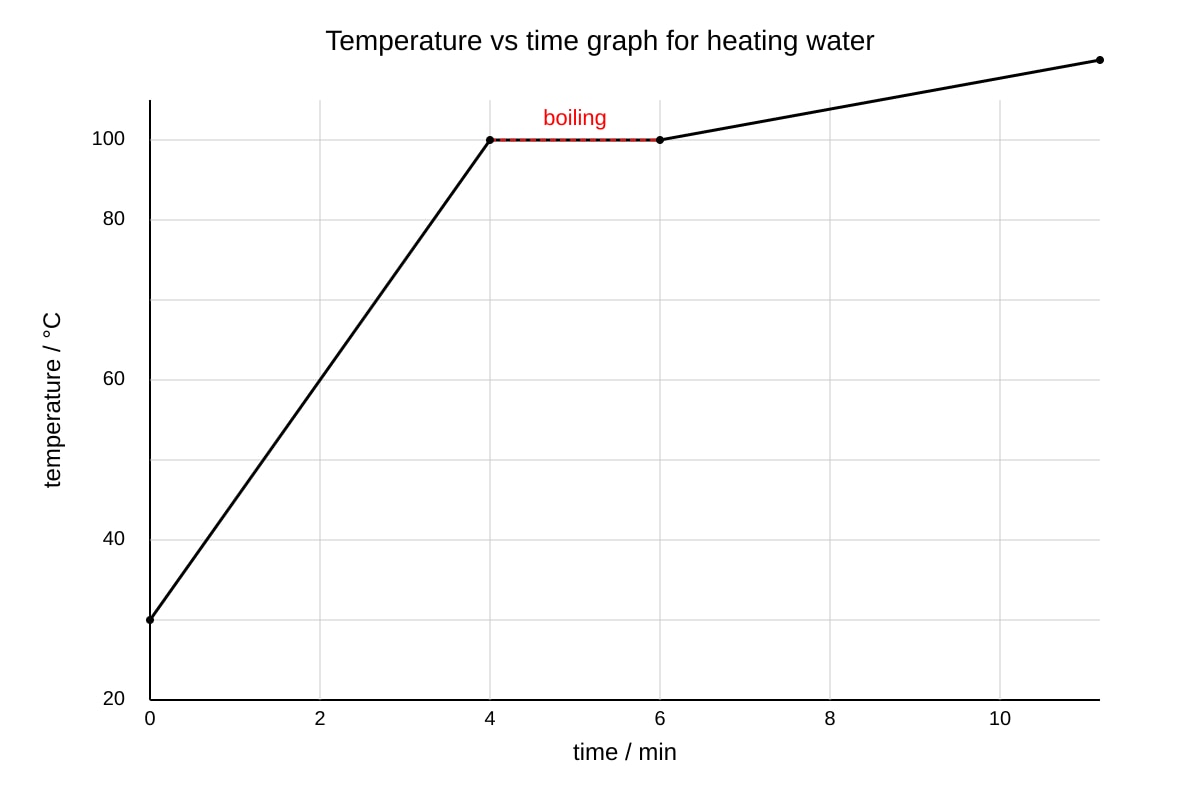
Image pending generation: graph for Q9.
Explain why the graph shows a flat section at 100∘C. [2]
10. A machine does 400 J of useful work from 1000 J input. Calculate its efficiency as a percentage. [3]
Section C: Waves, Electricity and Magnetism (Questions 11–15) — 10 marks
11. State the law relating voltage, current and resistance in a metal wire at constant temperature. [1]
12. Calculate the resistance of a bulb with 6.0 V across it and 0.50 A through it. [2]
13. Name the process by which a moving magnet induces a current in a coil. [1]
14.
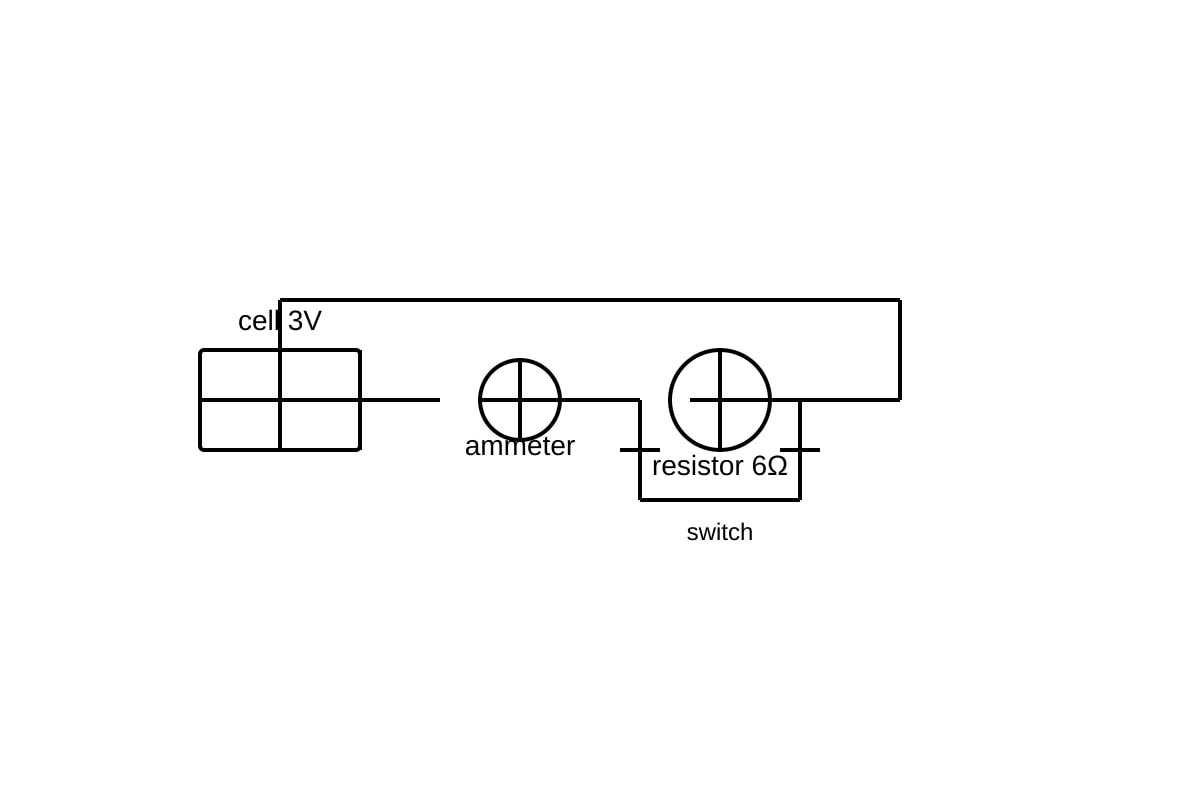
Image pending generation: diagram for Q14.
Calculate the current in the circuit shown. [2]
15. State one danger of ultraviolet radiation. [1]
16. A ray of light hits a plane mirror at 30∘ to the normal. State the angle of reflection. [1]
17. Name the type of wave that is longitudinal and used for hearing. [1]
18. Two resistors of 4 Ω and 6 Ω are connected in parallel. Calculate their combined resistance. [2]
19. Explain why a transformer uses an alternating current in the primary coil. [2]
20. A student connects a 12 V battery to two resistors in series: 2 Ω and 4 Ω. Calculate the total current. [3]
Answers
TuitionGoWhere Practice Paper — Answer Key (Version 3)
Subject: Combined Science Physics
Level: Secondary 4
Paper: Practice Paper (Topic: Summary)
Total Marks: 40
Section A: Kinematics and Forces (10 marks)
Q1 [2 marks]
Average speed = total distance / total time
= 120 m/8.0 s=15 m/s
Teaching note: Average speed uses total distance, not average of speeds. Mark: 1 for formula, 1 for correct answer with unit.
Q2 [1 mark]
a=(v−u)/t=(16−4)/6.0=2.0 m/s2
Answer: 2.0 m/s2
Common mistake: writing m/s instead of m/s².
Q3 [2 marks]
Frictional force = 5.0 N.
Explanation: constant speed → acceleration = 0 → net force = 0 (Newton’s First Law). Thus friction equals applied force.
Marking: 1 for value, 1 for explanation.
Q4 [1 mark]
From graph: a=Δv/Δt=(10−0)/(5−0)=2 m/s2.
Image note: graph shows straight line from origin to (5,10).
Q5 [2 marks]
Weight W=mg=0.50×10=5.0 N.
Marking: 1 for method, 1 for answer.
Section B: Thermal Physics and Energy (10 marks)
Q6 [2 marks]
Particles gain energy; temperature constant so kinetic energy unchanged; bonds between particles break, allowing particles to move from fixed positions to a less ordered arrangement (liquid).
Marking: 1 for energy/bond idea, 1 for arrangement change.
Q7 [2 marks]
E=Pt=1000×20=20000 J=2.0×10⁴ J.
Marking: 1 for formula, 1 for answer.
Q8 [1 mark]
Radiation (thermal radiation / infrared radiation).
Q9 [2 marks]
At 100∘C water boils; energy supplied is latent heat used to break bonds, not raise temperature, so temperature stays constant.
Image note: plateau at 100°C labelled boiling.
Q10 [3 marks]
Efficiency = (useful output / input) × 100% = (400 / 1000) × 100% = 40%.
Marking: 1 formula, 1 substitution, 1 answer.
Section C: Waves, Electricity and Magnetism (20 marks total; Q11–15 = 10 marks)
Q11 [1 mark]
Ohm’s law: V=IR (at constant temperature).
Q12 [2 marks]
R=V/I=6.0/0.50=12 Ω.
Marking: 1 method, 1 answer.
Q13 [1 mark]
Electromagnetic induction.
Q14 [2 marks]
Total resistance = 6 Ω. Current I=V/R=3/6=0.50 A.
Image note: series circuit, 3 V cell, 6 Ω resistor.
Q15 [1 mark]
Causes skin cancer / eye damage.
Q16 [1 mark]
30∘ (law of reflection: angle of incidence = angle of reflection).
Q17 [1 mark]
Sound wave.
Q18 [2 marks]
1/R=1/4+1/6=5/12, so R=12/5=2.4 Ω.
Marking: 1 for reciprocal sum, 1 for answer.
Q19 [2 marks]
Alternating current produces a changing magnetic field; this induces a changing emf in the secondary coil (required for transformer action).
Marking: 1 for changing field, 1 for induction link.
Q20 [3 marks]
Total R=2+4=6 Ω. I=V/R=12/6=2.0 A.
Marking: 1 series sum, 1 formula, 1 answer.
Total marks check: Section A 10 + B 10 + C 20 = 40 ✓
Free quiz and exam paper access
Enter your details to view this paper
Your access is remembered on this device.