AI Generated Exam Paper
Secondary 4 Combined Science Physics Practice Paper 2
Free Sec 4 Comb Sci Phy Practice Paper 2, HY3 AI version, with questions, answers, and O Level-style practice for Singapore students.
These static practice materials are generated from the site's syllabus and paper-generation workflow, with source and model context shown so students and parents can evaluate the material before use.
Questions
TuitionGoWhere Practice Paper - Combined Science Physics Secondary 4
TuitionGoWhere Practice Paper (AI) — Version 2
Subject: Combined Science Physics
Level: Secondary 4
Paper: Practice Paper (Topic: Summary)
Duration: 1 hour
Total Marks: 40
Name: ________________________
Class: ________
Date: ________
Instructions:
- This practice paper contains 20 questions on a summary of Secondary 4 Combined Science Physics topics.
- Answer all questions in the spaces provided.
- Show all working clearly where calculations are required.
- Use a calculator if needed. Take g=9.8 m/s2 or 10 m/s2 as instructed.
- Section A: 1–8 (16 marks), Section B: 9–14 (12 marks), Section C: 15–20 (12 marks).
Section A (16 marks)
1. State the SI unit for acceleration. [1]
2. A car moves at constant velocity. State the net force acting on the car. [1]
3. Define the term "scalar quantity" in physics. [1]
4. A book of mass 1.5 kg rests on a table. Calculate its weight. (Use g=10 m/s2) [2]
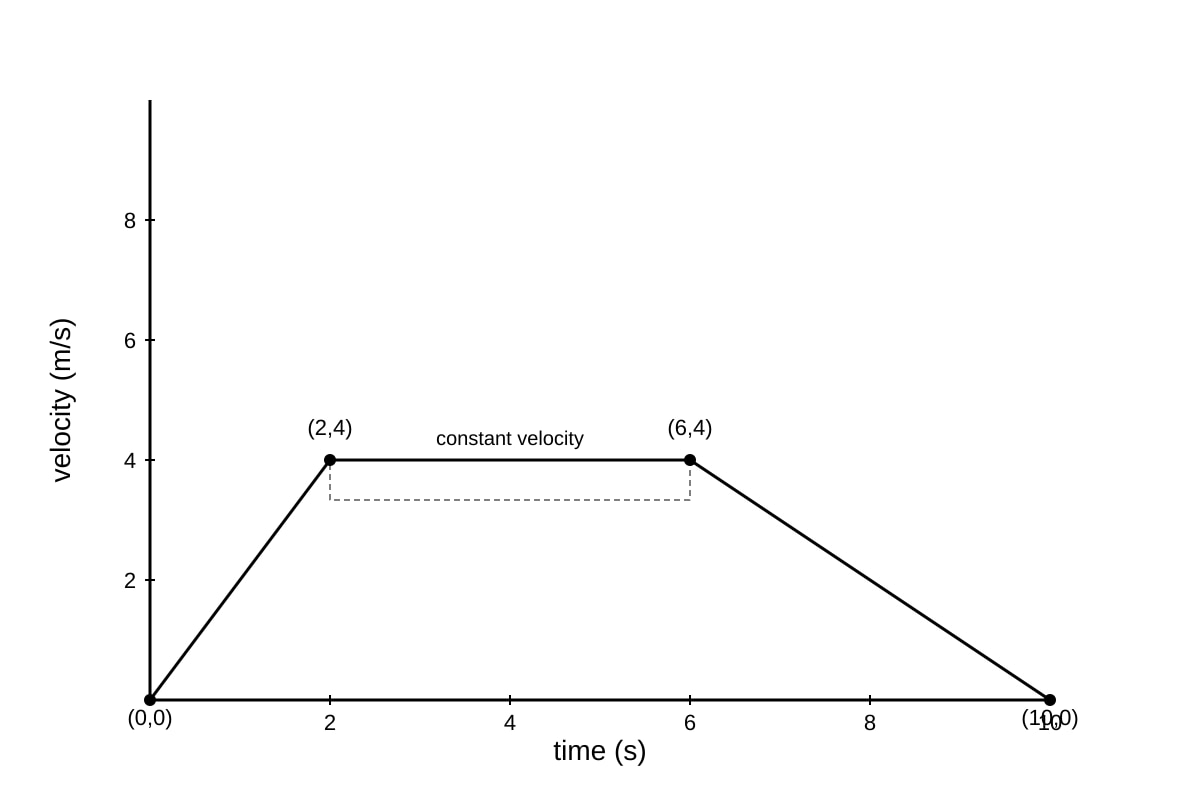
5. The diagram shows a velocity–time graph for a bicycle.
Image pending generation: graph for Q5.
State the acceleration of the bicycle between t=2 s and t=6 s. [1]
6. Name the process by which heat is transferred through a vacuum. [1]
7. An electrical appliance has a power rating of 1200 W. Calculate the energy used in 10 minutes. [2]
8. A ray of light strikes a plane mirror at 30∘ to the normal. State the angle of reflection. [1]
Section B (12 marks)
9. A block is pushed across a horizontal floor at constant speed by a force of 5 N. (a) State the size of the frictional force. [1] (b) Explain how you obtain your answer. [1]
(a) ________________________ (b) ________________________
10. Water is heated from −5∘C to 105∘C. The graph shows temperature vs time with a plateau at 0∘C and another at 100∘C.
Image pending generation: graph for Q10.
Describe the arrangement and movement of particles during the plateau at 0∘C. [2]
11. A 2.0 m uniform plank of mass 8.0 kg is supported at ends A and B. Calculate the reaction force at A. (Take g=10 m/s2) [2]
12. A 12 V battery is connected to a resistor of 4 Ω. Calculate the current in the circuit. [2]
13. State two differences between a series and a parallel circuit. [2]
14. A shuttlecock is dropped from a height. Explain why it reaches terminal velocity before hitting the ground. [2]
Section C (12 marks)
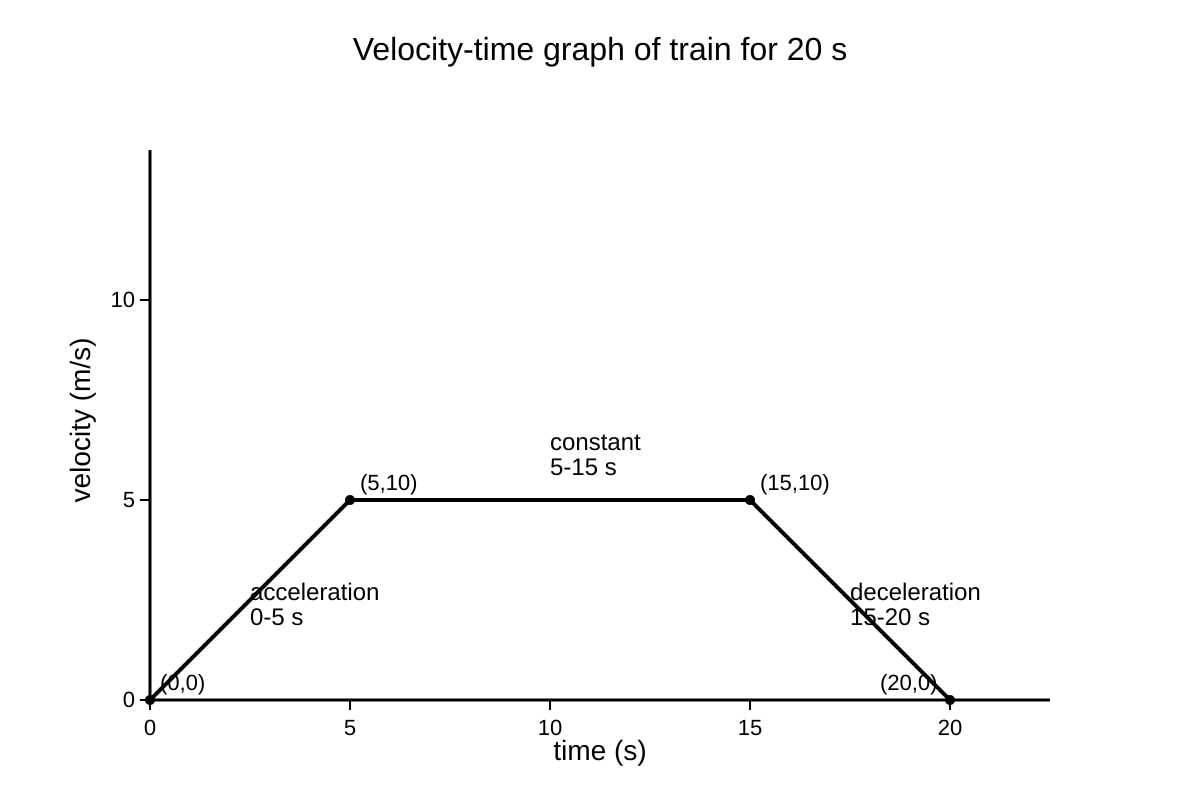
15. The velocity–time graph shows a train’s motion for 20 s.
Image pending generation: graph for Q15.
(a) Calculate the acceleration from t=0 to t=5 s. [2] (b) Calculate the total distance travelled. [2]
(a) ________________________ (b) ________________________
16. A 60 W lamp is left on for 2 hours. Calculate the energy consumed in kWh. [2]
17. Explain, in terms of energy conservation, why a bouncing ball does not reach the same height on each bounce. [2]
18. Compare conduction and convection as methods of thermal transfer. [2]
19. A magnet is brought near a coil connected to a galvanometer. The needle deflects only while moving. Explain this observation using electromagnetic induction. [2]
20. A student says: "Average speed is the mean of the speeds in each part of a journey." Explain why this is wrong and state the correct formula. [2]
Answers
TuitionGoWhere Practice Paper — Combined Science Physics Secondary 4 (Version 2) Answer Key
Total Marks: 40
Section A (16 marks)
1. m/s2 (metre per second squared) [1]
Teaching note: Acceleration is change in velocity per unit time, so unit is (m/s)/s=m/s2.
2. Zero (0 N) [1]
Teaching note: Constant velocity means no acceleration (a=0), so by Newton’s First Law net force = 0.
3. A scalar quantity has magnitude only, no direction. [1]
Example: mass, speed, temperature.
4. Weight =m×g=1.5×10=15 N [2]
Marks: 1 for formula, 1 for answer with unit.
5. Acceleration = 0 m/s2 [1]
From graph, velocity constant between 2 s and 6 s, so gradient = 0.
6. Radiation [1]
Radiation does not need medium; travels as EM waves.
7. E=P×t=1200×(10×60)=720000 J=720 kJ [2]
Marks: 1 for converting 10 min to 600 s, 1 for answer.
8. 30∘ [1]
Law of reflection: angle of incidence = angle of reflection (both measured to normal).
Section B (12 marks)
9. (a) 5 N [1]
(b) At constant speed, acceleration = 0 so net force = 0; friction equals applied force. [1]
10. At 0∘C melting occurs: particles gain energy, bonds break, move from fixed positions to free movement; arrangement changes from ordered solid to less ordered liquid; average kinetic energy unchanged (temp constant). [2]
Marks: 1 for movement description, 1 for arrangement/energy.
11. Weight =8×10=80 N acts at centre (1.0 m from A).
Taking moments about B: RA×2.0=80×1.0⇒RA=40 N [2]
Marks: 1 for method, 1 for answer.
12. I=V/R=12/4=3 A [2]
13. Two differences, e.g.:
- Series: same current through all; parallel: current splits.
- Series: total R = sum; parallel: total R less than smallest. [2]
14. Gravity pulls down; air resistance increases with speed; at terminal velocity, air resistance = weight, net force 0, constant speed. [2]
Section C (12 marks)
15. (a) a=(10−0)/(5−0)=2 m/s2 [2]
(b) Distance = area = 21(5)(10)+(10)(10)+21(5)(10)=25+100+25=150 m [2]
16. E=P×t=0.060 kW×2 h=0.12 kWh [2]
17. Some kinetic energy converts to sound/heat on impact; total energy conserved but less mechanical energy for rebound. [2]
18. Conduction: via particles colliding in solid; convection: via fluid movement. [2]
19. Moving magnet changes magnetic flux in coil, induces EMF (Faraday’s law); only moving gives changing flux, so deflection only then. [2]
20. Wrong because distances/time differ; correct: average speed = total distance / total time. [2]
Free quiz and exam paper access
Enter your details to view this paper
Your access is remembered on this device.