AI Generated Exam Paper

Secondary 4 Combined Science Physics Practice Paper 2

Free AI-Generated Gemma 4 31B Secondary 4 Combined Science Physics Practice Paper 2 practice paper with questions and answers for Singapore students. This page is rendered as a direct URL so the questions and answers can be discovered without pressing in-page buttons.

These static practice materials are generated from the site's syllabus and paper-generation workflow, with source and model context shown so students and parents can evaluate the material before use.

Secondary 4 Combined Science Physics AI Generated Generated by Gemma 4 31B Updated 2026-06-03

Questions

<!-- TuitionGoWhere generation metadata: stage=5-2; model=google/gemma-4-31b-it; model_label=Gemma 4 31B; generated=2026-05-31; Sources: Stage 4-0 LLM templates, syllabus context, and Stage 2 evidence where available. -->

TuitionGoWhere Practice Paper - Combined Science Physics Secondary 4

TuitionGoWhere Practice Paper (AI) - Version 2

Subject: Combined Science Physics
Level: Secondary 4
Paper: Theory (Comprehensive)
Duration: 1 hour 15 minutes
Total Marks: 65
Name: __________________________ Class: __________ Date: __________

Instructions:

  • Answer all questions in the spaces provided.
  • Show all working for calculations.
  • Use g=10 m/s2g = 10\text{ m/s}^2 where necessary.
  • Write your answers in the spaces provided.

Section A: Newtonian Mechanics (25 Marks)

Question 1 A toy car is pushed across a smooth floor. Its motion is recorded on a velocity-time graph. Between t=0st = 0\text{s} and t=4st = 4\text{s}, the velocity increases linearly from 0m/s0\text{m/s} to 12m/s12\text{m/s}. (a) Calculate the acceleration of the car. [2]


(b) Determine the total distance traveled by the car in the first 4 seconds. [2]


Question 2 A wooden crate of mass 5kg5\text{kg} is being pushed across a rough horizontal surface by a constant horizontal force of 30N30\text{N}. The crate moves at a constant velocity. (a) State the magnitude of the frictional force acting on the crate. [1]


(b) Explain your answer to (a) by referring to Newton's Laws of Motion. [2]


Question 3 An electric hoist lifts a load of 100kg100\text{kg} to a height of 15m15\text{m} in 20s20\text{s}. The motor has a power input of 1200W1200\text{W}. (a) Calculate the useful work done by the hoist. [2]


(b) Calculate the efficiency of the hoist. [3]


Question 4 A student uses a meter rule as a lever to lift a heavy stone. The pivot is placed 10cm10\text{cm} from the stone. (a) Where should the student apply the force to make it easiest to lift the stone? [1]


(b) Explain the principle of moments in this context. [2]


Question 5 A diver descends from the surface of a lake to a depth of 12m12\text{m}. (a) Calculate the increase in pressure experienced by the diver. (Density of water =1000kg/m3= 1000\text{kg/m}^3) [2]


(b) State whether the pressure depends on the surface area of the diver's body. Explain your answer. [2]


Section B: Thermal Physics (20 Marks)

Question 6 A sample of paraffin wax is heated. A graph of temperature against time shows a plateau at 54C54^\circ\text{C}. (a) Describe the arrangement and motion of the wax particles during this plateau period. [3]


(b) Explain why the temperature remains constant despite continuous heating. [2]


Question 7 A small metal sphere is heated to 100C100^\circ\text{C} and then placed in a beaker of water at 20C20^\circ\text{C}. (a) Describe the process of thermal energy transfer from the sphere to the water. [2]


(b) State the condition when the sphere and water reach thermal equilibrium. [1]


Question 8 A vacuum flask is designed to keep liquids hot. (a) Explain how the silvered inner walls of the flask reduce heat loss by radiation. [2] (b) Explain why the vacuum between the double walls is effective in reducing heat loss. [3]


Question 9 Compare the rate of heat absorption of a matte black surface and a shiny white surface of the same area when exposed to the same source of radiation. [3]


Section C: Waves, Electricity & Magnetism (20 Marks)

Question 10 A ray of light travels from air into a glass block with a refractive index of 1.51.5. (a) Calculate the critical angle for the glass-air interface. [2]


(b) State the two conditions necessary for total internal reflection to occur. [2]


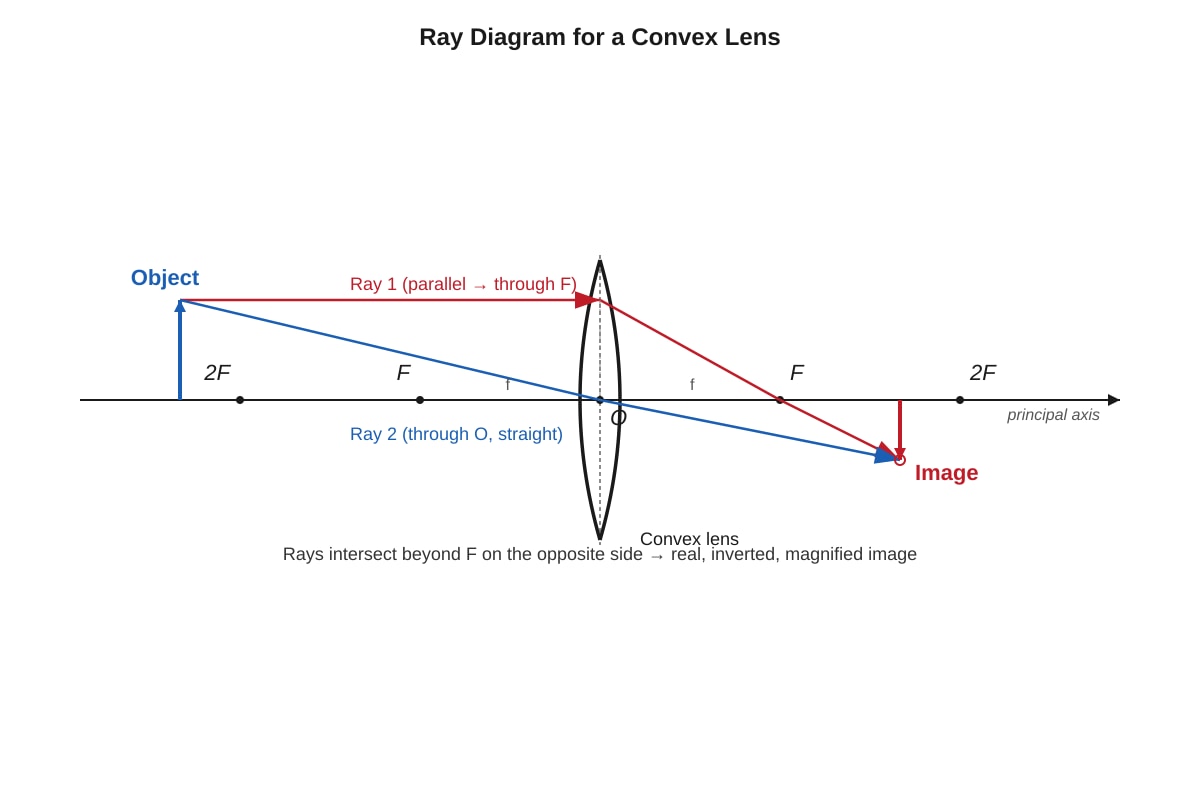
Question 11 A converging lens has a focal length of 10cm10\text{cm}. An object is placed 15cm15\text{cm} from the lens. (a) Complete a ray diagram to show the image formation. [3] (b) State two characteristics of the image formed. [2]


Question 12 A household circuit contains a 2kW2\text{kW} electric kettle and a 100W100\text{W} light bulb connected in parallel to a 230V230\text{V} supply. (a) Calculate the current flowing through the kettle. [2]


(b) The circuit is protected by a 13A13\text{A} fuse. Discuss whether this fuse is suitable if both appliances are used simultaneously. [3]


Question 13 A step-down transformer has 10001000 turns in the primary coil and 200200 turns in the secondary coil. (a) Calculate the output voltage if the input voltage is 240V240\text{V}. [2]


(b) State the purpose of a transformer in the national grid. [1]


Answers

<!-- TuitionGoWhere generation metadata: stage=5-2; model=google/gemma-4-31b-it; model_label=Gemma 4 31B; generated=2026-05-31; Sources: Stage 4-0 LLM templates, syllabus context, and Stage 2 evidence where available. -->

Answer Key - Combined Science Physics Secondary 4 (Version 2)

Section A: Newtonian Mechanics

Q1 (a) a=Δv/Δt=(120)/4=3 m/s2a = \Delta v / \Delta t = (12 - 0) / 4 = 3\text{ m/s}^2 [2] (b) Distance=Area under graph=0.5×4×12=24m\text{Distance} = \text{Area under graph} = 0.5 \times 4 \times 12 = 24\text{m} [2]

Q2 (a) 30N30\text{N} [1] (b) Since the crate moves at constant velocity, acceleration is zero. According to Newton's First Law, the net force must be zero. Therefore, the frictional force must equal the applied force. [2]

Q3 (a) Work=mgh=100×10×15=15,000J\text{Work} = mgh = 100 \times 10 \times 15 = 15,000\text{J} [2] (b) Energy input=P×t=1200×20=24,000J\text{Energy input} = P \times t = 1200 \times 20 = 24,000\text{J}. Efficiency=(15,000/24,000)×100%=62.5%\text{Efficiency} = (15,000 / 24,000) \times 100\% = 62.5\% [3]

Q4 (a) At the furthest point from the pivot. [1] (b) Moment = Force ×\times perpendicular distance. By increasing the distance from the pivot, a smaller force is required to produce the same moment to lift the stone. [2]

Q5 (a) ΔP=hρg=12×1000×10=120,000 Pa\Delta P = h\rho g = 12 \times 1000 \times 10 = 120,000\text{ Pa} [2] (b) No. Liquid pressure depends only on depth, density, and gravity, not on the surface area of the object. [2]

Section B: Thermal Physics

Q6 (a) Arrangement: Particles are moving from a fixed regular lattice to a random arrangement. Motion: Particles move faster/vibrate more vigorously. [3] (b) The energy is used to overcome the intermolecular forces of attraction between particles to change the state from solid to liquid, rather than increasing the kinetic energy (temperature). [2]

Q7 (a) Thermal energy is transferred from the hot sphere to the water via conduction (direct contact). [2] (b) When the sphere and the water reach the same temperature. [1]

Q8 (a) Silvered surfaces are poor emitters and poor absorbers of infrared radiation, reflecting heat back into the flask. [2] (b) Vacuum prevents heat loss by conduction and convection, as these processes require a medium (particles) to transfer energy. [3]

Q9 The matte black surface absorbs heat at a much faster rate than the shiny white surface. This is because black surfaces are excellent absorbers of radiation, while white surfaces reflect most of the radiation. [3]

Section C: Waves, Electricity & Magnetism

Q10 (a) sinθc=1/1.5θc=arcsin(0.667)41.8\sin \theta_c = 1 / 1.5 \rightarrow \theta_c = \arcsin(0.667) \approx 41.8^\circ [2] (b) 1. Light must travel from a denser medium to a less dense medium. 2. Angle of incidence must be greater than the critical angle. [2]

Q11 (a) [Diagram check: Ray 1 parallel to axis \rightarrow through F; Ray 2 through optical center O \rightarrow straight. Intersection beyond FF on opposite side.] [3] (b) Real, Inverted, Magnified. (Any two) [2]
Q12 (a) I=P/V=2000/2308.70AI = P/V = 2000 / 230 \approx 8.70\text{A} [2] (b) Total current Itotal=(2000+100)/230=2100/2309.13AI_{total} = (2000 + 100) / 230 = 2100 / 230 \approx 9.13\text{A}. Since 9.13A<13A9.13\text{A} < 13\text{A}, the fuse will not blow during normal operation. It is suitable as it protects against surges while allowing normal use. [3]

Q13 (a) Vs/Vp=Ns/NpVs=240×(200/1000)=48VV_s/V_p = N_s/N_p \rightarrow V_s = 240 \times (200/1000) = 48\text{V} [2] (b) To reduce the voltage to a safe level for domestic use. [1]