AI Generated Exam Paper
Secondary 4 Combined Science Physics Practice Paper 1
Free Sec 4 Comb Sci Phy Practice Paper 1, HY3 AI version, with questions, answers, and O Level-style practice for Singapore students.
These static practice materials are generated from the site's syllabus and paper-generation workflow, with source and model context shown so students and parents can evaluate the material before use.
Questions
Free quiz and exam paper access
Enter your details to view this paper
Your access is remembered on this device.
Answers
TuitionGoWhere Practice Paper — Answer Key (Version 1 of 5)
Subject: Combined Science Physics
Level: Secondary 4
Topic: Summary
Total Marks: 40
Section A: Questions 1–10 (14 marks)
Q1 [1] C. Velocity
Teaching note: Vector quantities have magnitude and direction. Velocity includes direction; speed, distance, time are scalars.
Q2 [1] newton (N)
Teaching note: Force is measured in newtons, symbol N.
Q3 [2]
Average speed = total distance / total time = 100 m / 20 s = 5 m/s.
Marks: 1 for correct formula, 1 for answer with unit.
Q4 [2]
Particles are closely packed in a fixed arrangement; they vibrate about fixed positions.
Marks: 1 for arrangement, 1 for movement.
Q5 [1] 0 N
Teaching note: At rest, no acceleration → net force = 0 (Newton’s First Law).
Q6 [2]
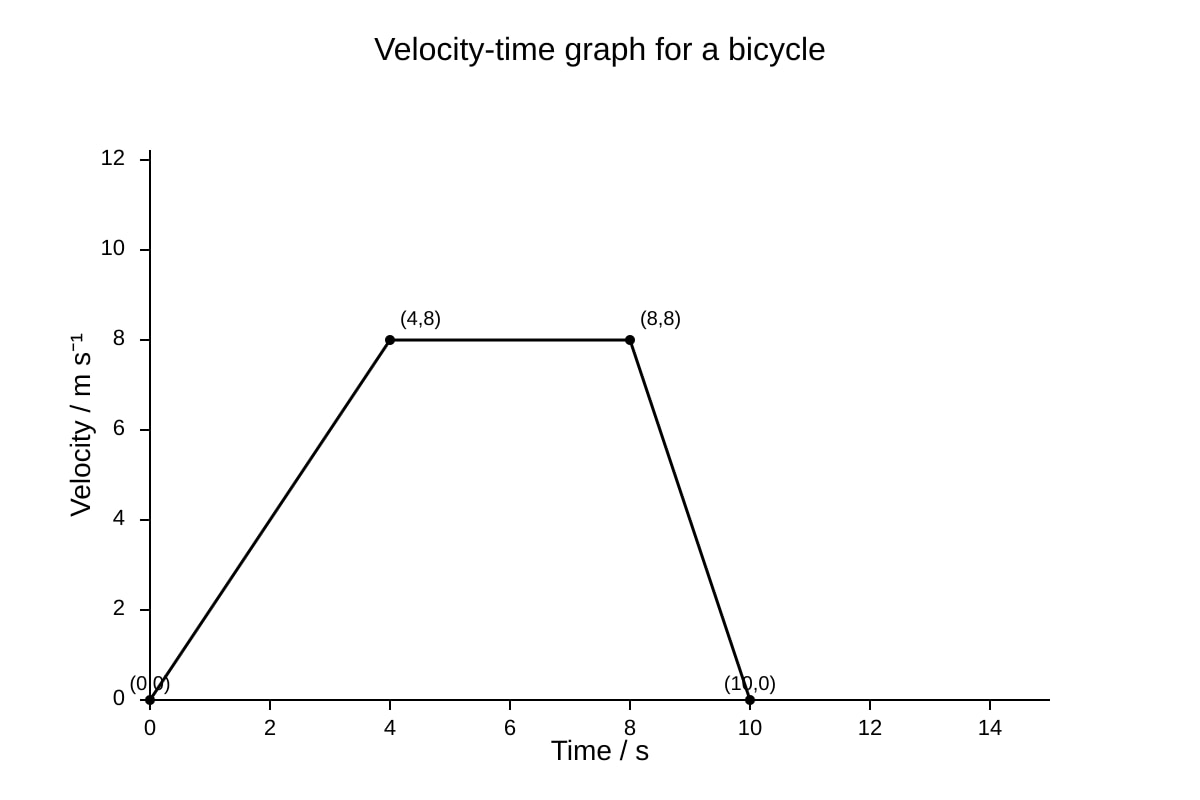
Acceleration = gradient = (8 – 0) / (4 – 0) = 2 m/s².
Marks: 1 for method, 1 for answer with unit.
Q7 [1] Radiation
Teaching note: Radiation (infrared) transfers heat through vacuum.
Q8 [2]
I = V / R = 12 / 4 = 3 A.
Marks: 1 for formula, 1 for answer.
Q9 [1] In series, current is same through all components; in parallel, current splits. (Any one valid difference.)
Q10 [1] 6 N
Teaching note: Constant speed → net force 0 → friction = applied force.
Section B: Questions 11–15 (12 marks)
Q11 [3]
Moment = force × perpendicular distance = 10 N × 0.5 m = 5 N m.
Direction: clockwise (if weight on left of pivot).
Marks: 1 formula, 1 calc, 1 direction.
Q12 [3]
Particles gain kinetic energy; move faster; arrangement becomes less ordered as temperature rises (before boiling).
Marks: energy gain, faster movement, arrangement change.
Q13 [2]
Angle of reflection = 30°. Law: angle of incidence = angle of reflection (measured to normal).
Marks: 1 value, 1 law.
Q14 [2]
E = P × t = 24 W × (5 × 60) s = 24 × 300 = 7200 J.
Marks: 1 conversion/method, 1 answer.
Q15 [2]
Air resistance increases with speed; eventually equals weight → net force 0 → constant terminal velocity.
Marks: 1 for balance, 1 for constant speed.
Section C: Questions 16–20 (14 marks)
Q16 [4]
(a) a = (v – u)/t = (20 – 0)/10 = 2 m/s². [2]
(b) s = ut + ½at² = 0 + ½ × 2 × 10² = 100 m. [2]
Q17 [3]
Upwards throw: KE → GPE. At top: max GPE. Falling: GPE → KE. On ground: KE (then dissipated as sound/heat).
Marks: 3 stages.
Q18 [3]
Conduction: through solids by particle vibration, no bulk movement. Convection: in fluids by density changes and bulk movement.
Marks: 1 each + comparison.
Q19 [3]
P_max = V × I = 230 × 5 = 1150 W. Fuse melts if current exceeds 5 A, protecting circuit.
Marks: 1 calc, 2 explanation.
Q20 [3]
Phase 1: uniform acceleration (straight rising line). Phase 2: constant velocity (horizontal). Phase 3: deceleration (falling line). Distance = total area under graph.
Marks: 1 per phase + area note.