AI Generated Exam Paper
Secondary 4 Combined Science Physics Practice Paper 1
Free Sec 4 Comb Sci Phy Practice Paper 1, DeepSeek AI version, with questions, answers, and O Level-style practice for Singapore students.
These static practice materials are generated from the site's syllabus and paper-generation workflow, with source and model context shown so students and parents can evaluate the material before use.
Questions
Free quiz and exam paper access
Enter your details to view this paper
Your access is remembered on this device.
Answers
TuitionGoWhere Practice Paper - Combined Science Physics Secondary 4
Answer Key and Marking Scheme (Version 1)
Total Marks: 65
Duration: 1 hour 15 minutes
Section A: Multiple Choice (10 marks)
| Question | Answer | Mark |
|---|---|---|
| 1 | D. Displacement | 1 |
| 2 | A. 60 km/h | 1 |
| 3 | A. 0.1 cm | 1 |
| 4 | C. Conduction involves the movement of particles or free electrons. | 1 |
| 5 | B. 4.0 m/s² | 1 |
| 6 | B. real, inverted, and diminished. | 1 |
| 7 | A. 20 000 J | 1 |
| 8 | B. The earth wire provides a low-resistance path for fault current. | 1 |
| 9 | C. 300 m/s | 1 |
| 10 | A. 80 cm mark | 1 |
Section B: Structured Questions (35 marks)
Question 11 (6 marks)
(a) Describe the motion of the trolley between t = 0 s and t = 4 s. [1 mark]
Answer: The trolley accelerates uniformly from rest to 8.0 m/s. / The trolley moves with constant/uniform acceleration.
Marking note: Accept "accelerates uniformly" or "constant acceleration." Must indicate acceleration, not just "speed increases."
(b) Calculate the acceleration of the trolley between t = 0 s and t = 4 s. [2 marks]
Answer:
a = Δv / Δt
a = (8.0 - 0) / (4 - 0)
a = 8.0 / 4 = 2.0 m/s²
Marking scheme:
- Correct formula or substitution [1 mark]
- Correct answer with unit [1 mark]
(c) Calculate the total distance travelled by the trolley in the 12 seconds. [3 marks]
Answer:
Distance = area under velocity-time graph
Area 1 (0–4 s): ½ × 4 × 8.0 = 16 m
Area 2 (4–10 s): 6 × 8.0 = 48 m
Area 3 (10–12 s): ½ × 2 × 8.0 = 8 m
Total distance = 16 + 48 + 8 = 72 m
Marking scheme:
- Correct identification of method (area under graph) [1 mark]
- Correct calculation of at least two areas [1 mark]
- Correct total with unit [1 mark]
Question 12 (5 marks)
(a) State the size of the frictional force acting on the block. Explain your answer. [2 marks]
Answer:
Frictional force = 15 N.
Explanation: The block moves at constant speed, so acceleration = 0. By Newton's First Law, the resultant force is zero. Therefore, the frictional force must equal the applied force of 15 N in the opposite direction.
Marking scheme:
- Correct force stated [1 mark]
- Explanation linking constant speed to zero resultant force / balanced forces [1 mark]
(b) The student then pushes the same block with a force of 25 N. The block accelerates. Calculate the resultant force acting on the block. [1 mark]
Answer:
Resultant force = Applied force - Frictional force = 25 - 15 = 10 N
Marking scheme:
- Correct answer with unit [1 mark]
(c) The mass of the block is 5.0 kg. Calculate the acceleration of the block when pushed with the 25 N force. [2 marks]
Answer:
F = ma
10 = 5.0 × a
a = 10 / 5.0 = 2.0 m/s²
Marking scheme:
- Correct formula and substitution [1 mark]
- Correct answer with unit [1 mark]
Question 13 (6 marks)
(a) Calculate the electrical energy supplied by the heater in 5.0 minutes. [2 marks]
Answer:
E = Pt
t = 5.0 × 60 = 300 s
E = 50 × 300 = 15 000 J
Marking scheme:
- Correct conversion of time to seconds [1 mark]
- Correct answer with unit [1 mark]
(b) Assuming no heat loss to the surroundings, calculate the final temperature of the water. [3 marks]
Answer:
Q = mcΔθ
15 000 = 0.40 × 4200 × Δθ
Δθ = 15 000 / (0.40 × 4200) = 15 000 / 1680 = 8.93°C ≈ 8.9°C
Final temperature = 30 + 8.9 = 38.9°C (accept 38.9°C or 39°C)
Marking scheme:
- Correct formula Q = mcΔθ [1 mark]
- Correct substitution and calculation of Δθ [1 mark]
- Correct final temperature [1 mark]
(c) In practice, the actual temperature rise is less than the calculated value. Suggest one reason for this difference. [1 mark]
Answer:
Heat is lost to the surroundings (air/beaker/thermometer). / The heater also heats the beaker. / Not all electrical energy is converted to thermal energy in the water.
Marking scheme:
- Any valid reason [1 mark]
Question 14 (4 marks)
(a) State what is meant by the term "refraction". [1 mark]
Answer:
Refraction is the bending of light as it passes from one medium to another due to a change in speed.
Marking scheme:
- Mention of bending and change in speed / change in medium [1 mark]
(b) Calculate the angle of refraction in the glass. [2 marks]
Answer:
n = sin i / sin r
1.5 = sin 45° / sin r
sin r = sin 45° / 1.5 = 0.7071 / 1.5 = 0.4714
r = sin⁻¹(0.4714) = 28.1° (accept 28°)
Marking scheme:
- Correct formula and substitution [1 mark]
- Correct answer with unit (degrees) [1 mark]
(c) The ray of light then travels from the glass back into air. State the condition required for total internal reflection to occur. [1 mark]
Answer:
The angle of incidence in the glass must be greater than the critical angle. / Light must travel from a denser to a less dense medium AND the angle of incidence must exceed the critical angle.
Marking scheme:
- Correct condition stated [1 mark]
Question 15 (4 marks)
(a) Calculate the pressure at a depth of 3.0 m below the surface of the water. (Atmospheric pressure = 1.0 × 10⁵ Pa) [2 marks]
Answer:
Pressure due to water: p = ρgh = 1000 × 10 × 3.0 = 30 000 Pa
Total pressure = atmospheric pressure + water pressure = 1.0 × 10⁵ + 30 000 = 1.3 × 10⁵ Pa (or 130 000 Pa)
Marking scheme:
- Correct calculation of water pressure [1 mark]
- Correct total pressure including atmospheric pressure [1 mark]
(b) The student then uses a liquid of higher density. State and explain how the pressure at the same depth would compare. [2 marks]
Answer:
The pressure would be greater.
Explanation: Pressure in a liquid is given by p = ρgh. At the same depth (h) and same g, pressure is directly proportional to density (ρ). A higher density means a greater weight of liquid above, resulting in higher pressure.
Marking scheme:
- Correct statement (greater pressure) [1 mark]
- Correct explanation linking density to pressure [1 mark]
Question 16 (6 marks)
(a) Calculate the current flowing through the kettle when it is operating normally. [2 marks]
Answer:
P = VI
2200 = 240 × I
I = 2200 / 240 = 9.17 A (accept 9.2 A)
Marking scheme:
- Correct formula and substitution [1 mark]
- Correct answer with unit [1 mark]
(b) The kettle is used for 3.0 minutes to heat water. Calculate the energy consumed in kilowatt-hours (kWh). [2 marks]
Answer:
E = Pt
P = 2200 W = 2.2 kW
t = 3.0 min = 3.0/60 = 0.050 h
E = 2.2 × 0.050 = 0.11 kWh
Marking scheme:
- Correct conversion of power to kW and time to hours [1 mark]
- Correct answer with unit [1 mark]
(c) Explain why the fuse used in the kettle's plug should be rated slightly above the normal operating current. [2 marks]
Answer:
The fuse should be rated slightly above the normal operating current (e.g., 10 A or 13 A for a 9.17 A current) so that it does not blow during normal operation. However, if a fault occurs causing a much higher current, the fuse will blow and disconnect the circuit, preventing overheating and potential fire hazards.
Marking scheme:
- Explanation that fuse should not blow during normal use [1 mark]
- Explanation that fuse protects against excessive/fault current [1 mark]
Section C: Data-Based and Extended Response Questions (20 marks)
Question 17 (7 marks)
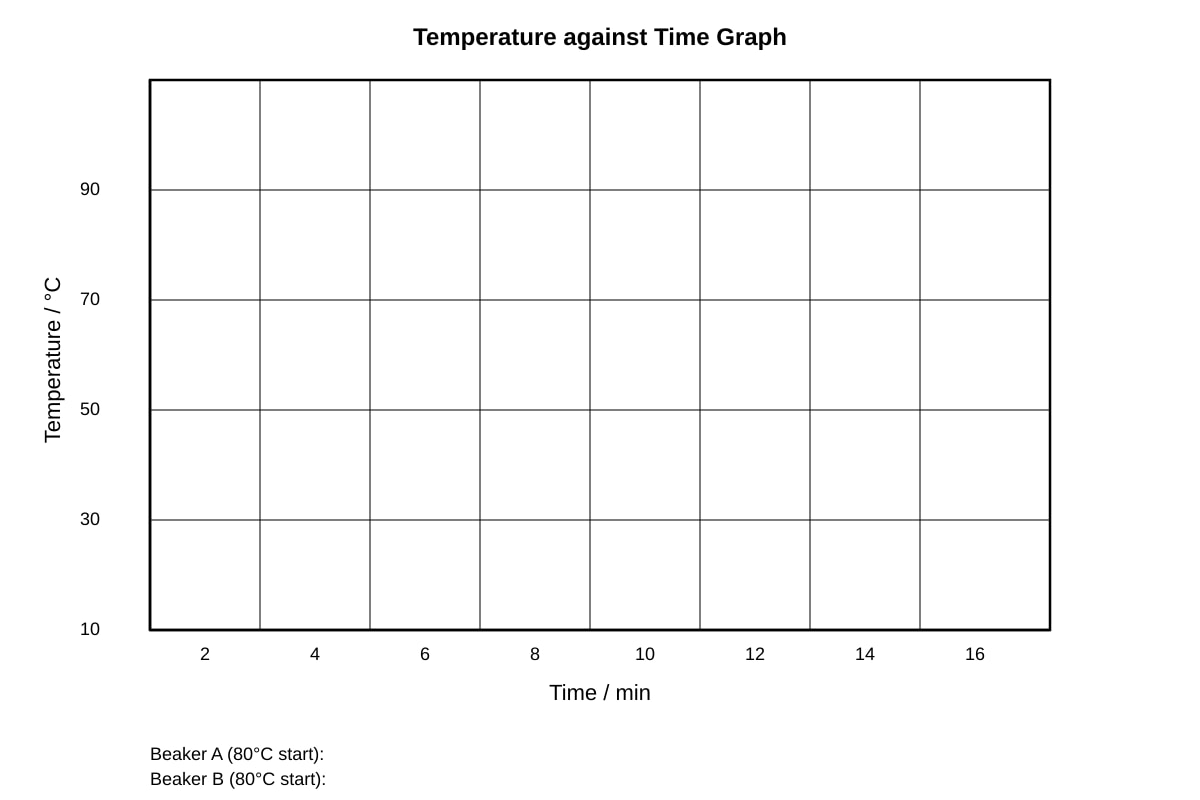
(a) On the same axes, sketch graphs of temperature against time for both beakers. Label your graphs clearly. [3 marks]
Answer:
Graphs should show:
- Both starting at 80°C at t = 0
- Beaker A (shiny silver) cooling more slowly (higher temperatures at each time)
- Beaker B (matt black) cooling more quickly (lower temperatures at each time)
- Both curves sloping downward, with Beaker B having a steeper gradient
- Axes labelled: x-axis "Time / min", y-axis "Temperature / °C"
- Appropriate scales
- Data points plotted correctly (or smooth curves through correct points)
Marking scheme:
- Correct axes labels and scales [1 mark]
- Both curves starting at 80°C and sloping downward [1 mark]
- Beaker B curve below Beaker A curve with correct relative positions [1 mark]
(b) State which beaker cools faster. Use the data to support your answer. [1 mark]
Answer:
Beaker B (matt black) cools faster. After 10 minutes, Beaker B is at 38°C while Beaker A is at 50°C, showing a greater temperature drop (42°C vs 30°C).
Marking scheme:
- Correct identification with data reference [1 mark]
(c) Explain, in terms of thermal radiation, why one beaker cools faster than the other. [2 marks]
Answer:
Matt black surfaces are better emitters of thermal radiation than shiny silver surfaces. Beaker B (matt black) emits/radiates more thermal energy per unit time, so it loses heat faster and cools more quickly. Shiny silver surfaces are poor emitters (and good reflectors) of thermal radiation, so Beaker A loses heat more slowly.
Marking scheme:
- Statement that matt black is a better emitter of radiation [1 mark]
- Linking emission rate to rate of cooling [1 mark]
(d) Suggest one way the student could improve the reliability of this experiment. [1 mark]
Answer:
Repeat the experiment and calculate average temperatures. / Use a lid to reduce heat loss by convection/evaporation. / Ensure the same initial temperature and volume of water. / Use a data logger for more frequent readings.
Marking scheme:
- Any valid suggestion [1 mark]
Question 18 (9 marks)
(a) Calculate the weight of the concrete block. [1 mark]
Answer:
W = mg = 500 × 10 = 5000 N
Marking scheme:
- Correct answer with unit [1 mark]
(b) State the upward force exerted by the crane on the block. Explain your answer. [2 marks]
Answer:
Upward force = 5000 N.
Explanation: The block moves at constant speed, so acceleration = 0. By Newton's First Law, the resultant force is zero. Therefore, the upward force must equal the downward weight of 5000 N.
Marking scheme:
- Correct force stated [1 mark]
- Explanation linking constant speed to balanced forces [1 mark]
(c) The crane lifts the block through a height of 12 m. Calculate:
(i) The work done by the crane. [2 marks]
Answer:
Work done = Force × distance (in direction of force)
W = Fd = 5000 × 12 = 60 000 J (or 60 kJ)
Marking scheme:
- Correct formula and substitution [1 mark]
- Correct answer with unit [1 mark]
(ii) The power output of the crane. [2 marks]
Answer:
Time taken: t = distance / speed = 12 / 0.50 = 24 s
Power = Work done / time = 60 000 / 24 = 2500 W (or 2.5 kW)
Marking scheme:
- Correct calculation of time [1 mark]
- Correct power calculation with unit [1 mark]
(d) The crane's motor has an efficiency of 80%. Calculate the total electrical energy input required to lift the block through 12 m. [2 marks]
Answer:
Efficiency = (Useful energy output / Total energy input) × 100%
80% = (60 000 / E_input) × 100%
E_input = 60 000 / 0.80 = 75 000 J (or 75 kJ)
Marking scheme:
- Correct formula and substitution [1 mark]
- Correct answer with unit [1 mark]
Question 19 (5 marks)
(a) State what is observed on the ammeter when the magnet is moved into the coil. [1 mark]
Answer:
The ammeter needle deflects (shows a current). / A current is induced.
Marking scheme:
- Correct observation [1 mark]
(b) Explain why this observation occurs. [2 marks]
Answer:
When the magnet moves into the coil, the magnetic field lines passing through the coil change. This changing magnetic flux induces an electromotive force (e.m.f.) across the coil. The induced e.m.f. drives a current through the circuit, which is detected by the ammeter. This is electromagnetic induction.
Marking scheme:
- Mention of changing magnetic field/flux [1 mark]
- Link to induced e.m.f./current [1 mark]
(c) State two ways to increase the magnitude of the induced current. [2 marks]
Answer:
Any two of:
- Move the magnet faster.
- Use a stronger magnet.
- Use a coil with more turns.
- Use a coil with a soft iron core.
Marking scheme:
- One mark for each correct method [2 marks]
Question 20 (6 marks)
(a) Explain how double-glazed windows reduce heat loss by conduction. [2 marks]
Answer:
Double-glazed windows have two panes of glass with a layer of trapped air (or gas) between them. Air is a poor conductor of heat (a good insulator). The trapped air layer reduces the rate of heat transfer by conduction from the warm interior to the cold exterior because particles in gases are far apart, making it difficult to transfer kinetic energy through collisions.
Marking scheme:
- Mention of trapped air/gas layer [1 mark]
- Explanation that air is a poor conductor / particles far apart [1 mark]
(b) The article also mentions that cavity wall insulation reduces heat loss by convection. Explain how cavity wall insulation achieves this. [2 marks]
Answer:
Cavity wall insulation fills the air gap (cavity) between the inner and outer walls with insulating material (e.g., foam). This traps the air in small pockets, preventing large-scale convection currents from forming. Without insulation, warm air would rise and cold air would sink in the cavity, transferring heat from the inner wall to the outer wall by convection.
Marking scheme:
- Mention of trapped air / prevention of convection currents [1 mark]
- Explanation linking to reduced heat transfer [1 mark]
(c) Suggest one other method to reduce heat loss from a home and explain the physics principle involved. [2 marks]
Answer:
Any valid method with explanation, e.g.:
- Loft insulation (fibreglass): Traps air, which is a poor conductor, reducing heat loss by conduction through the roof.
- Reflective foil behind radiators: Reflects thermal radiation back into the room instead of being absorbed by the wall.
- Carpets/curtains: Provide insulation by trapping air, reducing conduction and convection.
- Draught excluders: Prevent warm air from escaping and cold air from entering, reducing heat loss by convection.
Marking scheme:
- Correct method stated [1 mark]
- Correct physics principle explained [1 mark]
END OF ANSWER KEY