AI Generated Exam Paper
Secondary 4 Combined Science Physics Practice Paper 1
Free Sec 4 Comb Sci Phy Practice Paper 1, AI version, with questions, answers, and O Level-style practice for Singapore students.
These static practice materials are generated from the site's syllabus and paper-generation workflow, with source and model context shown so students and parents can evaluate the material before use.
Questions
Free quiz and exam paper access
Enter your details to view this paper
Your access is remembered on this device.
Answers
TuitionGoWhere Practice Paper - Combined Science Physics Secondary 4 (Marking Scheme)
Total Marks: 65
Section A [25 marks]
1.(a) [1 mark]
- ±0.5 mm or ±0.05 cm
- Accept either unit, must include ± symbol
1.(b) [2 marks]
- Micrometer has smaller scale divisions / can measure to 0.01 mm (1 mark)
- Therefore gives more precise/accurate readings (1 mark)
- Accept reference to reduced uncertainty
2.(a) [2 marks]
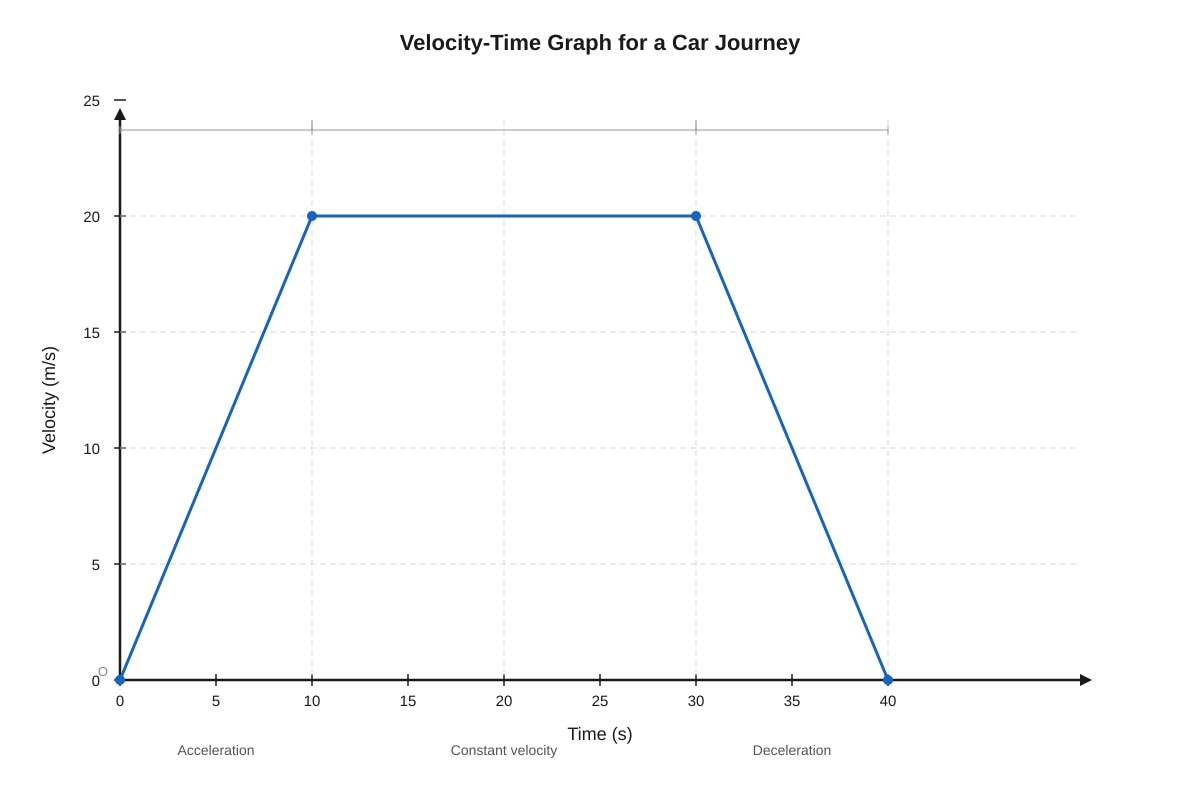
- a = (v - u)/t = (20 - 0)/10 (1 mark)
- a = 2 m/s² (1 mark)
- Must show working for full marks
2.(b) [4 marks]
- Distance = area under velocity-time graph
- Area 1 (0-10s): ½ × 10 × 20 = 100 m (1 mark)
- Area 2 (10-30s): 20 × 20 = 400 m (1 mark)
- Area 3 (30-40s): ½ × 10 × 20 = 100 m (1 mark)
- Total distance = 100 + 400 + 100 = 600 m (1 mark)
2.(c) [3 marks]
- Curved line from 0 to 100m (0-10s) - increasing gradient (1 mark)
- Straight line from 100m to 500m (10-30s) - constant gradient (1 mark)
- Curved line from 500m to 600m (30-40s) - decreasing gradient (1 mark)
- Award marks for correct shape in each section
3.(a) [2 marks]
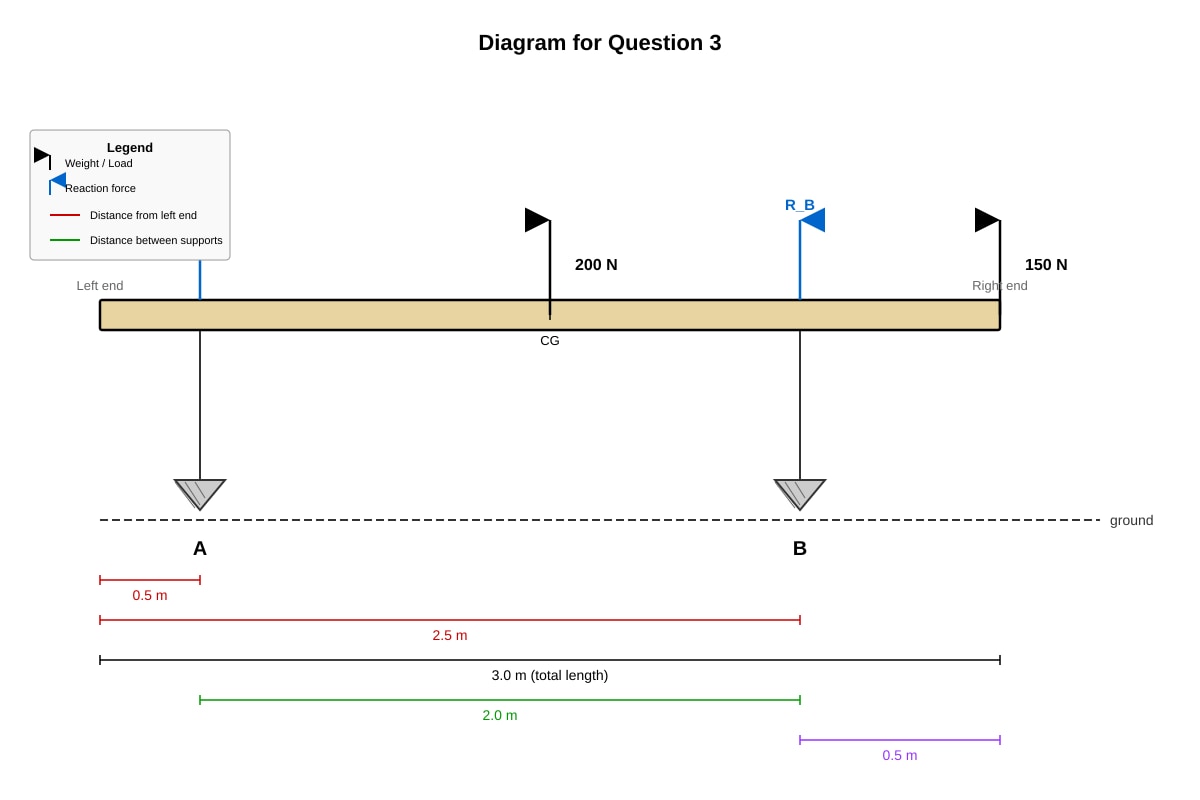
- Moment = force × perpendicular distance (1 mark)
- Moment = 150 × (3.0 - 0.5) = 150 × 2.5 = 375 N m (1 mark)
3.(b) [3 marks]
- Taking moments about A:
- Clockwise moments = anticlockwise moments (1 mark)
- 200 × 1.0 + 150 × 2.5 = RB × 2.0 (1 mark)
- RB = (200 + 375)/2.0 = 287.5 N (1 mark)
- Accept 288 N
3.(c) [2 marks]
- For vertical equilibrium: RA + RB = 200 + 150 (1 mark)
- RA = 350 - 287.5 = 62.5 N (1 mark)
- Accept 62 N or 63 N
4.(a) [2 marks - 1 mark each] Accept any two from:
- Conduction (through beaker/table)
- Convection (air currents)
- Radiation (electromagnetic waves)
- Evaporation
4.(b) [2 marks]
- Reduces convection currents / prevents hot air escaping (1 mark)
- Reduces evaporation of water (1 mark)
4.(c) [2 marks - 1 mark each] Accept any two from:
- Insulate the beaker (polystyrene, wool, etc.)
- Use a smaller surface area container
- Place in a warmer environment
- Use a vacuum flask
- Reduce air movement around beaker
Section B [40 marks]
5.(a) [3 marks]
- At maximum height, v = 0
- Using v² = u² + 2as: 0² = 25² + 2(-10)s (1 mark)
- 0 = 625 - 20s (1 mark)
- s = 31.25 m (accept 31.3 m) (1 mark)
5.(b) [2 marks]
- Using s = ut + ½at²: 0 = 25t + ½(-10)t² (1 mark)
- t = 5 s (1 mark)
- Alternative: time up = time down = 2.5s each, total = 5s
5.(c)(i) [2 marks]
- Air resistance opposes motion / acts upward (1 mark)
- Reduces net upward force / reduces acceleration upward (1 mark)
5.(c)(ii) [4 marks]
- Initially: kinetic energy converts to gravitational potential energy (1 mark)
- Some energy lost to thermal energy due to air resistance (1 mark)
- At maximum height: some energy has been dissipated, so less PE than expected (1 mark)
- On return: PE converts back to KE, but more energy lost to air resistance (1 mark)
6.(a) [2 marks]
- P = VI, so I = P/V (1 mark)
- I = 2000/230 = 8.7 A (1 mark)
6.(b)(i) [3 marks]
- Kettle current = 2000/230 = 8.7 A (1 mark)
- Lamp current = 100/230 = 0.43 A (1 mark)
- Microwave current = 800/230 = 3.5 A
- Total current = 8.7 + 0.43 + 3.5 = 12.6 A (1 mark)
6.(b)(ii) [3 marks]
- Total current (12.6 A) is less than fuse rating (13 A) (1 mark)
- Fuse will not blow during normal operation (1 mark)
- Provides adequate protection against overload currents (1 mark)
- Accept discussion of safety margin
6.(c) [4 marks]
- Energy per day = 2 kW × (6/60) h = 0.2 kWh (1 mark)
- Energy for 30 days = 0.2 × 30 = 6 kWh (1 mark)
- Cost = 6 × 1.50 (1 mark)
- Award 1 mark for clear working shown
7.(a)(i) [3 marks]
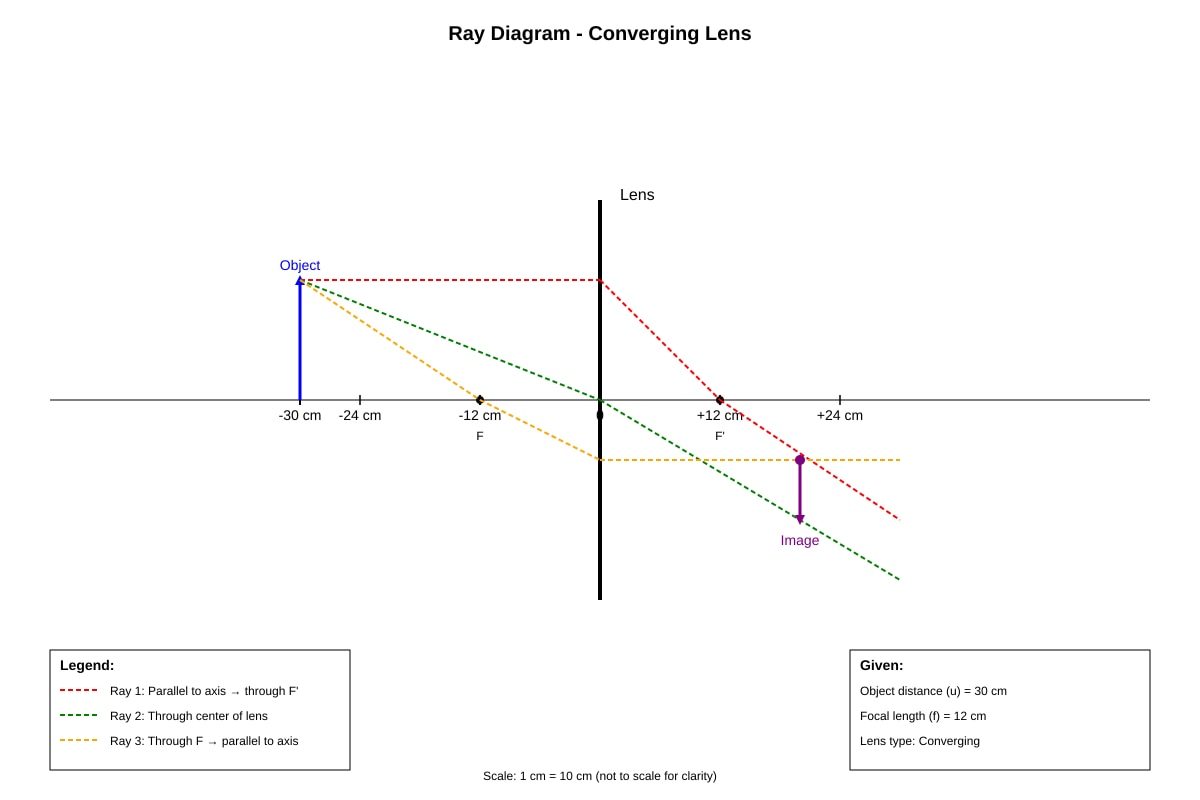
- Ray parallel to axis, refracted through focal point (1 mark)
- Ray through optical center, undeviated (1 mark)
- Rays intersect to form real, inverted image on opposite side (1 mark)
7.(a)(ii) [3 marks - 1 mark each]
- Real
- Inverted
- Diminished/smaller
- Accept "on opposite side of lens"
7.(b)(i) [1 mark]
- Virtual (image)
7.(b)(ii) [1 mark]
- Magnifying glass / simple microscope / reading aid
- Accept any reasonable optical instrument
8.(a) [2 marks]
- Time taken for half the radioactive nuclei to decay (1 mark)
- Or time for activity/mass to reduce to half its original value (1 mark)
8.(b)(i) [2 marks]
- 12 hours = 3 half-lives (1 mark)
- Mass remaining = 800 × (½)³ = 800 × ⅛ = 100 g (1 mark)
8.(b)(ii) [3 marks]
- 25 g = 800 × (½)ⁿ (1 mark)
- (½)ⁿ = 25/800 = 1/32 = (½)⁵ (1 mark)
- Time = 5 × 4 = 20 hours (1 mark)
8.(c) [3 marks]
- Medical tracer / cancer treatment / sterilization (1 mark)
- Emits detectable radiation for imaging (1 mark)
- Half-life suitable for procedure duration / minimizes long-term exposure (1 mark)
- Accept other valid medical applications with appropriate explanations
Grade Boundaries:
- A: 59-65 marks (90-100%)
- B: 52-58 marks (80-89%)
- C: 46-51 marks (70-79%)
- D: 39-45 marks (60-69%)
- E: 33-38 marks (50-59%)
Common Errors to Watch:
- Missing units in final answers
- Incorrect significant figures
- Not showing working for calculations
- Confusing velocity with acceleration
- Incorrect ray diagram construction
- Missing ± in uncertainty measurements