From Real Exams Exam Paper
Secondary 4 Combined Science Physics Preliminary Examination Paper 5
Free Sec 4 Comb Sci Phy Prelim Paper 5, HY3 Exam version, with questions, answers, and O Level-style practice for Singapore students.
These static practice materials are generated from the site's syllabus and paper-generation workflow, with source and model context shown so students and parents can evaluate the material before use.
Questions
TuitionGoWhere Practice Paper - Combined Science Physics Secondary 4
School: TuitionGoWhere Secondary School (AI)
Subject: Combined Science Physics
Level: Secondary 4
Paper: Prelim Practice (Version 5 of 5)
Duration: 60 minutes
Total Marks: 60
Name: ___________________________
Class: ____________
Date: ____________
Instructions:
- Answer all questions in the spaces provided.
- Show your working clearly for calculation questions.
- Use SI units unless stated otherwise.
- Section A: Multiple Choice (5 questions, 1 mark each)
- Section B: Structured Questions (10 questions, 2–4 marks each)
- Section C: Extended Response (5 questions, 4–5 marks each)
Section A (5 marks)
1. A car travels at constant speed along a straight road. Which statement is correct?
A. The net force on the car is zero.
B. There is no frictional force.
C. The car has zero acceleration because no forces act.
D. The applied force is greater than friction.
[1]
2. Which of the following is a vector quantity?
A. Mass
B. Temperature
C. Velocity
D. Energy
[1]
3. When water boils at 100 °C, the temperature remains constant because
A. no heat is supplied.
B. energy is used to break intermolecular bonds.
C. the heater is switched off.
D. the surroundings are hotter.
[1]
4. In a series circuit with two identical resistors, the total resistance is
A. half of one resistor.
B. equal to one resistor.
C. twice one resistor.
D. zero.
[1]
5. A ray of light strikes a plane mirror at 30° to the normal. The angle of reflection is
A. 30°
B. 60°
C. 90°
D. 15°
[1]
Section B (30 marks)
6. A bus moves from rest and reaches 20 m/s in 10 s.
Calculate its average acceleration. [2]
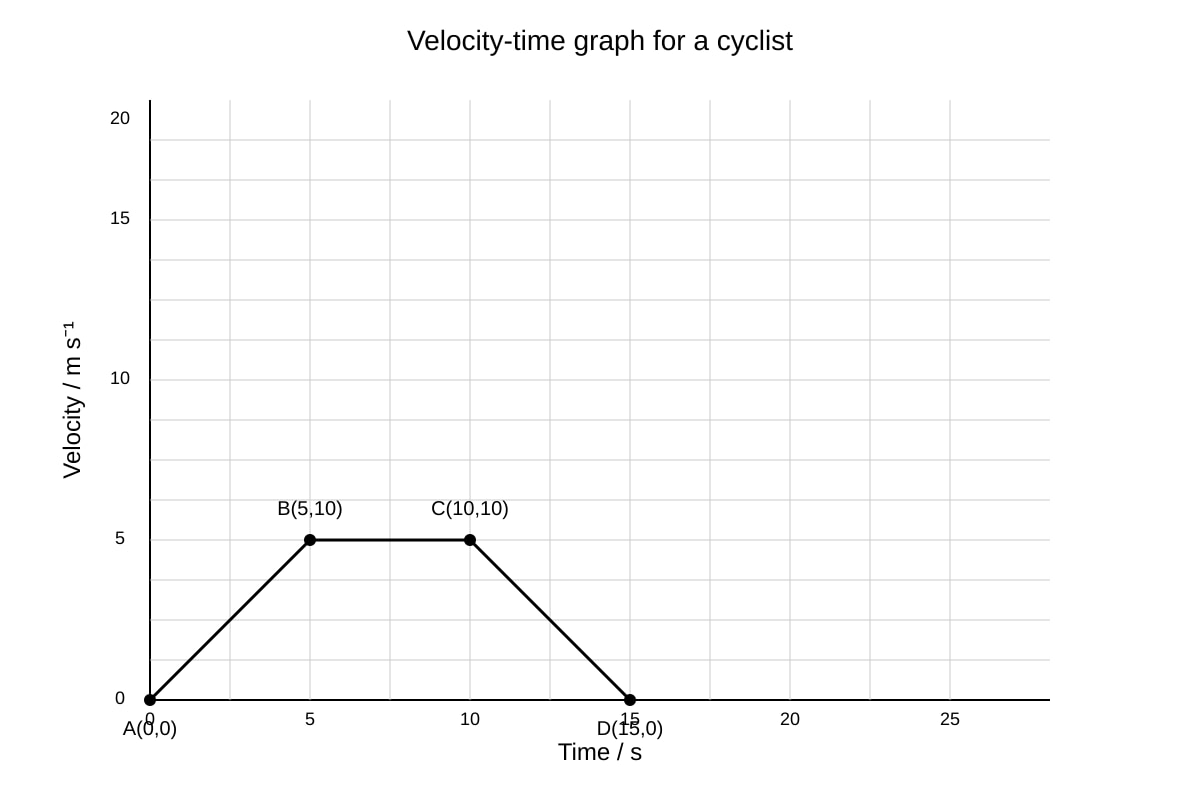
7.
Image pending generation: graph for Q7.
State the magnitude of the acceleration of the cyclist between point B and point C. [1]
8. A wooden block is pushed across a table at constant speed by a force of 5 N.
(i) State the size of the frictional force. [1]
(ii) Explain how you obtain your answer. [1]
9. Describe, in terms of movement and arrangement of particles, what happens when ice melts to water at 0 °C. [2]
10. A 100 W immersion heater heats 0.50 kg of water. The temperature rises from 20 °C to 30 °C in 210 s. Specific heat capacity of water = 4200 J kg⁻¹ °C⁻¹.
Calculate the energy supplied by the heater. [2]
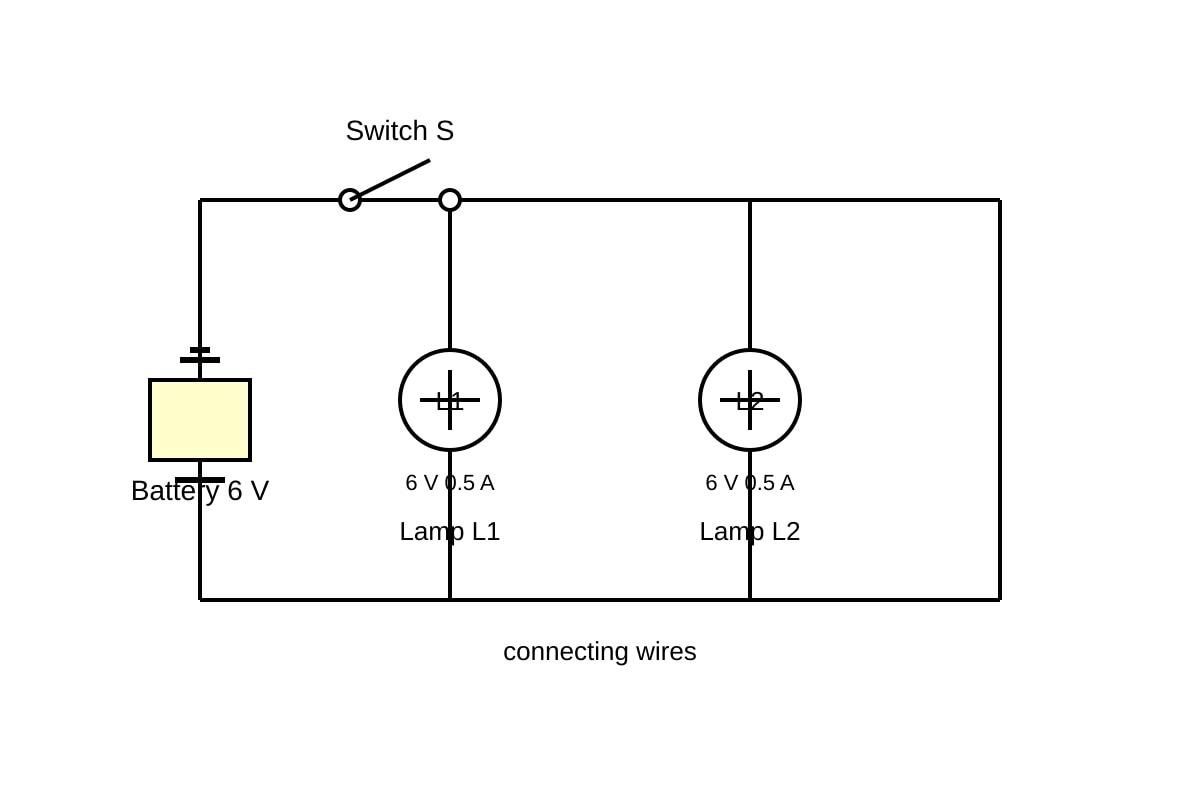
11.
Image pending generation: experimental_setup for Q11.
State the potential difference across lamp L2. [1]
12. A object is lifted 2.0 m by a force of 50 N. Calculate the work done. [2]
13. Explain why a shiny metal teapot cools slower than a black ceramic one by radiation. [2]
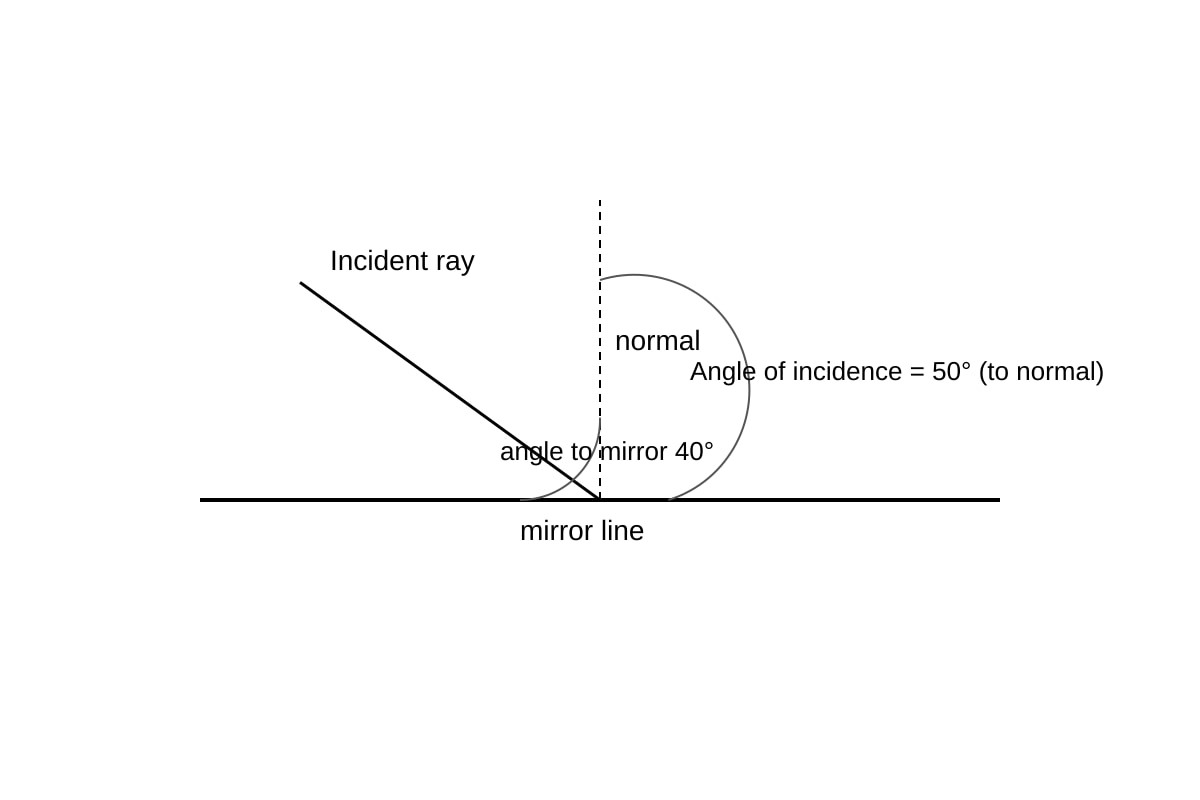
14. A student completes a ray diagram for a plane mirror but the reflected ray is missing.
Image pending generation: diagram for Q14.
State the angle between the reflected ray and the normal. [1]
15. A transformer has 100 primary turns and 200 secondary turns. The primary voltage is 12 V. Calculate the secondary voltage. [2]
Section C (25 marks)
16. A train travels 300 m in 20 s at constant speed, then stops for 10 s, then travels 150 m in 15 s.
(a) Calculate the average speed for the whole journey. [3]
(b) Explain why average speed is not the mean of the two speeds. [2]
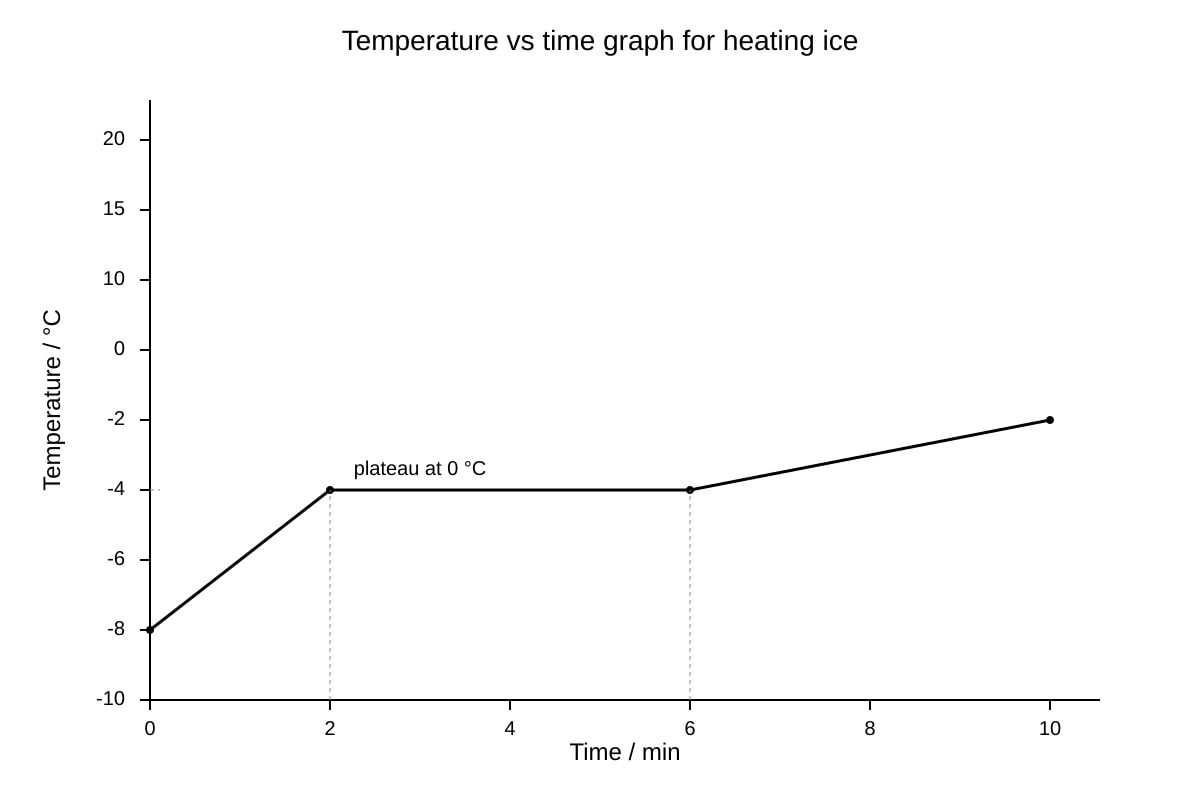
17.
Image pending generation: graph for Q17.
(a) State the temperature of the plateau. [1]
(b) Explain, in terms of particles, what is happening during the plateau. [3]
(c) Calculate the total time for the ice to become water at 0 °C. [1]
18. A household circuit has a 12 V supply, a switch, and two resistors of 4 Ω and 6 Ω in series.
(a) Calculate total resistance. [1]
(b) Calculate current in the circuit. [2]
(c) State one safety feature of household circuits and why it is used. [2]
19. A badminton shuttlecock falls to the ground.
(a) State the direction of air resistance acting on it. [1]
(b) Describe how its acceleration changes as it reaches terminal velocity. [2]
(c) Explain, using forces, why terminal velocity is reached. [2]
20. Compare conduction and convection as methods of thermal energy transfer. Include in your answer: particle movement, medium required, and one everyday example each. [5]
Answers
TuitionGoWhere Practice Paper - Combined Science Physics Secondary 4 (Version 5) Answer Key
Total Marks: 60
Section A
1. A [1]
Teaching note: Constant speed in a straight line means zero acceleration → net force zero (Newton's 1st Law). Friction still exists; applied force balances it.
2. C [1]
Teaching note: Vector has magnitude + direction. Velocity is vector; mass, temperature, energy are scalars.
3. B [1]
Teaching note: At boiling, supplied energy breaks bonds (latent heat), not raising temperature.
4. C [1]
Teaching note: Series: R_total = R1 + R2 = 2R for identical.
5. A [1]
Teaching note: Law of reflection: angle of incidence = angle of reflection measured to normal = 30°.
Section B
6. [2]
Average acceleration = Δv / Δt = (20 – 0) / 10 = 2.0 m/s².
Marks: 1 for formula, 1 for answer with unit.
7. 0 m/s² [1]
Teaching note: B to C is horizontal (constant velocity) → acceleration = 0.
8.
(i) 5 N [1]
(ii) At constant speed, acceleration = 0, net force = 0, so friction = applied force = 5 N. [1]
9. [2]
Particles gain energy, vibrate more, break fixed positions; arrangement changes from fixed (solid) to free to move past each other (liquid). 1 mark movement, 1 mark arrangement.
10. [2]
Energy = P × t = 100 × 210 = 21 000 J (or 2.1 × 10⁴ J).
Marks: 1 formula/substitution, 1 answer.
11. 6 V [1]
Teaching note: Parallel branches have same PD as source.
12. [2]
Work = F × d = 50 × 2.0 = 100 J.
Marks: 1 formula, 1 answer.
13. [2]
Shiny surface is poor absorber/emitter of radiation; black is good emitter. So shiny loses less by radiation. 1 mark property, 1 mark application.
14. 50° [1]
Teaching note: Incidence to normal = 50°, reflection = same.
15. [2]
V_s / V_p = N_s / N_p → V_s = 12 × 200/100 = 24 V.
Marks: 1 ratio, 1 answer.
Section C
16. [5]
(a) Total dist = 300 + 150 = 450 m. Total time = 20 + 10 + 15 = 45 s. Avg speed = 450/45 = 10 m/s. [3: 1 dist, 1 time, 1 answer]
(b) Average speed = total dist/total time, not mean of speeds because time spent at each speed differs (and rest included). [2]
17. [5]
(a) 0 °C [1]
(b) At plateau, energy breaks bonds, particles gain potential energy not kinetic; arrangement changes from solid to liquid, movement increases but temp constant. [3]
(c) 6 min [1]
18. [5]
(a) R = 4 + 6 = 10 Ω [1]
(b) I = V/R = 12/10 = 1.2 A [2]
(c) Fuse: stops overload/current excess; earth wire: prevents shock. [2]
19. [5]
(a) Upward (opposes motion) [1]
(b) Acceleration decreases from g to 0 as air resistance increases with speed. [2]
(c) Weight constant down, air resistance up increases until equal → net force 0 → terminal velocity. [2]
20. [5]
Conduction: particles vibrate, pass energy, no bulk movement, needs solid/media, e.g. metal spoon in hot soup. [2]
Convection: fluid moves in currents due to density change, needs fluid, e.g. boiling water. [2]
Clear comparison structure. [1]
Free quiz and exam paper access
Enter your details to view this paper
Your access is remembered on this device.