From Real Exams Exam Paper

Secondary 4 Combined Science Physics Preliminary Examination Paper 5

Free Exam-Derived DeepSeek V4 Pro Secondary 4 Combined Science Physics Preliminary Examination Paper 5 practice paper with questions and answers for Singapore students. This page is rendered as a direct URL so the questions and answers can be discovered without pressing in-page buttons.

These static practice materials are generated from the site's syllabus and paper-generation workflow, with source and model context shown so students and parents can evaluate the material before use.

Secondary 4 Combined Science Physics From Real Exams Generated by DeepSeek V4 Pro Updated 2026-06-03

Questions

<!-- TuitionGoWhere generation metadata: stage=3-1; model=deepseek/deepseek-v4-pro; model_label=DeepSeek V4 Pro; generated=2026-05-29; Sources: Stage 2-1 real exam-derived templates and Stage 2-2 exam-enriched syllabus. -->

TuitionGoWhere Practice Paper - Combined Science Physics Secondary 4

TuitionGoWhere Secondary School (AI)

PRELIMINARY EXAMINATION

Subject: Combined Science Physics (5086/5087) Level: Secondary 4 Paper: Paper 2 (Physics) Duration: 1 hour 15 minutes Total Marks: 65 Version: 5 of 5

Name: _________________________ Class: _________________________ Date: _________________________


Instructions to Candidates

  1. This paper consists of three sections: Section A, Section B, and Section C.
  2. Answer all questions in the spaces provided.
  3. Write your name, class, and date clearly at the top of this page.
  4. The number of marks is given in brackets [ ] at the end of each question or part question.
  5. You are advised to spend about 25 minutes on Section A, 25 minutes on Section B, and 25 minutes on Section C.
  6. Show all working for calculation questions. Marks will be awarded for correct working even if the final answer is wrong.
  7. Use appropriate units in all numerical answers.
  8. Take g = 10 m/s² unless otherwise stated.

Section A: Multiple Choice (10 marks)

Answer all questions in this section. Circle the letter of the correct answer.

1. A student measures the length of a metal rod using a metre rule. The reading is 24.6 cm. What is the uncertainty in this measurement?

A. ±0.05 cm B. ±0.1 cm C. ±0.5 cm D. ±1.0 cm

[1 mark]


2. A car accelerates uniformly from rest to 20 m/s in 5 seconds. What is the distance travelled during this time?

A. 25 m B. 50 m C. 100 m D. 200 m

[1 mark]


3. Which of the following statements about a body moving at constant velocity is correct?

A. No forces act on the body. B. The net force acting on the body is zero. C. The applied force is greater than friction. D. The body must be accelerating.

[1 mark]


4. A block of mass 2 kg is placed on a horizontal surface. The coefficient of static friction between the block and the surface is 0.4. What is the minimum horizontal force required to move the block?

A. 2 N B. 4 N C. 8 N D. 20 N

[1 mark]


5. An immersion heater rated at 50 W is used to heat 200 g of water for 5 minutes. The temperature of the water rises by 15°C. What is the efficiency of the heating process? (Specific heat capacity of water = 4200 J/kg°C)

A. 42% B. 63% C. 84% D. 100%

[1 mark]


6. A ray of light travels from glass into air. The critical angle for the glass-air boundary is 42°. What happens when the angle of incidence in the glass is 50°?

A. The ray refracts into the air at an angle greater than 50°. B. The ray refracts into the air at an angle less than 50°. C. The ray undergoes total internal reflection. D. The ray travels along the boundary.

[1 mark]


7. A sound wave has a frequency of 500 Hz and travels at 340 m/s in air. What is its wavelength?

A. 0.68 m B. 1.47 m C. 170 m D. 170,000 m

[1 mark]


8. In a 3-pin plug, what is the function of the earth wire?

A. To complete the circuit for current flow. B. To provide a low-resistance path to ground in case of a fault. C. To carry the main current to the appliance. D. To increase the voltage supplied to the appliance.

[1 mark]


9. Two resistors of 4 Ω and 6 Ω are connected in parallel. What is the effective resistance?

A. 2.0 Ω B. 2.4 Ω C. 10.0 Ω D. 24.0 Ω

[1 mark]


10. A transformer has 500 turns in the primary coil and 50 turns in the secondary coil. If the primary voltage is 240 V, what is the secondary voltage?

A. 12 V B. 24 V C. 120 V D. 2400 V

[1 mark]


Section B: Structured Questions (30 marks)

Answer all questions in this section. Write your answers in the spaces provided.

11. A student investigates the motion of a trolley rolling down a ramp. The velocity-time graph obtained is shown below.

![Velocity-time graph showing a straight line from (0,0) to (4,8), then a horizontal line from (4,8) to (8,8), then a straight line from (8,8) to (12,0)]

(a) State the magnitude of the acceleration of the trolley between t = 0 s and t = 4 s.


[1 mark]

(b) Describe the motion of the trolley between t = 4 s and t = 8 s.


[1 mark]

(c) Calculate the total distance travelled by the trolley in the first 8 seconds.


[2 marks]

(d) Calculate the average speed of the trolley for the entire 12-second journey.


[2 marks]


12. A student heats a beaker of crushed ice using a Bunsen burner. The temperature of the ice is recorded every minute. The graph below shows the results.

![Temperature-time graph showing: horizontal line at 0°C from t=0 to t=5 min, then rising line from (5,0) to (12,100), then horizontal line at 100°C from t=12 to t=18 min]

(a) State the melting point of the ice.


[1 mark]

(b) Explain why the temperature remains constant between t = 0 min and t = 5 min, even though heating continues. Describe your answer in terms of the movement and arrangement of particles.


[2 marks]

(c) Describe what happens to the movement and spacing of the water particles between t = 5 min and t = 12 min.


[2 marks]

(d) The Bunsen burner supplies energy at a rate of 200 J/s. The mass of ice is 0.05 kg. Calculate the specific latent heat of fusion of ice.


[2 marks]


13. A student sets up the apparatus shown below to investigate the refraction of light through a glass block.

![Diagram showing a ray of light entering a rectangular glass block from air, refracting towards the normal, then emerging on the other side]

(a) State what happens to the speed of light as it enters the glass block from air.


[1 mark]

(b) The angle of incidence in air is 45°. The refractive index of the glass is 1.5. Calculate the angle of refraction in the glass.


[2 marks]

(c) Complete the ray diagram below to show how the ray emerges from the glass block into air. Label the angle of emergence.

![Diagram showing a ray entering a glass block, with the ray inside the block drawn. The ray needs to be extended to show emergence.]

[2 marks]


14. A household electric kettle is rated at 2200 W, 240 V.

(a) Calculate the current flowing through the kettle when it is operating normally.


[2 marks]

(b) The kettle is used to boil water for 3 minutes. Calculate the electrical energy consumed in joules.


[2 marks]

(c) The kettle is fitted with a 13 A fuse in its plug. Explain why a 5 A fuse would not be suitable for this kettle.


[2 marks]

(d) State one safety feature of a 3-pin plug, other than the fuse, and explain how it protects the user.


[2 marks]


Section C: Data-Based and Extended Response Questions (25 marks)

Answer all questions in this section. Write your answers in the spaces provided.

15. A group of students investigates the factors affecting the rate of cooling of hot water. They pour 200 cm³ of hot water at 80°C into four different containers and record the temperature every 2 minutes for 20 minutes. The containers are:

  • Container A: Silver-coloured metal beaker (shiny surface)
  • Container B: Black-painted metal beaker (dull surface)
  • Container C: Silver-coloured metal beaker wrapped in cotton wool
  • Container D: Black-painted metal beaker with a lid

The results are shown in the table below.

Time / minTemperature in Container A / °CTemperature in Container B / °CTemperature in Container C / °CTemperature in Container D / °C
080808080
472687674
865587269
1259506864
1654436560
2050386256

(a) Using the data, compare the rate of cooling in Container A and Container B. Suggest a reason for the difference.


[2 marks]

(b) Explain why Container C cools more slowly than Container A.


[2 marks]

(c) Container D has both a black surface and a lid. Explain why its cooling rate is between that of Container B and Container C.


[2 marks]

(d) The students want to design a container to keep hot drinks warm for as long as possible. Using the evidence from this experiment, describe two features the container should have and explain your choices.


[3 marks]


16. A homeowner installs solar panels on the roof of their house. The solar panels convert light energy from the Sun into electrical energy. The electrical energy is used to power household appliances and any excess energy is stored in a battery system.

The solar panels have a total area of 20 m² and receive an average solar radiation of 800 W/m² during daylight hours. The efficiency of the solar panels is 18%.

(a) Calculate the total solar power incident on the solar panels.


[1 mark]

(b) Calculate the useful electrical power output of the solar panels.


[2 marks]

(c) During one sunny day, the solar panels operate at full capacity for 6 hours. Calculate the total electrical energy generated in kilowatt-hours (kWh).


[2 marks]

(d) The battery system stores energy at 24 V. The total charge stored in the battery after one full day of charging is 180,000 C. Calculate the energy stored in the battery.


[2 marks]

(e) The homeowner notices that on cloudy days, the solar panels produce less electrical energy. Explain why the energy output is reduced, using your knowledge of energy transfer and conservation.


[2 marks]


17. A student investigates the relationship between the extension of a spring and the force applied to it. The student hangs different masses from the spring and measures the extension. The results are shown in the table below.

Mass / gWeight / NExtension / cm
00.00.0
1001.02.5
2002.05.0
3003.07.5
4004.010.0
5005.013.0
6006.016.5

(a) Plot a graph of extension (y-axis) against weight (x-axis) on the grid below. Draw the best-fit line or curve through the points.

[Grid provided: x-axis 0-7 N, y-axis 0-18 cm]

[3 marks]

(b) Using your graph, determine the weight at which the spring stops obeying Hooke's Law. Explain how you obtained your answer.


[2 marks]

(c) Calculate the spring constant for the linear portion of the graph.


[2 marks]

(d) The student repeats the experiment with two identical springs connected in series. Predict how the extension for a weight of 4.0 N would compare to the extension with a single spring. Explain your reasoning.


[2 marks]


END OF PAPER

Answers

<!-- TuitionGoWhere generation metadata: stage=3-1; model=deepseek/deepseek-v4-pro; model_label=DeepSeek V4 Pro; generated=2026-05-29; Sources: Stage 2-1 real exam-derived templates and Stage 2-2 exam-enriched syllabus. -->

TuitionGoWhere Practice Paper - Combined Science Physics Secondary 4

ANSWER KEY AND MARKING SCHEME

Paper: Paper 2 (Physics) - PRELIMINARY EXAMINATION Version: 5 of 5 Total Marks: 65


Section A: Multiple Choice (10 marks)

QuestionAnswerMark
1B1
2B1
3B1
4C1
5C1
6C1
7A1
8B1
9B1
10B1

Working for selected questions:

Q2: s = ut + ½at²; a = (v-u)/t = 20/5 = 4 m/s²; s = 0 + ½(4)(5²) = 50 m. Alternatively: average speed = 10 m/s, distance = 10 × 5 = 50 m.

Q4: F = μN = μmg = 0.4 × 2 × 10 = 8 N.

Q5: Energy supplied = Pt = 50 × 300 = 15,000 J. Energy gained by water = mcΔθ = 0.2 × 4200 × 15 = 12,600 J. Efficiency = (12,600/15,000) × 100% = 84%.

Q7: λ = v/f = 340/500 = 0.68 m.

Q9: 1/R = 1/4 + 1/6 = 3/12 + 2/12 = 5/12; R = 12/5 = 2.4 Ω.

Q10: Vs/Vp = Ns/Np; Vs = 240 × (50/500) = 24 V.


Section B: Structured Questions (30 marks)

Question 11 (6 marks)

(a) Acceleration = gradient = (8 - 0)/(4 - 0) = 2 m/s² [1 mark]

(b) The trolley moves at constant velocity / constant speed of 8 m/s / zero acceleration. [1 mark]

(c) Distance in first 4 s = area under graph = ½ × 4 × 8 = 16 m. Distance from 4-8 s = 4 × 8 = 32 m. Total distance = 16 + 32 = 48 m. [2 marks: 1 for correct method, 1 for correct answer with units]

(d) Distance from 8-12 s = ½ × 4 × 8 = 16 m. Total distance = 48 + 16 = 64 m. Average speed = total distance/total time = 64/12 = 5.33 m/s (or 5.3 m/s). [2 marks: 1 for total distance, 1 for correct average speed with units]


Question 12 (7 marks)

(a) 0°C [1 mark]

(b) The temperature remains constant because the ice is melting/changing state from solid to liquid. The energy supplied is used to overcome the forces of attraction between particles / to break the bonds between particles, not to increase kinetic energy. The particles change from a fixed, regular arrangement (solid lattice) to a less ordered arrangement where they can slide past each other (liquid). [2 marks: 1 for energy used to overcome forces/break bonds, 1 for description of arrangement change]

(c) The water particles gain kinetic energy, so they move/vibrate faster. The spacing between particles increases slightly (thermal expansion). The particles remain in the liquid state but have higher average speed. [2 marks: 1 for movement (faster), 1 for spacing (increases)]

(d) Energy supplied during melting = Pt = 200 × (5 × 60) = 200 × 300 = 60,000 J. L = E/m = 60,000/0.05 = 1,200,000 J/kg (or 1.2 × 10⁶ J/kg). [2 marks: 1 for correct energy calculation, 1 for correct latent heat with units]


Question 13 (5 marks)

(a) The speed of light decreases / slows down. [1 mark]

(b) n = sin i / sin r 1.5 = sin 45° / sin r sin r = sin 45° / 1.5 = 0.7071 / 1.5 = 0.4714 r = sin⁻¹(0.4714) = 28.1° (accept 28°). [2 marks: 1 for correct substitution, 1 for correct answer]

(c) [Diagram showing:]

  • Ray emerging from glass block parallel to the incident ray (shifted laterally)
  • Angle of emergence = 45° (equal to angle of incidence)
  • Ray bends away from normal at the glass-air boundary [2 marks: 1 for correct direction (parallel to incident ray), 1 for correct angle of emergence labelled]

Question 14 (8 marks)

(a) I = P/V = 2200/240 = 9.17 A (accept 9.2 A). [2 marks: 1 for formula, 1 for correct answer with units]

(b) E = Pt = 2200 × (3 × 60) = 2200 × 180 = 396,000 J (or 3.96 × 10⁵ J). [2 marks: 1 for correct time conversion, 1 for correct answer with units]

(c) A 5 A fuse would blow during normal operation because the operating current (9.17 A) exceeds the fuse rating. The fuse is designed to protect the circuit by melting when current exceeds its rating. A 5 A fuse would melt even when the kettle is working correctly, preventing normal use. [2 marks: 1 for stating current exceeds 5 A, 1 for explaining that fuse would blow during normal operation]

(d) The earth wire provides a low-resistance path to the ground. If a fault occurs (e.g., live wire touches the metal casing), current flows through the earth wire to ground instead of through the user. This large current blows the fuse, disconnecting the appliance and protecting the user from electric shock. [2 marks: 1 for identifying earth wire, 1 for explaining how it protects user]


Section C: Data-Based and Extended Response Questions (25 marks)

Question 15 (9 marks)

(a) Container B (black, dull) cools faster than Container A (silver, shiny). The temperature drop in Container B is 42°C compared to 30°C in Container A over 20 minutes. This is because dull, black surfaces are better emitters/radiators of thermal radiation than shiny, silver surfaces. [2 marks: 1 for comparison with data, 1 for explanation linking surface colour to radiation emission]

(b) Container C is wrapped in cotton wool, which is a good thermal insulator. The cotton wool traps air, and air is a poor conductor of heat. This reduces heat loss by conduction and convection from the hot water to the surroundings. [2 marks: 1 for identifying cotton wool as insulator, 1 for explaining reduced conduction/convection]

(c) Container D has a black surface (increases radiation heat loss, like Container B) but also has a lid (reduces heat loss by convection and evaporation, unlike Container B). The lid reduces some heat loss, so the cooling rate is slower than Container B. However, the black surface still radiates more heat than the shiny Container A, so it cools faster than Container C (which has insulation). [2 marks: 1 for explaining effect of black surface, 1 for explaining effect of lid]

(d) Two features:

  1. Shiny/silver outer surface – to reduce heat loss by radiation (shiny surfaces are poor emitters of thermal radiation).
  2. Insulating layer (e.g., vacuum or foam) between inner and outer walls – to reduce heat loss by conduction and convection (vacuum prevents conduction and convection; trapped air in foam is a poor conductor). [3 marks: 1 for each feature with correct explanation, 1 for linking to experimental evidence]

Question 16 (9 marks)

(a) Total solar power = area × solar radiation = 20 × 800 = 16,000 W (or 16 kW). [1 mark]

(b) Useful power output = efficiency × total power = 0.18 × 16,000 = 2,880 W (or 2.88 kW). [2 marks: 1 for correct formula, 1 for correct answer with units]

(c) Energy = Pt = 2.88 kW × 6 h = 17.28 kWh. [2 marks: 1 for correct power in kW, 1 for correct answer with units]

(d) E = QV = 180,000 × 24 = 4,320,000 J (or 4.32 MJ). [2 marks: 1 for correct formula, 1 for correct answer with units]

(e) On cloudy days, less solar radiation reaches the solar panels because clouds reflect, scatter, and absorb some of the sunlight. The incident power on the panels is reduced, so less light energy is converted to electrical energy. The efficiency of the panels remains the same, but the total energy input is lower, so the useful output is lower. Energy is still conserved: the reduced solar energy input results in reduced electrical energy output. [2 marks: 1 for explaining reduced incident radiation, 1 for linking to energy conservation]


Question 17 (9 marks)

(a) [Graph requirements:]
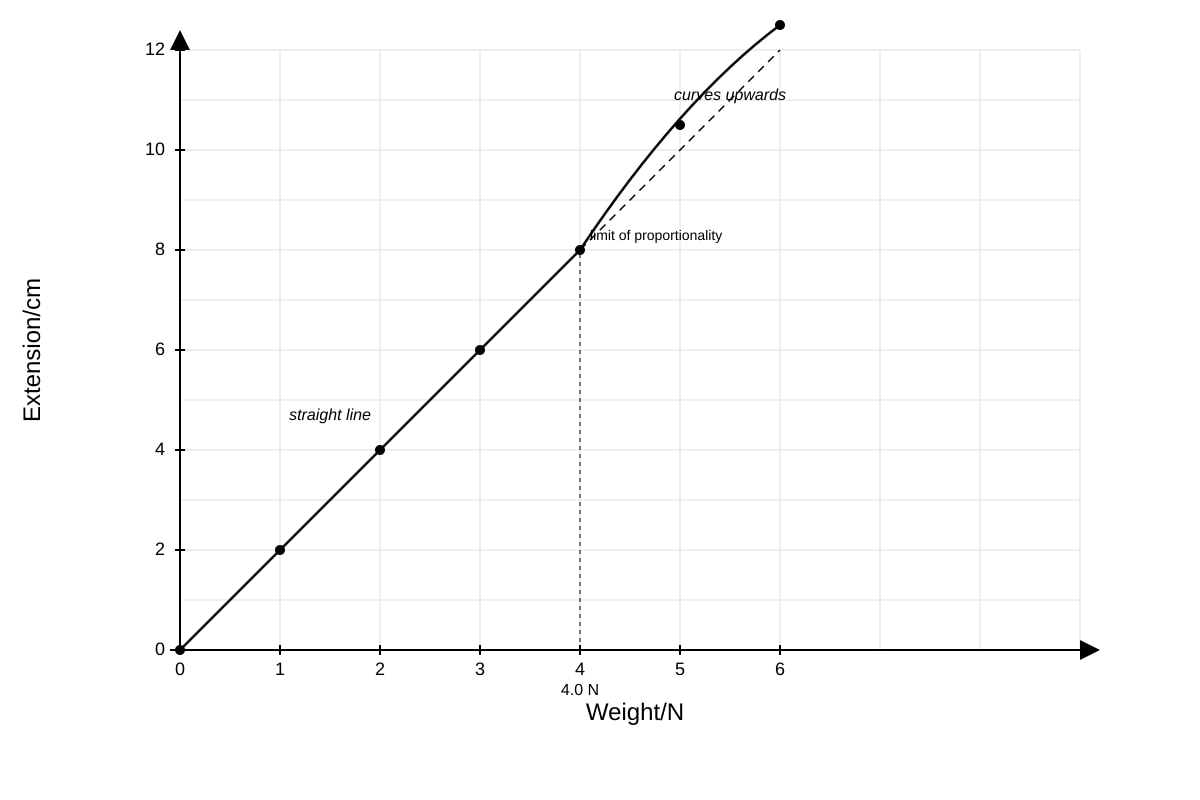
  • Correct axes labels: Extension/cm on y-axis, Weight/N on x-axis
  • Appropriate scales (e.g., 1 cm = 2 cm extension, 1 cm = 1 N)
  • All 7 points plotted correctly (± half small square)
  • Best-fit straight line through first 5 points (0 to 4.0 N)
  • Line curves upwards after 4.0 N (points at 5.0 N and 6.0 N above the straight line) [3 marks: 1 for correct axes and scales, 1 for correct plotting, 1 for correct line/curve]

(b) The spring stops obeying Hooke's Law at a weight of 4.0 N. This is determined from the graph as the point where the line stops being straight / starts to curve. Up to 4.0 N, extension is proportional to weight (straight line through origin). Beyond 4.0 N, the extension increases more than proportionally (curve). [2 marks: 1 for identifying 4.0 N, 1 for explaining using graph]

(c) Spring constant k = F/x. Using any point on the linear portion (e.g., F = 4.0 N, x = 10.0 cm = 0.10 m): k = 4.0/0.10 = 40 N/m. [2 marks: 1 for correct formula and substitution, 1 for correct answer with units]

(d) With two identical springs in series, the extension for the same weight (4.0 N) would be double / 20 cm. Each spring experiences the full 4.0 N force and extends by 10 cm (same as single spring). The total extension is the sum of individual extensions = 10 + 10 = 20 cm. The effective spring constant is halved (k_effective = 20 N/m). [2 marks: 1 for stating extension doubles, 1 for correct reasoning]


Marking Summary

SectionQuestionsMarks
A: Multiple Choice1-1010
B: Structured Questions11-1430
C: Data-Based/Extended Response15-1725
Total65

Grade Boundaries (indicative):

  • A1: 58-65
  • A2: 50-57
  • B3: 42-49
  • B4: 35-41
  • C5: 28-34
  • C6: 20-27
  • D7: 13-19
  • E8: 0-12

END OF ANSWER KEY