From Real Exams Exam Paper
Secondary 4 Combined Science Physics Preliminary Examination Paper 4
Free Sec 4 Comb Sci Phy Prelim Paper 4, HY3 Exam version, with questions, answers, and O Level-style practice for Singapore students.
These static practice materials are generated from the site's syllabus and paper-generation workflow, with source and model context shown so students and parents can evaluate the material before use.
Questions
TuitionGoWhere Exam Practice (AI) - Combined Science Physics Secondary 4
School: TuitionGoWhere Secondary School (AI)
Subject: Combined Science Physics
Level: Secondary 4
Paper: Prelim Practice Paper (Version 4 of 5)
Duration: 60 minutes
Total Marks: 60
Name: ___________________________
Class: ____________
Date: ____________
Instructions
- Answer all questions in the spaces provided.
- Show all working clearly where calculation is required.
- Use SI units unless otherwise stated.
- Section A: Structured Questions (30 marks)
- Section B: Data & Diagram Interpretation (18 marks)
- Section C: Extended Response (12 marks)
Section A: Structured Questions (30 marks)
1. A car travels 120 m in 8.0 s at constant speed. Calculate its average speed. [2]
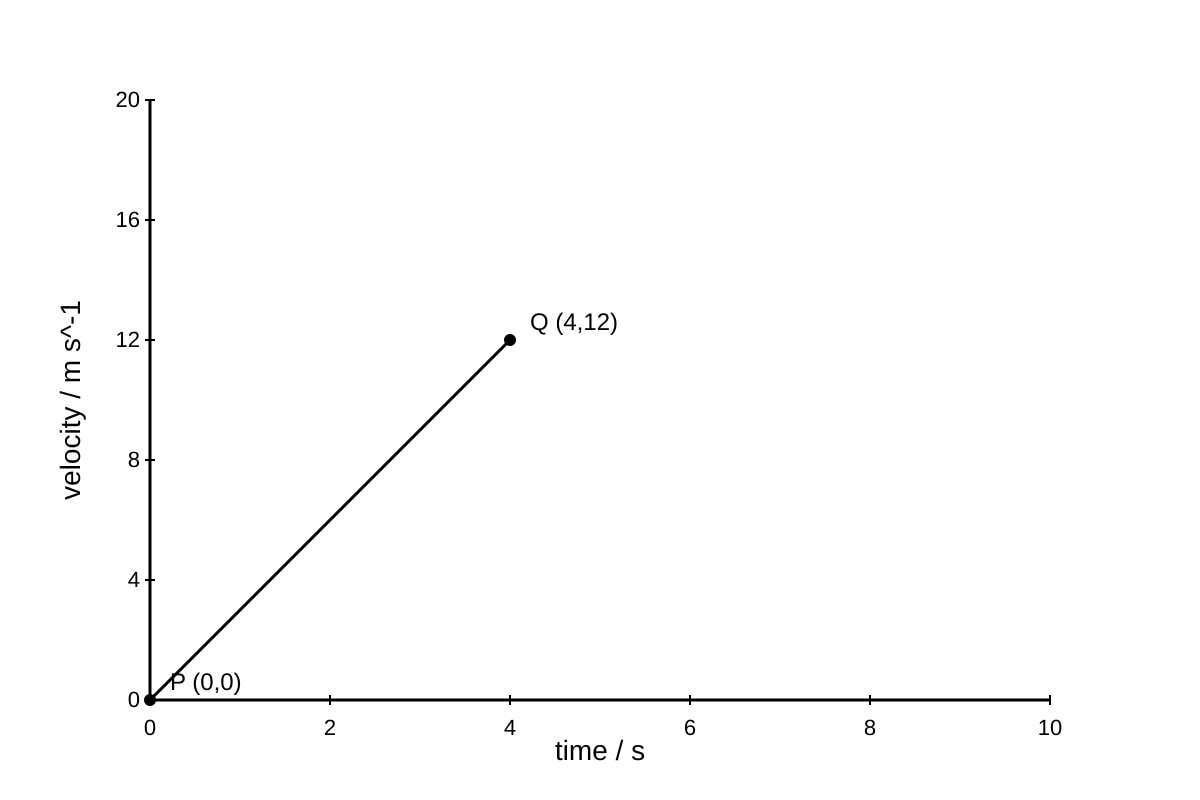
2. State the magnitude of the acceleration of the object between point P and point Q on the velocity–time graph below. [1]
Image pending generation: graph for Q2.
___________________________________________________________ m/s²
3. A wooden block is pushed across a table at constant speed by a force of 5.0 N. State the size of the frictional force and explain how you obtain the answer. [2]
4. Define scalar and vector quantities. Give one example of each. [2]
5. A 60 W immersion heater heats 0.50 kg of water. Calculate the energy supplied in 100 s. [2]
6. Describe, in terms of movement and arrangement of particles, what happens when ice melts at 0 °C. [2]
7. State Ohm’s law. [1]
8. A resistor of 10 Ω has a current of 0.20 A flowing through it. Calculate the potential difference across it. [2]
9. A badminton shuttlecock falls to the ground. State one factor that causes air resistance to act on it. [1]
10. Calculate the moment of a 4.0 N force applied at a perpendicular distance of 0.25 m from a pivot. [2]
11. A kitchen hood is controlled by a switch in a circuit. State the purpose of the switch. [1]
12. Light travels from air into glass. State what happens to the speed of light. [1]
13. A object is in thermal equilibrium with its surroundings. What does this mean? [1]
14. State the formula for efficiency. [1]
15. A force of 20 N moves an object 5.0 m in the direction of the force. Calculate the work done. [2]
Section B: Data & Diagram Interpretation (18 marks)
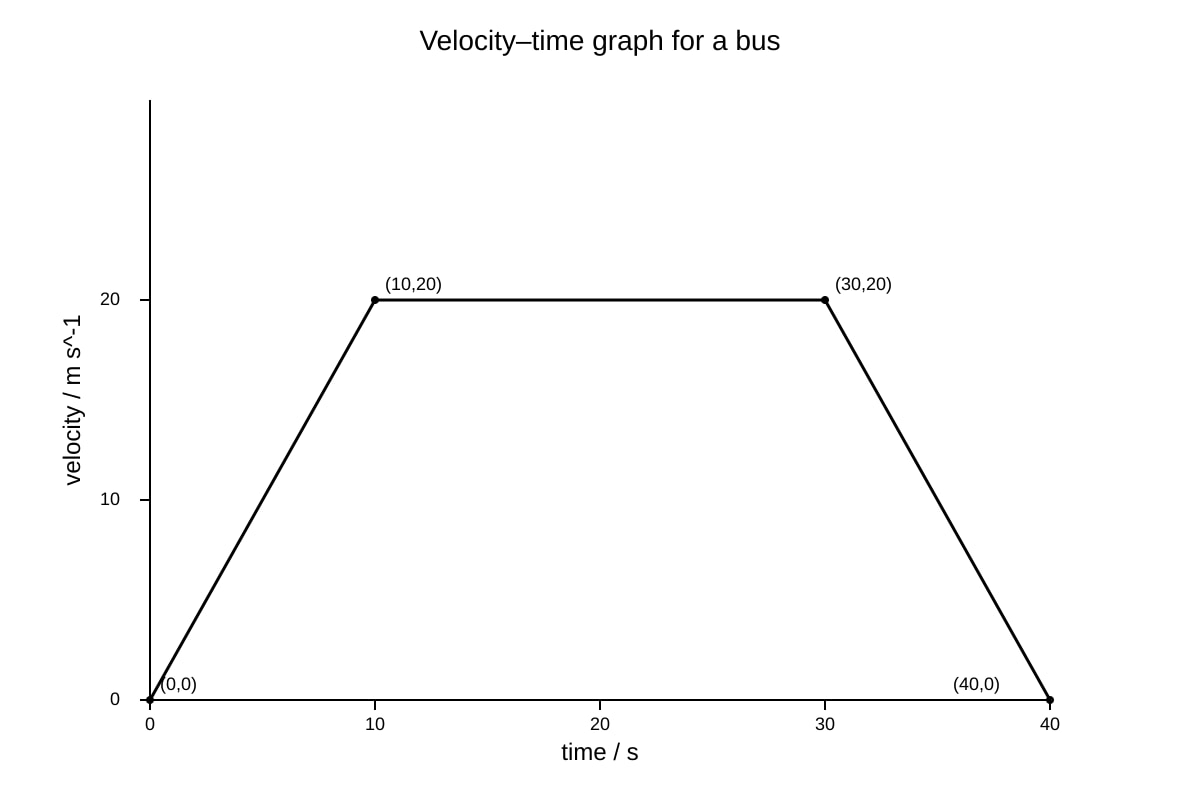
16. The diagram shows a velocity–time graph for a bus.
Image pending generation: graph for Q16.
(a) State the acceleration of the bus between 0 and 10 s. [1]
(b) Calculate the total distance travelled by the bus. [3]
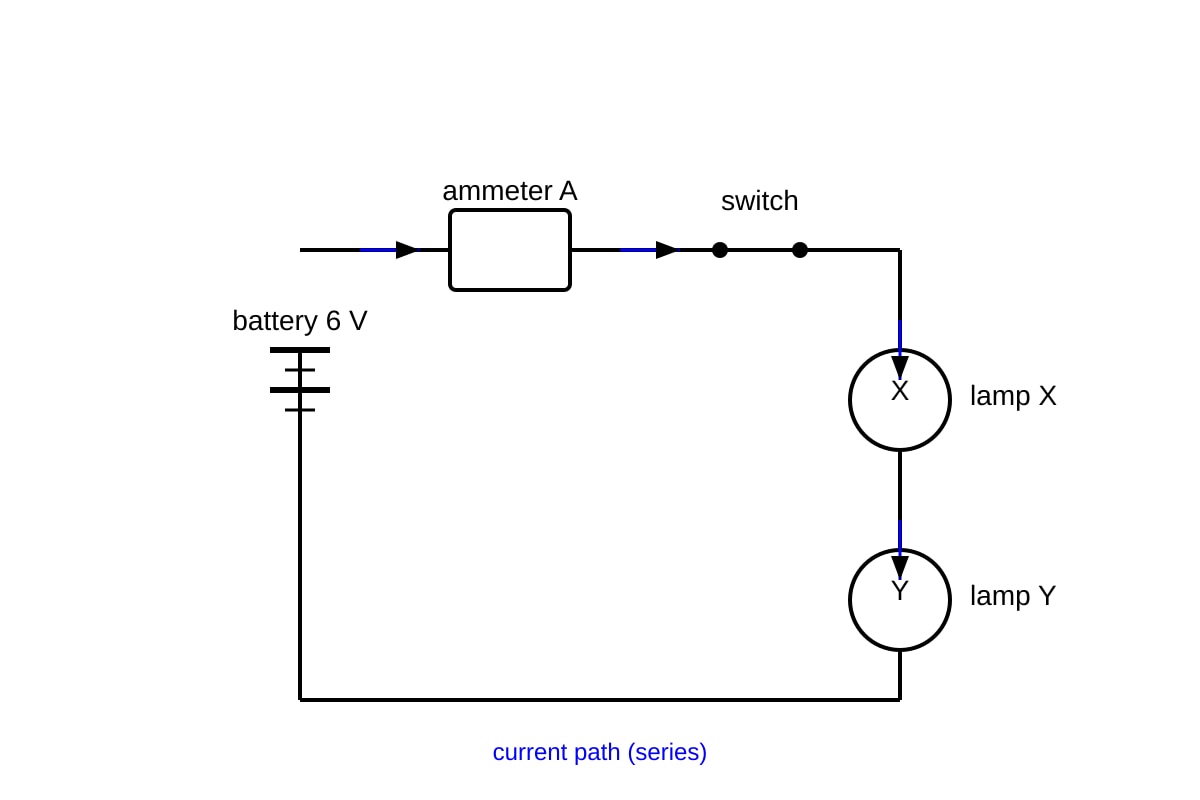
17. The diagram shows a simple circuit with a 6 V battery, a switch, and two lamps in series.
Image pending generation: diagram for Q17.
(a) State the brightness of lamp Y compared to lamp X. [1]
(b) The current at the ammeter is 0.30 A. Calculate the total resistance of the circuit. [2]
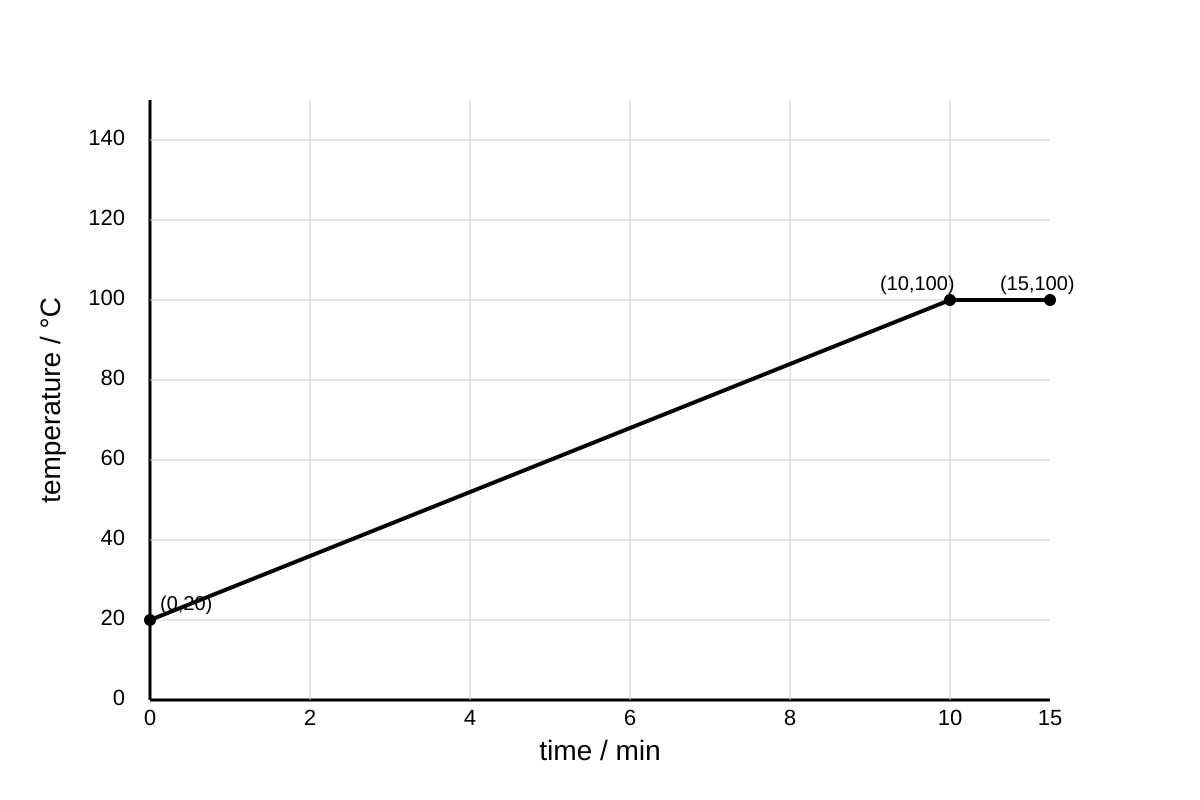
18. The figure shows temperature against time for water heated by a 100 W heater.
Image pending generation: graph for Q18.
(a) State the temperature at which the plateau occurs. [1]
(b) Explain, in terms of particles, why temperature stays constant during the plateau. [2]
19. The diagram shows a ray of light incident on a plane mirror at 30° to the normal.
Image pending generation: diagram for Q19.
(a) State the angle of reflection. [1]
(b) Complete the diagram to show the reflected ray. [1]
20. A student records the following for a falling object: mass = 0.20 kg, acceleration = 10 m/s².
(a) State the weight of the object. [1]
(b) Calculate the force acting on it during fall (ignore air resistance). [2]
Section C: Extended Response (12 marks)
21. A household circuit contains a refrigerator and a lamp connected in parallel to a 230 V supply. Explain why parallel connection is used and describe what happens to the current in each branch when the lamp is switched off. [4]
22. A train accelerates uniformly from rest to 30 m/s in 20 s, then travels at constant speed for 40 s, then decelerates uniformly to rest in 10 s.
(a) Calculate the acceleration in the first stage. [2]
(b) Calculate the total distance travelled. [4]
(c) Sketch a velocity–time graph label for this journey (describe axes and key points). [2]
End of Paper — Total Marks: 60
Answers
TuitionGoWhere Exam Practice (AI) - Combined Science Physics Secondary 4
Answer Key (Version 4 of 5)
Section A: Structured Questions
Q1 [2 marks]
Average speed = total distance / total time
= 120 m / 8.0 s = 15 m/s
Teaching note: Average speed uses total distance over total time, not average of speeds. Unit m/s required.
Q2 [1 mark]
Acceleration = gradient of v–t graph = (12 – 0) / (4 – 0) = 3.0 m/s²
Expected from image Q2-fig1: straight line P(0,0) to Q(4,12). Magnitude = 3 m/s².
Q3 [2 marks]
Frictional force = 5.0 N.
Explanation: At constant speed, acceleration = 0, so net force = 0 (Newton’s First Law). Thus applied force = frictional force = 5.0 N.
Common mistake: stating friction = 0 because “no acceleration”.
Q4 [2 marks]
Scalar: quantity with magnitude only (e.g., mass).
Vector: quantity with magnitude and direction (e.g., force).
1 mark each.
Q5 [2 marks]
Energy = P × t = 60 W × 100 s = 6000 J = 6.0 kJ.
Teaching: immersion heater power rating shows energy per second.
Q6 [2 marks]
Particles gain energy, vibrate more, break from fixed positions; arrangement changes from ordered (solid) to less ordered (liquid) while temperature constant.
Marking: movement (1), arrangement (1).
Q7 [1 mark]
Current through a metallic conductor is directly proportional to potential difference, provided temperature constant.
Q8 [2 marks]
V = I R = 0.20 A × 10 Ω = 2.0 V.
Q9 [1 mark]
Any one: speed, cross-sectional area, shape, air density.
Q10 [2 marks]
Moment = F × d = 4.0 N × 0.25 m = 1.0 N m.
Q11 [1 mark]
To open/close (complete/break) the circuit.
Q12 [1 mark]
Speed decreases (light slows in glass).
Q13 [1 mark]
No net heat transfer; same temperature as surroundings.
Q14 [1 mark]
Efficiency = (useful energy output / total energy input) × 100%.
Q15 [2 marks]
Work done = F × d = 20 N × 5.0 m = 100 J.
Section B: Data & Diagram Interpretation
Q16 [4 marks total]
(a) [1] Acceleration = (20–0)/(10–0) = 2.0 m/s².
(b) [3] Distance = area under graph:
Stage1: ½ × 10 × 20 = 100 m
Stage2: 20 × 20 = 400 m
Stage3: ½ × 10 × 20 = 100 m
Total = 600 m.
Image Q16-fig1 must show three segments as described.
Q17 [3 marks total]
(a) [1] Same brightness (series, same current).
(b) [2] R = V/I = 6 V / 0.30 A = 20 Ω.
Q18 [3 marks total]
(a) [1] 100 °C.
(b) [2] Energy supplied breaks intermolecular bonds; particles gain potential energy not kinetic, so temperature constant.
Image Q18-fig1 plateau at 100 °C required.
Q19 [2 marks total]
(a) [1] 30° (law of reflection).
(b) [1] Reflected ray drawn at 30° to normal on opposite side. Image Q19-fig1 shows incident 30°.
Q20 [3 marks total]
(a) [1] Weight = mg = 0.20 × 10 = 2.0 N.
(b) [2] Force = ma = 0.20 × 10 = 2.0 N (same as weight if no air resistance).
Section C: Extended Response
Q21 [4 marks]
- Parallel used so each appliance gets full 230 V and operates independently (2 marks).
- When lamp off, current in lamp branch = 0, refrigerator branch unchanged (2 marks).
Descriptors: correct reason (2), correct current behaviour (2).
Q22 [8 marks total]
(a) [2] a = (30–0)/20 = 1.5 m/s².
(b) [4] Stage1: ½×20×30 = 300 m; Stage2: 30×40 = 1200 m; Stage3: ½×10×30 = 150 m; Total = 1650 m.
(c) [2] Axes: time (s) 0–70, velocity (m/s) 0–30; points: (0,0),(20,30),(60,30),(70,0).
Marking: axes described (1), key points (1).
Total Marks: 60 — matches paper.
Free quiz and exam paper access
Enter your details to view this paper
Your access is remembered on this device.