From Real Exams Exam Paper
Secondary 4 Combined Science Physics Preliminary Examination Paper 3
Free Sec 4 Comb Sci Phy Prelim Paper 3, HY3 Exam version, with questions, answers, and O Level-style practice for Singapore students.
These static practice materials are generated from the site's syllabus and paper-generation workflow, with source and model context shown so students and parents can evaluate the material before use.
Questions
TuitionGoWhere Practice Paper – Combined Science Physics Secondary 4 (PRELIM)
School: TuitionGoWhere Secondary School (AI)
Subject: Combined Science Physics
Level: Secondary 4
Paper: Practice Prelim Version 3
Duration: 60 minutes
Total Marks: 60
Name: ________________________
Class: ________
Date: ____________
Instructions
- Answer all questions in the spaces provided.
- Show all working clearly where calculation is required.
- Use SI units unless stated otherwise.
- Section A: 10 short questions (2 marks each) = 20 marks
- Section B: 6 structured questions (4 marks each) = 24 marks
- Section C: 4 extended questions (4 marks each) = 16 marks
- Total = 60 marks
Section A (20 marks)
Answer all questions. Each carries 2 marks.
1. A car travels 120 m in 8.0 s at constant speed. Calculate its average speed.
2. State the SI unit for acceleration.
3. A block is pushed at constant speed across a rough table. The applied force is 5.0 N. State the size of the frictional force and explain how you obtain the answer.
4. A 60 W immersion heater heats 0.50 kg of water. The temperature rises from 20 °C to 30 °C in 60 s. Calculate the energy supplied by the heater.
5. Describe, in terms of movement and arrangement of particles, what happens when ice melts at 0 °C.
6. A student draws a velocity–time graph. Between point P (t = 2 s, v = 4 m/s) and point Q (t = 6 s, v = 12 m/s), what is the acceleration?
7. State one difference between a series and a parallel circuit.
8. A ray of light hits a plane mirror at 30° to the normal. State the angle of reflection.
9. Name the process by which thermal energy travels through a metal rod without bulk movement of the material.
10. A battery of 6.0 V is connected to a resistor of 3.0 Ω. Calculate the current flowing.
Section B (24 marks)
Answer all questions. Each carries 4 marks.
11. A bus moves from rest with uniform acceleration of 2.0 m/s² for 5.0 s. (a) Calculate the final velocity. [2] (b) Calculate the distance travelled in this time. [2]
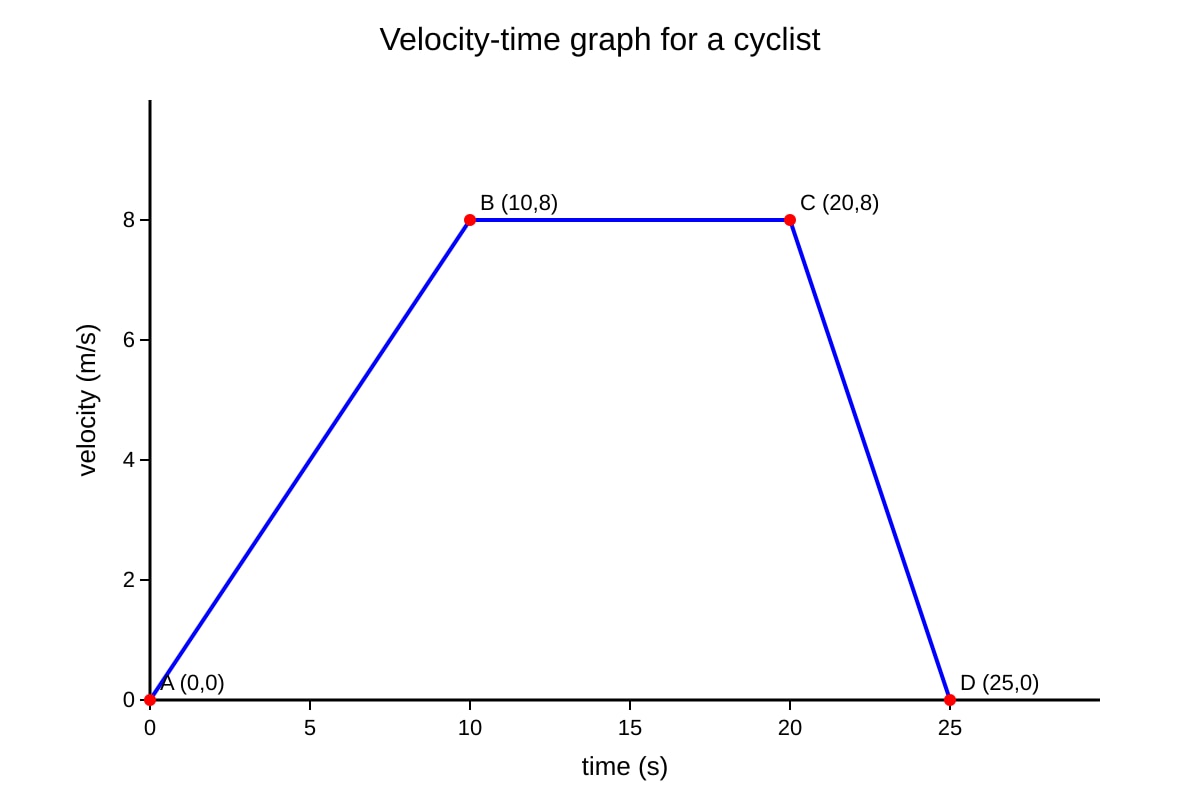
12.
Image pending generation: graph for Q12.
Using the graph: (a) State the acceleration between 0 and 10 s. [2] (b) Calculate the total distance travelled. [2]
13. A 12 V battery powers a lamp with resistance 4.0 Ω in series with another resistor of 2.0 Ω. (a) Calculate total resistance. [1] (b) Calculate current in the circuit. [1] (c) Calculate power of the lamp. [2]
14. Water of mass 1.0 kg is heated from 25 °C to 100 °C using a 500 W heater. Specific heat capacity of water = 4200 J/(kg·°C). (a) Calculate energy needed. [2] (b) Calculate minimum time required. [2]
15. A wooden block rests on a table. A force of 10 N right is balanced by friction. (a) State net force. [1] (b) Explain why the block does not move if it was initially at rest. [1] (c) If force increases to 15 N and block accelerates, state friction assuming constant 10 N. [1] (d) Calculate acceleration if mass = 1.0 kg. [1]
16. Describe how to draw a ray diagram for an object 10 cm from a convex lens of focal length 15 cm. State the image nature.
Section C (16 marks)
Answer all questions. Each carries 4 marks.
17. A train travels 200 km in 2.0 h, stops 0.5 h, then 300 km in 3.0 h. (a) Calculate average speed for whole journey. [2] (b) Explain why this is not the average of the two speeds. [2]
18. Explain, using particle theory, why a liquid cools before freezing and why temperature stays constant during freezing.
19. Compare conduction, convection, and radiation in terms of medium needed and how energy moves.
20. A household circuit has a 3 A fuse and a 230 V appliance. (a) Calculate max power before fuse blows. [2] (b) State one safety reason for earthing. [2]
Answers
TuitionGoWhere Practice Paper – Combined Science Physics Secondary 4 (PRELIM) Answer Key
Version: 3
Total Marks: 60
Section A
1. average speed = total distance / total time = 120 / 8.0 = 15 m/s. [2]
Teaching: speed = distance ÷ time; unit m/s. Common mistake: using wrong unit.
2. m/s² (or m s⁻²). [2]
Teaching: acceleration is change in velocity per second.
3. Frictional force = 5.0 N. [1] At constant speed, a = 0, net force = 0, so friction = applied force. [1]
Teaching: Newton’s first law equilibrium.
4. E = P t = 60 × 60 = 3600 J. [2]
Teaching: energy = power × time.
5. Particles gain energy, vibrate more, break from fixed positions, move freely but still close. [2]
Teaching: melting = solid to liquid; arrangement less fixed.
6. a = (12 − 4) / (6 − 2) = 8 / 4 = 2.0 m/s². [2]
7. In series same current flows; in parallel voltage same across branches. [2]
8. 30° (law of reflection: angle of incidence = angle of reflection). [2]
9. Conduction. [2]
10. I = V / R = 6.0 / 3.0 = 2.0 A. [2]
Section B
11. (a) v = u + at = 0 + 2.0×5.0 = 10 m/s [2]
(b) s = ut + ½at² = 0 + ½×2.0×25 = 25 m [2]
12. (a) a = (8−0)/(10−0) = 0.8 m/s² [2]
(b) distance = area: triangle ½×10×8=40, rect 10×8=80, triangle ½×5×8=20, total=140 m [2]
13. (a) R = 4 + 2 = 6 Ω [1]
(b) I = 12/6 = 2 A [1]
(c) P = I²R = 4×4 = 16 W [2]
14. (a) Q = mcΔT = 1×4200×75 = 315 000 J [2]
(b) t = Q/P = 315000/500 = 630 s [2]
15. (a) 0 N [1]
(b) Balanced forces → no acceleration [1]
(c) 10 N [1]
(d) a = (15−10)/1 = 5 m/s² [1]
16. Draw ray parallel to axis refracted through F, ray through centre undeviated, meet virtual image same side, upright, magnified. [4]
Section C
17. (a) total dist = 500 km, total time = 5.5 h, avg = 500/5.5 ≈ 90.9 km/h [2]
(b) Because time weights differ; average speed uses total dist/time not mean of speeds. [2]
18. Cooling: particles lose KE, move slower. Freezing: KE constant, energy out as latent heat, arrangement becomes fixed. [4]
19. Conduction: needs solid, via vibrations. Convection: needs fluid, bulk movement. Radiation: needs no medium, EM waves. [4]
20. (a) P = VI = 230×3 = 690 W [2]
(b) Earthing prevents shock by directing fault current. [2]
Free quiz and exam paper access
Enter your details to view this paper
Your access is remembered on this device.