From Real Exams Exam Paper

Secondary 4 Combined Science Physics Preliminary Examination Paper 1

Free Exam-Derived Secondary 4 Combined Science Physics Preliminary Examination Paper 1 practice paper with questions and answers for Singapore students. This page is rendered as a direct URL so the questions and answers can be discovered without pressing in-page buttons.

These static practice materials are generated from the site's syllabus and paper-generation workflow, with source and model context shown so students and parents can evaluate the material before use.

Secondary 4 Combined Science Physics From Real Exams Generated by Claude Sonnet 4 Updated 2026-06-03

Questions

TuitionGoWhere Practice Paper - Combined Science Physics Secondary 4

TuitionGoWhere Secondary School (AI)

Subject: Combined Science Physics
Level: Secondary 4
Paper: PRELIM
Duration: 1 hour 15 minutes
Total Marks: 65

Name: _________________ Class: _______ Date: _____________


Instructions to Candidates

  • Answer ALL questions in the spaces provided
  • Show all working clearly for calculations
  • The use of calculators is permitted
  • Take g = 10 m/s² where required
  • Give answers to an appropriate number of significant figures

Section A: Multiple Choice [15 marks]

For each question, choose the best answer and write the letter in the box provided.

1. A car accelerates uniformly from rest. After 8 seconds, its velocity is 24 m/s. The acceleration of the car is:

A. 3 m/s² B. 16 m/s²
C. 32 m/s² D. 192 m/s²

Answer: [ ]

2. The diagram shows a wooden block being pushed across a horizontal surface at constant velocity.

Which statement about the forces is correct?

A. The applied force is greater than friction B. The applied force equals the frictional force C. The net force is in the direction of motion D. No friction acts on the block

Answer: [ ]

3. A simple pendulum completes 20 oscillations in 40 seconds. The period of the pendulum is:

A. 0.5 s B. 2.0 s C. 20 s
D. 40 s

Answer: [ ]

4. Which colour should a refrigerator be painted to reduce heat gain from the surroundings?

A. Black B. Dark blue C. White D. Red

Answer: [ ]

5. The speed of sound in air is 340 m/s. A sound wave has a frequency of 170 Hz. The wavelength is:

A. 0.5 m B. 2.0 m C. 170 m D. 340 m

Answer: [ ]


Section B: Structured Questions [50 marks]

6. A badminton shuttlecock is hit vertically upward. The graph shows how its velocity changes with time.

[Velocity-time graph showing: positive velocity decreasing linearly to zero at t=1s, then negative velocity increasing in magnitude]

(a) State the magnitude of the acceleration of the shuttlecock between t = 0 and t = 1.0 s.

_________________ m/s² [1]

(b) Explain why the magnitude of acceleration is different during the upward and downward motion.


_________________________________________________________________ [2]

(c) Calculate the maximum height reached by the shuttlecock.

Working:

Maximum height = _________________ m [3]

7. A student investigates the heating of a metal block using a 150 W heater. The graph shows the results.

[Temperature-time graph showing steady increase from 20°C to 100°C over 10 minutes]

(a) Calculate the energy supplied by the heater in 10 minutes.

Working:

Energy = _________________ J [2]

(b) The mass of the metal block is 0.50 kg. Calculate the specific heat capacity of the metal.

Working:

Specific heat capacity = _________________ J/(kg°C) [3]

(c) Suggest why the actual temperature rise might be less than calculated.


_________________________________________________________________ [1]

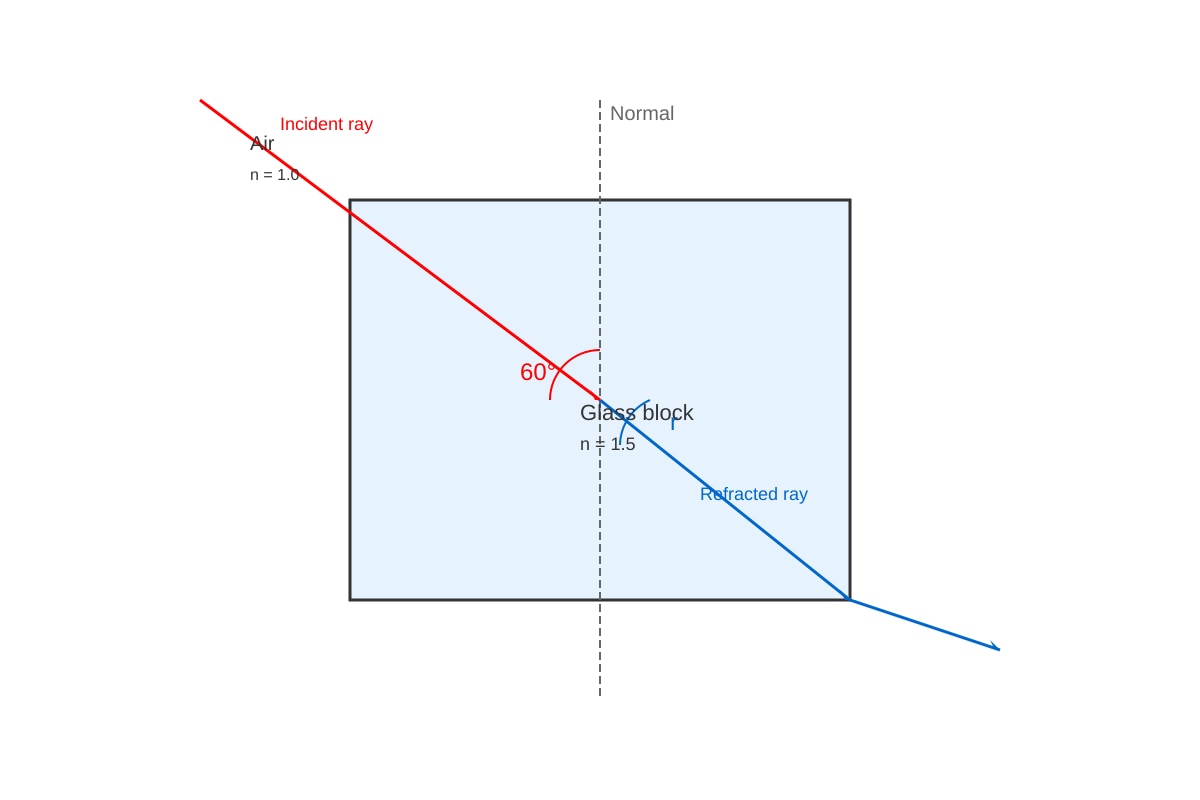
8. The diagram shows a ray of light incident on a glass block.

[Diagram showing incident ray at 60° to normal, glass block with refractive index 1.5]

(a) Calculate the angle of refraction when the light enters the glass. (Refractive index of glass = 1.5, refractive index of air = 1.0)

Working:

Angle of refraction = _________________ ° [3]

(b) Complete the ray diagram to show the path of light through the glass block and back into air. [3]

(c) State what happens when the angle of incidence exceeds the critical angle.

_________________________________________________________________ [1]

9. A household circuit contains the following appliances connected in parallel:

  • Electric oven: 3000 W
  • Washing machine: 2400 W
  • Dishwasher: 1800 W

All appliances operate at 240 V.

(a) Calculate the current drawn by each appliance when operating.

Oven: I = _________________ A [1]

Washing machine: I = _________________ A [1]

Dishwasher: I = _________________ A [1]

(b) Calculate the total current when all three appliances operate simultaneously.

Total current = _________________ A [1]

(c) The circuit is protected by a 32 A fuse. Discuss whether this fuse rating is appropriate for safe operation.


_________________________________________________________________ [3]

10. A block of ice at 0°C is heated until it completely melts and the resulting water reaches 20°C.

(a) Describe what happens to the ice particles during melting in terms of:

(i) Motion: ___________________________________________________

_________________________________________________________________ [1]

(ii) Spacing: _________________________________________________

_________________________________________________________________ [1]

(b) The graph shows temperature against time during the heating process.

[Temperature-time graph showing: 0°C plateau, then linear increase to 20°C]

Explain why the temperature remains constant during melting even though heat is continuously supplied.


_________________________________________________________________ [2]

(c) State the name given to the energy required to change the state of a substance without changing its temperature.

_________________________________________________________________ [1]

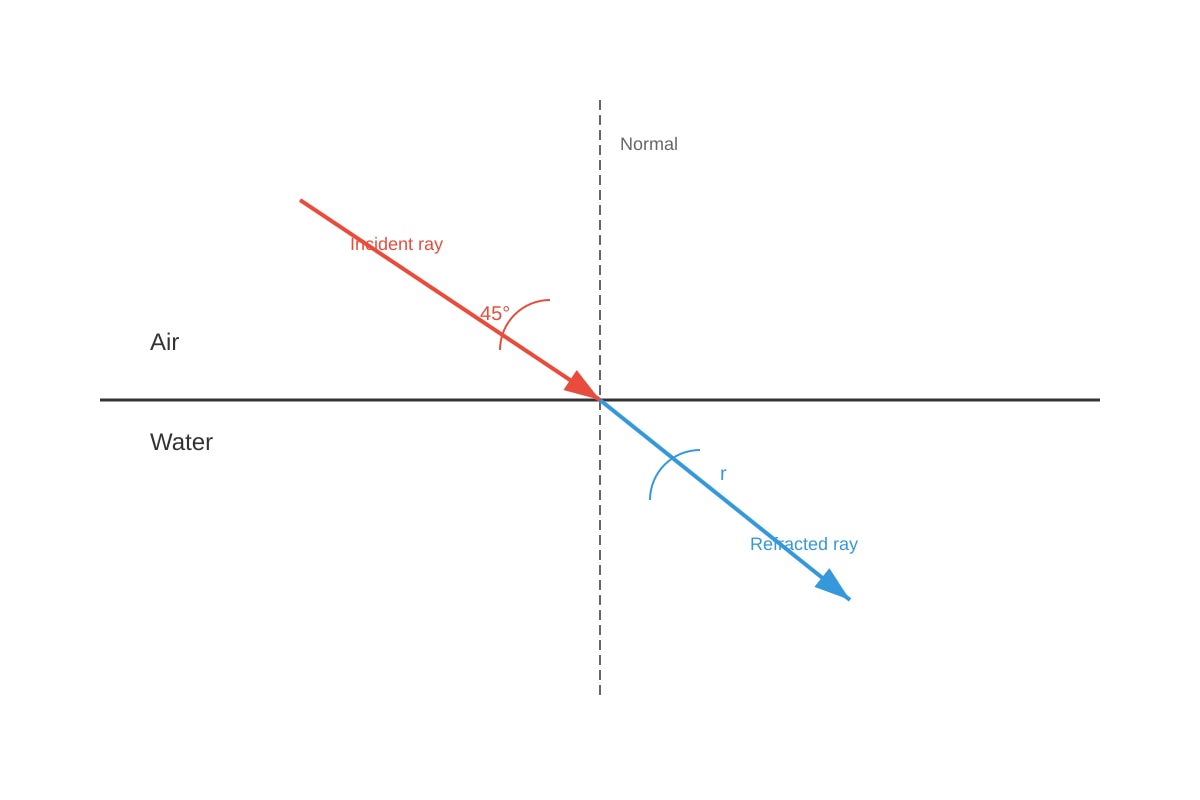
11. A student uses a ray box to investigate refraction. The diagram shows a light ray traveling from air into water.

[Diagram showing incident ray at 45° and refracted ray in water]

(a) Measure and record the angle of refraction in the water.

Angle of refraction = _________________ ° [1]

(b) Calculate the refractive index of water using your measurement. (sin 45° = 0.71)

Working:

Refractive index = _________________ [3]

(c) Explain what would happen if the light ray traveled from water to air at the same angle.


_________________________________________________________________ [2]

12. A car of mass 1200 kg accelerates from rest to 30 m/s in 15 seconds.

(a) Calculate the acceleration of the car.

Working:

Acceleration = _________________ m/s² [2]

(b) Calculate the net force acting on the car during acceleration.

Working:

Net force = _________________ N [2]

(c) The car then travels at constant speed. Explain what this tells you about the forces acting on the car.


_________________________________________________________________ [2]

Answers

TuitionGoWhere Practice Paper - Combined Science Physics Secondary 4 (Answers)

Section A: Multiple Choice [15 marks]

1. A - 3 m/s² a = (v-u)/t = (24-0)/8 = 3 m/s²

2. B - The applied force equals the frictional force At constant velocity, acceleration = 0, so net force = 0. Therefore, applied force = friction.

3. B - 2.0 s
Period = total time / number of oscillations = 40/20 = 2.0 s

4. C - White White surfaces reflect thermal radiation, reducing heat absorption.

5. B - 2.0 m λ = v/f = 340/170 = 2.0 m

Section B: Structured Questions [50 marks]

6.(a) 10 m/s² [1] From graph: a = Δv/Δt = (0-10)/(1-0) = -10 m/s², magnitude = 10 m/s²

6.(b) During upward motion, air resistance acts downward (same direction as gravity), so total deceleration is greater. During downward motion, air resistance acts upward (opposite to gravity), so net acceleration is less. [2]

6.(c) Maximum height = 5.0 m [3] Working:

  • Initial velocity = 10 m/s (from graph)
  • Using v² = u² + 2as, at maximum height v = 0
  • 0 = 10² + 2(-10)s
  • s = 100/20 = 5.0 m

7.(a) Energy = 90,000 J [2] E = Pt = 150 × (10 × 60) = 150 × 600 = 90,000 J

7.(b) Specific heat capacity = 2250 J/(kg°C) [3] Working:

  • Q = mcΔT
  • 90,000 = 0.50 × c × (100-20)
  • c = 90,000/(0.50 × 80) = 2250 J/(kg°C)

7.(c) Heat is lost to the surroundings / air around the block [1]

8.(a) Angle of refraction = 35.3° [3] Working:

  • n₁sin θ₁ = n₂sin θ₂
  • 1.0 × sin 60° = 1.5 × sin θ₂
  • sin θ₂ = (1.0 × 0.866)/1.5 = 0.577
  • θ₂ = 35.3°

8.(b) Ray diagram showing: refraction toward normal entering glass, parallel path through glass, refraction away from normal exiting glass [3]

8.(c) Total internal reflection occurs [1]

9.(a) [3 marks]

  • Oven: I = P/V = 3000/240 = 12.5 A
  • Washing machine: I = 2400/240 = 10.0 A
  • Dishwasher: I = 1800/240 = 7.5 A

9.(b) Total current = 30.0 A [1] 12.5 + 10.0 + 7.5 = 30.0 A

9.(c) The 32 A fuse is appropriate. The total current (30.0 A) is less than the fuse rating (32 A), providing adequate protection while allowing normal operation. The fuse rating is close enough to the operating current to provide protection against overloads. [3]

10.(a) [2 marks] (i) Motion: Particles vibrate faster / gain kinetic energy (ii) Spacing: Spacing between particles increases significantly

10.(b) During melting, the energy supplied is used to break the bonds between particles (latent heat) rather than increasing their kinetic energy. Temperature only increases when kinetic energy increases. [2]

10.(c) Latent heat [1]

11.(a) Angle of refraction = 32° [1] Accept 30-34° depending on diagram accuracy

11.(b) Refractive index = 1.33 [3] Working:

  • n = sin θ₁/sin θ₂
  • n = sin 45°/sin 32°
  • n = 0.71/0.53 = 1.33

11.(c) The light ray would refract away from the normal as it enters the less dense medium (air). The angle of refraction would be larger than the angle of incidence. [2]

12.(a) Acceleration = 2.0 m/s² [2] a = (v-u)/t = (30-0)/15 = 2.0 m/s²

12.(b) Net force = 2400 N [2] F = ma = 1200 × 2.0 = 2400 N

12.(c) At constant speed, the acceleration is zero, so the net force is zero. This means the driving force equals the total resistive forces (friction, air resistance). [2]

Total: 65 marks