AI Generated Quiz
Secondary 4 Combined Science Chemistry Stoichiometry Moles Quiz
Free Sec 4 Comb Sci Chem Stoichiometry Moles quiz, HY3 AI version, with questions, answers, and O Level-style practice for Singapore students.
These static practice materials are generated from the site's syllabus and paper-generation workflow, with source and model context shown so students and parents can evaluate the material before use.
Questions
Free quiz and exam paper access
Enter your details to view this paper
Your access is remembered on this device.
Answers
Secondary 4 Combined Science Chemistry Quiz - Stoichiometry Moles (Answer Key)
Total Marks: 40
Note: This answer key is syllabus-first generated using LLM-inferred templates. It is not based on official past-year exam papers.
Section A (1 mark each)
1. B
- The mole is the unit for amount of substance; symbol is mol. Grams measure mass, dm³ and cm³ measure volume.
2. C
- Oxygen atom has Ar ≈ 16 from the periodic table.
3. B
- At RTP (room temperature and pressure, ~25 °C, 1 atm), molar gas volume = 24 dm³/mol.
4. B
- From equation (2H_2 + O_2), coefficients give ratio (H_2 : O_2 = 2 : 1).
5. B
- Concentration (mol/dm³) = moles ÷ volume in dm³.
Section B (2 marks each)
6. (2 marks)
- A mole is the amount of substance that contains the same number of particles as there are atoms in 12 g of carbon-12. / It contains Avogadro’s number ((6 \times 10^{23})) of particles.
- Marking: 1 mark for "amount of substance", 1 mark for reference to (6 \times 10^{23}) particles or 12 g carbon-12.
7. (2 marks)
- (Mr(H_2O) = 2(1) + 16 = 18)
- 1 mark for correct Ar use, 1 mark for final 18.
8. (2 marks)
- (Mg + 2HCl \rightarrow MgCl_2 + H_2)
- 1 mark for correct formulae, 1 mark for balancing (2 HCl, H₂ shown).
9. (2 marks)
- Volume = moles × 24 = 2.0 × 24 = 48 dm³
- 1 mark for using 24 dm³/mol, 1 mark for 48 dm³.
10. (2 marks)
- Concentration = 0.50 ÷ 2.0 = 0.25 mol/dm³
- 1 mark for formula, 1 mark for answer.
Section C
11. (3 marks)
- Step 1: Mr of (CaCO_3 = 40 + 12 + 3(16) = 100)
- Step 2: mass = moles × Mr = 0.25 × 100 = 25 g
- Marks: 1 for Mr, 1 for substitution, 1 for 25 g.
12. (3 marks)
- moles = mass ÷ Ar = 4.8 ÷ 24 = 0.20 mol
- Marks: 1 for formula, 1 for division, 1 for 0.20 mol.
13. (4 marks)
- From equation: 2 vol (H_2) : 1 vol (O_2) (same T,P so volume ratio = mole ratio)
- (O_2) volume = 6.0 ÷ 2 = 3.0 dm³
- Marks: 1 for ratio identified, 1 for method, 2 for correct 3.0 dm³ with unit.
14. (4 marks)
- moles (CaCO_3 = 10.0 ÷ 100 = 0.10) mol
- From equation 1:1, moles (CaO = 0.10) mol
- mass (CaO = 0.10 × 56 = 5.6) g
- Marks: 1 mole CaCO₃, 1 ratio, 1 Mr CaO, 1 mass 5.6 g.
15. (3 marks)
- Convert 250 cm³ to dm³: 250 ÷ 1000 = 0.250 dm³
- Concentration = 0.125 ÷ 0.250 = 0.500 mol/dm³
- Marks: 1 conversion, 1 division, 1 answer.
16. (4 marks)
- moles Zn = 13.0 ÷ 65 = 0.20 mol
- From equation 1:1, moles (H_2 = 0.20) mol
- Volume (H_2 = 0.20 × 24 = 4.8) dm³
- Marks: 1 mole Zn, 1 ratio, 1 ×24, 1 answer 4.8 dm³.
17. (3 marks)
- moles (CH_4 = 8.0 ÷ 16 = 0.50) mol
- From equation 1:2, moles (O_2 = 1.0) mol
- mass (O_2 = 1.0 × (2×16) = 32) g
- Marks: 1 mole CH₄, 1 ratio/mole O₂, 1 mass 32 g.
18. (5 marks)
- moles NaOH = 0.100 × (25.0/1000) = 0.00250 mol
- 1:1 ratio → moles HCl = 0.00250 mol
- Concentration HCl = 0.00250 ÷ (20.0/1000) = 0.125 mol/dm³
- Marks: 1 for NaOH moles, 1 for ratio, 1 for HCl moles, 1 for volume conversion, 1 for final 0.125.
19. (3 marks)
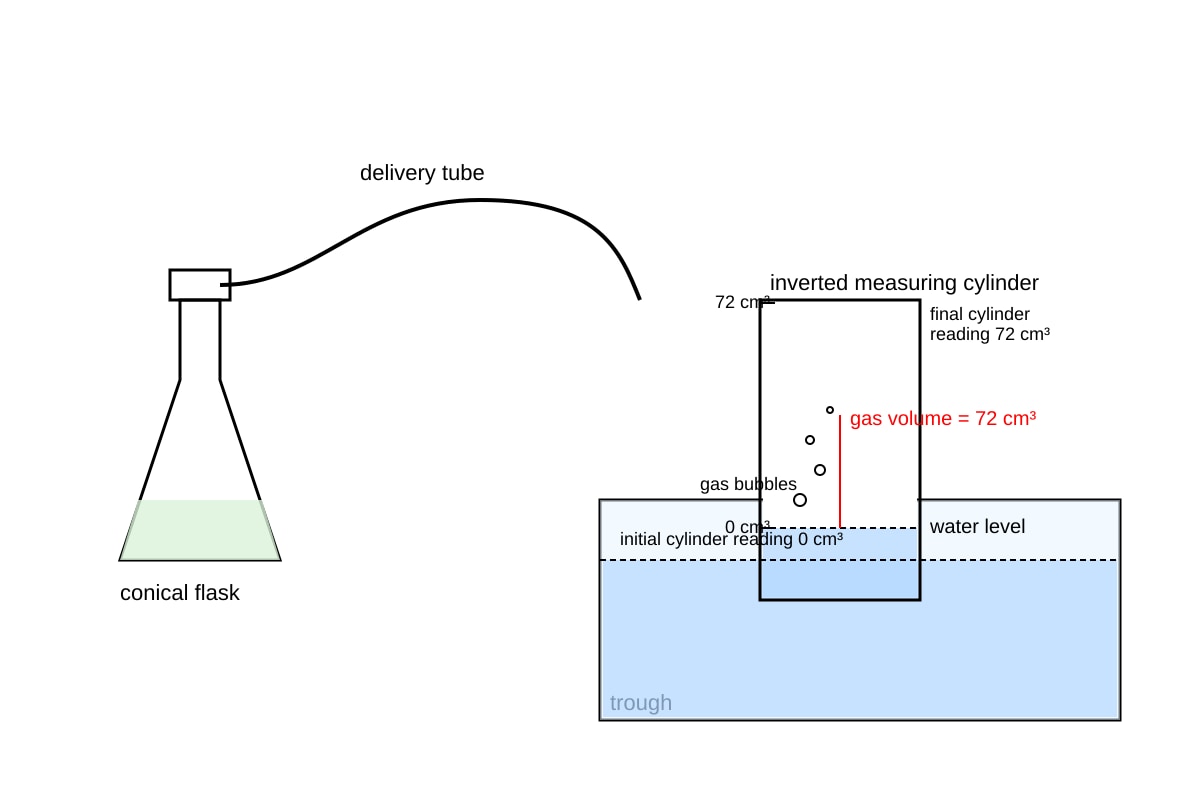
- From placeholder: final reading 72 cm³ → volume gas = 72 cm³
- Convert: 72 ÷ 1000 = 0.072 dm³
- Marks: 1 for reading 72 cm³ from image, 1 for conversion, 1 for 0.072 dm³.
- Image must show 72 cm³ collected in inverted cylinder.
20. (5 marks)
- moles CuO = 8.0 ÷ 80 = 0.10 mol
- 1:1 ratio → moles CuSO₄ = 0.10 mol
- mass CuSO₄ = 0.10 × 160 = 16 g
- Marks: 1 mole CuO, 1 ratio, 1 Mr CuSO₄, 1 multiplication, 1 answer 16 g.