AI Generated Quiz
Secondary 4 Combined Science Chemistry Redox Electrochemistry Quiz
Free Sec 4 Comb Sci Chem Redox Electrochemistry quiz, HY3 AI version, with questions, answers, and O Level-style practice for Singapore students.
These static practice materials are generated from the site's syllabus and paper-generation workflow, with source and model context shown so students and parents can evaluate the material before use.
Questions
Secondary 4 Combined Science Chemistry Quiz - Redox Electrochemistry
Name: ___________________________
Class: ____________
Date: ____________
Score: ____________
Duration: 45 minutes
Total Marks: 40
Instructions:
- This quiz contains 20 questions on Redox Electrochemistry.
- Section A: Multiple-choice style short questions (1–5)
- Section B: Structured short-answer questions (6–15)
- Section C: Extended response and data-based questions (16–20)
- Write your answers in the spaces provided.
- Show all working for calculation questions.
Section A (2 marks each, Total 10 marks)
1. Which of the following processes is an example of oxidation?
A. Gain of electrons
B. Loss of oxygen
C. Loss of electrons
D. Decrease in oxidation state
Answer: __________
2. In the reaction Zn(s)+Cu2+(aq)→Zn2+(aq)+Cu(s), which species is reduced?
A. Zn
B. Cu2+
C. Zn2+
D. Cu
Answer: __________
3. What is the oxidation state of manganese in KMnO4?
A. +1
B. +4
C. +6
D. +7
Answer: __________
4. A simple electrochemical cell is made using zinc and copper electrodes. Which metal acts as the negative terminal?
A. Copper
B. Zinc
C. Both equally
D. Neither
Answer: __________
5. Which of the following is produced at the cathode during electrolysis of aqueous copper(II) sulfate using inert electrodes?
A. Oxygen gas
B. Hydrogen gas
C. Copper metal
D. Sulfur dioxide
Answer: __________
Section B (2–4 marks each, Total 20 marks)
6. State the meaning of the term redox reaction. [2]
7. Write the half-equation for the oxidation of iron(II) ions to iron(III) ions. [2]
8. Calculate the oxidation state of sulfur in H2SO4. Show your working. [3]
Working:
Answer: __________
9. A student sets up a cell using magnesium and silver electrodes.
(a) Which electrode is the anode? [1]
(b) Write the overall cell reaction. [2]
10. During electrolysis of molten lead(II) bromide, state the products at the anode and cathode. [2]
Anode: ____________________
Cathode: ____________________
11. Explain why a salt bridge is used in a simple voltaic cell. [2]
12. Given the reactivity series: Mg > Zn > Fe > Cu > Ag.
Predict whether copper can displace silver ions from solution. Explain. [3]
13. Balance the following redox equation in acidic medium:
Fe2++MnO4−→Fe3++Mn2+ [3]
Working:
Balanced equation: ________________________________________________________
14.
Image pending generation: experimental_setup for Q14.
Using the diagram, state the gas formed at the cathode and a test to identify it. [2]
Gas: ____________________
Test: ________________________________________________________________
15. A copper rod is placed in silver nitrate solution. After some time, a grey deposit forms on the rod.
(a) Identify the grey deposit. [1]
(b) Write the ionic equation for the reaction. [2]
Section C (2–6 marks each, Total 10 marks)
16. Electrolysis of aqueous copper(II) sulfate using copper electrodes was carried out.
(a) State what happens at the anode. [2]
(b) State what happens at the cathode. [2]
17. The table shows standard electrode potentials:
| Half-cell | E∘ / V |
|---|---|
| Zn2+/Zn | -0.76 |
| Cu2+/Cu | +0.34 |
(a) Calculate the standard cell potential of a Zn–Cu cell. [2]
Working: ________________________________________________________
Answer: __________ V
(b) State the direction of electron flow in the external circuit. [1]
18. A student electrolyses concentrated aqueous potassium chloride.
Explain why chlorine is produced at the anode instead of oxygen, using the concept of discharge of ions. [4]
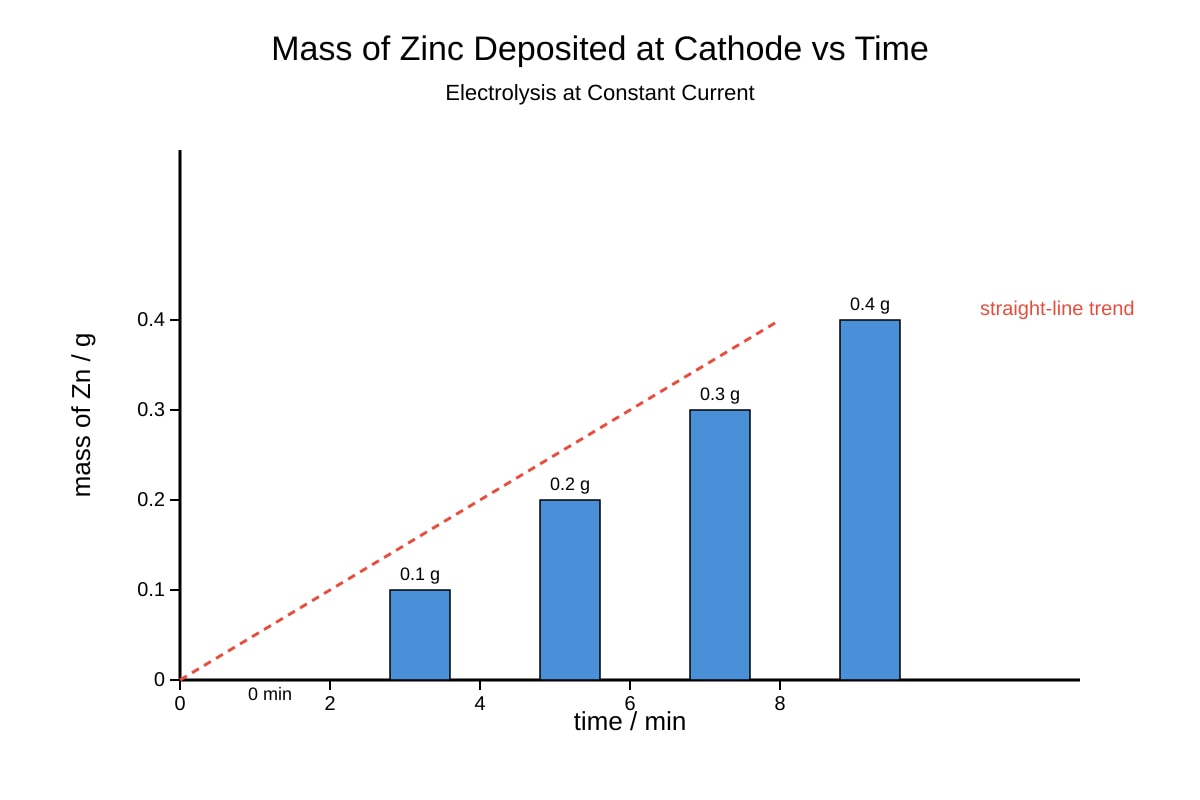
19.
Image pending generation: graph for Q19.
Using the graph, determine the mass of zinc deposited after 5 minutes and explain whether the rate is constant. [3]
Mass: __________ g
Explanation: ________________________________________________________________
20. Compare the use of a voltaic cell and an electrolytic cell. Include energy change and examples of each. [6]
Answers
Answer Key: Secondary 4 Combined Science Chemistry Quiz - Redox Electrochemistry
Total Marks: 40
Topic: Redox Electrochemistry
Note: This quiz is syllabus-first generated from LLM-inferred templates. Past-paper evidence for this topic was limited (52 references in Stage 2-1), so questions are designed to match syllabus expectations and familiar Singapore practice style, not claimed as exam-derived.
Section A (2 marks each)
1. C [2]
Oxidation is loss of electrons (OIL RIG: Oxidation Is Loss, Reduction Is Gain). Gain of electrons is reduction; loss of oxygen is reduction; decrease in oxidation state is reduction.
2. B [2]
Cu2+ gains 2 electrons to become Cu(s): Cu2++2e−→Cu. Gain of electrons = reduction.
3. D [2]
In KMnO4: K = +1, O = -2 (×4 = -8). Sum = 0, so Mn + 1 - 8 = 0 → Mn = +7.
4. B [2]
Zinc is more reactive (higher in series) so it is oxidised, releasing electrons; it is the negative terminal (anode).
5. C [2]
With inert electrodes and Cu2+ present, Cu2+ is discharged at cathode: Cu2++2e−→Cu(s).
Section B
6. [2]
A redox reaction is a reaction where both reduction and oxidation occur simultaneously (electron transfer).
Marking: 1 mark for simultaneous oxidation+reduction, 1 mark for electron transfer idea.
7. [2]
Fe2+→Fe3++e−
Marking: correct species 1, electron on product side 1.
8. [3]
Let oxidation state of S = x.
H = +1 (×2 = +2), O = -2 (×4 = -8).
+2 + x - 8 = 0 → x = +6.
Answer: +6.
Marking: working 2, answer 1.
9. [3]
(a) Mg (anode, oxidised) [1]
(b) Mg(s)+2Ag+(aq)→Mg2+(aq)+2Ag(s) [2]
Mg is above Ag in reactivity series, so Mg loses electrons.
10. [2]
Anode: bromine (Br2) [1]
Cathode: lead (Pb) [1]
Molten PbBr2: 2Br−→Br2+2e−; Pb2++2e−→Pb.
11. [2]
A salt bridge completes the circuit by allowing ion flow / maintains electrical neutrality in half-cells.
Marking: complete circuit 1, ion/neutrality 1.
12. [3]
Yes, copper displaces silver ions [1] because Cu is above Ag in reactivity series [1], so Cu is oxidised and Ag+ reduced [1].
Equation: Cu(s)+2Ag+(aq)→Cu2+(aq)+2Ag(s).
13. [3]
Oxidation: Fe2+→Fe3++e− (×5)
Reduction: MnO4−+8H++5e−→Mn2++4H2O
Balanced: 5Fe2++MnO4−+8H+→5Fe3++Mn2++4H2O
Marking: balancing Fe 1, balancing Mn 1, H+/H2O 1.
14. [2]
Gas: hydrogen (H2) [1]
Test: lighted splint gives pop sound [1].
From diagram: cathode (-) produces H2 from water; pop test confirms.
15. [3]
(a) Silver (Ag) [1]
(b) Cu(s)+2Ag+(aq)→Cu2+(aq)+2Ag(s) [2]
Section C
16. [4]
(a) Anode: copper electrode dissolves: Cu(s)→Cu2+(aq)+2e− [2]
(b) Cathode: copper ions deposit: Cu2+(aq)+2e−→Cu(s) [2]
17. [3]
(a) Ecell∘=Ecathode∘−Eanode∘=0.34−(−0.76)=+1.10 V [2]
(b) From Zn to Cu (Zn is anode, electrons flow out) [1]
18. [4]
At anode, possible ions: Cl− and OH− (from water). In concentrated KCl, Cl− concentration is high; Cl− is discharged preferentially over OH− because of lower discharge preference / higher concentration: 2Cl−→Cl2+2e−. Oxygen is not formed because Cl− oxidises more readily under these conditions.
Marking: identify Cl- discharged 1, reason concentration 1, equation 1, contrast with OH-/O2 1.
19. [3]
Mass at 5 min = 0.25 g (from linear interpolation) [1]
Rate constant because graph is straight line / equal mass per equal time [2].
20. [6]
Voltaic cell: converts chemical energy to electrical energy (spontaneous redox), e.g., Zn-Cu cell, battery. [3]
Electrolytic cell: uses electrical energy to drive non-spontaneous reaction, e.g., electrolysis of water, electroplating. [3]
Marking: energy change each 2, example each 1.
Free quiz and exam paper access
Enter your details to view this paper
Your access is remembered on this device.