AI Generated Quiz
Secondary 4 Combined Science Chemistry Periodic Table Quiz
Free Sec 4 Comb Sci Chem Periodic Table quiz, HY3 AI version, with questions, answers, and O Level-style practice for Singapore students.
These static practice materials are generated from the site's syllabus and paper-generation workflow, with source and model context shown so students and parents can evaluate the material before use.
Questions
Secondary 4 Combined Science Chemistry Quiz - Periodic Table
Name: ___________________________
Class: ___________________________
Date: ___________________________
Score: _______ / 40
Duration: 50 minutes
Total Marks: 40
Instructions:
- Answer all 20 questions.
- Section A: Multiple-choice style (1 mark each).
- Section B: Short structured questions (2 marks each).
- Section C: Extended structured questions (3–4 marks each).
- Write your answers clearly in the spaces provided.
- Use proper chemical notation where needed.
Section A (Questions 1–5, 1 mark each)
1. The elements in the Periodic Table are arranged in increasing order of their
A. atomic mass
B. proton number
C. number of neutrons
D. nucleon number
2. Which of the following is a noble gas?
A. Chlorine
B. Argon
C. Sodium
D. Magnesium
3. An element has proton number 11. In which group is it found?
A. Group 1
B. Group 2
C. Group 11
D. Group 17
4. Which statement about transition elements is correct?
A. They are all gases at room temperature.
B. They form colourless compounds only.
C. They are good conductors of electricity.
D. They have only one oxidation state.
5. As you go down Group 1, the reactivity of the elements
A. decreases
B. increases
C. stays the same
D. first increases then decreases
Section B (Questions 6–15, 2 marks each)
6. State the period and group of an element with proton number 17.
Period: __________
Group: __________
7. Give two physical properties that are generally similar for elements in the same group.
8. Explain why all elements in Group 0 are unreactive.
9. Write the electronic configuration of a magnesium atom (proton number 12).
10. State the trend in melting point of Group 1 elements going down the group and give a reason.
Trend: ___________________________
Reason: ___________________________
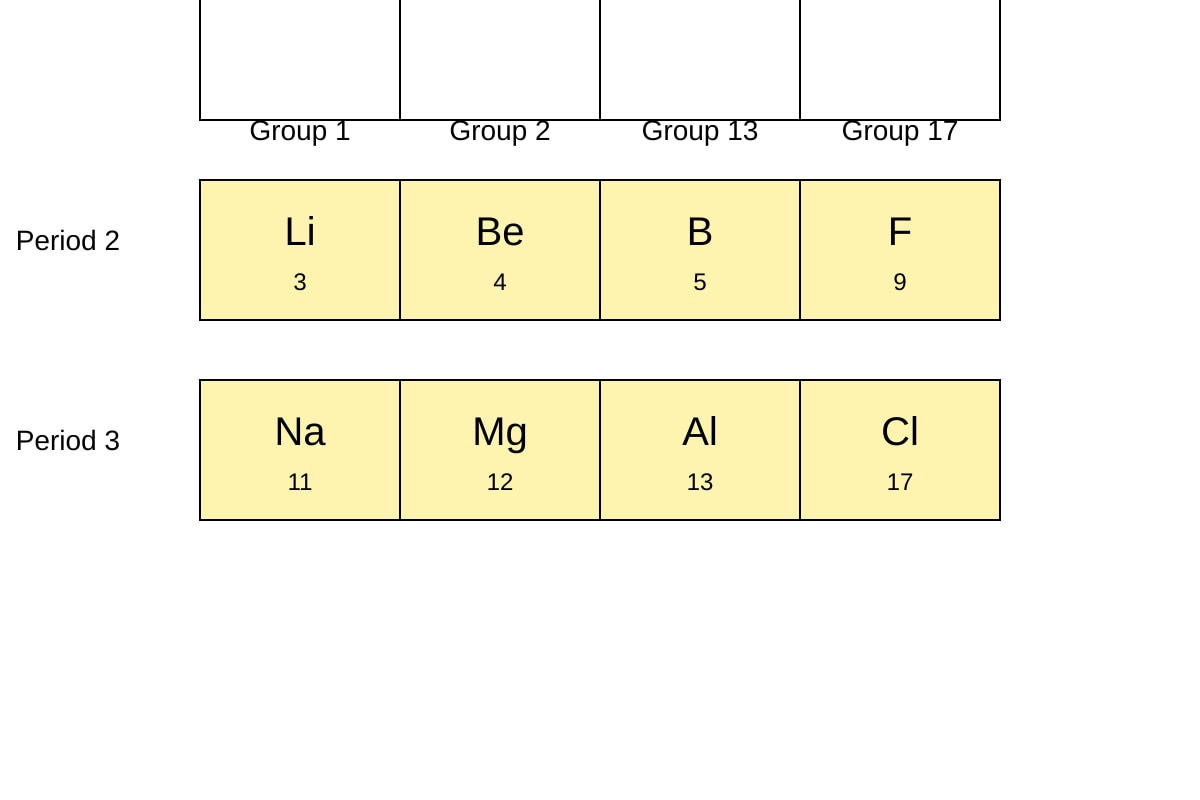
11. The diagram below shows part of the Periodic Table.
Image pending generation: table for Q11.
Name the element in Period 3, Group 17. __________
12. State the charge of the ion formed by an element in Group 2 and explain why.
Charge: __________
Explanation: ________________________________________________________
13. Give the formula of the compound formed between sodium (Group 1) and oxygen (Group 16).
14. Describe one difference between the arrangement of elements in the s-block and d-block.
15. State the trend in atomic radius across Period 3 from left to right and explain.
Trend: ___________________________
Explanation: ________________________________________________________
Section C (Questions 16–20, 3–4 marks each)
16. (a) Describe the trend in reactivity of Group 17 elements going down the group. (2 marks)
(b) Explain this trend in terms of atomic structure. (2 marks)
17. The table shows properties of four elements W, X, Y, Z.
| Element | Proton no. | State at r.t.p. | Electronic config. |
|---|---|---|---|
| W | 3 | solid | 2,1 |
| X | 9 | gas | 2,7 |
| Y | 12 | solid | 2,8,2 |
| Z | 18 | gas | 2,8,8 |
(a) Identify the group of each element. (2 marks)
W: ____ X: ____ Y: ____ Z: ____
(b) Which element is a noble gas? Give a reason. (2 marks)
18. A student says: "As we go across Period 2, the elements become more metallic."
(a) Is this statement correct? (1 mark)
(b) Explain your answer with reference to the position of metals and non-metals. (3 marks)
19. Chlorine (proton 17) and potassium (proton 19) are in Period 3 and Period 4 respectively.
(a) State the number of shells in a potassium atom. (1 mark)
(b) Explain why potassium is more reactive than chlorine. (3 marks)
20. The reactivity series places metals in order of reactivity.
(a) State where the most reactive metals are found in the Periodic Table. (1 mark)
(b) Describe how the Periodic Table helps predict the reactivity of an unknown metal. (3 marks)
Answers
Answer Key: Secondary 4 Combined Science Chemistry Quiz - Periodic Table
Total Marks: 40
Topic: Periodic Table (syllabus-first, Stage 4/5 generated; not claimed as past-year derived)
Section A (1 mark each)
Q1. B
Elements are arranged by increasing proton number (atomic number).
Teaching note: Modern Periodic Table orders by proton number, not atomic mass (Mendeleev used atomic mass).
Common mistake: Choosing A (atomic mass) due to historical context.
Q2. B
Argon (Ar) is in Group 0 (noble gases).
Teaching note: Noble gases: He, Ne, Ar, Kr, Xe, Rn.
Q3. A
Proton number 11 = sodium, Group 1 (alkali metals). Group number = valence electrons for main groups.
Common mistake: Confusing group with period or proton number.
Q4. C
Transition elements are metals, thus good conductors.
Teaching note: They are solid, form coloured compounds, multiple oxidation states.
Q5. B
Reactivity of Group 1 increases down the group (easier loss of outer electron).
Section B (2 marks each)
Q6. Period: 3, Group: 17
Working: Proton 17 → 2,8,7 → 3 shells (period 3), 7 valence (group 17).
Q7. Any two: metallic character, melting point trend, state at r.t.p., conductivity, colour (for some groups).
Marking: 1 mark each.
Q8. Group 0 elements have full outer electron shells (octet), so they do not need to gain/lose/share electrons.
Marking: 2 marks for "full shell" + "no tendency to react".
Q9. 2,8,2
Teaching note: Mg (12): shell 1 holds 2, shell 2 holds 8, remainder 2.
Q10. Trend: decreases. Reason: increased atomic radius / weaker metallic bond down group.
Marking: 1 for trend, 1 for reason.
Q11. Chlorine (Cl)
Image note: Grid shows Period 3 (Na, Mg, Al, Cl); Group 17 column = Cl.
Q12. Charge: +2. Explanation: Group 2 atoms lose 2 outer electrons to achieve stable octet.
Marking: 1 + 1.
Q13. Na₂O
Working: Na⁺ and O²⁻ → cross charges: Na₂O.
Q14. s-block = Groups 1–2 (outer s electrons); d-block = transition metals (d electrons filling).
Marking: 2 marks for clear difference.
Q15. Trend: decreases. Explanation: increased nuclear charge pulls electrons closer across period.
Marking: 1 + 1.
Section C (3–4 marks each)
Q16.
(a) Reactivity decreases down Group 17. (2)
(b) Atom gets larger, outer shell further from nucleus, less attraction for electron → harder to gain e⁻. (2)
Marking descriptors: trend stated (2); reason with atomic size & attraction (2).
Q17.
(a) W: Group 1, X: Group 17, Y: Group 2, Z: Group 18. (2 marks, 0.5 each)
(b) Z is noble gas; config 2,8,8 full outer shell. (2)
Teaching: Group from valence electrons.
Q18.
(a) No / incorrect. (1)
(b) Across Period 2, metals (Li, Be) on left, non-metals (B–Ne) on right; metallic character decreases. (3)
Marking: 1 + 3.
Q19.
(a) 4 shells. (1)
(b) K (Group 1) loses 1 e⁻ easily; Cl (Group 17) gains e⁻ but K more reactive as larger atom, weaker hold. (3)
Note: Reactivity compared as metal vs non-metal; K is more reactive metal.
Q20.
(a) Bottom of Group 1 / far left. (1)
(b) Periodic Table groups show valence; metals lower left are more reactive; predict by group/period position. (3)
Marking: position (1); use of group/period (2).
Free quiz and exam paper access
Enter your details to view this paper
Your access is remembered on this device.