AI Generated Quiz
Secondary 4 Combined Science Chemistry Organic Chemistry Quiz
Free AI-Generated Gemma 4 31B Secondary 4 Combined Science Chemistry Organic Chemistry quiz with questions and answers for Singapore students. This page is rendered as a direct URL so the questions and answers can be discovered without pressing in-page buttons.
These static practice materials are generated from the site's syllabus and paper-generation workflow, with source and model context shown so students and parents can evaluate the material before use.
Questions
Secondary 4 Combined Science Chemistry Quiz - Organic Chemistry
Name: ____________________
Class: ____________________
Date: ____________________
Score: ________ / 45
Duration: 60 Minutes
Total Marks: 45 Marks
Instructions:
- Answer all questions in the spaces provided.
- Use a ruler for any diagrams.
- Show all working for calculations.
Section A: Fundamentals of Hydrocarbons (Questions 1–7)
-
Define the term hydrocarbon. [1] \
-
Draw the displayed structure of butane. [1]
\ -
State the general formula for the alkene series. [1] \
-
Compare the saturation of an alkane and an alkene. [2] \
\
-
A hydrocarbon has the molecular formula . (a) Name the hydrocarbon. [1] \
(b) Is this molecule saturated or unsaturated? [1] \
-
Describe the process of fractional distillation of crude oil. [3] \
\
\
-
Explain why alkanes are generally less reactive than alkenes. [2] \
\
Section B: Chemical Properties & Tests (Questions 8–14)
-
Describe a chemical test to distinguish between ethane and ethene. State the observations for both. [3]
Test: _____________________________________________________________________
Observation for ethane: ____________________________________________________
Observation for ethene: ____________________________________________________ -
What is the name of the reaction where an alkene reacts with steam in the presence of a catalyst? [1] \
-
Write the chemical equation for the complete combustion of methane. [2] \
-
A sample of organic compound X reacts with bromine water, causing it to decolorise. (a) What functional group is present in X? [1] \
(b) Give an example of a compound that would give this result. [1] \
-
Describe the conditions required for the cracking of long-chain alkanes. [2] \
\
-
Explain the term isomerism in the context of organic chemistry. [2] \
\
-
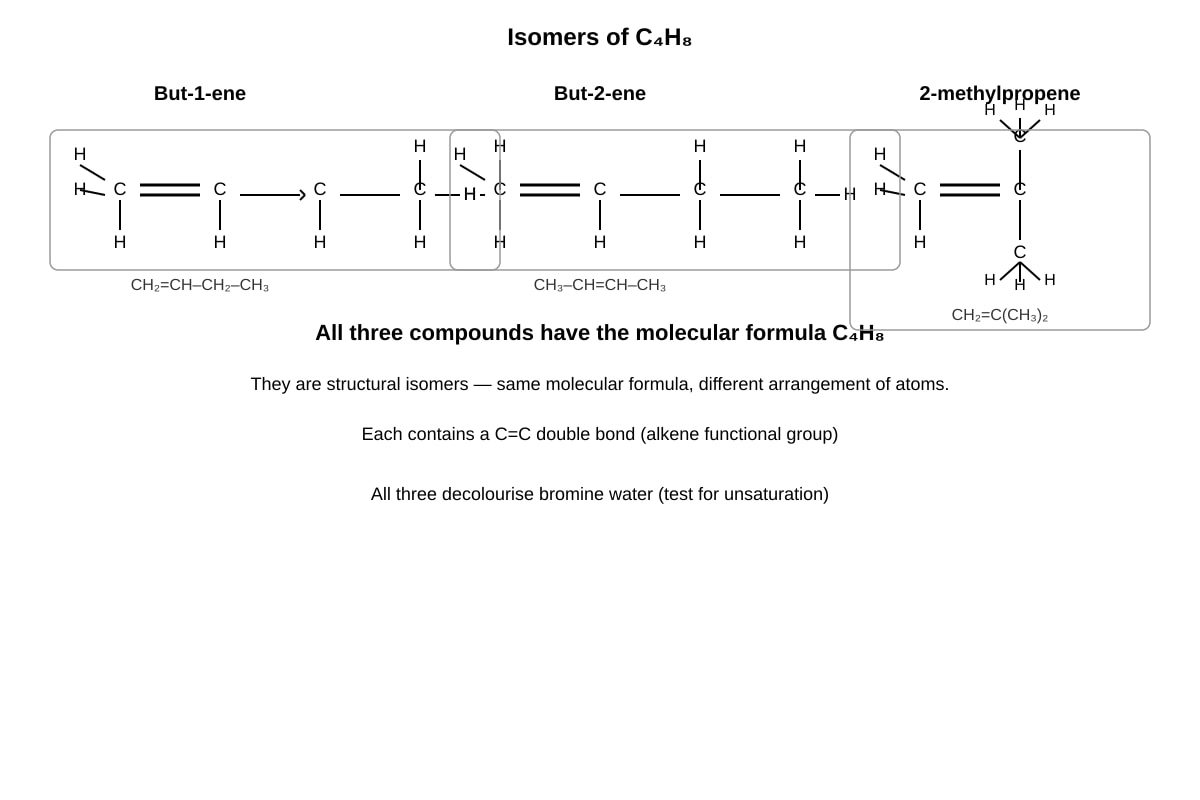
Draw two possible structural isomers for the formula (alkenes). [2]
\
Section C: Alcohols, Acids & Polymers (Questions 15–20)
-
State the functional group present in ethanol. [1] \
-
Describe how ethanol can be produced from ethene. [2] \
\
-
Ethanoic acid is a weak acid. Explain what is meant by "weak acid" in terms of ionisation. [2] \
\
-
A reaction occurs between ethanol and ethanoic acid to produce an ester. (a) Name the ester formed. [1] \
(b) State the catalyst used for this reaction. [1] \
-
Define addition polymerisation. [2] \
\
-
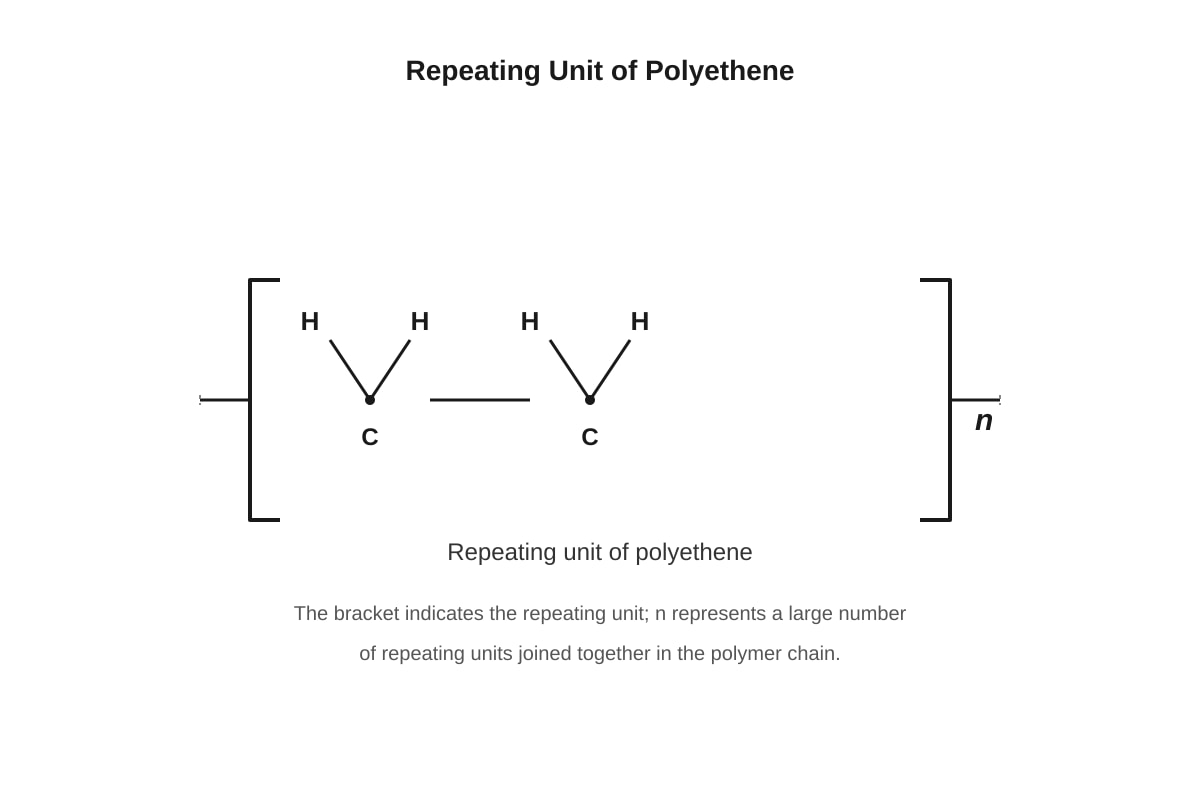
Poly(ethene) is a common plastic. (a) Draw the repeating unit of poly(ethene). [2]
(b) Explain why poly(ethene) is not biodegradable. [2] \
\
Answers
Answer Key - Organic Chemistry Quiz
- A compound consisting of carbon and hydrogen atoms only. [1]
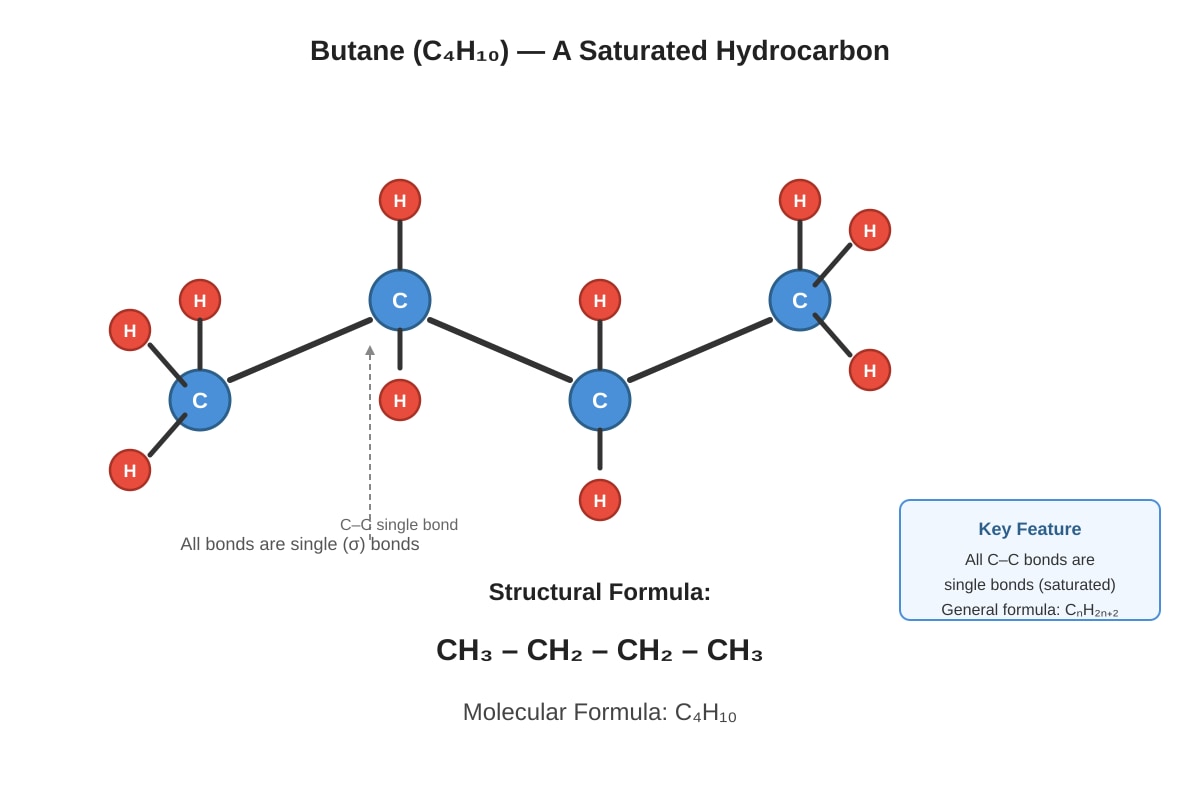
- [Diagram: 4 carbons in a chain, single bonds, saturated with hydrogens]. [1]
- [1]
- Alkanes are saturated (contain only single bonds); Alkenes are unsaturated (contain at least one double bond). [2]
- (a) Propene [1] (b) Unsaturated [1]
- Crude oil is heated; different fractions condense at different heights in the fractionating column based on their boiling points; lower boiling point fractions (shorter chains) condense at the top. [3]
- Alkanes only have strong and single bonds; Alkenes have a double bond which is more reactive and can undergo addition reactions. [2]
- Test: Add bromine water. [1] Ethane: Solution remains orange/brown. [1] Ethene: Solution decolorises / becomes colourless. [1]
- Hydration [1]
- [2]
- (a) double bond / Alkene group [1] (b) Ethene / Propene / Butene [1]
- High temperature (approx. ) and a catalyst (e.g., alumina/silica). [2]
- Compounds with the same molecular formula but different structural arrangements of atoms. [2]
- [Diagrams: But-1-ene and But-2-ene or 2-methylpropene]. [2]
- Hydroxyl group () [1]
- Reaction of ethene with steam [1] in the presence of phosphoric acid catalyst at high temperature/pressure [1].
- It only partially ionises/dissociates in aqueous solution [1], meaning only a small fraction of molecules release ions [1].
- (a) Ethyl ethanoate [1] (b) Concentrated sulfuric acid [1]
- The process where many small unsaturated monomers (like ethene) join together to form a long-chain saturated polymer [2].
- (a) [Diagram: in brackets with subscript]. [2] (b) It is a synthetic polymer with strong bonds [1] that microorganisms/enzymes cannot break down [1].