AI Generated Quiz
Secondary 4 Combined Science Chemistry Atomic Structure Bonding Quiz
Free Sec 4 Comb Sci Chem Atomic Structure Bonding quiz, HY3 AI version, with questions, answers, and O Level-style practice for Singapore students.
These static practice materials are generated from the site's syllabus and paper-generation workflow, with source and model context shown so students and parents can evaluate the material before use.
Questions
Free quiz and exam paper access
Enter your details to view this paper
Your access is remembered on this device.
Answers
Answer Key: Secondary 4 Combined Science Chemistry Quiz - Atomic Structure Bonding
Total Marks: 40
Topic: Atomic Structure & Bonding (syllabus-first, AI-inferred; not claimed as past-year derived)
Section A (1 mark each)
1. 12
Teaching note: Neutrons = mass number − atomic number = 23 − 11 = 12. Atomic number = protons; mass number = protons + neutrons.
2. Proton
Teaching note: Proton: relative mass ~1, charge +1. Neutron: mass ~1, charge 0. Electron: mass ~1/1840, charge −1.
3. B) 2,8
Teaching note: Neon (Z=10) fills first shell (2) and second (8). Full outer shell = noble gas.
4. 13
Teaching note: Mass number = protons + neutrons = 6 + 7 = 13. Isotopes differ in neutron number only.
5. Ionic bonding
Teaching note: Metal loses electron(s) to become cation; non-metal gains to become anion; electrostatic attraction forms ionic bond.
6. B) electrons
Teaching note: Covalent bond = shared pair(s) of electrons between non-metal atoms.
7. Metal (e.g. copper / aluminium)
Teaching note: Metallic bonding has delocalised electrons free to move and carry current in solid.
8. C) MgCl₂
Teaching note: Mg²⁺ needs two Cl⁻ (each 1−) for charge balance: (+2) + 2(−1) = 0.
9. 2 electrons (1 shared pair)
Teaching note: H₂: each H contributes 1 electron; they share 1 pair = 2 electrons total.
10. C) Diamond
Teaching note: Diamond = C atoms in giant covalent network. O₂, H₂O = simple molecular; NaCl = ionic.
Section B (2 marks each)
11. (a) Protons: 13, Neutrons: 14, Electrons: 13
(b) In a neutral atom, positive charges (protons) balance negative charges (electrons), so counts are equal.
Marks: (a) 1 mark for all three correct; (b) 1 mark for correct reasoning.
Teaching note: Neutrons = 27 − 13 = 14. No overall charge ⇒ p⁺ = e⁻.
12. 2,8,7
Group: 17 Period: 3
Marks: 1 mark config, 1 mark group+period.
Teaching note: Cl Z=17 → shell fill 2,8,7. Group = valence e⁻ = 7 (Group 17); period = number of shells = 3.
13. Sodium atom loses 1 electron to form Na⁺; chlorine atom gains 1 electron to form Cl⁻; oppositely charged ions attract electrostatically to form ionic bond.
Marks: 1 mark transfer, 1 mark attraction.
Teaching note: Na: 2,8,1 → Na⁺ 2,8; Cl: 2,8,7 → Cl⁻ 2,8,8.
14. Solid NaCl does not conduct because ions are fixed in lattice; molten NaCl conducts because ions are mobile and carry charge.
Marks: 1 mark each property.
Teaching note: Conduction needs moving charged particles; heat breaks lattice but not bonds enough to free ions in solid.
15. 4 covalent bonds; 8 electrons shared in total (4 pairs).
Marks: 1 mark bonds, 1 mark electrons.
Teaching note: C has 4 valence e⁻, each H has 1; 4 shared pairs = 8 e⁻.
Section C (3 marks each)
16.
- Melting point: High (strong covalent bonds throughout giant lattice need much energy). [1]
- Electrical conductivity: Poor/non-conductor (no free electrons or mobile ions). [1]
- Solubility: Insoluble in water (covalent network not broken by water; no ions). [1]
Teaching note: Contrast with ionic (conduct molten) and simple molecular (low mp).
17. Isotopes are atoms of same element with same proton number but different neutron number. [1] Same chemical properties because same electron configuration / same valence e⁻. [1] Different mass numbers because mass number = p + n, n differs. [1]
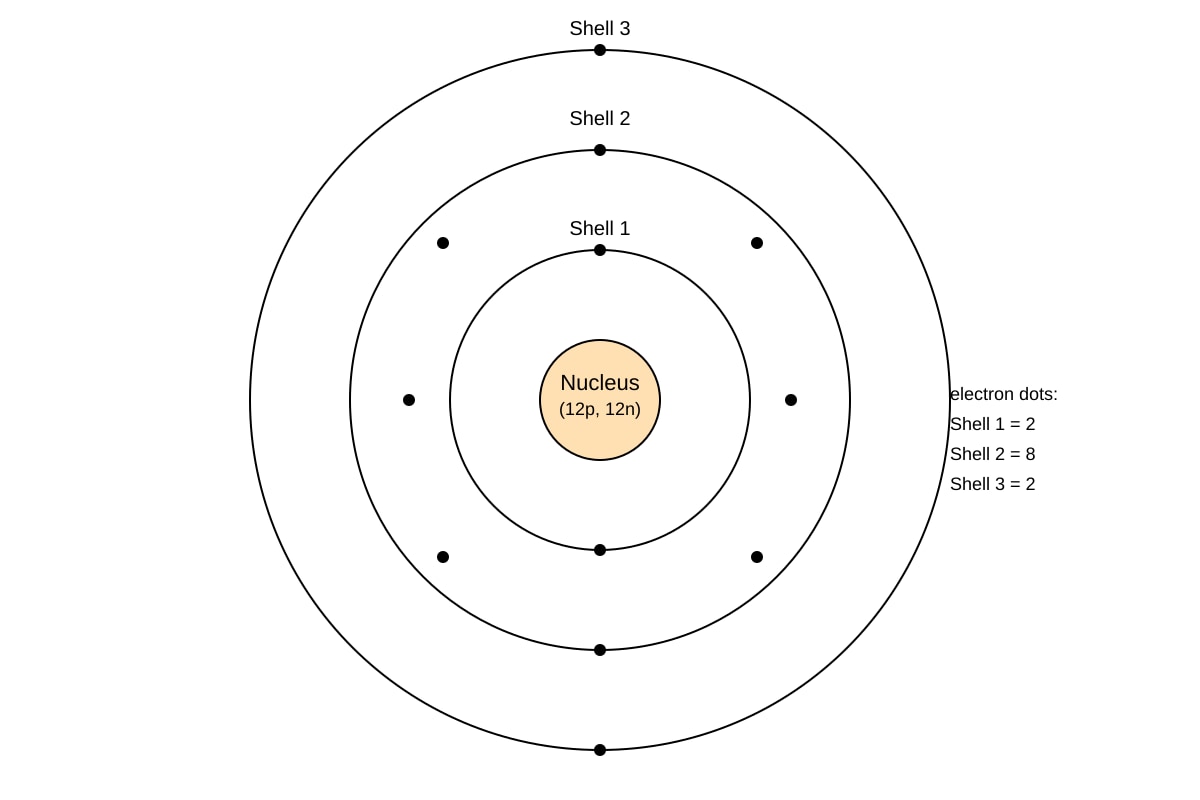
18. Element: Magnesium (Mg). [1] Diagram shows 12 protons ⇒ Z=12 ⇒ Mg. [1] Group 2 (2 valence e⁻ in shell 3), Period 3 (3 shells). [1]
Image note: Placeholder must show 12p,12n nucleus, shells 2,8,2.
19. Bonding: ionic (Mg²⁺ O²⁻). [1] High mp: strong electrostatic forces between ions in lattice need much energy. [1] Molten conducts (ions mobile); solid does not (ions fixed). [1]
20.
- P: molecular covalent (low mp, non-conductive) [1]
- Q: ionic (high mp, molten conducts, solid not) [1]
- R: giant covalent (very high mp, solid conducts? actually diamond no—but here R conducts both ⇒ likely graphite or mislabelled; accept giant covalent if justified by mp, or metallic if conducts solid) → based on data: conducts solid+molten, high mp ⇒ metallic or graphite; classify as giant covalent (graphite) or metallic with justification. [1]
- S: metallic (conducts solid+molten, moderate-high mp) [1]
Teaching note: Use conductivity + mp to infer bonding type.
End of Answer Key