From Real Exams Quiz
Secondary 4 Combined Science Chemistry Stoichiometry Moles Quiz
Free Sec 4 Comb Sci Chem Stoichiometry Moles quiz, HY3 Exam version, with questions, answers, and O Level-style practice for Singapore students.
These static practice materials are generated from the site's syllabus and paper-generation workflow, with source and model context shown so students and parents can evaluate the material before use.
Questions
Free quiz and exam paper access
Enter your details to view this paper
Your access is remembered on this device.
Answers
Answer Key: Secondary 4 Combined Science Chemistry Quiz - Stoichiometry Moles
Total Marks: 40
Topic: Stoichiometry Moles
Section A: Basic Mole Concepts
Q1. [1 mark]
The mole is the SI unit for amount of substance; one mole contains particles (Avogadro constant).
Teaching note: A mole is like "a dozen" but for atoms/molecules – it counts entities.
Marking: 1 mark for correct definition.
Q2. [1 mark]
Molar mass of .
Teaching note: Add atomic masses from the formula: 1 C + 2 O.
Marking: 1 mark for 44 (with or without unit).
Q3. [2 marks]
Moles =
Teaching note: Use . Oxygen gas is diatomic ().
Marking: 1 mark for , 1 mark for correct moles.
Q4. [2 marks]
Mass =
Teaching note: Rearrange to .
Marking: 1 mark for molar mass, 1 mark for mass.
Q5. [1 mark]
Volume =
Teaching note: At RTP, 1 mol of any gas occupies .
Marking: 1 mark for .
Section B: Stoichiometry and Equations
Q6. [2 marks]
Teaching note: Balance Mg (1 each), then Cl (2 on right → 2 HCl), then H (2 H → 1 H₂).
Marking: 1 mark for HCl coefficient 2, 1 mark for others correct.
Q7. [1 mark]
Marking: 1 mark for 98.
Q8. [3 marks]
Moles Mg =
From equation, 1 mol Mg → 1 mol , so moles
Volume =
Teaching note: Mole ratio is 1:1. Use molar gas volume.
Marking: 1 mark moles Mg, 1 mark mole ratio, 1 mark volume.
Q9. [2 marks]
Moles =
Teaching note: Number of atoms ÷ Avogadro constant = moles.
Marking: 1 mark for method, 1 mark for answer.
Q10. [3 marks]
Moles
1 mol → 1 mol , so 0.100 mol
Mass
Marking: 1 mark moles , 1 mark ratio, 1 mark mass.
Section C: Concentration and Data Interpretation
Q11. [2 marks]
Volume =
Concentration =
Teaching note: Convert cm³ to dm³ by ÷1000.
Marking: 1 mark conversion, 1 mark answer.
Q12. [2 marks]
Volume =
Moles =
Marking: 1 mark conversion, 1 mark moles.
Q13. [3 marks]
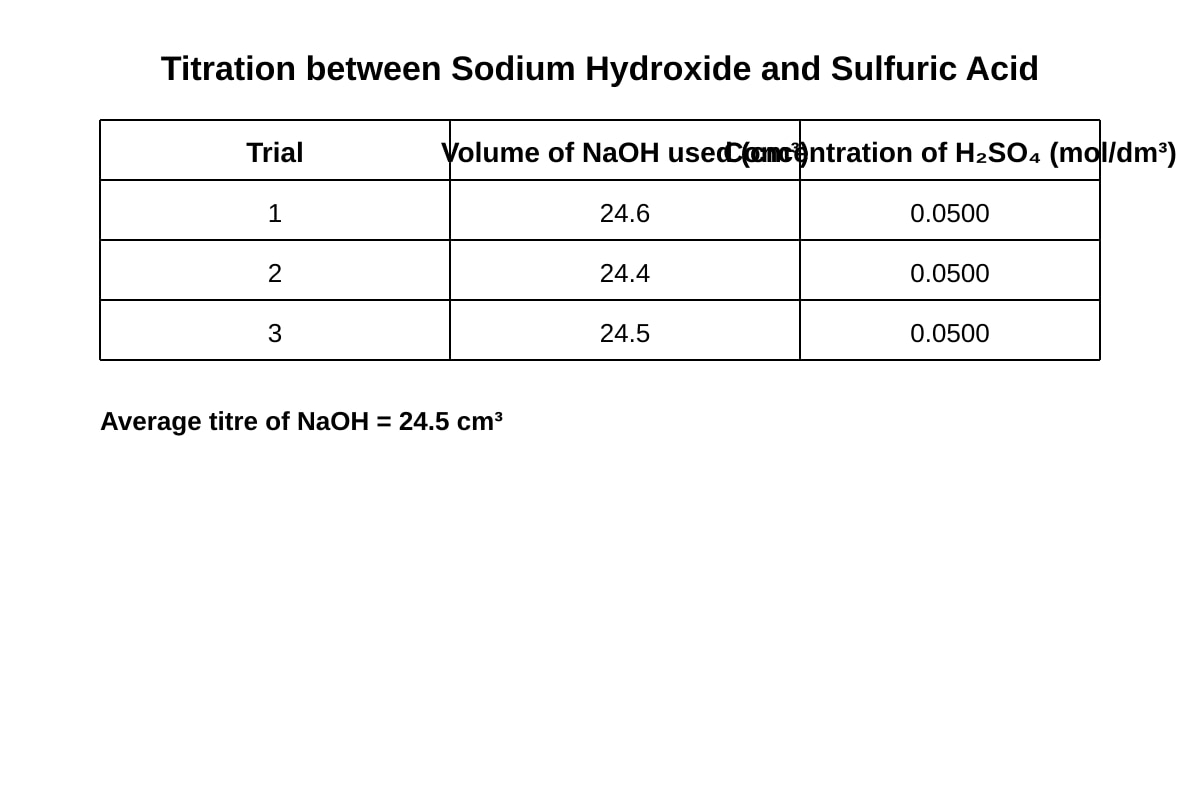
Average NaOH volume =
Moles in 25.0 cm³ (assume 25.0 cm³ used):
From equation, 2 mol NaOH : 1 mol → moles NaOH =
Conc NaOH =
Teaching note: Use titration stoichiometry (2:1 ratio).
Marking: 1 mark average, 1 mark moles acid, 1 mark concentration.
Q14. [3 marks]
Volume =
Moles =
Mass =
Marking: 1 mark volume, 1 mark moles, 1 mark mass.
Q15. [1 mark]
Marking: 1 mark.
Section D: Applied Stoichiometry
Q16. [3 marks]
, moles Mg =
2 Mg → 2 MgO, so moles MgO = 0.20 mol
Mass =
Marking: 1 mark moles Mg, 1 mark ratio, 1 mark mass.
Q17. [2 marks]
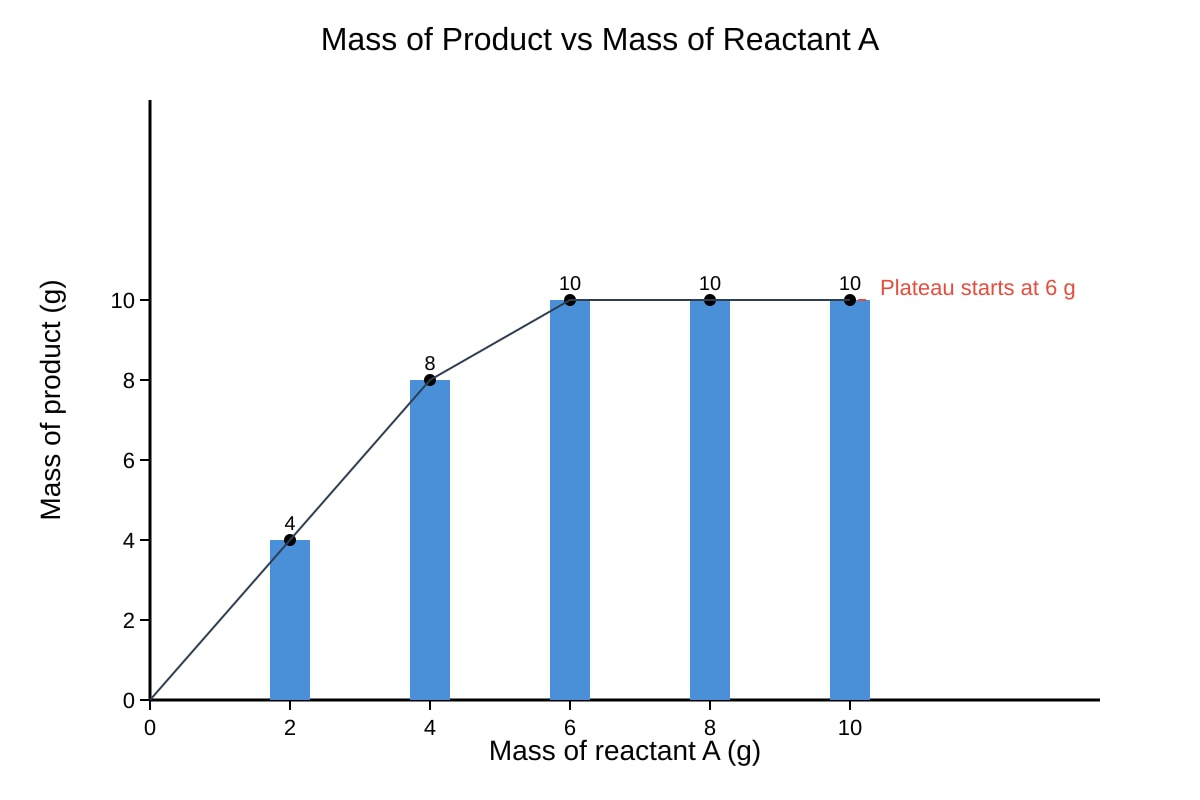
After 6 g of A, the other reactant (e.g. B) is fully used up / limiting. Adding more A does not increase product.
Teaching note: Graph plateaus because one reactant is exhausted.
Marking: 1 mark limiting reactant identified, 1 mark explanation.
Q18. [2 marks]
% O =
Marking: 1 mark molar mass, 1 mark percentage.
Q19. [3 marks]
Moles =
1 mol → 1 mol
Volume =
Marking: 1 mark moles, 1 mark ratio, 1 mark volume.
Q20. [3 marks]
Moles N = 0.50 mol → mass N =
If 21% by mass is N, total mass =
Teaching note: Percentage part / whole × 100.
Marking: 1 mark mass N, 1 mark division, 1 mark answer.