From Real Exams Quiz
Secondary 4 Combined Science Chemistry Redox Electrochemistry Quiz
Free Sec 4 Comb Sci Chem Redox Electrochemistry quiz, HY3 Exam version, with questions, answers, and O Level-style practice for Singapore students.
These static practice materials are generated from the site's syllabus and paper-generation workflow, with source and model context shown so students and parents can evaluate the material before use.
Questions
Secondary 4 Combined Science Chemistry Quiz - Redox Electrochemistry
Name:
Class:
Date:
Score:
Duration: 60 minutes
Total Marks: 40
Instructions: Answer all 20 questions. Section A is short answer, Section B is structured response, Section C is data/interpretation. Show all working where calculation is required.
Section A: Short Answer (Questions 1–5)
1. State the meaning of the term oxidation in terms of electrons. [1]
2. State the meaning of the term reduction in terms of electrons. [1]
3. Write the colour of the cathode in a simple copper sulfate electrolysis cell using copper electrodes. [1]
4. Name the gas produced at the anode during electrolysis of aqueous sodium chloride using inert electrodes. [1]
5. State one use of electroplating in everyday life. [1]
Section B: Structured Response (Questions 6–15)
6. (a) Define redox reaction. [1]
(b) State what happens to the oxidation state of an element that is oxidised. [1]
(a) _______________________________________________________
(b) _______________________________________________________
7. (a) Write the ionic half-equation for the discharge of copper(II) ions at the cathode. [1]
(b) Write the ionic half-equation for the discharge of bromide ions at the anode. [1]
(a) _______________________________________________________
(b) _______________________________________________________
8. A student places a clean iron nail into copper(II) sulfate solution.
(a) State the observation on the iron nail. [1]
(b) Explain why this reaction occurs using the reactivity series. [2]
(a) _______________________________________________________
(b) _______________________________________________________
9. (a) State the products at the anode and cathode during electrolysis of molten lead(II) bromide using inert electrodes. [2]
(b) Write the equation for the overall reaction. [1]
(a) Anode: ______________ Cathode: ______________
(b) _______________________________________________________
10. (a) State two conditions necessary for rusting of iron to occur. [2]
(b) Name one method to prevent rusting. [1]
(a) _______________________________________________________
(b) _______________________________________________________
11. In the electrolysis of acidified water using platinum electrodes:
(a) State the gas produced at the cathode and a test for it. [2]
(b) State the gas produced at the anode and a test for it. [2]
(a) _______________________________________________________
(b) _______________________________________________________
12. (a) Explain why zinc is used to galvanise iron. [2]
(b) State what happens to the zinc when the coated iron is scratched. [1]
(a) _______________________________________________________
(b) _______________________________________________________
13. A cell is set up with zinc and copper electrodes in contact with their own ions.
(a) State which metal is the anode. [1]
(b) State the direction of electron flow in the external wire. [1]
(c) Write the overall cell reaction. [1]
(a) _______________________________________________________
(b) _______________________________________________________
(c) _______________________________________________________
14. (a) State the colour change of litmus paper in chlorine gas produced at anode during electrolysis of aqueous sodium chloride. [1]
(b) Explain why this change occurs. [2]
(a) _______________________________________________________
(b) _______________________________________________________
15. (a) Calculate the charge in coulombs passed when a current of 0.50 A flows for 200 s. [2]
(b) State the formula linking charge, current and time. [1]
(a) _______________________________________________________
(b) _______________________________________________________
Section C: Data and Interpretation (Questions 16–20)
16. The reactivity series (most to least reactive) is: Potassium, Sodium, Calcium, Magnesium, Aluminium, Zinc, Iron, Tin, Lead, Copper, Silver, Gold.
(a) Which of iron or copper is more easily oxidised? [1]
(b) Write a word equation for the reaction when iron is placed in copper(II) nitrate solution. [2]
(a) _______________________________________________________
(b) _______________________________________________________
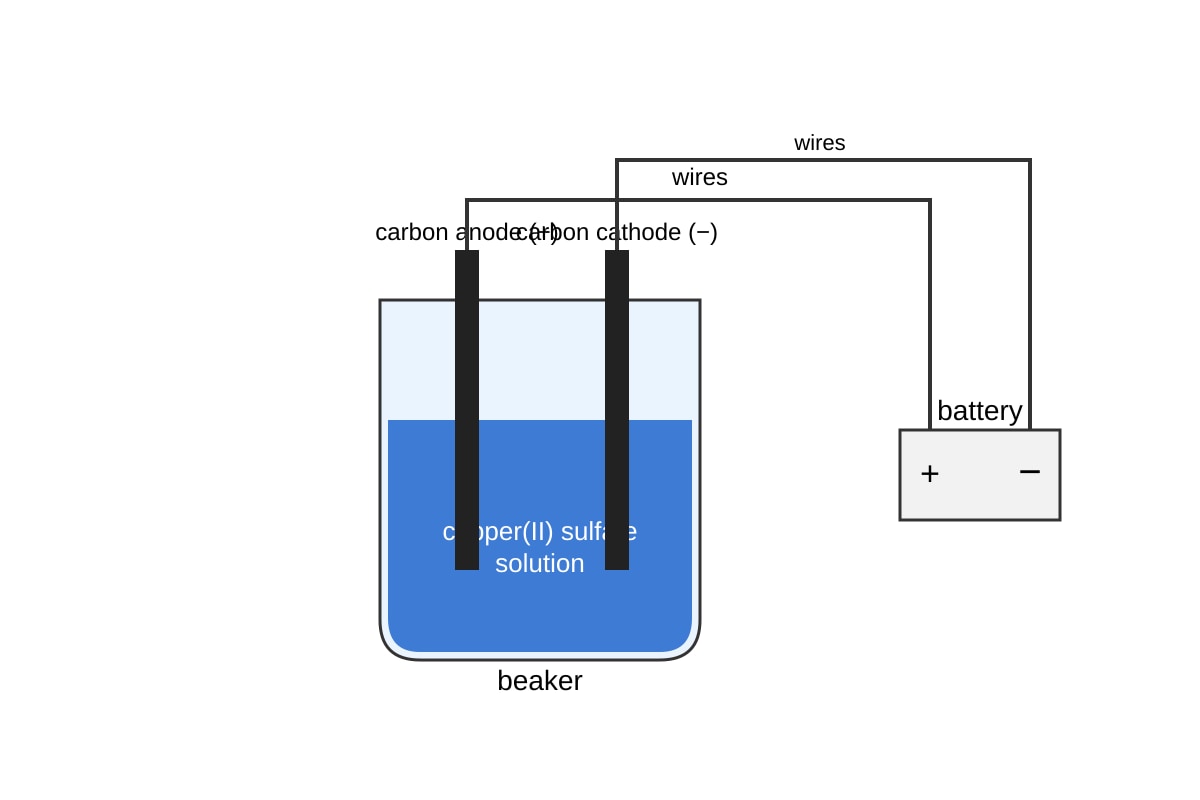
17.
Image pending generation: experimental_setup for Q17.
Using the diagram, state:
(a) the colour of the solution after some time. [1]
(b) the product at the cathode. [1]
(c) the product at the anode. [1]
(a) _______________________________________________________
(b) _______________________________________________________
(c) _______________________________________________________
18. A battery is connected to two inert electrodes in potassium iodide solution.
(a) State the product at the anode and its observation. [2]
(b) State the product at the cathode. [1]
(a) _______________________________________________________
(b) _______________________________________________________
19. The table shows results when metal X and metal Y are placed in solutions of their ions.
| Metal in solution of | X ions | Y ions |
|---|---|---|
| X strip | No change | X dissolves |
| Y strip | No change | No change |
(a) State which metal is more reactive. [1]
(b) Explain your answer using redox ideas. [2]
(a) _______________________________________________________
(b) _______________________________________________________
20. (a) State the oxidation state of Mn in KMnO4. [2]
(b) State the oxidation state of Cr in K2Cr2O7. [2]
(a) _______________________________________________________
(b) _______________________________________________________
Answers
Secondary 4 Combined Science Chemistry Quiz - Redox Electrochemistry: Answer Key
Total Marks: 40
Topic: Redox Electrochemistry
Section A
1. Oxidation is loss of electrons (OIL). [1]
Teaching note: Recall OIL RIG: Oxidation Is Loss, Reduction Is Gain of electrons.
2. Reduction is gain of electrons (RIG). [1]
Teaching note: Opposite of Q1; electrons are gained by the species reduced.
3. Copper (pink/brown) – cathode remains copper coloured or gains copper deposit. [1]
Teaching note: In CuSO₄ with Cu electrodes, Cu²⁺ deposits as Cu metal on cathode, same colour.
4. Chlorine gas, Cl2. [1]
Teaching note: In aqueous NaCl with inert electrodes, Cl⁻ is discharged preferentially over OH⁻ in concentrated solution forming Cl₂.
5. Any one: protect objects from corrosion (e.g. chrome plating on taps), decorative coating (silver plating jewellery), reduce friction. [1]
Teaching note: Electroplating uses electrolysis to coat a metal object with a thin layer of another metal.
Section B
6. (a) Redox reaction is a reaction where both reduction and oxidation occur simultaneously. [1]
(b) Its oxidation state increases. [1]
Teaching note: Oxidation state tracks electron loss; loss of electrons → number becomes more positive.
7. (a) Cu2++2e−→Cu [1]
(b) 2Br−→Br2+2e− [1]
Teaching note: Cations go to cathode and gain electrons; anions go to anode and lose electrons.
8. (a) Iron nail becomes coated with a reddish-brown (copper) layer. [1]
(b) Iron is above copper in reactivity series, so iron is more reactive and displaces Cu²⁺ from solution: Fe+Cu2+→Fe2++Cu. Iron is oxidised. [2]
Marking: 1 for reactivity reason, 1 for displacement/oxidation explanation.
9. (a) Anode: bromine (Br2); Cathode: lead (Pb). [2]
(b) Pb2++2Br−→Pb+Br2 or molten PbBr2→Pb+Br2. [1]
10. (a) Presence of oxygen (air) and water (moisture). [2]
(b) Painting, greasing, galvanising, alloying, sacrificial protection. [1]
11. (a) Cathode: hydrogen (H2); test: lighted splint gives pop sound. [2]
(b) Anode: oxygen (O2); test: glowing splint relights. [2]
12. (a) Zinc is more reactive than iron, so it acts as sacrificial anode; oxidised first, protecting iron. [2]
(b) Zinc is oxidised (corrodes) instead of iron. [1]
13. (a) Zinc. [1]
(b) From zinc (anode) to copper (cathode). [1]
(c) Zn+Cu2+→Zn2++Cu. [1]
14. (a) Litmus turns red (then may be bleached white). [1]
(b) Chlorine reacts with water to form HCl and HOCl (acidic), turning litmus red; bleaching by HOCl. [2]
15. (a) Q=I×t=0.50×200=100 C. [2]
(b) Q=It. [1]
Section C
16. (a) Iron. [1]
(b) Iron + copper(II) nitrate → iron(II) nitrate + copper. [2]
17. (a) Blue colour fades (becomes paler). [1]
(b) Copper metal (Cu). [1]
(c) Oxygen (O2) from water (carbon anode inert, OH⁻ discharged). [1]
Image note: Diagram must show carbon electrodes, blue CuSO₄, battery; correct polarity confirms products.
18. (a) Iodine (I2); brown solution / black solid at anode. [2]
(b) Hydrogen (H2). [1]
19. (a) Y is more reactive. [1]
(b) Y strip dissolves in X ions, meaning Y is oxidised and X²⁺ reduced; Y loses electrons more readily. [2]
20. (a) K = +1, O = −2; let Mn = x: +1+x+4(−2)=0⇒x=+7. [2]
(b) K = +1, O = −2; 2(+1)+2y+7(−2)=0⇒2y=12⇒y=+6. [2]
Free quiz and exam paper access
Enter your details to view this paper
Your access is remembered on this device.