Secondary 4 Combined Science Chemistry Quiz - Periodic Table
Name: ___________________________
Class: ______________
Date: ______________
Score: ______________ / 40
Duration: 45 minutes
Total Marks: 40
Instructions: Answer all 20 questions. Section A is multiple-choice (1 mark each). Section B is short structured questions. Section C requires extended responses. Use a separate answer sheet if needed.
Section A: Multiple Choice (Questions 1–5, 1 mark each, total 5 marks)
-
Which of the following elements is a transition metal?
A. Sodium
B. Iron
C. Oxygen
D. Neon
Answer: ______
-
Which group in the Periodic Table contains the most reactive metals?
A. Group 1
B. Group 2
C. Group 17
D. Group 18
Answer: ______
-
As we go down Group 1, the reactivity of the metals ____________.
A. decreases
B. increases
C. remains the same
D. becomes zero
Answer: ______
-
Which property generally decreases across a Period from left to right?
A. Atomic radius
B. Number of shells
C. Melting point
D. Reactivity of metals
Answer: ______
-
An element has electronic structure 2,8,7. To which group does it belong?
A. Group 1
B. Group 7
C. Group 8
D. Group 17
Answer: ______
Section B: Structured Questions (Questions 6–15, total 20 marks)
6. [2 marks] State the colour of the flame when lithium is heated in air and placed in oxygen.
7. [2 marks] Write the balanced equation for the reaction between potassium and water.
8. [2 marks] Explain why the atomic radius decreases across Period 3 from sodium to argon.
9. [2 marks] Name the element in Period 3 that is a noble gas. State its group number.
10. [2 marks] The table below shows the melting points of four elements from Period 3.
| Element | Na | Mg | Al | Si |
|---|
| Melting point (°C) | 98 | 650 | 660 | 1410 |
Describe the trend in melting point across these elements and give a reason.
11. [2 marks] Chlorine reacts with potassium bromide solution. Write the word equation for this reaction.
12. [2 marks] Explain why fluorine is a stronger oxidising agent than chlorine.
13. [2 marks] A student tests a solution with universal indicator and obtains a purple colour. State the pH range and whether the solution is acidic, alkaline, or neutral.
14. [2 marks] Give two physical properties that are typical of transition metals.
-
-
15. [2 marks] State one use of argon and explain why its electronic structure makes it suitable.
Section C: Extended Questions (Questions 16–20, total 15 marks)
16. [3 marks] The diagram below shows the first 20 elements of the Periodic Table.
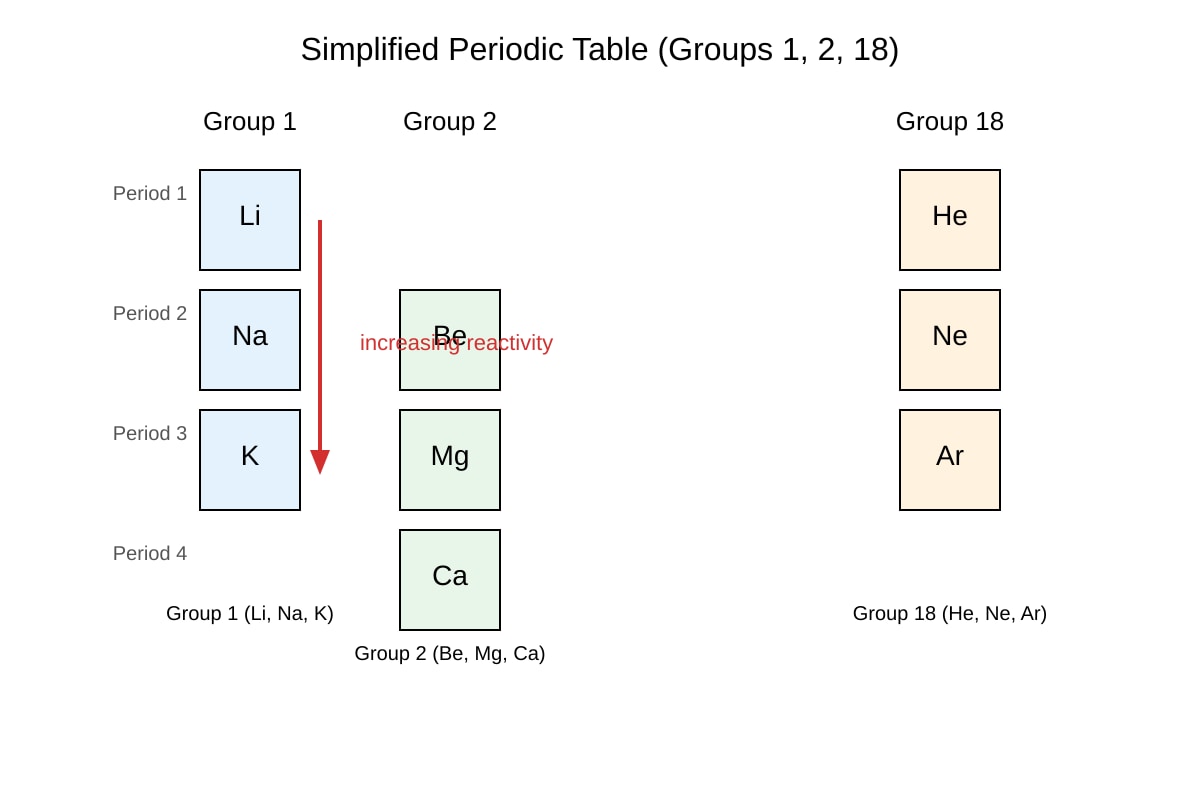
Generated diagram for Q16.
Using the diagram, explain the trend in reactivity of Group 1 elements down the group and link this to their atomic structure.
17. [3 marks] A sample of Period 3 elements shows the following properties:
| Element | X | Y | Z |
|---|
| Type | metal | metalloid | non-metal |
| Chloride formula | XCl | YCl₄ | ZCl₄ |
Identify X, Y, and Z from Na, Si, P, S, Cl. Explain your choices using the Periodic Table.
18. [3 marks] Compare the boiling points of the halogens fluorine, chlorine, bromine, and iodine. Explain the trend in terms of intermolecular forces.
19. [3 marks] A transition metal compound is used as a catalyst in the manufacture of ammonia. Name the metal and state two general properties of transition metals that make them useful as catalysts.
20. [3 marks] The electronic structures of three elements are given:
P: 2,8,1
Q: 2,8,7
R: 2,8,8
(a) State which are metals and which are non-metals.
(b) Predict the formula of the compound formed between P and Q.
(c) Explain your answer using the octet rule.
</stage3_quiz_answers_md>
<stage3_quiz_answers_md>
Secondary 4 Combined Science Chemistry Quiz - Periodic Table (Answer Key)
Total Marks: 40
Duration: 45 minutes
Section A: Multiple Choice (5 marks)
1. B (Iron)
- Teaching note: Transition metals are found in the central block of the Periodic Table (Groups 3–12). Iron (Fe) is a transition metal. Sodium is Group 1, oxygen is a non-metal in Group 16, neon is a Group 18 noble gas.
- Mark: 1
2. A (Group 1)
- Teaching note: Group 1 metals (alkali metals) are the most reactive metals because they easily lose one electron to form a +1 ion. Group 17 are non-metals (halogens), Group 18 are unreactive noble gases.
- Mark: 1
3. B (increases)
- Teaching note: Down Group 1, the outer electron is further from the nucleus and shielding increases, so it is lost more easily. Reactivity increases down the group.
- Mark: 1
4. A (Atomic radius)
- Teaching note: Across a period, protons increase but shells stay the same, pulling electrons closer. Atomic radius decreases. Number of shells stays the same; melting points vary; metal reactivity decreases.
- Mark: 1
5. B (Group 7)
- Teaching note: Electronic structure 2,8,7 means 7 valence electrons → Group 7 (or Group 17 in IUPAC numbering).
- Mark: 1
Section B: Structured Questions (20 marks)
6. [2 marks]
- Answer: Crimson red flame / red flame.
- Teaching note: Lithium burns with a crimson red flame in oxygen to form lithium oxide.
- Marks: 1 for colour, 1 for context if needed.
7. [2 marks]
- Answer: ( 2K + 2H_2O \rightarrow 2KOH + H_2 )
- Teaching note: Potassium reacts vigorously with water to form potassium hydroxide and hydrogen gas. Balance: 2K + 2H₂O → 2KOH + H₂.
- Marks: 1 for correct reactants/products, 1 for balancing.
8. [2 marks]
- Answer: Across Period 3, nuclear charge increases but electrons are added to the same shell. The increased pull pulls electrons closer, so atomic radius decreases.
- Teaching note: More protons = stronger attraction; same shell number.
- Marks: 1 for nuclear charge idea, 1 for same shell/attraction.
9. [2 marks]
- Answer: Argon (Ar); Group 18 (or Group 0 / Group VIII).
- Teaching note: Argon is the Period 3 noble gas with full outer shell (2,8,8).
- Marks: 1 for argon, 1 for group number.
10. [2 marks]
- Answer: Melting point increases from Na to Si then drops for P and S (non-molecular). Reason: metallic bonding strengthens from Na→Al; Si is giant covalent (very high mp).
- Teaching note: Trend shows increase due to stronger metallic bonding; Si high due to covalent network.
- Marks: 1 for trend stated, 1 for reason.
11. [2 marks]
- Answer: Potassium chloride + bromine → potassium bromide + chlorine.
- Teaching note: Cl₂ displaces Br⁻: ( Cl_2 + 2KBr \rightarrow 2KCl + Br_2 ). Word equation as above.
- Marks: 1 for products, 1 for correct names.
12. [2 marks]
- Answer: Fluorine has a smaller atomic radius and higher electronegativity, so it more easily gains electrons than chlorine.
- Teaching note: Oxidising ability = ease of gaining electrons. F is smaller, more reactive.
- Marks: 1 for size/electronegativity, 1 for conclusion.
13. [2 marks]
- Answer: pH 10–14 (purple = strongly alkaline); alkaline.
- Teaching note: Universal indicator purple = strong alkali (pH ~12–14).
- Marks: 1 for pH range, 1 for alkaline.
14. [2 marks]
- Answer: Any two from: high melting point, good conductors of heat/electricity, hard, high density, malleable, form coloured compounds.
- Teaching note: Transition metals share these properties.
- Marks: 1 each.
15. [2 marks]
- Answer: Used in light bulbs / welding / inert atmosphere. Reason: full outer shell (stable, unreactive).
- Teaching note: Argon’s 2,8,8 structure is stable, so it does not react.
- Marks: 1 for use, 1 for reason.
Section C: Extended Questions (15 marks)
16. [3 marks]
- Answer: Reactivity increases down Group 1 (Li < Na < K). Atoms get larger; outer electron further from nucleus; easier to lose e⁻.
- Teaching note: Use diagram arrow. Link to atomic radius and shielding.
- Marks: 1 trend, 1 atomic size, 1 electron loss ease.
17. [3 marks]
- Answer: X = Na (metal, forms XCl), Y = Si (metalloid, forms YCl₄), Z = P or S (non-metal, ZCl₄). From list: X=Na, Y=Si, Z=P (or S).
- Teaching note: Na is metal (Group 1); Si metalloid (Group 14, 4 Cl); P/S non-metal forms 4 chlorides.
- Marks: 1 each identification + reason.
18. [3 marks]
- Answer: BP increases F < Cl < Br < I. Larger molecules = stronger London forces. More electrons = greater induced dipoles.
- Teaching note: Trend due to increasing molecular size / van der Waals.
- Marks: 1 trend, 1 forces, 1 explanation.
19. [3 marks]
- Answer: Iron (Fe) used in Haber process. Properties: variable oxidation states; ability to adsorb gases; high melting point; form complexes.
- Teaching note: Transition metals good catalysts due to incomplete d-orbitals.
- Marks: 1 metal, 2 properties.
20. [3 marks]
- (a) P metal, Q non-metal, R noble gas (unreactive).
- (b) Formula: NaCl (or PCl).
- (c) P loses 1e⁻ to Q (needs 1e⁻ for octet). Ionic bond forms.
- Teaching note: Octet rule: P gives e⁻ to Q; both achieve 2,8.
- Marks: 1(a), 1(b), 1(c).
</stage3_quiz_answers_md>
<stage3_quiz_md>
Secondary 4 Combined Science Chemistry Quiz - Periodic Table
Name: ___________________________
Class: ______________
Date: ______________
Score: ______________ / 40
Duration: 45 minutes
Total Marks: 40
Instructions: Answer all 20 questions. Section A is multiple-choice (1 mark each). Section B is short structured questions. Section C requires extended responses. Use a separate answer sheet if needed.
Section A: Multiple Choice (Questions 1–5, 1 mark each, total 5 marks)
-
Which of the following elements is a transition metal?
A. Sodium
B. Iron
C. Oxygen
D. Neon
Answer: ______
-
Which group in the Periodic Table contains the most reactive metals?
A. Group 1
B. Group 2
C. Group 17
D. Group 18
Answer: ______
-
As we go down Group 1, the reactivity of the metals ____________.
A. decreases
B. increases
C. remains the same
D. becomes zero
Answer: ______
-
Which property generally decreases across a Period from left to right?
A. Atomic radius
B. Number of shells
C. Melting point
D. Reactivity of metals
Answer: ______
-
An element has electronic structure 2,8,7. To which group does it belong?
A. Group 1
B. Group 7
C. Group 8
D. Group 17
Answer: ______
Section B: Structured Questions (Questions 6–15, total 20 marks)
6. [2 marks] State the colour of the flame when lithium is heated in air and placed in oxygen.
7. [2 marks] Write the balanced equation for the reaction between potassium and water.
8. [2 marks] Explain why the atomic radius decreases across Period 3 from sodium to argon.
9. [2 marks] Name the element in Period 3 that is a noble gas. State its group number.
10. [2 marks] The table below shows the melting points of four elements from Period 3.
| Element | Na | Mg | Al | Si |
|---|
| Melting point (°C) | 98 | 650 | 660 | 1410 |
Describe the trend in melting point across these elements and give a reason.
11. [2 marks] Chlorine reacts with potassium bromide solution. Write the word equation for this reaction.
12. [2 marks] Explain why fluorine is a stronger oxidising agent than chlorine.
13. [2 marks] A student tests a solution with universal indicator and obtains a purple colour. State the pH range and whether the solution is acidic, alkaline, or neutral.
14. [2 marks] Give two physical properties that are typical of transition metals.
-
-
15. [2 marks] State one use of argon and explain why its electronic structure makes it suitable.
Section C: Extended Questions (Questions 16–20, total 15 marks)
16. [3 marks] The diagram below shows the first 20 elements of the Periodic Table.
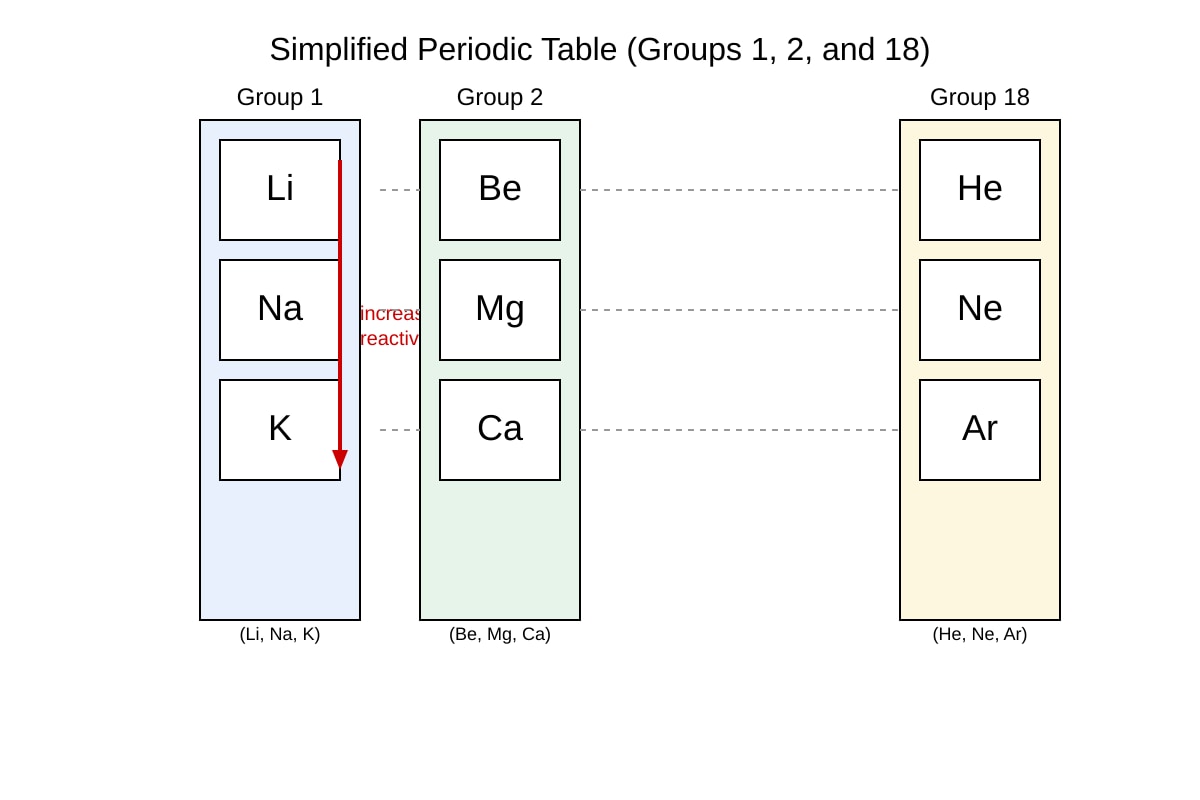
Generated diagram for Q16.
Using the diagram, explain the trend in reactivity of Group 1 elements down the group and link this to their atomic structure.
17. [3 marks] A sample of Period 3 elements shows the following properties:
| Element | X | Y | Z |
|---|
| Type | metal | metalloid | non-metal |
| Chloride formula | XCl | YCl₄ | ZCl₄ |
Identify X, Y, and Z from Na, Si, P, S, Cl. Explain your choices using the Periodic Table.
18. [3 marks] Compare the boiling points of the halogens fluorine, chlorine, bromine, and iodine. Explain the trend in terms of intermolecular forces.
19. [3 marks] A transition metal compound is used as a catalyst in the manufacture of ammonia. Name the metal and state two general properties of transition metals that make them useful as catalysts.
20. [3 marks] The electronic structures of three elements are given:
P: 2,8,1
Q: 2,8,7
R: 2,8,8
(a) State which are metals and which are non-metals.
(b) Predict the formula of the compound formed between P and Q.
(c) Explain your answer using the octet rule.