From Real Exams Quiz
Secondary 4 Combined Science Chemistry Periodic Table Quiz
Free Sec 4 Comb Sci Chem Periodic Table quiz, DeepSeek Exam version, with questions, answers, and O Level-style practice for Singapore students.
These static practice materials are generated from the site's syllabus and paper-generation workflow, with source and model context shown so students and parents can evaluate the material before use.
Questions
Free quiz and exam paper access
Enter your details to view this paper
Your access is remembered on this device.
Answers
Secondary 4 Combined Science Chemistry Quiz - Periodic Table
ANSWER KEY AND MARKING SCHEME
Total Marks: 40
Section A: Short Answer and Structured Questions (20 marks)
1. Element X is in Group 17 and Period 3.
(a) Chlorine ✓ [1 mark]
(b) 2, 8, 7 ✓ [1 mark]
Accept: 2.8.7 or 1s²2s²2p⁶3s²3p⁵
(c) Gas ✓ [1 mark]
Explanation: Chlorine has a simple molecular structure with weak intermolecular forces of attraction between molecules / Chlorine exists as diatomic Cl₂ molecules with low boiling point / Chlorine is a non-metal with low melting and boiling points. ✓ [1 mark]
Award 1 mark for correct state, 1 mark for valid explanation referencing structure or intermolecular forces.
2. Properties of elements W, X, Y, Z.
(a) Element W ✓ [1 mark]
Reason: It conducts electricity in both solid and molten states / It has good electrical conductivity in solid state, which is a characteristic property of metals. ✓ [1 mark]
Accept any valid reason linking conductivity to metallic bonding.
(b) Explanation: Element X has an ionic structure / giant ionic lattice. ✓ [1 mark] In the solid state, the ions are held in fixed positions and cannot move, so it does not conduct electricity. When molten, the ions are free to move and carry electric charge, so it conducts electricity. ✓ [1 mark]
Award 1 mark for identifying ionic bonding, 1 mark for explaining conductivity in terms of ion mobility.
(c) Structure: Giant covalent structure / Giant molecular structure ✓ [1 mark]
Bonding: Covalent bonding ✓ [1 mark]
Accept: Macromolecular structure / Diamond-like structure. Award 1 mark for structure type, 1 mark for bonding type.
3. Atomic radii of Group 1 elements.
(a) Atomic radius increases down Group 1. ✓ [1 mark]
Accept: Atoms get larger down the group.
(b) Explanation: Down the group, the number of electron shells increases / each element has one more electron shell than the one above it. ✓ [1 mark] The increased distance between the nucleus and the outermost electrons / increased shielding effect of inner electrons results in a larger atomic radius. ✓ [1 mark]
Award 1 mark for identifying increase in electron shells, 1 mark for linking to increased distance or shielding.
(c) Prediction: Francium will have a larger atomic radius than potassium. ✓ [1 mark]
Reason: Francium is below potassium in Group 1, so it has more electron shells / one additional electron shell compared to potassium, resulting in a larger atomic radius. ✓ [1 mark]
Award 1 mark for correct prediction, 1 mark for valid reason referencing electron shells.
4. Group 17 elements.
(a) Halogens ✓ [1 mark]
(b) Reactivity decreases down Group 17. ✓ [1 mark]
Accept: Reactivity decreases down the group / halogens become less reactive down the group.
(c)(i) Colour change: Colourless solution turns yellow/orange/brown / Solution changes from colourless to reddish-brown. ✓ [1 mark]
Accept any valid colour change indicating formation of bromine.
(c)(ii) Equation: Cl₂(g) + 2KBr(aq) → 2KCl(aq) + Br₂(aq) ✓ [1 mark for correct formulae and balancing, 1 mark for correct state symbols]
Award 1 mark for correct chemical equation (balanced), 1 mark for all state symbols correct. Accept Br₂(l) if justified.
5. Group properties and reactions.
(a) Explanation: Elements in the same group have the same number of valence electrons / outer shell electrons. ✓ [1 mark] Chemical properties are determined by the number of valence electrons, so elements with the same number of valence electrons undergo similar chemical reactions. ✓ [1 mark]
Award 1 mark for identifying same number of valence electrons, 1 mark for linking to chemical properties.
(b)(i) Gas produced: Hydrogen / H₂ ✓ [1 mark]
(b)(ii) Equation: 2Na(s) + 2H₂O(l) → 2NaOH(aq) + H₂(g) ✓ [1 mark for correct formulae and balancing, 1 mark for correct state symbols]
Award 1 mark for balanced equation, 1 mark for all state symbols correct.
(b)(iii) Prediction: Potassium would react more vigorously / violently / explosively with water compared to sodium. ✓ [1 mark]
Reason: Potassium is below sodium in Group 1, so it is more reactive / Potassium loses its valence electron more easily than sodium / Potassium has a larger atomic radius, so the valence electron is further from the nucleus and more easily lost. ✓ [1 mark]
Award 1 mark for correct prediction, 1 mark for valid reason referencing reactivity trend or atomic structure.
Section B: Data-Based and Extended Response Questions (20 marks)
6. Electronic configurations of elements A, B, C, D.
(a) Same group: A and C ✓ [1 mark]
Explanation: Both have one valence electron / one electron in their outermost shell (A: 2,1 and C: 2,8,1). Elements in the same group have the same number of valence electrons. ✓ [1 mark]
Award 1 mark for identifying A and C, 1 mark for correct explanation.
(b) Same period: C and D ✓ [1 mark]
Explanation: Both have three electron shells / three occupied electron shells (C: 2,8,1 and D: 2,8,7). Elements in the same period have the same number of electron shells. ✓ [1 mark]
Award 1 mark for identifying C and D, 1 mark for correct explanation.
(c)(i) Type of bonding: Ionic bonding ✓ [1 mark]
Element B (2,7) is a halogen; sodium is a Group 1 metal. Metal + non-metal → ionic bonding.
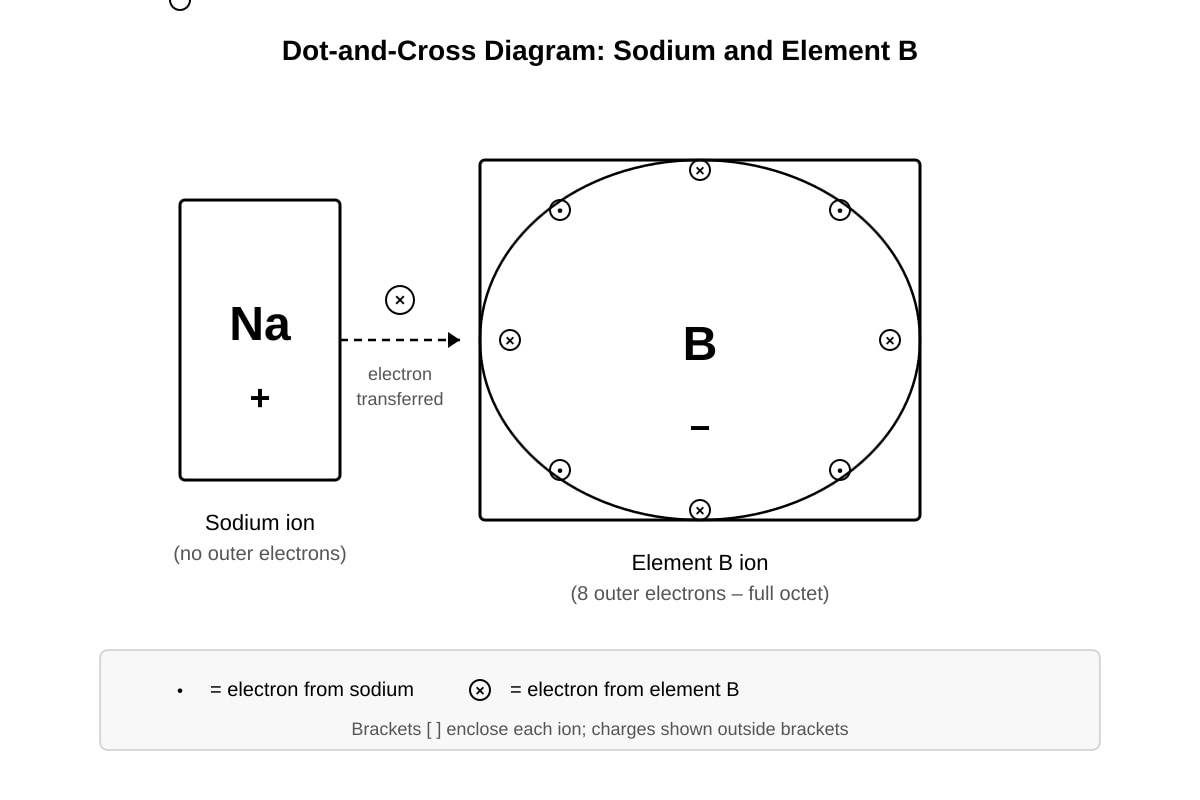
(c)(ii) Dot-and-cross diagram:
Diagram should show:
- Sodium atom losing one electron to become Na⁺ with electronic configuration 2,8 ✓ [1 mark]
- Element B atom gaining one electron to become B⁻ with electronic configuration 2,8 ✓ [1 mark]
- Correct dot-and-cross representation showing electron transfer, with sodium electrons as dots (or crosses) and Element B electrons as crosses (or dots) ✓ [1 mark]
- Charges clearly shown: Na⁺ and B⁻
Award 1 mark for correct electron transfer, 1 mark for correct final electronic configurations of ions, 1 mark for correct dot-and-cross notation with charges.
7. Transition elements.
(a) Two properties (any two, 1 mark each):
- Transition elements have higher melting points / densities than Group 1 metals ✓
- Transition elements form coloured compounds, while Group 1 compounds are usually white/colourless ✓
- Transition elements have variable oxidation states, while Group 1 metals have only +1 ✓
- Transition elements are less reactive than Group 1 metals ✓
- Transition elements can act as catalysts, while Group 1 metals generally do not ✓
Award 1 mark each for any two valid differences, up to 2 marks.
(b)(i) Equation: CuO(s) + H₂(g) → Cu(s) + H₂O(l) ✓ [1 mark for correct formulae and balancing, 1 mark for correct state symbols]
Award 1 mark for balanced equation, 1 mark for all state symbols correct. Accept H₂O(g) if justified by reaction conditions.
(b)(ii) Type of reaction: Redox reaction / Reduction-oxidation reaction ✓ [1 mark]
Explanation: Copper(II) oxide loses oxygen / is reduced to copper, while hydrogen gains oxygen / is oxidised to water. ✓ [1 mark]
Accept: Reduction of copper(II) oxide / Oxidation of hydrogen. Award 1 mark for naming redox, 1 mark for explanation in terms of oxygen loss/gain.
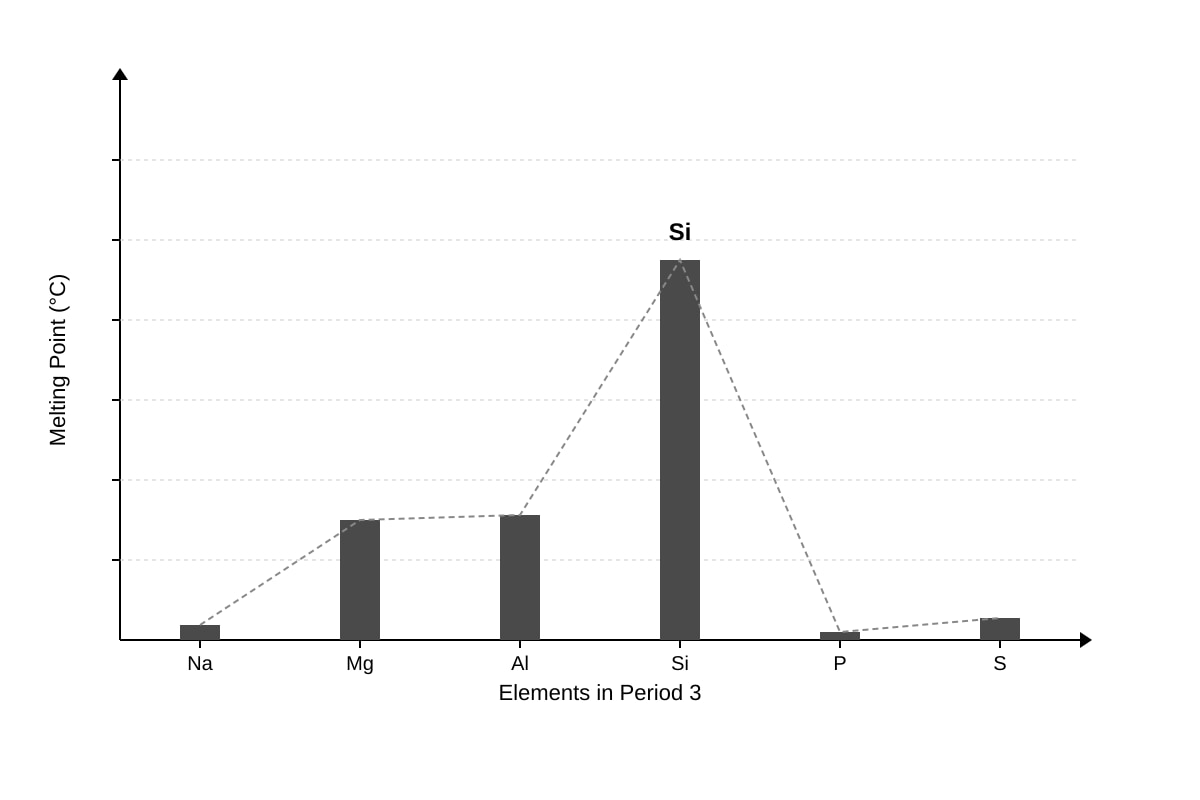
8. Melting points of Period 3 elements.
(a) Silicon / Si ✓ [1 mark]
(b) Explanation: Silicon has a giant covalent structure / giant molecular structure. ✓ [1 mark] A large amount of energy is required to break the strong covalent bonds between silicon atoms throughout the structure. ✓ [1 mark]
Award 1 mark for identifying giant covalent structure, 1 mark for linking to strong covalent bonds requiring large energy to break.
(c) Explanation: Argon is a noble gas with a monatomic structure / exists as single atoms. ✓ [1 mark] It has a simple atomic structure with very weak intermolecular forces of attraction between atoms, so very little energy is required to overcome these forces. ✓ [1 mark]
Award 1 mark for identifying simple atomic/monatomic structure, 1 mark for linking to weak intermolecular forces.
9. Group 1 metals reactivity.
(a) Alkali metals ✓ [1 mark]
(b)(i) Equation: 4Li(s) + O₂(g) → 2Li₂O(s) ✓ [1 mark for correct formulae and balancing, 1 mark for correct state symbols]
Award 1 mark for balanced equation, 1 mark for all state symbols correct.
(b)(ii) Observations: Lithium burns with a red/crimson flame ✓ [1 mark] and produces a white solid / white smoke. ✓ [1 mark]
Award 1 mark for flame colour, 1 mark for white solid/smoke.
(c) Explanation: Down Group 1, the atomic radius increases / the number of electron shells increases. ✓ [1 mark] The valence electron is further from the nucleus and experiences greater shielding effect from inner electrons. ✓ [1 mark] Therefore, the valence electron is more easily lost / the attraction between the nucleus and the valence electron is weaker, making the metal more reactive. ✓ [1 mark]
Award 1 mark for increasing atomic radius/shells, 1 mark for increased distance/shielding, 1 mark for easier electron loss/increased reactivity.
10. Predicting properties of elements.
(a)(i) 2 valence electrons ✓ [1 mark]
(a)(ii) QO ✓ [1 mark]
Accept: Any formula showing a 1:1 ratio of Q to O, as Group 2 elements form oxides with formula MO.
(b)(i) Neon ✓ [1 mark]
(b)(ii) Explanation: Neon has a full outer shell of electrons / a stable octet configuration (2,8). ✓ [1 mark] It does not need to gain, lose, or share electrons to achieve a stable electronic configuration, so it is unreactive. ✓ [1 mark]
Award 1 mark for full outer shell, 1 mark for linking to lack of reactivity.
11. Atomic radii and ionisation energies of Group 1.
(a) First ionisation energy decreases down Group 1. ✓ [1 mark]
(b) Explanation: As atomic radius increases down the group, the valence electron is further from the nucleus. ✓ [1 mark] The attraction between the nucleus and the valence electron decreases, so less energy is required to remove the valence electron, resulting in a lower first ionisation energy. ✓ [1 mark]
Award 1 mark for linking larger radius to greater distance, 1 mark for linking to lower ionisation energy.
(c) Prediction: Caesium will have a lower first ionisation energy than rubidium. ✓ [1 mark]
Reason: Caesium is below rubidium in Group 1, so it has a larger atomic radius / the valence electron is further from the nucleus, requiring less energy to remove. ✓ [1 mark]
Award 1 mark for correct prediction, 1 mark for valid reason referencing atomic radius or electron distance.
12. Group 17 elements as diatomic molecules.
(a) Colour: Red-brown / reddish-brown ✓ [1 mark]
Physical state: Liquid ✓ [1 mark]
Award 1 mark for correct colour, 1 mark for correct state.
(b) Explanation: Down Group 17, the size of the halogen molecules increases / the number of electrons in the molecules increases. ✓ [1 mark] This results in stronger intermolecular forces of attraction / van der Waals' forces between molecules, so more energy is required to overcome these forces, leading to higher boiling points. ✓ [1 mark]
Award 1 mark for identifying larger molecular size/more electrons, 1 mark for linking to stronger intermolecular forces.
(c)(i) Sublimation ✓ [1 mark]
(c)(ii) Explanation: Iodine molecules (I₂) are larger than chlorine molecules (Cl₂) / have more electrons. ✓ [1 mark] The intermolecular forces of attraction / van der Waals' forces between iodine molecules are stronger than those between chlorine molecules, so more energy is required to overcome these forces, resulting in a higher boiling point. ✓ [1 mark]
Award 1 mark for identifying larger molecular size/more electrons in iodine, 1 mark for linking to stronger intermolecular forces.
13. Trends across Period 3.
(a) Atomic radius decreases across Period 3 from sodium to chlorine. ✓ [1 mark]
(b) Explanation: Across Period 3, the number of protons in the nucleus increases, so the nuclear charge increases. ✓ [1 mark] Electrons are added to the same electron shell, so the shielding effect remains approximately the same. The increased nuclear charge attracts the electrons more strongly, pulling them closer to the nucleus and decreasing the atomic radius. ✓ [1 mark]
Award 1 mark for increasing nuclear charge, 1 mark for linking to stronger attraction and smaller radius.
(c)(i) Ionic bonding ✓ [1 mark]
(c)(ii) Simple molecular structure ✓ [1 mark]
(c)(iii) Prediction: Sodium oxide has a higher melting point than sulfur dioxide. ✓ [1 mark]
Reason: Sodium oxide has a giant ionic structure with strong electrostatic forces of attraction between oppositely charged ions, requiring a lot of energy to overcome. Sulfur dioxide has a simple molecular structure with weak intermolecular forces of attraction between molecules, requiring less energy to overcome. ✓ [1 mark]
Award 1 mark for correct prediction, 1 mark for valid reason comparing structure and bonding.
14. Chlorides of Period 3 elements.
(a) Group 13 / III ✓ [1 mark]
(b) Explanation: Sodium is in Group 1 and loses one electron to form a Na⁺ ion. Magnesium is in Group 2 and loses two electrons to form a Mg²⁺ ion. ✓ [1 mark] Chlorine is in Group 17 and gains one electron to form a Cl⁻ ion. To balance the charges, one Mg²⁺ ion requires two Cl⁻ ions, giving MgCl₂, while one Na⁺ ion requires one Cl⁻ ion, giving NaCl. ✓ [1 mark]
Award 1 mark for identifying ion charges, 1 mark for explaining formula based on charge balance.
(c) Structure: Simple molecular structure ✓ [1 mark]
Bonding: Covalent bonding ✓ [1 mark]
Award 1 mark for structure type, 1 mark for bonding type.
15. Displacement reactions of halogens.
(a) Definition: A displacement reaction is a reaction in which a more reactive halogen displaces a less reactive halogen from an aqueous solution of its halide salt. ✓ [2 marks]
Award 2 marks for correct definition referencing relative reactivity and displacement from solution. Award 1 mark for partial definition.
(b)(i) Colour change: Colourless solution turns brown / yellow-brown / reddish-brown. ✓ [1 mark]
Accept any valid colour change indicating formation of iodine.
(b)(ii) Ionic equation: Cl₂(aq) + 2I⁻(aq) → 2Cl⁻(aq) + I₂(aq) ✓ [1 mark for correct formulae and balancing, 1 mark for correct state symbols]
Award 1 mark for correct ionic equation, 1 mark for state symbols.
(c) Explanation: Chlorine is more reactive than iodine / chlorine is above iodine in Group 17. ✓ [1 mark] Chlorine has a greater ability to gain electrons than iodine, so chlorine can displace iodine from potassium iodide solution. ✓ [1 mark]
Award 1 mark for identifying chlorine as more reactive, 1 mark for linking to electron gain ability.
Section C: Application and Analysis Questions (10 marks)
16. Unknown element Z.
(a) Group 1 ✓ [1 mark]
Reason: It forms a basic oxide with the formula Z₂O, indicating it has one valence electron / it is a Group 1 metal. ✓ [1 mark]
Award 1 mark for correct group, 1 mark for valid reason referencing oxide formula or valence electrons.
(b) Sodium / Na ✓ [1 mark]
(c) Equation: 2Na(s) + 2H₂O(l) → 2NaOH(aq) + H₂(g) ✓ [1 mark for correct formulae and balancing, 1 mark for correct state symbols]
Award 1 mark for balanced equation, 1 mark for all state symbols correct.
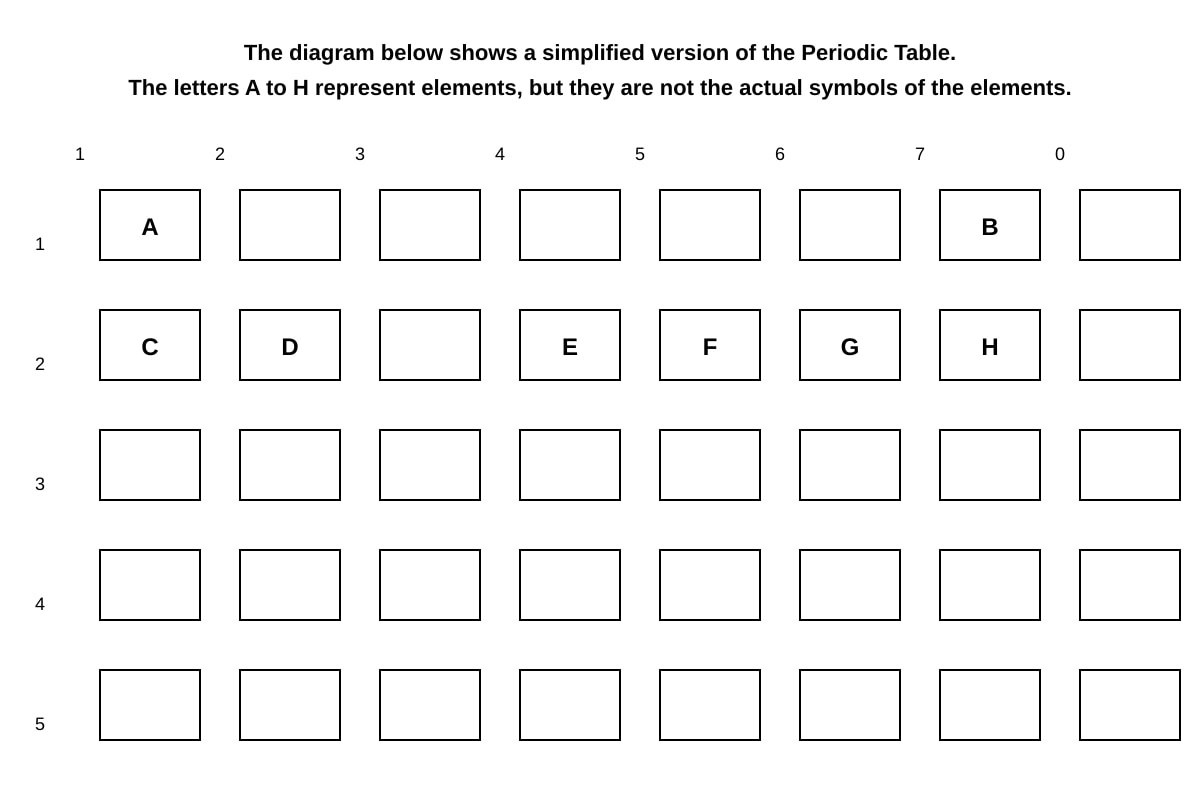
17. Simplified Periodic Table.
(a) B ✓ [1 mark]
(b) A or C ✓ [1 mark]
Accept either A or C, as both are Group 1 elements.
(c)(i) EF₂ ✓ [1 mark]
Element E is in Group 4 (e.g., carbon), Element F is in Group 5 (e.g., nitrogen). The formula could be CF₂ or similar, but EF₂ is acceptable as a general formula. Accept any reasonable formula based on Group 4 and Group 5 combination.
(c)(ii) Covalent bonding ✓ [1 mark]
(d) Type of bonding: Ionic bonding ✓ [1 mark]
Explanation: Element D is in Group 2 (forms D²⁺ ion), Element H is in Group 17 (forms H⁻ ion). ✓ [1 mark] Element D transfers two electrons to two atoms of Element H, forming D²⁺ and 2H⁻ ions. These oppositely charged ions are held together by strong electrostatic forces of attraction, forming an ionic compound. ✓ [1 mark]
Award 1 mark for identifying ionic bonding, 1 mark for identifying ion charges, 1 mark for explaining electron transfer and electrostatic attraction.
18. Reaction of Group 1 metals with water.
(a) Reactivity increases down Group 1 / from lithium to potassium. ✓ [1 mark]
(b) Explanation: Potassium has a larger atomic radius than sodium / has more electron shells. ✓ [1 mark] The valence electron in potassium is further from the nucleus and experiences greater shielding, so it is more easily lost, making potassium more reactive. ✓ [1 mark]
Award 1 mark for larger atomic radius/more shells, 1 mark for easier electron loss/greater reactivity.
(c) Observation: Red litmus paper turns blue. ✓ [1 mark]
Explanation: The solution formed is lithium hydroxide, which is an alkali / alkaline solution. Alkalis turn red litmus paper blue. ✓ [1 mark]
Award 1 mark for correct observation, 1 mark for explanation referencing alkaline solution.
19. Halogens and their properties.
(a) Any one valid use: Water purification / making PVC / making bleach / disinfectant / making solvents. ✓ [1 mark]
Accept any valid use of chlorine.
(b)(i) Explanation: Fluorine has a smaller atomic radius than chlorine / fewer electron shells. ✓ [1 mark] The valence shell is closer to the nucleus and experiences less shielding, so fluorine attracts electrons more strongly / gains an electron more easily, making it more reactive. ✓ [1 mark]
Award 1 mark for smaller atomic radius/fewer shells, 1 mark for stronger electron attraction/greater reactivity.
(b)(ii) Suggestion: Fluorine is too reactive / too dangerous / reacts violently with water / highly toxic. ✓ [1 mark]
Accept any valid reason related to safety or extreme reactivity.
(c)(i) Solid ✓ [1 mark]
(c)(ii) Prediction: Astatine will not displace iodine from potassium iodide solution. ✓ [1 mark]
Explanation: Astatine is below iodine in Group 17, so it is less reactive than iodine. A less reactive halogen cannot displace a more reactive halogen from its salt solution. ✓ [1 mark]
Award 1 mark for correct prediction, 1 mark for valid reason referencing reactivity trend.
20. Development of the Periodic Table.
(a) Any one valid contribution: Arranged elements in order of increasing atomic mass / left gaps for undiscovered elements / predicted properties of undiscovered elements / grouped elements with similar properties together. ✓ [1 mark]
*Accept any valid contribution
<stage3_quiz_answers_md>
Secondary 4 Combined Science Chemistry Quiz - Periodic Table - ANSWERS
Total Marks: 40
Section A: Short Answer and Structured Questions (20 marks)
1. Element X is in Group 17 and Period 3 of the Periodic Table.
(a) State the name of Element X. [1] Chlorine
(b) Write the electronic configuration of Element X. [1] 2, 8, 7
(c) Predict whether Element X will be a solid, liquid, or gas at room temperature. Explain your answer. [2] Gas. Chlorine is a non-metal with a simple molecular structure. The intermolecular forces of attraction between Cl₂ molecules are weak, requiring little energy to overcome, so it exists as a gas at room temperature.
2. The table below shows some properties of four elements, W, X, Y, and Z.
(a) Which element is most likely to be a metal? Give a reason for your answer. [2] W. It has a relatively low melting point (for a metal) and conducts electricity in both solid and molten states. Electrical conductivity in the solid state is a characteristic property of metals.
(b) Element X conducts electricity when molten but not when solid. Explain why. [2] Element X is an ionic compound. In the solid state, the ions are held in fixed positions in a giant ionic lattice and are not free to move. When molten, the ions are free to move and can carry an electric current.
(c) Element Y has a very high melting point and does not conduct electricity in any state. Name the type of structure and bonding present in Element Y. [2] Giant covalent structure (or giant molecular structure) with covalent bonding.
3. The diagram below shows the relative atomic radii of the first three elements in Group 1.
Image pending generation for this question.
(a) Describe the trend in atomic radius down Group 1. [1] Atomic radius increases down the group.
(b) Explain why the atomic radius changes in this way down the group. [2] Going down the group, the number of electron shells increases. The outermost electron is in a shell further from the nucleus. Increased shielding of the nuclear charge by inner electron shells also reduces the attraction on the outer electron, leading to a larger atomic radius.
(c) Predict, with a reason, whether francium (Fr), which is below potassium in Group 1, will have a larger or smaller atomic radius than potassium. [2] Larger. Francium has more electron shells than potassium, so its outermost electron is further from the nucleus, resulting in a larger atomic radius.
4. Chlorine, bromine, and iodine are elements in Group 17 of the Periodic Table.
(a) State the name given to the elements in Group 17. [1] Halogens
(b) Describe the trend in reactivity down Group 17. [1] Reactivity decreases down the group.
(c) Chlorine gas is bubbled through a colourless solution of potassium bromide. A colour change is observed.
(i) State the colour change observed. [1] Colourless to orange/brown (or yellow-brown).
(ii) Write a balanced chemical equation, with state symbols, for the reaction that occurs. [2] Cl₂(g) + 2KBr(aq) → 2KCl(aq) + Br₂(aq) (Accept Cl₂(g) + 2Br⁻(aq) → 2Cl⁻(aq) + Br₂(aq))
5. The Periodic Table is an arrangement of elements in order of increasing atomic number. Elements in the same group have similar chemical properties.
(a) Explain why elements in the same group have similar chemical properties. [2] Elements in the same group have the same number of valence (outer shell) electrons. Chemical properties are determined by the number of valence electrons, so they react in similar ways.
(b) Sodium (Na) and potassium (K) are both in Group 1. When a small piece of sodium is added to water, it reacts vigorously, producing a gas and an alkaline solution.
(i) Name the gas produced in this reaction. [1] Hydrogen
(ii) Write a balanced chemical equation for the reaction of sodium with water. Include state symbols. [2] 2Na(s) + 2H₂O(l) → 2NaOH(aq) + H₂(g)
(iii) Predict, with a reason, how the reaction of potassium with water would compare to that of sodium with water. [2] The reaction of potassium with water would be more vigorous (or violent/explosive). Potassium is more reactive than sodium because its outermost electron is further from the nucleus and more easily lost.
Section B: Data-Based and Extended Response Questions (20 marks)
6. The table below shows the electronic configurations of four elements, A, B, C, and D.
(a) Which two elements belong to the same group of the Periodic Table? Explain your answer. [2] A and C. Both have 1 valence electron (electronic configurations end in 1).
(b) Which two elements belong to the same period of the Periodic Table? Explain your answer. [2] C and D. Both have three electron shells (electronic configurations have three numbers).
(c) Element B and Element D react with metals to form compounds.
(i) State the type of bonding present in the compound formed when Element B reacts with sodium. [1] Ionic bonding
(ii) Draw a dot-and-cross diagram to show the electronic structure of the compound formed between sodium and Element B. Show outer electrons only. [3] **
Generated diagram for this question.
⁻ with 8 electrons shown.]** (Award 1 mark for correct ion charges, 1 mark for correct electron transfer/octet, 1 mark for correct diagram format)
7. Transition elements are found in the central block of the Periodic Table. They have properties that are different from those of Group 1 metals.
(a) State two properties of transition elements that are different from those of Group 1 metals. [2] Any two from:
- Higher melting points / densities
- Harder / stronger
- Less reactive
- Form coloured compounds
- Have variable oxidation states
- Act as catalysts
(b) Copper(II) oxide is a black solid. When heated with hydrogen gas, it forms copper metal and water.
(i) Write a balanced chemical equation for this reaction. Include state symbols. [2] CuO(s) + H₂(g) → Cu(s) + H₂O(g) (Accept H₂O(l))
(ii) Name the type of reaction that occurs. Explain your answer in terms of oxygen. [2] Redox reaction (or reduction-oxidation). Copper(II) oxide loses oxygen (is reduced) and hydrogen gains oxygen (is oxidised).
8. The graph below shows the melting points of the elements in Period 3 of the Periodic Table.
Generated graph for this question.
(a) Identify the element with the highest melting point in Period 3. [1] Silicon (Si)
(b) Explain why silicon has a very high melting point. [2] Silicon has a giant covalent structure. A large amount of energy is required to break the many strong covalent bonds between silicon atoms throughout the structure.
(c) Explain why the melting point of argon is very low. [2] Argon is a noble gas with a monatomic simple molecular structure. The intermolecular forces of attraction between argon atoms are very weak, requiring very little energy to overcome.
9. The reactivity of Group 1 metals increases down the group.
(a) State the name given to the Group 1 metals. [1] Alkali metals
(b) Lithium reacts with oxygen to form lithium oxide.
(i) Write a balanced chemical equation for this reaction. Include state symbols. [2] 4Li(s) + O₂(g) → 2Li₂O(s)
(ii) Describe the observations you would make when a small piece of lithium is heated in air. [2] Lithium burns with a red/crimson flame, producing a white solid/smoke.
(c) Explain, in terms of atomic structure, why the reactivity of Group 1 metals increases down the group. [3] Going down the group, the atomic radius increases and the number of inner electron shells increases. This means the outermost electron is further from the nucleus and experiences greater shielding from the nuclear attraction. Therefore, the outermost electron is more easily lost, making the element more reactive.
10. The Periodic Table can be used to predict the properties of elements and their compounds.
(a) Element Q is in Group 2 and Period 4.
(i) State the number of valence electrons in an atom of Element Q. [1] 2
(ii) Predict the formula of the oxide of Element Q. [1] QO
(b) Element R is a noble gas in Period 2.
(i) Name Element R. [1] Neon
(ii) Explain why Element R is unreactive. [2] Neon has a full/complete outer electron shell (octet). It does not need to gain, lose, or share electrons to achieve a stable electronic configuration, so it is chemically inert.
11. The table below shows the atomic radii and first ionisation energies of some Group 1 elements.
(a) Describe the trend in first ionisation energy down Group 1. [1] First ionisation energy decreases down the group.
(b) Explain the relationship between atomic radius and first ionisation energy for these elements. [2] As atomic radius increases, the outermost electron is further from the nucleus. The attraction between the nucleus and the outermost electron is weaker, so less energy is required to remove it, resulting in a lower first ionisation energy.
(c) Predict, with a reason, whether caesium (Cs) will have a higher or lower first ionisation energy than rubidium (Rb). [2] Lower. Caesium is below rubidium in Group 1, so it has a larger atomic radius. Its outermost electron is further from the nucleus and more shielded, so it is more easily removed, requiring less energy.
12. Group 17 elements exist as diatomic molecules.
(a) State the colour and physical state of bromine at room temperature. [2] Red-brown liquid
(b) Explain why the boiling points of the halogens increase down the group. [2] Going down the group, the size of the diatomic molecules increases (more electrons). This leads to stronger intermolecular forces of attraction (van der Waals' forces) between molecules, requiring more energy to overcome.
(c) Iodine crystals are heated gently in a test tube. A purple vapour is observed.
(i) Name the process that occurs when solid iodine changes directly to a purple vapour. [1] Sublimation
(ii) Explain why iodine has a higher boiling point than chlorine. [2] Iodine molecules (I₂) are larger than chlorine molecules (Cl₂) and have more electrons. The intermolecular forces of attraction between I₂ molecules are stronger than those between Cl₂ molecules, so more energy is required to separate the I₂ molecules.
13. Elements in the same period show trends in their properties.
(a) State the general trend in atomic radius across Period 3 from sodium to chlorine. [1] Atomic radius decreases across the period.
(b) Explain why the atomic radius changes across Period 3. [2] Going across Period 3, the number of protons in the nucleus increases, leading to a greater nuclear charge. Electrons are added to the same outer shell, so shielding remains similar. The increased nuclear attraction pulls the outer electrons closer to the nucleus, decreasing the atomic radius.
(c) Sodium oxide (Na₂O) and sulfur dioxide (SO₂) are both oxides of Period 3 elements.
(i) State the type of bonding present in sodium oxide. [1] Ionic bonding
(ii) State the type of structure present in sulfur dioxide. [1] Simple molecular structure