From Real Exams Quiz
Secondary 4 Combined Science Chemistry Organic Chemistry Quiz
Free Sec 4 Comb Sci Chem Organic Chemistry quiz, HY3 Exam version, with questions, answers, and O Level-style practice for Singapore students.
These static practice materials are generated from the site's syllabus and paper-generation workflow, with source and model context shown so students and parents can evaluate the material before use.
Questions
Free quiz and exam paper access
Enter your details to view this paper
Your access is remembered on this device.
Answers
Secondary 4 Combined Science Chemistry Quiz - Organic Chemistry (Answer Key)
Total Marks: 40
Topic: Organic Chemistry
Section A (1 mark each)
1. B [1]
Teaching note: Alkanes are saturated hydrocarbons with single bonds only. General formula is . A is alkene, C is alkyne, D is not a standard series.
2. B [1]
Teaching note: Alcohols contain the hydroxyl functional group –OH. –COOH is carboxylic acid, –CHO is aldehyde, –COO– is ester.
3. B [1]
Teaching note: Complete combustion of any hydrocarbon gives carbon dioxide and water: .
4. B [1]
Teaching note: Ethene () monomers add together without losing atoms to form poly(ethene) – addition polymerisation.
5. B [1]
Teaching note: Bromine water decolourises (orange→colourless) in presence of C=C as it undergoes addition reaction.
Section B (2 marks each)
6. [2]
- Name: butene [1]
- Structural formula: (or ) [1]
Teaching note: 4-carbon alkene = butene. Show C=C anywhere in chain.
7. [2]
- Add bromine water to olive oil. [1]
- Observation: orange/brown bromine water turns colourless. [1]
Teaching note: Unsaturated fats have C=C bonds that react with bromine.
8. [2]
[2 for fully balanced]
Marking: 1 mark for products, 1 mark for balancing.
Teaching note: Combustion needs O₂, gives CO₂ + H₂O. Balance C:3, H:8→4H₂O, O: 6+4=10 → 5O₂.
9. [2]
Any two:
- Liquid at room temperature [1]
- Dissolves many organic substances / miscible with water in low amounts [1]
- Volatile / evaporates easily [1 if used]
Teaching note: Ethanol is a versatile solvent due to polar –OH and non-polar chain.
10. [2]
- Monomer: chloroethene () [1]
- Repeated unit: –[CH₂–CHCl]– [1]
Teaching note: PVC from chloroethene via addition polymerisation.
Section C (3–4 marks each)
11. [4]
(a) A homologous series is a family of compounds with same general formula, similar chemical properties, and successive members differ by . [2]
(b) Example: alkanes, general formula . [2] (or alcohols )
Teaching note: Define clearly + example with formula.
12. [3]
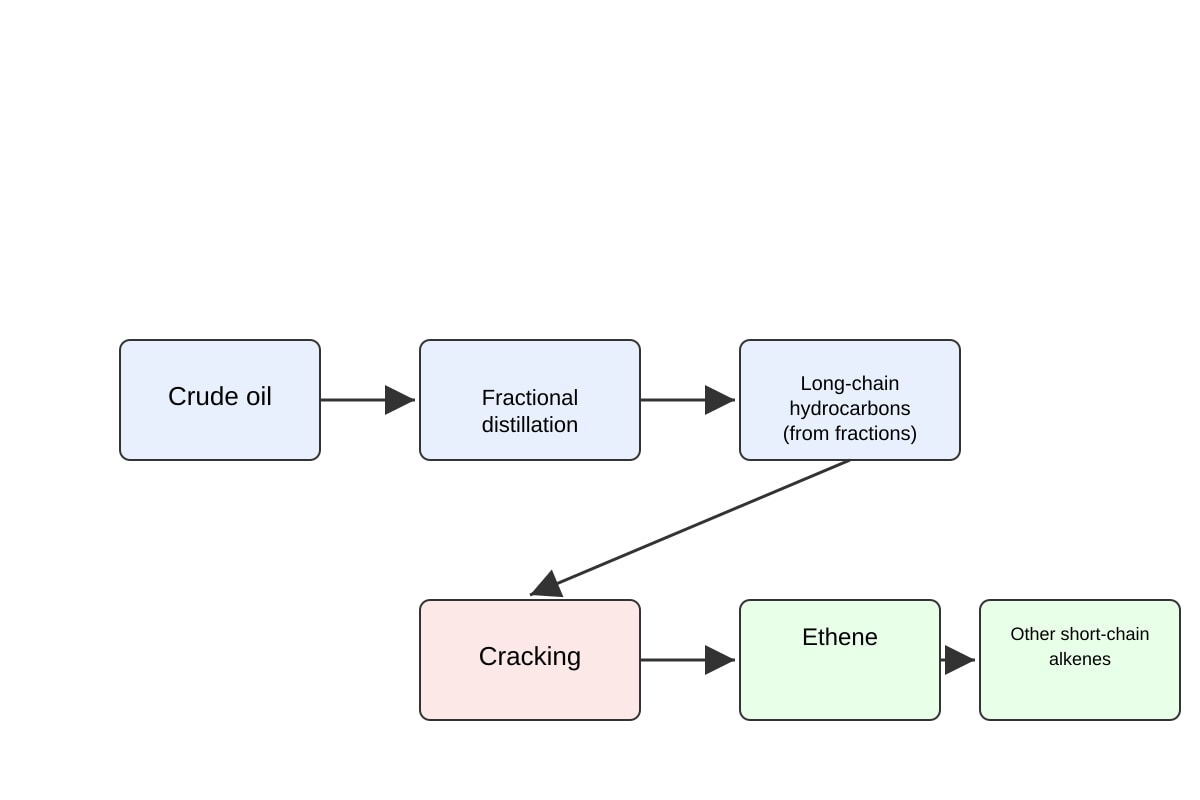
(a) Cracking [1]
(b) Ethene is used to make polymers (e.g., poly(ethene)), and as a starting material for many chemicals. [2]
Teaching note: Image shows cracking of long chains. Ethene is a key feedstock.
13. [4]
(a) Oxidation [1]
(b) Oxidising agent e.g., acidified potassium dichromate(VI) / + [1]
(c) Ethanoic acid is sour / turns litmus red / has pungent smell vs ethanol neutral odour. [2]
Teaching note: Ethanol → ethanoic acid is oxidation; acid properties differ from alcohol.
14. [3]
(a) Displayed formula: H–C–C–C–O–H with correct H count (3,2,2,1) [2]
(b) Alcohols [1]
Teaching note: Propanol = 3-carbon alcohol. Draw all bonds.
15. [4]
(a) Unsaturated [1]; formula means one C=C present, not enough H for alkane (). [1]
(b) e.g., or ring structure cyclobutane (but cyclobutane is saturated – avoid). Use butene. [2]
Teaching note: fits alkene or cycloalkane; alkene expected.
16. [4]
(a) Boiling point increases with more carbon atoms. [1]
(b) Larger molecules have greater surface area → stronger intermolecular forces (van der Waals) → more energy to separate. [3]
Teaching note: No hydrogen bonding increase; chain length drives trend.
17. [4]
(a) Addition polymerisation: unsaturated monomers (with C=C) join to form a polymer without losing small molecules. [2]
(b) Repeating unit: –[CH₂–CH₂]– [2]
Teaching note: Ethene double bond opens to link.
18. [4]
(a) Hexane: bromine water stays orange/brown. [1]
(b) Hexene: bromine water turns colourless. [1]
(c) Hexane saturated (no C=C) so no reaction; hexene unsaturated (C=C) reacts with bromine by addition. [2]
Teaching note: Colour change indicates unsaturation.
19. [4]
(a) Glucose solution and yeast (enzyme). [2]
(b) [2]
Teaching note: Fermentation is anaerobic, yeast catalyst.
20. [4]
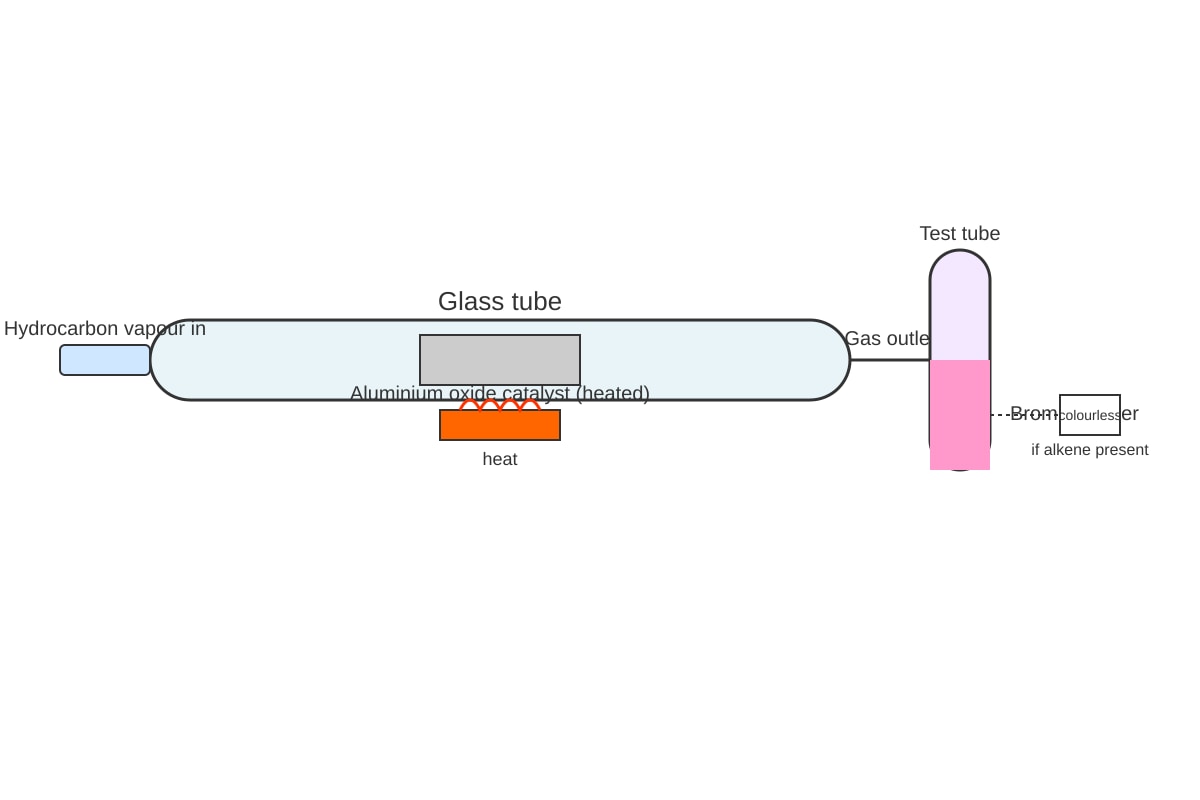
(a) Aluminium oxide () [1]
(b) To test for alkene (unsaturation) in cracked products. [1]
(c) Indicates an alkene (e.g., ethene) is produced, as it decolourises bromine water via addition. [2]
Teaching note: Cracking uses catalyst; bromine water confirms unsaturation.