From Real Exams Quiz
Secondary 4 Combined Science Chemistry Atomic Structure Bonding Quiz
Free Sec 4 Comb Sci Chem Atomic Structure Bonding quiz, HY3 Exam version, with questions, answers, and O Level-style practice for Singapore students.
These static practice materials are generated from the site's syllabus and paper-generation workflow, with source and model context shown so students and parents can evaluate the material before use.
Questions
Secondary 4 Combined Science Chemistry Quiz - Atomic Structure Bonding
Name: ___________________________
Class: ____________
Date: ____________
Score: ____________ / 40
Duration: 45 minutes
Total Marks: 40
Instructions:
- Answer all 20 questions.
- Section A: Short answer (1-5). Section B: Structured response (6-15). Section C: Data and diagram interpretation (16-20).
- Show all working where calculation is required.
- Use proper chemical notation.
Section A: Short Answer (1-5)
1. State the charge of a proton. [1]
2. Define an isotope. [1]
3. Write the electronic configuration of a neon atom (atomic number 10). [1]
4. Name the type of bonding present in sodium chloride. [1]
5. State one property of covalent compounds related to electrical conductivity. [1]
Section B: Structured Response (6-15)
6. An atom of element X has 11 protons and 12 neutrons.
(a) State the mass number of X. [1]
(b) Write the electronic configuration of X. [1]
(c) State the group and period of X in the Periodic Table. [2]
(a) ____________________
(b) ____________________
(c) Group ______, Period ______
7. Explain why noble gases are chemically unreactive. [2]
8. Draw the dot-and-cross diagram for a molecule of hydrogen chloride (HCl). Show only the outer shell electrons. Hydrogen has 1 electron; chlorine has 7 outer electrons. [2]
9. Describe the structure and bonding in magnesium oxide (MgO). [3]
(Mg: 2,8,2; O: 2,6,6 outer shell 6)
10. Compare ionic and covalent bonding in terms of electron transfer or sharing. [2]
11. Element Y has electronic configuration 2,8,7.
(a) State the group of Y. [1]
(b) State the formula of the ion formed by Y. [1]
(c) Explain how the ion is formed. [1]
(a) __________
(b) __________
(c) ______________________________________________________
12. A sample of copper contains two isotopes: 63Cu (69%) and 65Cu (31%). Calculate the relative atomic mass of copper to 1 decimal place. [2]
13. State the type of bonding in each of the following:
(a) Oxygen gas, O2 [1]
(b) Copper metal [1]
(c) Carbon dioxide, CO2 [1]
(a) __________
(b) __________
(c) __________
14. Explain why ionic compounds conduct electricity when molten but not when solid. [2]
15. An element Z is in Group 2 and Period 3.
(a) State the number of protons in Z. [1]
(b) Write the formula of the chloride of Z. [1]
(c) State the type of bonding in the chloride. [1]
(a) __________
(b) __________
(c) __________
Section C: Data and Diagram Interpretation (16-20)
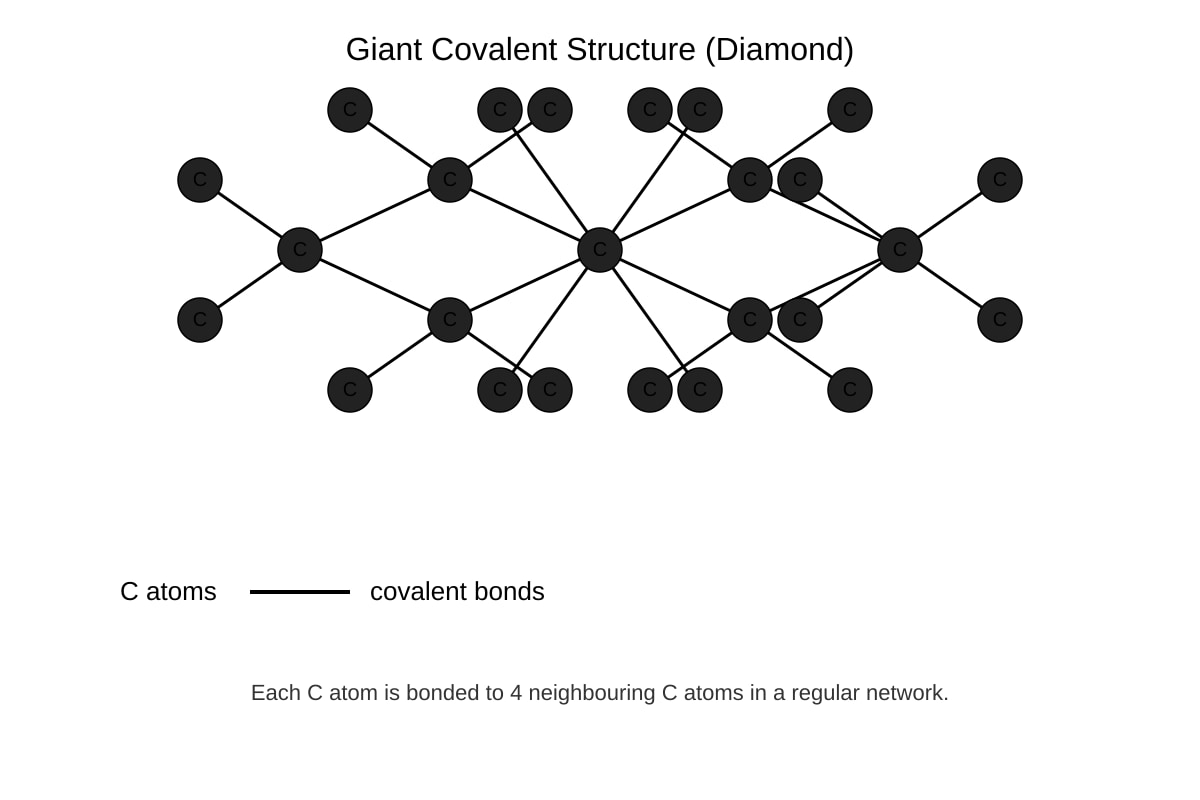
16. The diagram below shows the arrangement of atoms in a giant covalent structure.
Image pending generation: diagram for Q16.
(a) Name this structure. [1]
(b) State one physical property of this substance and explain it using the diagram. [2]
(a) ____________________
(b) Property: ____________________
Explanation: ______________________________________________________
17. The table shows the melting points of four substances.
| Substance | Melting point (°C) | Bonding type |
|---|---|---|
| A | -114 | covalent (simple molecular) |
| B | 801 | ionic |
| C | 3550 | giant covalent |
| D | 1083 | metallic |
(a) Which substance is likely to be a metal? [1]
(b) Explain why substance A has a low melting point. [2]
(c) Which substance is diamond? [1]
(a) __________
(b) ______________________________________________________
(c) __________
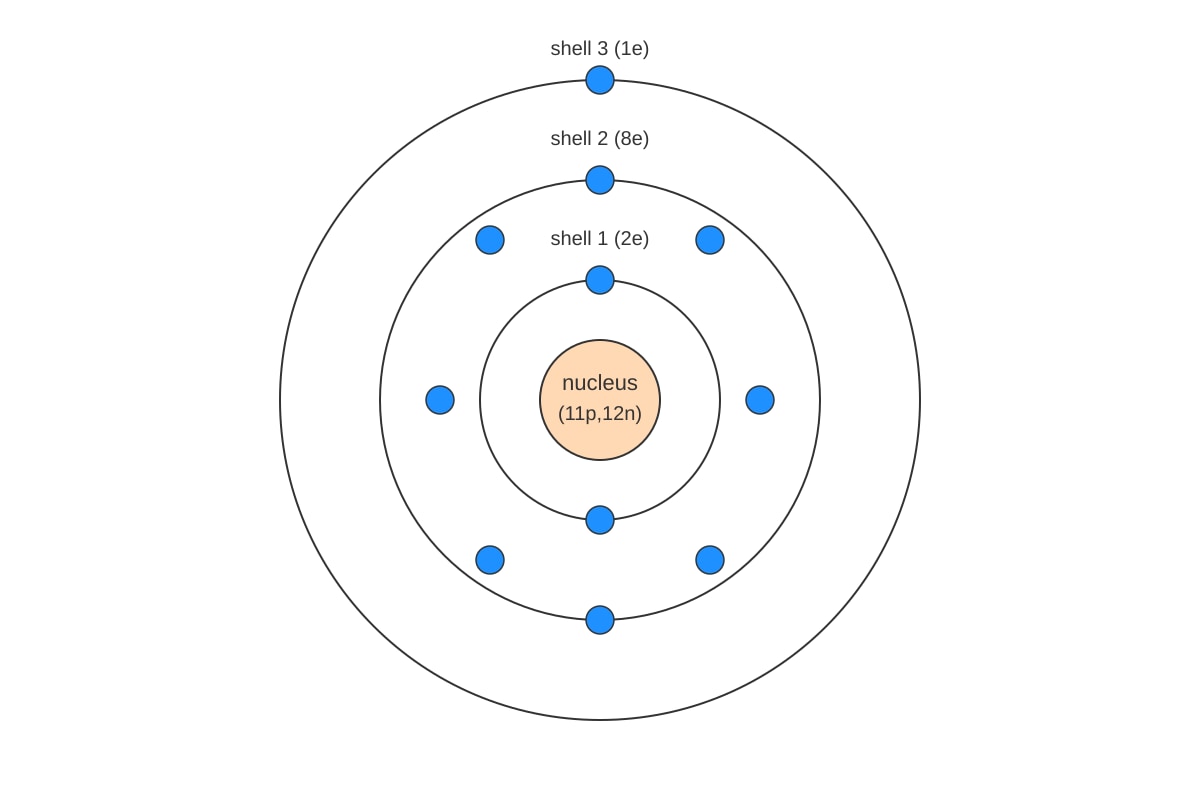
18. The figure shows a model of an sodium atom.
Image pending generation: diagram for Q18.
(a) State the number of electrons in the outer shell. [1]
(b) State the electronic configuration. [1]
(c) Explain how sodium forms a positive ion. [1]
(a) __________
(b) __________
(c) ______________________________________________________
19. Two isotopes of chlorine are 35Cl and 37Cl. Chlorine has 17 protons.
(a) State the number of neutrons in 37Cl. [1]
(b) Explain why the two isotopes have the same chemical properties. [2]
(a) __________
(b) ______________________________________________________
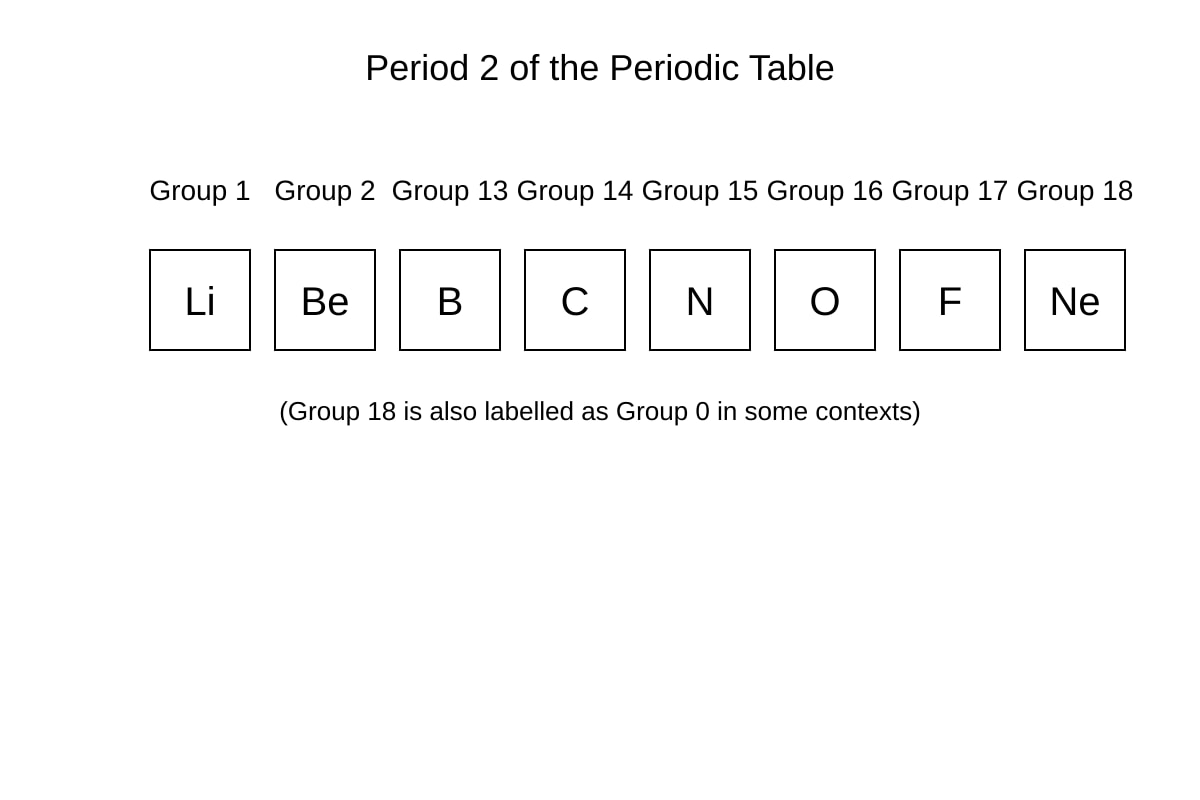
20. The diagram shows part of the Periodic Table.
Image pending generation: diagram for Q20.
(a) State the group of oxygen. [1]
(b) State the number of outer shell electrons of neon. [1]
(c) Explain why fluorine is more reactive than neon. [2]
(a) __________
(b) __________
(c) ______________________________________________________
Answers
Answer Key: Secondary 4 Combined Science Chemistry Quiz - Atomic Structure Bonding
Total Marks: 40
Topic: Atomic Structure Bonding
Section A (1-5)
1. +1 [1]
Teaching note: A proton carries a positive charge of +1. Neutrons are neutral (0), electrons are -1.
2. Atoms of the same element with the same number of protons but different numbers of neutrons. [1]
Teaching note: Isotopes have identical atomic number (proton count) but different mass numbers due to neutron difference.
3. 2,8 [1]
Teaching note: Neon (Z=10) fills first shell with 2, second with 8.
4. Ionic bonding [1]
Teaching note: Sodium chloride is formed by transfer of electron from Na to Cl, creating oppositely charged ions.
5. Do not conduct electricity (when molten or dissolved, some do; but simple covalent compounds do not) [1]
Teaching note: Covalent compounds lack free ions or electrons for conduction in solid/liquid state (except some special cases). Accept "poor conductors".
Section B (6-15)
6.
(a) 23 [1] (11p + 12n)
(b) 2,8,1 [1]
(c) Group 1, Period 3 [2] (1 each)
Teaching note: Mass number = p + n. Electronic config from shells. Group = outer e-, Period = number of shells.
7. They have a full outer shell of electrons (octet), so they do not need to gain/lose/share electrons. [2]
Marking: 1 for full outer shell, 1 for no tendency to react.
8. H has 1 dot, Cl has 7 crosses; one shared pair between H and Cl. [2]
Teaching note: Show H with 1 electron, Cl with 7 outer; one pair shared = covalent bond.
9. Mg loses 2 e- to O; O gains 2 e-; ionic bonds form between Mg2+ and O2− in a lattice. [3]
Marking: 1 transfer, 1 ion charges, 1 lattice/ionic bond.
10. Ionic: transfer of electrons; covalent: sharing of electrons. [2]
Marking: 1 each.
11.
(a) Group 17 [1]
(b) Y− or Cl− if identified [1]
(c) Gains 1 electron to achieve full outer shell. [1]
Teaching note: 2,8,7 → gains 1 e- → 2,8,8 stable.
12. RAM = (63×0.69)+(65×0.31) = 43.47+20.15 = 63.62 → 63.6 [2]
Working: show % as decimals. Marking: 1 for method, 1 for answer.
13.
(a) covalent [1]
(b) metallic [1]
(c) covalent [1]
14. Solid: ions fixed in lattice, cannot move; molten: ions free to move and carry charge. [2]
Marking: 1 for solid reason, 1 for molten reason.
15.
(a) 12 (Mg, Group 2 Period 3) [1]
(b) MgCl2 [1]
(c) ionic [1]
Section C (16-20)
16.
(a) Diamond [1]
(b) Property: very hard / high melting point [1]; Explanation: many strong covalent bonds need lots of energy to break [1].
Visual: diagram shows network of covalent bonds.
17.
(a) D [1]
(b) Simple molecular covalent: weak intermolecular forces, little energy to overcome [2]
(c) C [1]
18.
(a) 1 [1]
(b) 2,8,1 [1]
(c) Loses 1 outer electron to form Na+ [1]
19.
(a) 20 (37-17) [1]
(b) Same electron configuration / same outer electrons, so same bonding behaviour. [2]
20.
(a) Group 16 [1]
(b) 8 [1]
(c) F needs 1 e- to fill shell, very reactive; Ne full shell stable/unreactive. [2]
Visual: grid shows Ne at end, F before.
Free quiz and exam paper access
Enter your details to view this paper
Your access is remembered on this device.